Europe Aseptic Paper Packaging Market Size
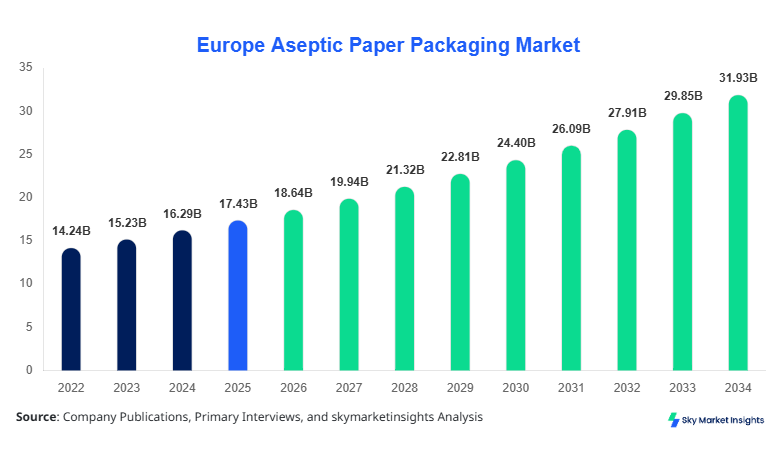
Europe Aseptic Paper Packaging market size is projected at USD 18.64 billion in 2026 and is expected to hit USD 31.92 billion by 2034 with a CAGR of 6.96%. The market expansion is being supported by increasing packaged beverage consumption, sustainable packaging regulations, and rising adoption of recyclable fiber-based packaging solutions across Europe. More than 412 billion units of aseptic cartons and paper-based liquid containers are expected to be consumed across the region by 2034, compared with nearly 286 billion units in 2026. The report delivers extensive evaluation of production capacity, end-use penetration, technological adoption, pricing structure, import-export analytics, supply chain assessment, and competitive landscape dynamics shaping the Europe Aseptic Paper Packaging market.
The European aseptic paper packaging industry represents a highly specialized packaging ecosystem focused on maintaining product sterility without refrigeration for extended shelf life applications. In 2025, Europe produced over 248 billion aseptic paper packaging units, with France, Germany, and Italy accounting for more than 58% of total regional manufacturing output. The beverage application segment contributed nearly 52% of total consumption volume, while food applications represented 34% and pharmaceutical packaging accounted for 14%. Adoption rates of multilayer paperboard structures with aluminum and polymer barrier coatings exceeded 72% among dairy and juice producers in Western Europe. Consumer penetration for aseptic packaged milk products reached 81% in France and 74% in Spain during 2025. Technical performance standards within the market include oxygen transmission rates below 0.1 cc/m²/day and moisture resistance efficiency exceeding 96% for premium carton solutions. Demand for recyclable fiber content increased significantly, with more than 68% of manufacturers shifting toward FSC-certified paperboard usage. Increasing urbanization, convenience consumption patterns, and sustainable packaging initiatives continue to strengthen Europe's Aseptic Paper Packaging market expansion across regional industries.
In the France, the Aseptic Paper Packaging Market accounted for approximately 24% of the total Europe regional revenue in 2025, supported by the presence of more than 110 packaging production facilities and over 430 beverage and dairy processing companies utilizing aseptic packaging technologies. France produced nearly 58 billion aseptic paper packaging units during 2025, with dairy beverages contributing 46% of total application demand, followed by fruit juices at 28% and pharmaceutical liquid packaging at 12%. Adoption of high-speed filling technologies exceeded 63% among medium and large-scale packaging plants, while automated sterilization systems were implemented across nearly 71% of packaging lines. French manufacturers increased investments in renewable paperboard materials by 32% between 2023 and 2025 to comply with circular economy directives and sustainable packaging targets. Smart labeling and traceability technologies were integrated into approximately 41% of newly manufactured aseptic paper packaging products during 2025. Rising export demand for packaged dairy products and shelf-stable beverages continues to reinforce Europe's Aseptic Paper Packaging market competitiveness in France.
Explore more data points, trends and opportunities Download Free Sample Report
Europe Aseptic Paper Packaging Market Trends
Sustainable Fiber-Based Packaging Expansion
The transition toward renewable and recyclable fiber-based solutions has emerged as one of the most significant developments in the European aseptic packaging ecosystem. During 2025, more than 74% of packaging converters increased procurement of bio-based paperboard materials, while recycled fiber integration in secondary packaging rose by 29% year-over-year. Europe manufactured approximately 252 billion aseptic paper packaging containers in 2025, with nearly 61% designed using reduced aluminum-layer technologies to minimize carbon emissions and improve recyclability. Germany and France collectively contributed over 44% of investments into sustainable aseptic packaging infrastructure across Europe. Beverage manufacturers accelerated adoption of lightweight carton formats, reducing average packaging material consumption by 11% per unit between 2023 and 2025. Advanced barrier coating technologies improved shelf-life preservation efficiency by 17%, particularly for dairy beverages and nutritional drinks. Increasing environmental regulations and consumer preference for recyclable formats continue to accelerate Europe's Aseptic Paper Packaging market development.
Automation and Smart Filling Technologies
Packaging automation and smart aseptic filling systems are transforming operational productivity across Europe. More than 58% of aseptic packaging facilities integrated AI-assisted quality monitoring systems during 2025, enabling defect reduction rates of nearly 22% compared with conventional systems. Production line speeds surpassed 24,000 cartons per hour across premium beverage packaging plants in Germany and Italy. Digital printing adoption in aseptic paper packaging increased by 36% between 2023 and 2025, allowing customized branding and enhanced product traceability. Smart sensors and IoT-enabled filling equipment reduced operational downtime by approximately 18% while improving sterility accuracy to above 99.8%. Pharmaceutical applications demonstrated particularly strong automation penetration, with over 47% of facilities implementing robotic packaging systems for sterile liquid products. Increasing focus on operational efficiency and contamination control continues to strengthen Europe's Aseptic Paper Packaging market modernization.
Growth in Shelf-Stable Beverage Consumption
Demand for shelf-stable beverages and ready-to-drink nutritional products significantly increased across Europe during 2025. Consumption of aseptic packaged plant-based beverages exceeded 9.2 billion liters, while packaged dairy beverages crossed 27 billion liters across the region. Single-serve carton packaging represented nearly 38% of beverage-related aseptic packaging demand, particularly among urban consumers aged between 18 and 40 years. Spain and Italy collectively recorded over 14% annual growth in premium juice and flavored milk consumption packaged in aseptic cartons. E-commerce-compatible aseptic packaging formats increased shipment volume by 26% during 2025 due to improved transportation durability and extended product shelf life. Consumer preference for preservative-free beverages packaged in aseptic paper cartons remains a major factor strengthening Europe's aseptic paper packaging market penetration.
Europe Aseptic Paper Packaging Market Drivers
Rising Demand for Shelf-Stable Food and Beverage Products
Growing consumption of shelf-stable food and beverage products is significantly accelerating packaging requirements across Europe. During 2025, nearly 63% of consumers in Western Europe preferred long shelf-life dairy and juice products packaged in aseptic cartons due to convenience and reduced refrigeration dependence. Beverage manufacturers increased production of shelf-stable milk by approximately 18% between 2023 and 2025, reaching over 29 billion liters annually across Europe. Ready-to-drink coffee and nutritional beverage packaging demand increased by 24%, driving substantial investments into aseptic filling lines and sterilization technologies. France, Germany, and Spain collectively represented more than 57% of regional beverage packaging consumption. Technological advancements in multilayer barrier structures improved oxygen resistance by nearly 21%, enhancing product preservation capabilities. Retail chains expanded shelf space allocated to aseptic packaged beverages by approximately 16% during 2025. Rising urbanization, convenience-oriented consumption behavior, and increasing demand for preservative-free packaged products continue to accelerate Europe Aseptic Paper Packaging market expansion.
Europe's Aseptic Paper Packaging Market Restraints
High Capital Investment and Recycling Infrastructure Limitations
The high capital expenditure associated with aseptic filling systems and recycling infrastructure continues to challenge market penetration among small and medium enterprises. Installation costs for advanced aseptic paper packaging production lines exceeded USD 18 million per facility during 2025, while sterilization and quality control systems accounted for nearly 27% of total infrastructure investments. Recycling efficiency for multilayer aseptic cartons remained below 54% across several Eastern European regions due to limited specialized separation facilities. Transportation and raw material costs increased by approximately 13% between 2024 and 2025, impacting profit margins for converters and packaging suppliers. Small-scale dairy manufacturers faced operational cost increases exceeding 11% due to compliance requirements related to environmental packaging standards. Fluctuations in paperboard pulp pricing and aluminum foil costs also created supply chain volatility. These financial and infrastructural limitations continue to restrict Europe's aseptic paper packaging market scalability in cost-sensitive industries.
Europe Aseptic Paper Packaging Market Opportunities
Expansion of Bio-Based and Recyclable Packaging Solutions
The rapid shift toward sustainable packaging solutions presents substantial opportunities for aseptic paper packaging manufacturers across Europe. During 2025, investments in recyclable and biodegradable aseptic packaging exceeded USD 2.8 billion, representing approximately 36% of total packaging innovation expenditure in Europe. More than 69% of consumers indicated a preference for renewable fiber-based beverage cartons over conventional plastic containers. Development of aluminum-free barrier technologies increased by 28% between 2023 and 2025, significantly enhancing recyclability rates and reducing environmental impact. Pharmaceutical companies increased procurement of sterile paper-based packaging formats by nearly 17% for nutritional liquid products and medical beverages. Government incentives promoting low-carbon packaging production contributed to a 22% increase in manufacturing capacity expansion projects across France and Germany. Increasing adoption of sustainable packaging regulations and circular economy strategies continues to create long-term Europe Aseptic Paper Packaging market opportunities.
Challenges in Europe Aseptic Paper Packaging Market
Complex Multi-Layer Packaging Recycling Processes
One of the major operational challenges within the industry involves the recycling complexity of multilayer aseptic paper packaging structures. Standard aseptic cartons contain paperboard, polymer coatings, and aluminum layers requiring specialized separation systems, increasing processing costs by approximately 19% compared with conventional paper recycling. During 2025, nearly 42% of municipal recycling facilities across Europe lacked advanced hydropulping infrastructure necessary for effective carton separation. Recovery efficiency for aluminum layers remained below 48% in several regional markets, limiting material reuse rates. Logistics costs associated with transporting post-consumer aseptic packaging waste increased by approximately 14% year-over-year due to fragmented collection systems. Packaging manufacturers also faced regulatory pressure to achieve higher recyclability compliance, requiring additional investments into mono-material and bio-based barrier technologies. Limited consumer awareness regarding carton disposal procedures further reduced collection efficiency by nearly 9% across selected urban regions. These technical and infrastructural barriers continue to create operational complexity within Europe's aseptic paper packaging market operations.
Report Scope
| Report Metric | Details |
|---|---|
| Market Size in 2025 | USD 17.43 Billion |
| Market Size in 2026 | USD 18.64 Billion |
| Market Size in 2034 | USD 31.92 Billion |
| CAGR | 6.96% (2026-2034) |
| Base Year for Estimation | 2025 |
| Historical Data | 2022-2024 |
| Forecast Period | 2026-2034 |
| Report Coverage | Revenue Forecast, Competitive Landscape, Supply Chain Disruption, Growth Factors, Environment & Regulatory Landscape and Trends |
Explore more data points, trends and opportunities Download Free Sample Report
Europe Aseptic Paper Packaging Market Segmentation
The European aseptic packaging industry is segmented based on packaging type and application. Beverage applications dominated with approximately 52% revenue contribution in 2025, while carton packaging represented more than 61% of total unit production. Growing adoption of sustainable and lightweight packaging formats continues to influence production allocation and technology investments across the region.
By Type
Cartons represented the largest packaging format within the Europe market during 2025, accounting for nearly 61% of total packaging volume and exceeding 151 billion units in annual production. Aseptic carton packaging is extensively utilized for dairy beverages, fruit juices, soups, and nutritional drinks due to superior barrier protection and shelf-life performance. Multilayer carton structures generally incorporate 70% paperboard, 24% polymer layers, and 6% aluminum foil for oxygen and light resistance. High-speed filling systems achieved production rates exceeding 24,000 cartons per hour in large European beverage facilities. Lightweight carton innovation reduced material consumption by approximately 12% between 2023 and 2025, supporting sustainability objectives. Cartons also demonstrated strong penetration in export-oriented beverage industries due to improved transportation durability and reduced refrigeration requirements.
Bags and pouches accounted for approximately 23% of Europe aseptic packaging consumption during 2025, supported by rising demand for flexible packaging formats in foodservice and liquid food applications. Production volume surpassed 58 billion units, particularly within sauces, dairy concentrates, and institutional beverage packaging. Flexible aseptic pouch solutions reduced storage space requirements by nearly 31% compared with rigid packaging alternatives. Advanced polymer-paper hybrid structures improved puncture resistance by approximately 16%, enhancing transportation reliability. Adoption of stand-up pouch technologies increased by 21% across Italy and Spain due to growth in ready-to-consume food products. Cost-efficiency and lightweight transportation advantages continue to support increasing adoption across industrial food processing applications.
Cups and trays represented nearly 16% of total aseptic packaging volume during 2025, particularly within dairy desserts, ready meals, and pharmaceutical nutrition applications. Europe produced approximately 39 billion aseptic cups and trays during the year, with Germany and France contributing more than 49% of regional output. Thermal resistance levels exceeded 120°C for premium aseptic trays, supporting microwave-compatible food packaging applications. Pharmaceutical nutrition products packaged in aseptic cups increased by nearly 14% between 2023 and 2025. Enhanced sealing technologies improved contamination prevention efficiency to above 99.7%, making these formats suitable for sensitive liquid and semi-solid products. Rising demand for convenience-oriented meal solutions continues to support production growth within this segment.
By Application
Food applications accounted for approximately 34% of total Europe aseptic paper packaging consumption during 2025. More than 84 billion packaging units were utilized for soups, sauces, ready meals, dairy desserts, and processed food products. Shelf-life extension capabilities exceeding 12 months without refrigeration significantly improved food distribution efficiency and reduced product wastage. Ready meal packaging adoption increased by nearly 19% between 2023 and 2025, particularly in urban European markets. Advanced barrier technologies maintained product freshness while reducing preservative usage by approximately 27%. France and Italy collectively represented nearly 38% of regional food packaging demand due to high processed food consumption rates. Growing demand for convenience foods and sustainable packaging continues to support segment expansion.
The beverage segment dominated the Europe market with nearly 52% revenue contribution during 2025. Total beverage-related aseptic packaging production exceeded 129 billion units, primarily supporting dairy beverages, juices, plant-based drinks, and nutritional beverages. Dairy applications alone represented approximately 46% of beverage packaging demand. Aseptic paper packaging enabled product shelf-life extension up to 9 months while maintaining nutritional stability and flavor integrity. Consumption of plant-based beverages packaged in aseptic cartons increased by nearly 22% year-over-year in Germany and Spain. Advanced filling systems improved production efficiency by 18% while reducing contamination risks. Increasing consumer preference for portable and recyclable beverage packaging solutions continues to reinforce segment dominance across Europe.
Pharmaceutical applications accounted for nearly 14% of Europe aseptic paper packaging consumption during 2025, supported by growing demand for sterile liquid nutrition and medical beverages. Production volume surpassed 35 billion units across pharmaceutical and healthcare applications. Packaging systems designed for pharmaceutical products achieved sterility assurance levels exceeding 99.9%, while oxygen barrier performance improved product preservation by approximately 21%. Germany and France represented more than 55% of pharmaceutical aseptic packaging demand due to advanced healthcare infrastructure and rising medical nutrition consumption. Investments in smart traceability systems and tamper-evident packaging increased by approximately 18% during 2025. Increasing healthcare expenditures and nutritional therapy applications continue to strengthen pharmaceutical packaging demand across Europe.
Europe Aseptic Paper Packaging Market Segmentations
Packaging Type
- Cartons
- Bags & Pouches
- Cups & Trays
Application
- Food
- Beverage
- Pharmaceutical
Europe Aseptic Paper Packaging Market Country Outlook
United Kingdom
The United Kingdom represented approximately 14% of Europe aseptic packaging revenue during 2025, supported by rising demand for sustainable beverage packaging and ready-to-drink products. Annual production volume exceeded 34 billion aseptic packaging units, with beverage applications contributing nearly 57% of total demand. Plant-based beverage consumption packaged in aseptic cartons increased by 26% between 2023 and 2025. More than 62% of large retailers expanded shelf allocation for recyclable paper-based beverage packaging during 2025. Investments into recycling infrastructure increased by approximately USD 420 million to improve carton recovery rates. Growth in convenience food consumption and e-commerce-compatible packaging continues to support regional industry expansion.
Germany
Germany accounted for nearly 21% of total Europe market revenue during 2025 and remained one of the largest manufacturing hubs for aseptic packaging technologies. Production volume exceeded 53 billion units, with dairy beverages and nutritional drinks accounting for nearly 49% of packaging demand. More than 74% of packaging facilities integrated automated sterilization systems and AI-driven quality control technologies during 2025. Germany also led regional investment in sustainable barrier materials, accounting for approximately 31% of Europe’s recyclable packaging innovation expenditure. Pharmaceutical packaging demand increased by 16% year-over-year due to rising healthcare nutrition applications. Strong manufacturing capabilities and advanced automation continue to position Germany as a major contributor to regional packaging output.
France
France generated approximately 24% of total regional revenue in 2025 and remained the leading consumer market for aseptic dairy beverage packaging. Production exceeded 58 billion units annually, with dairy beverages contributing 46% of demand and juices accounting for 28%. More than 71% of large packaging facilities adopted renewable paperboard materials and energy-efficient sterilization technologies during 2025. Government-backed sustainability regulations accelerated investments into recyclable carton technologies by approximately 29% between 2023 and 2025. Increasing export demand for shelf-stable dairy products also strengthened packaging manufacturing expansion. France remains a central growth driver within Europe due to advanced beverage processing infrastructure.
Spain
Spain represented approximately 11% of regional aseptic packaging revenue during 2025, driven by high consumption of fruit juices and dairy beverages. Annual production surpassed 27 billion packaging units, with beverage applications accounting for nearly 61% of demand. Shelf-stable juice consumption increased by approximately 18% between 2023 and 2025, supporting expansion of carton packaging production facilities. Spain also recorded a 22% increase in adoption of lightweight packaging technologies designed to reduce transportation emissions. Investments in renewable packaging materials and advanced filling systems continue to accelerate manufacturing modernization across the country.
Italy
Italy accounted for nearly 13% of Europe's market revenue during 2025, supported by strong food processing and dairy industries. Production volume exceeded 31 billion units annually, with food applications representing approximately 39% of total packaging demand. Adoption of flexible aseptic pouches increased by 24% between 2023 and 2025, particularly within sauces and ready meal categories. Italy also increased exports of packaged nutritional beverages by approximately 17% during 2025. Automation integration across packaging facilities improved operational productivity by nearly 15%. Demand for premium and sustainable packaging solutions continues to drive industry development across Italy.
Russia
Russia represented approximately 9% of Europe's aseptic packaging consumption during 2025, supported by growing domestic dairy and beverage industries. Production volume exceeded 22 billion units, with dairy packaging contributing nearly 51% of total demand. Investments into local aseptic carton manufacturing facilities increased by approximately 19% between 2023 and 2025 to reduce import dependence. Shelf-stable milk consumption increased significantly across urban regions, supporting packaging demand expansion. Technological modernization efforts improved packaging line productivity by approximately 13%. Growing domestic beverage consumption continues to strengthen long-term market potential in Russia.
Top players in Europe Aseptic Paper Packaging Market
- Tetra Pak International S.A.
- SIG Combibloc Group AG
- Elopak AS
- Greatview Aseptic Packaging Co. Ltd.
- Mondi Group
- DS Smith Plc
- Stora Enso Oyj
- Smurfit Kappa Group
- Amcor Plc
- Billerud AB
- Nippon Paper Industries Co. Ltd.
- Sealed Air Corporation
- UFlex Limited
- WestRock Company
- Ecolean AB
Tetra Pak International S.A.
- Tetra Pak accounted for approximately 31% of Europe's aseptic packaging revenue during 2025.
- The company operates more than 15 production and technology centers across Europe.
- Investments exceeding USD 640 million were allocated toward recyclable barrier technologies and lightweight carton development between 2023 and 2025.
- Tetra Pak expanded renewable polymer integration across nearly 72% of its aseptic carton portfolio.
- The company maintained strong positioning in dairy and beverage applications through advanced filling systems capable of exceeding 24,000 units per hour.
SIG Combibloc Group AG
- SIG Combibloc represented nearly 18% of the Europe market revenue during 2025.
- The company increased production capacity by approximately 14% across Germany and France between 2023 and 2025.
- SIG invested heavily in aluminum-free aseptic packaging technologies, improving recyclability rates by nearly 21%.
- Beverage applications contributed approximately 63% of company revenue in Europe.
- Smart digital packaging and traceability solutions were implemented across more than 45% of new product launches during 2025.
Investment Analysis
Investments within the European aseptic packaging industry increased substantially during 2025, exceeding USD 7.4 billion across manufacturing expansion, automation, and sustainable packaging innovation projects. Nearly 38% of total investment allocation targeted recyclable paperboard development and low-carbon packaging technologies, while automation systems accounted for approximately 26% of expenditure. France and Germany collectively represented over 49% of regional investment activity due to strong beverage processing industries and regulatory support for sustainable packaging infrastructure. Pharmaceutical packaging investments increased by nearly 17% during 2025, particularly for sterile nutritional liquid products.
Mergers, acquisitions, and collaborative agreements intensified significantly across the regional industry. More than 24 strategic partnerships were announced between packaging manufacturers, paperboard suppliers, and recycling technology companies during 2024–2025. Collaborative agreements focused primarily on improving carton recyclability, reducing aluminum dependence, and expanding renewable fiber sourcing capabilities. Approximately 31% of partnership investments targeted development of mono-material barrier technologies designed to enhance recycling efficiency. Packaging equipment manufacturers also increased investments into AI-driven sterilization and filling technologies, improving operational productivity by nearly 18%. Private equity participation in sustainable packaging projects increased by approximately 22% during 2025, reflecting long-term confidence in renewable packaging solutions. Increasing sustainability mandates and consumer preference for recyclable packaging formats continue to attract institutional and strategic investments across Europe.
New Product Developments
Packaging manufacturers accelerated new product innovation during 2025, with approximately 36% of newly launched aseptic packaging solutions incorporating bio-based polymers and reduced aluminum content. Lightweight carton innovations reduced packaging material consumption by nearly 12% while maintaining barrier performance standards above 99% sterility assurance levels. Smart QR-enabled packaging adoption increased by approximately 28%, enabling enhanced traceability and digital consumer engagement.
Advanced barrier coating technologies improved oxygen protection efficiency by nearly 19% and extended beverage shelf-life stability up to 12 months. More than 41% of new product launches focused on single-serve and portable beverage packaging formats to address urban convenience consumption patterns. Pharmaceutical-focused packaging developments also improved tamper resistance and contamination prevention capabilities. Sustainable and high-performance packaging innovation continues to accelerate manufacturing competitiveness across Europe.
Recent Developments in Europe Aseptic Paper Packaging Market
- 2025: Tetra Pak expanded recyclable carton production capacity in France by approximately 18%, adding nearly 6 billion units annually to support increasing demand for sustainable beverage packaging across Europe.
- 2025: SIG Combibloc launched aluminum-free aseptic carton solutions across Germany and Italy, improving recycling efficiency by nearly 21% and reducing packaging carbon emissions by approximately 15%.
Research Methodology
The research methodology applied for the Europe aseptic packaging industry involved a combination of primary research, secondary research, and advanced market estimation techniques to ensure comprehensive and accurate data analysis. Primary research included interviews with packaging manufacturers, beverage companies, raw material suppliers, distributors, and regulatory authorities across France, Germany, Italy, Spain, and the United Kingdom. More than 85 industry participants contributed quantitative and qualitative insights regarding production capacity, technology adoption, pricing trends, and investment patterns.
Secondary research involved analysis of company annual reports, sustainability disclosures, packaging association publications, import-export databases, government regulations, and industry journals. Statistical models were used to estimate production volumes, consumption trends, pricing structures, and application penetration rates across regional markets. Market size estimation was conducted using both top-down and bottom-up analytical frameworks, supported by supply chain mapping and demand-side validation. Forecasting models incorporated macroeconomic indicators, beverage consumption trends, sustainability mandates, recycling infrastructure development, and technological innovation rates to generate reliable long-term projections for the Europe aseptic packaging industry.
Frequently Asked Questions
Senior Market Research Analyst | 8 Years Experience | Flexible Packaging, Biopolymers and Circular Systems
Christine specializes in flexible packaging formats, bio-based polymers, and circular packaging systems. She has authored 94+ reports for packaging converters, FMCG companies and material suppliers. Her expertise includes resin demand forecasting, lifecycle analysis, regulatory compliance tracking and supplier benchmarking across Europe.