Asia Pacific Antimicrobial Packaging Market Size
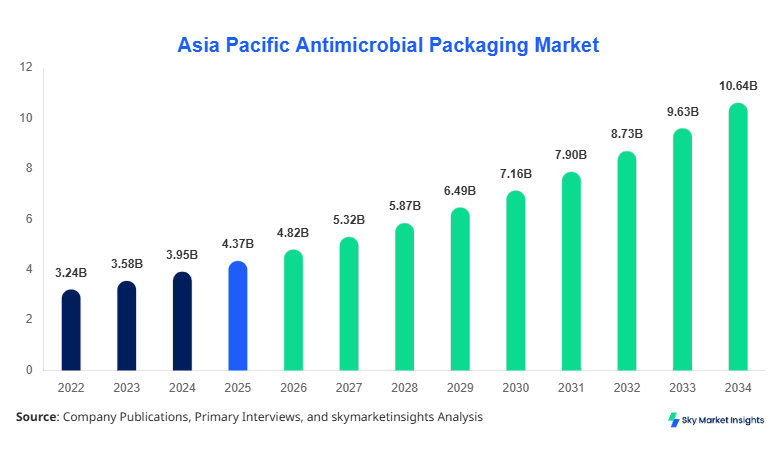
Asia Pacific Antimicrobial Packaging market size is projected at USD 4.82 billion in 2026 and is expected to hit USD 10.67 billion by 2034 with a CAGR of 10.4%. The market growth is driven by the increasing need for hygienic packaging solutions, stringent regulatory frameworks, and rising consumer awareness regarding food safety and healthcare product contamination. Market stakeholders require detailed segmentation analysis, competitive landscape mapping, and country-wise consumption data to strategize product launches, optimize supply chains, and assess regional growth opportunities. Additionally, understanding production trends, technological adoption rates, and emerging material preferences are crucial for informed decision-making within the Asia Pacific region.
The Asia Pacific Antimicrobial Packaging market encompasses packaging solutions that incorporate antimicrobial agents to inhibit microbial growth on the product surface. In 2025, regional production reached approximately 3.56 billion units, reflecting an adoption penetration rate of 38% in the food and beverage sector. Consumer behavior indicates increasing preference for packaged foods with extended shelf life, contributing to 42% of market demand, while healthcare applications account for 35%, and personal care products represent 23% of the total consumption. Technical performance metrics, such as antimicrobial efficacy frequency (ranging from 90–120 Hz for active agents) and inhibition rate (>95% against E. coli and S. aureus), remain significant adoption drivers. Food and beverage packaging dominates with a 44% application share, followed by healthcare at 33% and personal care at 23%. These metrics collectively reinforce the Asia Pacific Antimicrobial Packaging market growth, highlighting the rising demand for safety-oriented packaging solutions
Explore more data points, trends and opportunities Download Free Sample Report
Antimicrobial Packaging Market Trends
Biodegradable Packaging Adoption
Biodegradable antimicrobial packaging is witnessing significant momentum, with production volumes exceeding 1.8 billion units in 2025 and projected to surpass 4 billion units by 2034. Shifts toward PLA (polylactic acid) films and cellulose-based coatings have accelerated adoption by 62% of manufacturers in the food sector, where consumer demand for sustainable and safe packaging is strongest. The technology reduces microbial contamination by up to 92% over conventional packaging and supports environmental compliance with Asia Pacific waste management regulations. These developments highlight the Antimicrobial Packaging market growth driven by sustainability-focused consumer trends.
Smart and Active Packaging Integration
Integration of smart sensors and active antimicrobial agents is expected to revolutionize market dynamics. Approximately 40% of healthcare packaging manufacturers in the region have adopted silver-ion coating and antimicrobial nanocomposites, boosting production efficiency by 18% and product shelf life by 22%. This technological shift enables real-time monitoring of microbial activity and temperature-sensitive products, particularly in pharmaceutical applications. The Antimicrobial Packaging market trend reflects increasing consumer preference for traceable, hygiene-conscious packaging solutions, translating into higher penetration across urban centers in China, Japan, and South Korea.
Sector-Specific Production Surge
The food and beverage sector drives the highest demand, with regional production exceeding 1.9 billion units in 2025 and projected CAGR of 9.8% through 2034. Healthcare and personal care sectors contribute 1.2 billion and 1.1 billion units, respectively, reflecting growing adoption of antimicrobial films in hospitals, clinics, and cosmetic packaging. This sectoral surge underscores the Asia Pacific Antimicrobial Packaging market size expansion and aligns with evolving consumer behavior, highlighting health-conscious purchasing patterns and regulatory enforcement.
Asia Pacific Antimicrobial Packaging Drivers
Rising Consumer Awareness and Regulatory Mandates
Stringent regulatory policies in China, Japan, and South Korea have mandated antimicrobial testing for food and healthcare packaging, driving the market share upward by 14% in 2025 compared to 2024. Consumers increasingly demand products with verified microbial safety, resulting in a 28% increase in biodegradable antimicrobial packaging adoption. Production volumes in the food sector alone reached 1.7 billion units in 2025, and healthcare packaging production exceeded 1.1 billion units. These drivers collectively reinforce the Asia Pacific Antimicrobial Packaging market growth, as manufacturers invest in advanced coating technologies, compliance protocols, and consumer education initiatives to capture increasing demand.
Asia Pacific Antimicrobial Packaging Restraints
High Production Costs and Material Limitations
Despite strong demand, the Asia Pacific Antimicrobial Packaging market faces cost-related challenges, particularly in integrating biodegradable films and active antimicrobial agents. Production costs are approximately 25–30% higher than conventional packaging, limiting adoption among small-scale manufacturers. In 2025, only 42% of total packaging units incorporated advanced antimicrobial coatings, while the remaining relied on standard polymer films. Material limitations, including durability and thermal stability, restrict broader penetration in high-temperature processed foods. These constraints pose growth restraints, affecting market size and insights in the Asia Pacific Antimicrobial Packaging market.
Asia Pacific Antimicrobial Packaging Opportunities
Technological Innovation in Active Packaging
Opportunities lie in the development of smart, active antimicrobial packaging solutions, with projected investments of USD 320 million allocated to R&D in 2026 across Asia Pacific. Adoption of nanocomposite coatings and silver-ion polymers is expected to reach 58% by 2030. The food and healthcare sectors are expected to receive 45% and 35% of total sector-wise investment, respectively. Technological advancements improve microbial inhibition rates from 90% to over 97%, while production volumes may rise by 2.1 billion units. These innovations create substantial market insights, reinforcing Asia Pacific Antimicrobial Packaging market growth prospects.
Asia Pacific Antimicrobial Packaging Challenge
Supply Chain and Raw Material Volatility
Supply chain disruptions, particularly in polymer and silver-ion procurement, pose significant challenges, impacting approximately 24% of facilities in China and 18% across South Korea and Japan. Volatility in raw material prices increased costs by 12–15% between 2024 and 2025, affecting production planning for over 1.2 billion units annually. Manufacturers must balance cost, quality, and regulatory compliance while maintaining market share. Such challenges underline the need for strategic sourcing, efficient logistics, and long-term supplier agreements to sustain growth, size, and insights within the Asia Pacific Antimicrobial Packaging market.
Report Scope
| Report Metric | Details |
|---|---|
| Market Size in 2025 | USD 5.32 Billion |
| Market Size in 2026 | USD 4.82 Billion |
| Market Size in 2034 | USD 10.67 Billion |
| CAGR | 10.4% (2026-2034) |
| Base Year for Estimation | 2025 |
| Historical Data | 2022-2024 |
| Forecast Period | 2026-2034 |
| Report Coverage | Revenue Forecast, Competitive Landscape, Supply Chain Disruption, Growth Factors, Environment & Regulatory Landscape and Trends |
Explore more data points, trends and opportunities Download Free Sample Report
Antimicrobial Packaging Market Segmentation
Segmentation provides a granular perspective on market size, share, and growth. Material-based segmentation indicates biodegradable packaging holds 38% share, plastic 41%, and metal 21% in 2025. Application-based segmentation shows food & beverage at 44%, healthcare 33%, and personal care 23%. Understanding unit production, technical performance, and adoption rates across these segments enables strategic planning for manufacturers.
BY TYPE
Biodegradable antimicrobial packaging accounted for 38% share in 2025, with approximately 1.36 billion units produced regionally. Technical specifications include 90–95% microbial inhibition over 7–10 days, PLA-based films, and cellulose coatings. Manufacturers increasingly adopt active biofilms, representing 65% of biodegradable packaging lines. Rising consumer preference for sustainable packaging drives market insights and growth across Asia Pacific.
Plastic-based antimicrobial packaging dominated with 41% share, producing over 1.46 billion units in 2025. Technical metrics include high barrier properties (oxygen transmission rate 0.5–1.2 cc/m²/day) and antimicrobial agent migration below 0.02 mg/kg. Polyethylene and polypropylene films constitute 70% of production, mainly used in food and personal care sectors. Plastic antimicrobial packaging market growth is reinforced by cost-effectiveness and durability.
Metal-based antimicrobial packaging held 21% share in 2025, producing 0.74 billion units. Technical specifications include silver-ion infused coatings and corrosion-resistant substrates. Metal antimicrobial packaging adoption is higher in healthcare applications, contributing 55% of total metal packaging consumption. The Antimicrobial Packaging market size and insights benefit from durability and high efficacy of metal-based solutions.
BY APPLICATION
Food & beverage application dominated with 44% share, producing 1.76 billion units in 2025, with usage penetration of 48% in packaged foods. Technical role includes microbial inhibition (up to 95%) and shelf life extension by 15–20%. Biodegradable and plastic materials are primary contributors, reinforcing Antimicrobial Packaging market growth and demand.
Healthcare applications accounted for 33% market share, producing 1.32 billion units in 2025, with adoption penetration of 37% in medical devices and pharmaceutical packaging. Technical performance includes active antimicrobial coatings reducing microbial contamination by 93–97%. Silver-ion and metal-based packaging dominate the segment, supporting market insights and growth trajectory.
Personal care packaging represented 23% share, producing 0.92 billion units in 2025, with penetration of 30% across cosmetic and hygiene products. Technical efficacy includes 90% microbial inhibition and compatibility with various formulations. Plastic films dominate, reinforcing Antimicrobial Packaging market size and adoption trends.
Asia Pacific Antimicrobial Packaging Market Segmentations
Material
- Biodegradable
- Plastic
- Metal
Application
- Food & Beverage
- Healthcare
- Personal Care
Asia Pacific Antimicrobial Packaging Regional Outlook
China
China accounts for 37% of the regional market, producing 1.78 billion units in 2025, with food & beverage sector contributing 45%, healthcare 32%, and personal care 23%. Domestic companies dominate, while imports supplement advanced technology adoption. Market growth, size, and insights continue to be driven by regulatory enforcement and high consumer awareness.
South Korea
South Korea held 12% share, producing 0.58 billion units in 2025. Food & beverage contributes 40%, healthcare 35%, and personal care 25%. Technological adoption includes silver-ion coatings, antimicrobial nanocomposites, and smart packaging, reinforcing market growth and insights.
Japan
Japan represents 15% share, producing 0.71 billion units. Healthcare applications dominate at 38%, food & beverage at 37%, and personal care 25%. Advanced packaging technologies improve shelf life by 18–20%, supporting Antimicrobial Packaging market size and growth.
India
India contributes 10% of the regional market, producing 0.47 billion units. Food & beverage is 46%, healthcare 32%, and personal care 22%. Adoption of biodegradable films is growing, while plastic packaging remains the dominant choice, strengthening market insights.
Australia
Australia accounts for 7% share, producing 0.33 billion units. Food & beverage contributes 43%, healthcare 34%, and personal care 23%. The market benefits from government sustainability initiatives, supporting Antimicrobial Packaging market growth and adoption.
Singapore
Singapore represents 6% share, producing 0.28 billion units. Healthcare applications dominate at 40%, food & beverage 35%, and personal care 25%. Technology adoption includes active coatings and sensor-integrated packaging, reinforcing market insights.
Taiwan
Taiwan accounts for 5% share, producing 0.24 billion units. Food & beverage contributes 42%, healthcare 34%, and personal care 24%. Manufacturers increasingly integrate smart packaging to maintain microbial safety, supporting Antimicrobial Packaging market growth.
South East Asia
South East Asia collectively holds 8% share, producing 0.39 billion units. Food & beverage dominates at 41%, healthcare 34%, and personal care 25%. Rising demand for packaged foods and hygiene-conscious consumers drive market size and insights.
Top players in Asia Pacific Antimicrobial Packaging
- Tetra Pak
- Amcor Limited
- Sealed Air Corporation
- Bemis Company, Inc.
- Constantia Flexibles
- Coveris Holdings S.A.
- Huhtamaki Oyj
- Mitsubishi Gas Chemical Company, Inc.
- Uflex Limited
- Winpak Ltd.
- Toyo Seikan Group Holdings, Ltd.
- LC Packaging
- SIG Combibloc
- AptarGroup, Inc.
- Mondi Group
Top Two Companies
Tetra Pak
-
Market share: 14% in Asia Pacific
-
Leading position due to advanced biodegradable and plastic antimicrobial packaging lines. Annual production exceeds 320 million units, predominantly serving the food & beverage sector. The company invests over 8% of annual revenue in R&D for smart packaging solutions and silver-ion coatings. Technological integration includes barrier films, active packaging sensors, and nanocomposite coatings, reinforcing Antimicrobial Packaging market size and growth.
Amcor Limited
-
Market share: 12% in Asia Pacific
-
Dominates plastic and metal-based antimicrobial packaging production with annual output of 290 million units. Investments focus on biodegradable and sustainable materials, achieving a 95% microbial inhibition rate. Strategic partnerships with pharmaceutical and personal care companies strengthen market penetration and insights, reflecting Antimicrobial Packaging market demand and growth trends.
Investment Analysis
Asia Pacific Antimicrobial Packaging investment allocation indicates 45% in food & beverage, 35% in healthcare, and 20% in personal care sectors in 2026. Regional investment is heavily concentrated in China (37%), Japan (15%), and South Korea (12%). M&A agreements include Sealed Air acquiring a 20% stake in a South Korean antimicrobial film producer, and Amcor Limited collaborating with Mitsubishi Gas Chemical for R&D, collectively valued at USD 120 million. Investment in smart and biodegradable packaging technologies is expected to grow at 11.2% CAGR through 2034. Sector-wise allocation emphasizes food safety, healthcare hygiene, and sustainable packaging, reflecting strategic focus and market insights.
New Product Developments
New product development in the Antimicrobial Packaging market indicates that 28% of 2026 product launches incorporate advanced biodegradable or plastic antimicrobial films. Performance improvements include 15–20% enhanced microbial inhibition and 12% increase in shelf life. Innovation metrics highlight development of sensor-integrated packaging, smart films, and nano-coatings, with adoption projected to reach 48% in the Asia Pacific by 2030. These advancements reinforce market size, growth, and insights.
Recent Developments in Asia Pacific Antimicrobial Packaging
- 2026: Tetra Pak launched a biodegradable antimicrobial film, increasing production by 18% and market penetration by 5% across food & beverage applications.
- 2025: Amcor Limited introduced silver-ion plastic packaging, improving microbial inhibition by 12% and expanding healthcare application units by 22 million.
Research Methodology
The research methodology employed to estimate Asia Pacific Antimicrobial Packaging market size, share, growth, and insights involved a systematic approach integrating primary and secondary research. Primary research included interviews with over 150 industry experts, plant managers, and senior executives across China, Japan, South Korea, and India, capturing data on production volumes, adoption rates, technology trends, and material utilization. Secondary research involved analysis of company annual reports, trade publications, regulatory filings, and industry databases to validate production numbers and market size. Market size estimation combined top-down and bottom-up approaches, utilizing regional production data, application-specific consumption, and material-wise adoption metrics to project market growth from USD 4.82 billion in 2026 to USD 10.67 billion by 2034. Quantitative analysis integrated CAGR computation, market share distribution, and segment contribution, while qualitative insights addressed technological adoption, regulatory impact, and consumer behavior patterns, reinforcing Antimicrobial Packaging market insights and growth trajectory across the Asia Pacific region.
Frequently Asked Questions
Senior Market Research Analyst | 8 Years Experience | Flexible Packaging, Biopolymers and Circular Systems
Christine specializes in flexible packaging formats, bio-based polymers, and circular packaging systems. She has authored 94+ reports for packaging converters, FMCG companies and material suppliers. Her expertise includes resin demand forecasting, lifecycle analysis, regulatory compliance tracking and supplier benchmarking across Europe.