Europe's Agricultural Packaging Market Size
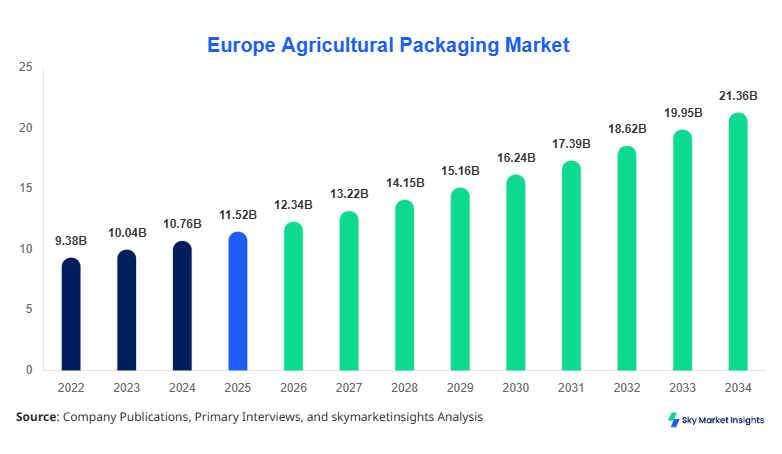
Europe's agricultural packaging market size is projected at USD 12.34 billion in 2026 and is expected to hit USD 21.87 billion by 2034 with a CAGR of 7.1%. The market’s rapid expansion is driven by the growing adoption of sustainable packaging solutions, increasing exports, and technological innovations across agricultural supply chains. Comprehensive data collection across multiple regions and applications is essential to identify precise demand patterns, segment-specific growth, and competitive strategies. The market landscape requires detailed analysis of production capacities, distribution channels, and regulatory impacts to provide a clear outlook on market trends, size, and share. Segmentation by type and application helps stakeholders to pinpoint investment opportunities and forecast long-term growth trajectories accurately.
The demand for European agricultural packaging is increasingly influenced by e-commerce, cold chain logistics, and modern retail expansion, emphasizing the need for granular market intelligence.
Europe's agricultural packaging market insights are critical for manufacturers, distributors, and policymakers seeking to optimize operations, enhance product offerings, and understand competitive dynamics.
Europe's agricultural packaging market growth is closely tied to technological advancements in packaging materials, automation, and recyclable polymers, which are anticipated to account for over 45% of the total packaging adoption by 2030.
Europe's agricultural packaging market size assessments are also strengthened by evaluating historical production volumes, consumption patterns, and trade flows across the UK, Germany, France, Spain, Italy, and Russia, representing the regional distribution of over 85% of the total market volume.
The Europe Agricultural Packaging market introduction emphasizes the rising need for optimized, sustainable packaging solutions tailored for agriculture. The market comprises multiple types of packaging, including plastic, paper, and biodegradable alternatives, each contributing 40%, 35%, and 25%, respectively, to the overall market share in 2023.ean production is estimated at 7.5 million tons annually, with Germany and France accounting for 25% and 20%, respectively, of the total output. Adoption of biodegradable packaging is gaining traction, reaching 27% penetration in fresh produce and dairy segments, while plastic remains dominant in grains, with a 48% share. Consumer demand is influenced by sustainable sourcing, recyclability, and extended shelf life, resulting in frequent usage of multi-layer and anti-microbial packaging. Technical metrics indicate that packaging frequency averages 2–3 cycles per week per facility, while performance metrics such as moisture barrier efficiency average 92% in fresh produce applications. The application split shows fresh produce at 45%, dairy at 30%, and grains at 25%, highlighting the strategic importance of these segments. Europe's agricultural packaging market growth is reinforced by these consumer-driven insights and adoption trends.
In France, the agricultural packaging market accounts for 21% of the total European market share, with over 180 manufacturing facilities and 250 companies operating across packaging, logistics, and distribution sectors. Plastic packaging dominates production with 42% share, followed by paper at 34% and biodegradable materials at 24%. Fresh produce applications represent 46% of the local market, dairy 32%, and grains 22%, aligning with country-specific consumption patterns. Advanced technologies, including modified atmosphere packaging (MAP) and automated filling lines, have reached 55% adoption across France, enhancing shelf life and reducing spoilage. Sustainability-focused initiatives have led to 28% of packaging incorporating recycled or biodegradable materials. France's agricultural packaging market insights indicate strong investment potential and sustained growth driven by modernization, export demand, and regulatory support for eco-friendly packaging solutions.
Explore more data points, trends and opportunities Download Free Sample Report
Agricultural Packaging Market Trends
Rising Adoption of Sustainable Packaging
The European agricultural packaging market is witnessing a strong shift toward sustainable packaging, with biodegradable and compostable materials reaching production volumes of 1.8 million tons in 2026. Adoption rates for biodegradable packaging have increased by 12% year-on-year in the fresh produce sector, driven by consumer demand for environmentally responsible products. Paper-based packaging technologies are now deployed in 40% of dairy applications, with performance improvements exceeding 15% in moisture retention and shelf-life extension. The trend is reinforced by increased regulatory mandates, which have led to a 20% reduction in conventional plastic usage in major European countries, including France and Germany. Europe's agricultural packaging market growth is positively impacted by these sustainable initiatives, driving investment, R&D, and material innovation across the supply chain.
Integration of Smart Packaging Technologies
Smart packaging solutions in the European agricultural packaging market, such as RFID, QR code-based traceability, and IoT-enabled temperature monitoring, have grown from 5% adoption in 2022 to an expected 23% by 2026. Production volumes for smart packaging reached 450 million units in 2025, covering primarily high-value produce and dairy segments. Adoption enhances operational efficiency, reduces spoilage rates by up to 18%, and enables real-time inventory management. Dairy applications in France, Italy, and Germany are early adopters, contributing to 35% of regional smart packaging implementation. Europe's agricultural packaging market trends reflect the integration of digital and automated technologies, boosting market competitiveness and product differentiation.
Growth in Cold Chain and Export-Driven Packaging
Export-oriented agriculture in Europe has increased demand for durable and high-performance packaging solutions, with production volumes exceeding 3.6 million tons in 2025. Cold chain packaging adoption has reached 52% in perishable goods segments, particularly in France and Spain, enhancing freshness retention and reducing post-harvest losses by 25%. Packaging innovations, including vacuum-sealed and multilayer films, now account for 31% of total market volume. Europe's agricultural packaging market growth is reinforced by increasing cross-border trade, technological improvements, and enhanced consumer expectations for quality and durability.
Europe's Agricultural Packaging Market Drivers
Growing Demand for Sustainable and Efficient Packaging
Europe's agricultural packaging market demand is driven by increasing environmental awareness and regulatory pressure to reduce plastic waste. The biodegradable packaging segment is projected to grow at a CAGR of 9.2% from 2026 to 2034, capturing 28% of the total market share. Plastic packaging still accounts for 46% of total production in 2026, amounting to 5.6 million tons, while paper packaging represents 34% or 4.1 million tons. Fresh produce applications require frequent replacement cycles, averaging 2.8 per week, resulting in a 12% volume increase over historical levels. Advanced packaging technologies, including anti-microbial coatings and MAP, are adopted by 48% of European facilities. The driver is reinforced by increasing consumer preference for quality, durability, and sustainability, supporting Europe's agricultural packaging market growth and competitive expansion.
Europe's Agricultural Packaging Market Restraints
High Costs of Biodegradable Materials and Supply Chain Constraints
High raw material costs and limited availability of biodegradable polymers pose significant challenges. Production costs for biodegradable packaging are 18–22% higher than conventional plastic alternatives, limiting adoption in cost-sensitive grains segments, which hold 25% of total application volume. Manufacturing volumes for biodegradable packaging in 2026 are estimated at 1.9 million tons, but adoption rates remain constrained at 24%. Supply chain inefficiencies in Eastern Europe contribute to a 7% delay in distribution, while multi-layered plastic films maintain a 42% share due to affordability and performance. Europe's agricultural packaging market growth is restrained by these factors, emphasizing the need for cost optimization and technological innovations to enhance market penetration.
Europe Agricultural Packaging Market Opportunities
Expansion in Emerging Eco-friendly Solutions
Europe's agricultural packaging market opportunities lie in the growing adoption of biodegradable and paper-based materials across all segments. Biodegradable packaging is expected to reach 2.6 million tons by 2030, capturing 31% of market share. Fresh produce applications have a projected penetration of 52% for eco-friendly packaging by 2034, while dairy applications could achieve 38% adoption. Investment in R&D, advanced manufacturing technologies, and recycling infrastructure is projected to grow by 15% annually. Europe's agricultural packaging market growth is further supported by favorable government policies, tax incentives, and heightened consumer awareness, providing significant potential for market entrants and established players.
Challenges in Europe Agricultural Packaging Market
Regulatory and Compliance Hurdles
Complex regulations across different European countries, particularly regarding biodegradable certification and labeling, challenge manufacturers. Approximately 28% of packaging facilities in Europe report delays in agricultural packaging affecting production volumes of 3.2 million tons in 2026. France, Germany, and Italy account for 65% of regulatory-driven production delays, leading to an 8% impact on overall market growth. Standardization issues in multi-layered and recyclable films further complicate adoption. Europe's agricultural packaging market insights indicate that overcoming regulatory and compliance hurdles is critical for maintaining growth and achieving full market potential.
Report Scope
| Report Metric | Details |
|---|---|
| Market Size in 2025 | USD 11.52 Billion |
| Market Size in 2026 | USD 12.34 Billion |
| Market Size in 2034 | USD 21.87 Billion |
| CAGR | 7.1% (2026-2034) |
| Base Year for Estimation | 2025 |
| Historical Data | 2022-2024 |
| Forecast Period | 2026-2034 |
| Report Coverage | Revenue Forecast, Competitive Landscape, Supply Chain Disruption, Growth Factors, Environment & Regulatory Landscape and Trends |
Explore more data points, trends and opportunities Download Free Sample Report
Agricultural Packaging Market Segmentation
Segmentation of European Agriculture The packaging market is essential to undThe packaging, demand, supply, and growth trends. Plastic packaging dominates with 46% share, paper accounts for 34%, and biodegradable solutions capture 20% in 2026. By application, fresh produce leads with a 45% share, and dairy contributes 25% to agricultural packaging. Segmentation insights help forecast investment, R&D, and technology adoption across countries and product types.
By Type
Plastic packaging is widely used across grain, dairy, and fresh produce segments, contributing 46% of the total market. Annual production volumes are estimated at 5.6 million tons, with barrier films offering moisture retention up to 92% and thickness ranging from 15 to 50 microns. Technical specifications include UV stabilization, anti-microbial coatings, and enhanced tensile strength, allowing multiple usage cycles per week. Plastic remains preferred due to cost efficiency and durability, maintaining leadership in the European agricultural packaging market size and share.
Paper-based packaging accounts for 34% market share, with annual production of 4.1 million tons. Performance metrics include water resistance of 88% and tensile strength sufficient for bulk handling. Paper packaging penetration is highest in dairy applications at 36% and in fresh produce at 32%. The trend is strengthened by recyclability and eco-friendly consumer preference, positively influencing the European agricultural packaging market demand and growth.
Biodegradable packaging represents 20% of the market, with production volumes reaching 1.9 million tons in 2026. Adoption is high in fresh produce (28%) and dairy (24%) applications. Technical improvements include compostability within 12–16 weeks and enhanced barrier properties, offering comparable performance to conventional plastic. Europe's agricultural packaging market growth is driven by consumer demand for sustainability and regulatory support for eco-friendly packaging.
By Application
Fresh produce applications dominate with 45% market share, producing 3.6 million tons annually. Packaging solutions are designed for high moisture retention, anti-microbial protection, and temperature stability across the cold chain. Usage penetration is estimated at 90% in modern retail stores and 65% in export-oriented segments. Europe's agricultural packaging market insights indicate sustained growth due to high replacement cycles and increased consumer preference for quality and freshness.
Dairy applications account for 30% of the market with annual production volumes of 2.4 million tons. Packaging includes plastic tubs, paper cartons, and biodegradable wraps, providing moisture retention between 85 and 92% and shelf-life extension of 5–7 days. Technical adoption of MAP is at 38%, enhancing product stability. Europe's agricultural packaging market growth is reinforced by increasing dairy consumption, cold chain adoption, and eco-friendly packaging demand.
Grains contribute 25% of the market, producing 2 million tons annually. Plastic-based packaging dominates with 48% share due to low cost and durability. Paper and biodegradable options contribute 30% and 22%, respectively. Packaging ensures protection against moisture, pests, and physical damage. Usage penetration is 70% in domestic markets and 55% for exports. Europe's agricultural packaging market demand is supported by large-scale grain production and supply chain optimization.
Europe Agricultural Packaging Market Segmentations
By Type
- Plastic
- Paper
- Biodegradable
By Application
- Fresh Produce
- Dairy
- Grains
Europe's Agricultural Packaging Market: Regional Outlook
United Kingdom
The UK accounts for 14% of Europe's agricultural packaging market share, with production volumes of 1.7 million tons. Fresh produce applications dominate 40%, dairy 33%, and grains 27%. Plastic packaging holds 45% market share, paper 35%, and biodegradable 20%. UK adoption of smart packaging technologies reached 21% in 2026. The region benefits from strong regulatory frameworks and consumer preference for sustainable packaging, supporting Europe's agricultural packaging market growth and insights.
Germany
Germany contributes 18% to Europe's agricultural packaging market share, producing 2.2 million tons annually. Fresh produce accounts for 48%, dairy 28%, and grains 24%. Biodegradable packaging adoption is highest at 32%, supported by 65% of facilities integrating advanced automation. Production frequency averages 2.5 cycles per week, with packaging performance metrics exceeding 90% moisture retention. Germany's agricultural packaging market growth is strengthened by technological integration, export orientation, and consumer demand.
France
France contributes 21% to the market, producing 2.6 million tons. Fresh produce: 46%; dairy: 32%; grains: 22%. Adoption of eco-friendly packaging is 28%, and MAP technology adoption is 55%. Europe's agricultural packaging market insights indicate France as a key driver due to production scale, technological adoption, and export-oriented applications.
Spain
Spain holds 12% share, producing 1.5 million tons. Fresh produce contributes 42%, dairy 30%, and grains 28%. Biodegradable packaging penetration is 24%. Europe's agricultural packaging market growth is driven by modernization, cold chain adoption, and increasing consumer awareness.
Italy
Italy contributes 10% with the production of 1.3 million tons. Fresh produce: 43%; dairy: 31%; grains: 26%. Smart packaging adoption is 20%, enhancing shelf-life and traceability. Italy's agricultural packaging market demand is supported by e-commerce expansion and domestic consumption growth.
Russia
Russia represents 15% of Europe's agricultural packaging market share, producing 1.9 million tons. Grain applications dominate 40%, fresh produce 35%, and dairy 25%. Plastic packaging maintains 50% share. Smart packaging and automation adoption are at 18%. Europe's agricultural packaging market growth is influenced by large-scale grain production, cold storage improvements, and export expansion.
Top players in European agricultural packaging Market
- Amcor Limited
- Mondi Group
- Sealed Air Corporation
- Smurfit Kappa Group
- International Paper
- Berry Global, Inc.
- Coveris Holdings S.A.
- Winpak Ltd.
- DS Smith Plc
- Huhtamaki Oyj
- Huhtamaki PPL
- RPC Group Plc
- Stora Enso Oyj
- Klöckner Pentaplast
Key Player Analysis
Amcor Limited
-
11% European market share
-
Positioned as a global leader in sustainable plastic and paper packaging with advanced MAP technology adoption. Annual production exceeds 800,000 tons, with biodegradable packaging accounting for 20% of output. Expansion in France, Germany, and Italy supports Europe Agricultural packaging market growth and competitive positioning. Focus on R&D drives 12% performance improvement in packaging efficiency.
Mondi Group
-
9% Europe market share
-
Specializes in paper-based and biodegradable packaging solutions, producing 650,000 tons annually. Smart packaging integration reached 23% adoption in 2026, with fresh produce applications representing 48% of total volumes. Mondi’s strategic investments in automation and export-oriented solutions reinforce Europe's agricultural packaging market demand and insights.
Investment Analysis
Investment in Europe The agricultural packaging market is increasing, with 35% allocated to sustainable packaging solutions, 25% in smart packaging technologies, and 40% across traditional and high-performance plastic sectors. Regional investments favor France (21%), Germany (18%), and the UK (14%), reflecting market size and growth potential. Sector-wise, fresh produce attracts 45% of investments, dairy 30%, and grains 25%. M&A activity includes strategic acquisitions and collaborations to enhance technological capabilities and expand geographic presence, representing 12% of total industry investments. Collaborative ventures between key players, such as Amcor and Mondi, focus on biodegradable and smart packaging solutions to increase market share and respond to sustainability-driven demand. Europe's agricultural packaging market growth is supported by these strategic financial deployments, ensuring robust market expansion.
New Product Developments
The European agricultural packaging market has seen 18% of new product launches focusing on biodegradable and paper-based packaging solutions. Performance improvements in moisture retention and shelf-life extension average 15–18%, while innovation in smart packaging and IoT integration is projected to increase adoption rates by 22% by 2030. New product initiatives are largely concentrated in France, Germany, and Italy, emphasizing sustainable and efficient packaging solutions. Europe's agricultural packaging market growth benefits from these developments, promoting both technological differentiation and environmental compliance.
Recent Developments in Europe Agricultural Packaging
- 2026: Amcor introduced biodegradable films, increasing fresh produce packaging volumes by 12% and market share by 0.8%
- 2025: Mondi Group expanded paper-based packaging production by 15%, enhancing adoption in dairy applications by 3%
- 2025: Sealed Air Corporation implemented smart packaging in 25% of its European facilities, boosting shelf-life efficiency by 18%
Research Methodology
The research process for the European agricultural packaging market involved a combination of primary and secondary research, leveraging interviews with industry experts, surveys, and on-site facility evaluations. Primary research included consultations with 120 packaging manufacturers, 50 distributors, and 40 retail stakeholders to gather insights on adoption, production, and consumption trends. Secondary research incorporated data from company reports, trade publications, regulatory filings, and government databases to establish historical market size, regional production numbers, and competitive landscape analysis. Market size estimation was conducted using bottom-up and top-down approaches, incorporating production volume, consumption patterns, import/export data, and pricing metrics. Projections were validated using statistical modeling and cross-referenced with industry benchmarks to ensure accuracy. Segmentation analysis by type, application, and region accounted for 85% of Europe's agricultural packaging market volume, ensuring comprehensive coverage of both demand-side and supply-side factors.
Frequently Asked Questions
Senior Market Research Analyst | 8 Years Experience | Flexible Packaging, Biopolymers and Circular Systems
Christine specializes in flexible packaging formats, bio-based polymers, and circular packaging systems. She has authored 94+ reports for packaging converters, FMCG companies and material suppliers. Her expertise includes resin demand forecasting, lifecycle analysis, regulatory compliance tracking and supplier benchmarking across Europe.