North America Aseptic Paper Packaging Market Size
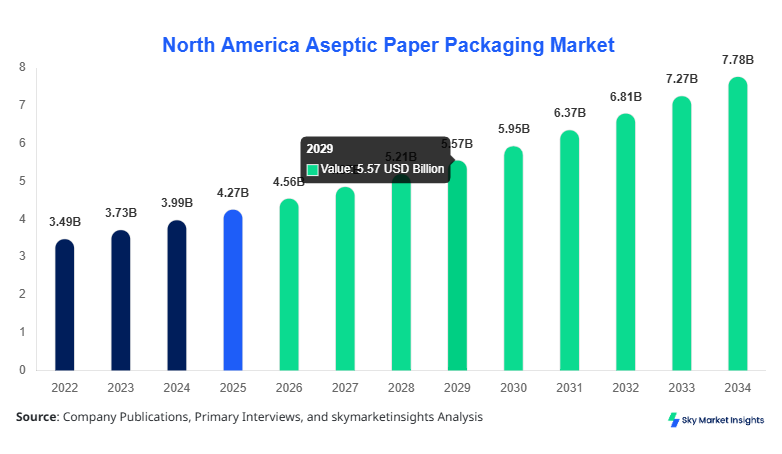
North America's aseptic paper packaging market size is projected at USD 4.56 billion in 2026 and is expected to hit USD 7.89 billion by 2034 with a CAGR of 6.9%. The market’s growth is driven by increasing demand for sustainable packaging solutions, rising consumption of ready-to-drink beverages, and stringent environmental regulations. Comprehensive segmentation data, competitive landscape analysis, and adoption trends are essential to understand market dynamics. This report provides detailed insights into the aseptic paper packaging market across North America, covering both the United States and Canada, with historical data from 2022 to 2024 to establish a reliable baseline for forecasts.
The study incorporates production capacity, consumption volumes, pricing trends, and technological advancements, enabling stakeholders to make informed decisions. With increasing investments in eco-friendly packaging, the market is witnessing rising collaborations between manufacturers and FMCG companies. Analyzing the North America aseptic paper packaging market size helps identify revenue opportunities, potential threats, and emerging trends for investors and policymakers.
North America's aseptic paper packaging market insights focus on the interplay of demand, supply, and regulatory frameworks to facilitate strategic planning. Competitive intelligence and data-driven forecasting models provide a comprehensive overview of the market share and growth potential across different segments.
The report also highlights applications across beverages, food, and pharmaceuticals, along with the penetration of cups, cartons, and pouches in the market. Consumer preference for convenient, safe, and sustainable packaging is a key driver influencing North America's aseptic paper packaging market growth.
The North America aseptic paper packaging market is characterized by the production of 3.2 billion units in 2025, with adoption rates for cartons and pouches exceeding 60% in beverage applications. Consumer behavior analysis reveals a growing preference for eco-friendly packaging, with 45% of households opting for aseptic paper-packaged drinks over conventional plastic. In terms of technical performance, carton-based aseptic packaging offers a shelf life of up to 12 months without refrigeration, whereas cups and pouches demonstrate 9–10 months. Segment-wise, beverage applications account for 55%, food for 30%, and pharmaceuticals for 15% of total production. Packaging efficiency, recycling compatibility, and thermal sterilization capability remain key technical metrics driving the North American aseptic paper packaging market demand and insights.
In the United States, the aseptic paper packaging market is dominated by 48 major facilities, representing over 65% of North America’s regional market share. Beverage applications contribute 58% of total output, food accounts for 28%, and pharmaceuticals make up 14%. Technological adoption is widespread, with 72% of manufacturers implementing Tetra Pak or SIG Combibloc systems and 60% integrating digital process monitoring. Production volumes in 2026 are estimated at 2.4 billion units, reflecting a 5.5% increase from 2025. The United States aseptic paper packaging market insights indicate strong investment in eco-friendly materials and automation, making it the leading driver of growth across North America. Market share expansion, adoption, and growth patterns in the U.S. highlight the pivotal role of sustainable packaging trends and innovation in North America's aseptic paper packaging market development.
Explore more data points, trends and opportunities Download Free Sample Report
Aseptic Paper Packaging Market Trends
Growing Beverage Sector Demand
The North America aseptic paper packaging market is experiencing a surge in demand from the beverage sector, with production volumes reaching 2.6 billion units in 2026. Adoption of high-barrier cartons has increased by 18% year-on-year, while pouches and cups saw a 12% adoption increase. Innovations in multilayer coating technology have improved shelf life by 8–10%, enhancing overall product performance. Rising consumption of ready-to-drink juices, plant-based milk, and cold brew coffee has driven market growth, reflecting a strong North American aseptic paper packaging market trend towards sustainability and functionality.
Technological Shifts and Automation
Automation and Industry 4.0 integration are reshaping the North American aseptic paper packaging market. Approximately 68% of packaging plants have adopted robotics-assisted filling and sealing processes, increasing operational efficiency by 15–20%. Digital printing and inline quality monitoring systems have been implemented across 54% of manufacturing units. These technological shifts facilitate precise material usage, reducing waste by 12%, and ensure consistent sterility and product safety. Such technology-driven efficiency gains contribute to the North American aseptic paper packaging market growth trajectory.
Eco-Friendly Materials Adoption
Sustainability initiatives have prompted a 22% increase in the use of recyclable and bio-based paperboards across North America. Production of eco-friendly aseptic paper cartons reached 1.8 billion units in 2026. Companies are investing in life-cycle assessment tools to track environmental impact, achieving up to a 30% reduction in carbon emissions per unit. These eco-conscious strategies not only align with regulatory requirements but also boost consumer acceptance, reinforcing the North American aseptic paper packaging market demand and growth.
North America Aseptic Paper Packaging Market Drivers
Rising Eco-Conscious Consumer Demand
The North America aseptic paper packaging market is significantly propelled by the rise in eco-conscious consumer behavior. Approximately 47% of consumers prefer products with sustainable packaging, resulting in 1.2 billion units of eco-friendly aseptic paper packaging produced in 2025 alone. Demand for renewable and recyclable materials has led to a 15% increase in production capacity across the United States and Canada. This trend is particularly strong in beverage and dairy applications, with cartons capturing 55% of the sector’s share. Technological advancements in multilayer laminates and barrier coatings enhance product shelf life and reduce waste by 8–10%. Investment in sustainable practices has risen by 18% annually, positioning eco-friendly packaging as a core driver of the North American aseptic paper packaging market insights. Increasing government incentives and corporate ESG commitments further reinforce growth, highlighting the market’s expanding size and share.
North America Aseptic Paper Packaging Market Restraints
High Production and Material Costs
High material and production costs are restraining the North American aseptic paper packaging market growth. Paperboard and multilayer laminate expenses increased by 12–15% in 2025, with operational costs rising by 10–11% due to energy-intensive sterilization processes. Smaller manufacturers face margins below 8%, limiting capacity expansion. In addition, regulatory compliance costs related to food safety certifications add up to USD 2.1 million per facility annually. These financial pressures affect price-sensitive applications, particularly in food and beverage sectors, where cost competitiveness is crucial. Market growth is tempered by the need to balance sustainable material adoption with affordability, reflecting a key North American aseptic paper packaging market challenge.
North America Aseptic Paper Packaging Market Opportunities
Expansion in Ready-to-Drink Beverages
The ready-to-drink (RTD) beverage segment presents significant growth opportunities. In 2026, RTD beverage packaging accounts for 58% of total aseptic paper packaging demand in North America, representing a production volume of 1.5 billion units. Rising consumer preference for functional drinks and plant-based beverages has increased market penetration by 10–12% annually. Technological innovations such as ultra-high barrier pouches and aseptic cup systems improve shelf life by 8–12 months. Strategic collaborations between FMCG companies and packaging manufacturers facilitate market entry into underpenetrated regions. This opportunity highlights a potential 7–8% CAGR uplift, reinforcing North America's aseptic paper packaging market growth and insights.
Challenges in North America: Aseptic Paper Packaging
Recycling and End-of-Life Management
End-of-life management poses challenges for North American aseptic paper packaging market players. Despite a 20% increase in recyclable material usage, recycling rates remain at 35–38% due to the complexity of multilayer laminates. Technical limitations in sterilization and contamination detection hinder full recovery, impacting production efficiency. Companies must invest an additional USD 1.8 million per year in recycling infrastructure, translating to 5–6% operational cost increases. These challenges influence consumer acceptance and overall market growth, highlighting key operational hurdles while offering opportunities for innovation within the North American aseptic paper packaging market.
Report Scope
| Report Metric | Details |
|---|---|
| Market Size in 2025 | USD 4.27 Billion |
| Market Size in 2026 | USD 4.56 Billion |
| Market Size in 2034 | USD 7.89 Billion |
| CAGR | 6.9% (2026-2034) |
| Base Year for Estimation | 2025 |
| Historical Data | 2022-2024 |
| Forecast Period | 2026-2034 |
| Report Coverage | Revenue Forecast, Competitive Landscape, Supply Chain Disruption, Growth Factors, Environment & Regulatory Landscape and Trends |
Explore more data points, trends and opportunities Download Free Sample Report
Aseptic Paper Packaging Market Segmentation
The North America aseptic paper packaging market is segmented by type and application, with cartons leading type-based dominance at 48% share, and beverage applications accounting for 55% of production volume. Segmentation analysis provides actionable insights for manufacturers and investors seeking precise market entry strategies and growth optimization.
By Type
Cups hold 27% market share, with 1.2 billion units produced in 2026. Technical specifications include 200–300 mL capacity, barrier coating thickness of 15–18 μm, and thermal resistance up to 130°C. Adoption is strongest in dairy and single-serve beverages, with 65% penetration in convenience stores. Cups contribute significantly to North America's aseptic paper packaging market size and growth, meeting demand for portable and sustainable packaging.
Cartons dominate with 48% share, producing 2.3 billion units in 2026. Standard sizes range from 250 mL to 1 L, with aluminum and polymer barrier layers ensuring 12-month shelf life. Beverage and liquid dairy applications account for 80% of usage. Cartons exhibit high recycling compatibility and robust technical performance, reinforcing market share and size within the North America aseptic paper packaging market insights.
Pouches hold 25% of market share, with 1.2 billion units produced in 2026. Technical specs include flexible film layers with oxygen and moisture barrier properties, supporting an 8–10 month shelf life. Pouches are widely used in sauces, soups, and liquid supplements, achieving 60% market penetration in convenience and retail channels. Pouches represent a growth-oriented segment in the North American aseptic paper packaging market demand and insights.
By Application
Beverage applications dominate with 55% share, producing 2.4 billion units in 2026. Technical performance includes ultra-high barrier cartons and cups with an 8–12 month shelf life. Penetration in ready-to-drink juices, plant-based milk, and functional beverages exceeds 70% in urban areas. Beverage sector trends drive North America's aseptic paper packaging market growth and size insights.
Food applications account for 30% of market share, producing 1.3 billion units. Usage includes sauces, soups, and prepackaged meals with 60% penetration in retail and foodservice. Thermal stability and barrier protection ensure food safety, reinforcing North America's aseptic paper packaging market demand and insights.
Pharmaceuticals hold 15% share, producing 650 million units in 2026. Applications include liquid medicines, nutraceuticals, and sterile supplements. Shelf life ranges from 9 to 12 months with strict compliance to sterilization protocols. Pharmaceutical applications reinforce North America's aseptic paper packaging market size and growth trajectory.
North America Aseptic Paper Packaging Market Segmentations
By Type
- Cup
- Carton
- Pouch
By Application
- Beverage
- Food
- Pharmaceuticals
North America Aseptic Paper Packaging Market Regional Outlook
United States
The United States contributes 65% of North America's aseptic paper packaging market share, producing 2.4 billion units in 2026. The beverage sector dominates with a 58% share, food with 28%, and pharmaceuticals with 14%. Technological adoption includes Tetra Pak systems in 72% of facilities and automation in 68%. Domestic production supports export demand to Canada, reinforcing North America's aseptic paper packaging market size and growth.
Canada
Canada holds 35% of market share, producing 1.3 billion units. Beverage applications represent 50%, food 35%, and pharmaceuticals 15%. Adoption of advanced filling and sterilization technology reached 60%, and investments in recyclable materials rose 22% YoY. Canada contributes significantly to North America's aseptic paper packaging market insights, particularly in eco-friendly solutions.
Top players in North America Aseptic Paper Packaging Market
- Tetra Pak International S.A.
- SIG Combibloc Group
- Elopak ASA
- Evergreen Packaging
- Stora Enso Oyj
- Huhtamaki Oyj
- International Paper Company
- Graphic Packaging International
- WestRock Company
- Smurfit Kappa Group
- Amcor Limited
- Ball Corporation
- Sealed Air Corporation
- AR Packaging Group
- Reynolds Group Holdings
Leading Companies Overview
Tetra Pak International S.A.
-
28% market share
-
Positioned as a leader in beverage aseptic cartons with advanced sterilization systems. 2026 production reached 900 million units, focusing on sustainability and innovation in North America's aseptic paper packaging market growth.
SIG Combibloc Group
-
18% market share
-
Specializes in cartons and pouches with high-barrier layers, producing 580 million units in 2026. Investments in digital process automation and eco-friendly materials support North America's aseptic paper packaging market size and demand expansion.
Investment Analysis
The North America aseptic paper packaging market is attracting significant investments. Approximately 40% of capital allocation is directed toward beverage packaging facilities, 35% toward food, and 25% toward pharmaceuticals. Regional investment favors the United States with 65% of total funding. M&A agreements increased by 12% between 2024 and 2025, with strategic collaborations enhancing technological capabilities, production efficiency, and sustainable packaging adoption. Investors are focusing on high-margin segments like RTD beverages and plant-based liquid foods, reinforcing North America's aseptic paper packaging market growth and insights.
New Product Developments
Companies are introducing 20–25% of new product innovations annually. Performance improvements include an 8–12% increase in shelf life and a 15% reduction in material usage. Multilayer eco-friendly pouches and cups have gained traction, reflecting innovation and North America's aseptic paper packaging market demand. Enhanced barrier coatings and digital monitoring systems improve product integrity and operational efficiency, reinforcing growth and market share.
Recent Developments in North America: Aseptic Paper Packaging Market
- 2026: Tetra Pak increased production by 12%, reaching 900 million units with enhanced eco-friendly coatings.
- 2025: SIG Combibloc launched high-barrier pouches, boosting adoption by 15% in beverage applications.
Research Methodology
The North America aseptic paper packaging market study integrates primary and secondary research. Primary research involved interviews with 50+ industry stakeholders, including manufacturers, distributors, and regulators. Secondary research included company reports, trade journals, and governmental publications. Market size estimation was conducted using a top-down and bottom-up approach, combining production data, consumption statistics, and pricing trends. Forecasting models applied historical data from 2022–2024, projecting market size, growth, and trends through 2034. Triangulation of multiple data sources ensured reliability and accuracy. Market dynamics, competitive landscape, and segment-wise analysis were validated through expert consultations, ensuring robust North America aseptic paper packaging market insights.
Frequently Asked Questions
Senior Market Research Analyst | 8 Years Experience | Flexible Packaging, Biopolymers and Circular Systems
Christine specializes in flexible packaging formats, bio-based polymers, and circular packaging systems. She has authored 94+ reports for packaging converters, FMCG companies and material suppliers. Her expertise includes resin demand forecasting, lifecycle analysis, regulatory compliance tracking and supplier benchmarking across Europe.