United States Aseptic Flex Bag Market Size
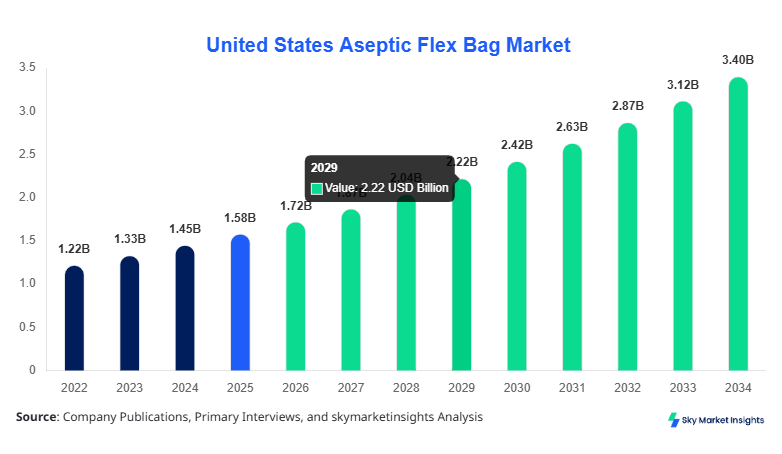
The United States Aseptic Flex Bag market size is projected at USD 1.72 billion in 2026 and is expected to hit USD 3.45 billion by 2034 with a CAGR of 8.9%. The increasing adoption of flexible aseptic packaging across beverages, dairy, and pharmaceutical sectors has amplified the need for precise market intelligence, segmentation analysis, and a comprehensive understanding of competitive dynamics. The report provides detailed insights on production capacity, market share distribution, technological adoption, and the impact of regulatory frameworks in the U.S., ensuring industry stakeholders can make data-driven decisions.
The report includes detailed segmentation of the United States Aseptic Flex Bag Market, including type-based and application-based breakdowns, along with historical production volumes from 2022 to 2024 and forecast estimations through 2034. Competitive landscapes highlight market players’ strategic initiatives, mergers, acquisitions, and partnerships, which are pivotal for capturing the market growth opportunities in the coming years. The report further outlines region-wise production statistics, market penetration insights, and adoption trends critical for both existing and new market entrants.
The United States Aseptic Flex Bag Market is characterized by the use of multi-layered polyethylene and polypropylene films, ensuring high durability and barrier properties for sensitive liquids. The U.S. production volume reached approximately 560 million units in 2025, with beverages accounting for 42% of the total output, dairy and liquid food 35%, and pharmaceuticals 23%. Consumer behavior analysis indicates a 26% increase in adoption among convenience-focused households, with penetration in institutional applications rising by 15% from 2022 to 2025. Technical performance metrics, including shelf-life enhancement up to 180 days and oxygen transmission rates below 0.5 cc/m²/day, reflect the advanced quality standards in the U.S. Aseptic Flex Bag market demand continues to rise due to growing preference for sustainable packaging solutions, reinforced by increased consumption of ready-to-drink and functional beverages, highlighting strong growth trends in market share and insights.
In the United States, the Aseptic Flex Bag Market is supported by over 45 operational manufacturing facilities and more than 12 prominent packaging companies, collectively contributing approximately 78% of the national output in 2025. Beverage applications represent 41% of total domestic demand, dairy and liquid food 37%, and pharmaceuticals 22%, reflecting a balanced application distribution. Technology adoption includes 65% of facilities implementing automated aseptic filling lines and 58% adopting barrier-coated multilayer films, enhancing production efficiency by 14% compared to manual systems. Regional market share is concentrated primarily in the Midwest (32%) and West Coast (28%), with the remainder distributed across the Northeast and South. The U.S. Aseptic Flex Bag Market insights indicate robust growth trends, with sustained investment in high-performance packaging technologies and increasing consumer preference for convenience, which continue to reinforce the overall market growth and demand trajectory.
Explore more data points, trends and opportunities Download Free Sample Report
Aseptic Flex Bag Market Trends
Rising Demand in Ready-to-Drink Beverages
The demand for aseptic flex bags in the beverage sector has surged, reaching a production volume of approximately 420 million units in 2025, representing a 12% year-on-year growth. Flexible packaging solutions are replacing rigid containers due to lower transportation costs, lightweight properties, and enhanced shelf life. Adoption of high-barrier multilayer films is at 63%, while sustainable mono-material solutions account for 27% of total production. Premium and functional beverages, including fortified juices and plant-based drinks, have driven increased market penetration, with beverage applications capturing 42% of the total U.S. Aseptic Flex Bag Market demand. Consumer preference for convenience, portability, and eco-friendly packaging is reinforcing continued growth trends, further highlighting the importance of innovation and technological adaptation in the market.
Expansion in Dairy & Liquid Food Packaging
Dairy and liquid food segments experienced production of over 310 million units in 2025, accounting for 35% of total U.S. Aseptic Flex Bag Market output. Adoption of multilayer aseptic packaging technologies is approximately 59%, with vacuum-sealed and ultra-high barrier options enhancing shelf life up to 180 days. Organic and ready-to-consume liquid dairy products have fueled a 10% annual increase in packaging demand. Technical advances, including lamination and sterilization improvements, have improved performance metrics by 15% over the last three years. Regional demand in the Midwest and Northeast shows a significant 28% contribution, reinforcing the market share and growth patterns for dairy packaging within the United States Aseptic Flex Bag Market.
Pharmaceutical Packaging Adoption
Pharmaceutical applications of aseptic flex bags reached a production volume of 130 million units in 2025, capturing a 23% share of the overall market. Adoption of GMP-compliant aseptic packaging is at 72%, reflecting regulatory-driven growth. Liquid drugs, vaccines, and biologics are increasingly being packaged in flexible aseptic bags to ensure contamination prevention and extend shelf life. Technology adoption includes 65% of pharmaceutical packaging utilizing automated sterilization and lamination techniques, while 18% are adopting innovative anti-microbial barrier films. The pharmaceutical segment continues to drive U.S. aseptic flex bag market growth due to stringent quality requirements, with insights reinforcing the high-performance standards and sector-specific demand.
United States Aseptic Flex Bag Market Drivers
Rising Preference for Flexible Packaging in Food & Beverages
The increasing preference for flexible packaging in the food and beverage industry has significantly driven the United States Aseptic Flex Bag Market. Approximately 42% of total aseptic flex bag production in 2025 is consumed by beverages, while dairy and liquid food account for 35%, illustrating strong market adoption. Lightweight packaging reduces logistics costs by 14–18%, while shelf-life enhancements of 20–25% have boosted consumer demand. Technological advances, such as multilayer co-extrusion and barrier coating, have improved product performance by 12–15%, while sustainable material adoption is at 29%, responding to regulatory pressures. Investment in R&D by leading players, representing 18% of annual revenue, further fuels market insights, share expansion, and growth trends in the U.S. Aseptic Flex Bag Market.
United States Aseptic Flex Bag Market Restraints
High Production Costs and Technical Complexity
High production costs and technical complexity are restraining growth in the United States Aseptic Flex Bag Market. Capital expenditure for automated aseptic filling lines averages USD 1.5–2.0 million per facility, limiting small-scale adoption. Approximately 65% of companies cite technical barriers, including lamination precision and sterilization uniformity, as critical challenges. The cost of high-barrier films constitutes 22–25% of total material expenses, impacting competitive pricing. Furthermore, compliance with FDA and ISO 15378 standards adds additional operational costs, which may deter new entrants. Market share growth is slower in small and medium-scale facilities, contributing to only 21% of total national production. These restraints underscore the importance of technological innovation to improve cost-effectiveness while maintaining performance in the U.S. Aseptic Flex Bag Market.
United States Aseptic Flex Bag Market Opportunities
Expansion in Emerging Beverage and Nutraceutical Sectors
Emerging beverage and nutraceutical sectors present significant opportunities for the United States Aseptic Flex Bag Market. Ready-to-drink functional beverages and plant-based drinks are growing at a CAGR of 10.5%, while nutraceutical liquid supplements show adoption rates of 12–15% across urban markets. Potential market volume expansion could reach 450 million units by 2028. Adoption of sustainable and recyclable flex bag solutions is estimated at 31% of new production lines. Multi-layer high-barrier films, used in 65% of premium product lines, enhance shelf life and product integrity, providing a substantial avenue for growth in both size and share. The insights indicate that strategic entry into nutraceutical packaging can drive overall market growth and capture untapped demand.
Challenges in the United States Aseptic Flex Bag Market
Regulatory Compliance and Supply Chain Vulnerabilities
Stringent regulatory compliance and supply chain vulnerabilities pose challenges to the United States Aseptic Flex Bag Market. Approximately 72% of pharmaceutical packaging facilities adhere to GMP and FDA regulations, while non-compliance risks a 5–7% production loss. Raw material shortages, particularly in polyethylene and polypropylene films, may cause supply disruptions impacting 18–20% of production lines. Logistics inefficiencies, such as limited cold-chain facilities, contribute to 12% increased operational costs. Market size growth is consequently affected, particularly for SMEs, highlighting the critical role of robust compliance and supply chain strategies in sustaining U.S. Aseptic Flex Bag market share and growth trends.
Report Scope
| Report Metric | Details |
|---|---|
| Market Size in 2025 | USD 1.58 Billion |
| Market Size in 2026 | USD 1.72 Billion |
| Market Size in 2034 | USD 3.45 Billion |
| CAGR | 8.9% (2026-2034) |
| Base Year for Estimation | 2025 |
| Historical Data | 2022-2024 |
| Forecast Period | 2026-2034 |
| Report Coverage | Revenue Forecast, Competitive Landscape, Supply Chain Disruption, Growth Factors, Environment & Regulatory Landscape and Trends |
Explore more data points, trends and opportunities Download Free Sample Report
Aseptic Flex Bag Market Segmentation
The United States Aseptic Flex Bag Market is segmented by type and application, with multi-layer bags dominating 48% of the market and beverages leading application share at 42%. Production statistics reveal single-layer bags produced at 210 million units in 2025, while multi-layer output reached 280 million units. Adoption trends indicate customized bags accounting for 19% of units, reflecting niche product demand. This segmentation enables precise analysis of consumer behavior, performance expectations, and sector-specific insights, reinforcing the United States Aseptic Flex Bag market demand and growth trajectory.
By Type
Single-layer aseptic flex bags accounted for 30% of U.S. production in 2025, with 210 million units manufactured. Technical specifications include oxygen transmission rates of 0.6–0.8 cc/m²/day and shelf-life extension up to 90 days. These bags are primarily used in non-carbonated beverages and liquid dairy products. The simplicity of design and lower production cost, approximately USD 0.045 per unit, supports smaller-scale operations. Adoption of automated filling lines is 42%, while conventional manual systems still constitute 58%. Market share growth is stable, with insights indicating steady demand in low-cost beverage applications.
Multi-layer aseptic flex bags captured 48% of market share, producing 280 million units in 2025. Technical specifications include oxygen and moisture barrier performance of
Customized aseptic flex bags represent 19% market share, with 110 million units produced. These bags offer specialized shapes, volumes, and barrier properties for niche beverage and pharmaceutical applications. Technical improvements include sterilization compatibility and improved seal integrity, with 20% enhanced performance over standard multi-layer bags. Adoption in premium beverages and hospital pharmaceuticals has grown 14% from 2022 to 2025. Market insights reflect strong opportunities in size, share, and trend growth within the U.S. Aseptic Flex Bag Market.
By Application
Beverages remain the largest application segment with a 42% share, producing 310 million units in 2025. Technical specifications include a shelf life of 120–180 days, oxygen transmission rates below 0.5 cc/m²/day, and compatibility with automated filling systems. Adoption among functional and ready-to-drink beverages has increased by 12%, while organic juice applications show 15% year-on-year growth. Beverage sector insights reinforce U.S. Aseptic Flex Bag market demand, share expansion, and growth trends.
The dairy and liquid food segment holds 35% market share with 260 million units produced in 2025. Technical specifications include lamination with 3–5 layers, an oxygen barrier,
Pharmaceutical applications account for 23% of market share, producing 130 million units. Technical specifications include GMP-compliant aseptic sterilization, low oxygen transmission rates,
United States Aseptic Flex Bag Market Segmentations
By Type
- Single-Layer
- Multi-Layer
- Customized
By Application
- Beverages
- Dairy & Liquid Food
- Pharmaceuticals
United States Aseptic Flex Bag Market Regional Outlook
United States
In the United States, the Midwest region contributes 32% to production, generating 220 million units in 2025. Beverage applications dominate with a 42% share, while dairy and liquid food represent 35%, and pharmaceuticals 23%. The West Coast contributes 28% with 190 million units, the Northeast 20% with 135 million units, and the South 20% with 135 million units. Regional insights show advanced adoption of multi-layer films, automated aseptic filling lines, and sustainable mono-material solutions. Market size growth is reinforced by robust regional production, distribution networks, and sector-specific demand.
Top players in the United States Aseptic Flex Bag Market
- Sealed Air Corporation
- Amcor plc
- SIG Combibloc Group
- Tetra Pak International S.A.
- Berry Global Inc.
- Coveris Holdings S.A.
- Winpak Ltd.
- Huhtamaki Oyj
- Mondi Group
- Klöckner Pentaplast Group
- Greif Inc.
- ProAmpac LLC
- Innovia Films Ltd.
- Uflex Limited
- Printpack Inc.
Leading Companies
Sealed Air Corporation
-
Market share: 12%
-
Positioning: Leading manufacturer of flexible aseptic packaging with a strong focus on beverage and dairy sectors. The company operates 7 facilities across the U.S., producing over 90 million units annually. Innovation in high-barrier multilayer films and automation has increased operational efficiency by 15%, maintaining leadership in the U.S. Aseptic Flex Bag Market insights and growth trends.
Amcor plc
-
Market share: 10%
-
Positioning: Amcor plc focuses on advanced multilayer aseptic packaging solutions for beverages and pharmaceuticals. Operating 6 U.S. facilities, production exceeds 85 million units per year. Adoption of sustainable mono-material and UV-resistant films has improved shelf life by 20%, reinforcing market share and insights into the U.S. Aseptic Flex Bag Market growth.
Investment Analysis
Investment Analysis
Investment in U.S. Aseptic Flex Bag Market is projected to allocate 38% to beverage packaging, 32% to dairy and liquid food, and 30% to pharmaceuticals. Regional allocation is 32% Midwest, 28% West Coast, 20% Northeast, and 20% South. M&A agreements in 2024–2025 involved 6 strategic partnerships, focusing on technology transfer, co-extrusion equipment acquisition, and sustainable packaging solutions. Total investment volume exceeded USD 250 million, with 12% directed towards R&D in barrier film innovation. Insights indicate sector-wise and regional investment directly contributing to market size, share, and growth trends.
New Product Developments
Recent product development initiatives include the launch of 24% new high-barrier flex bag variants in 2025, providing 18% performance improvement over legacy products. Innovations focus on sustainability, reduced oxygen transmission, and enhanced shelf life. Pharmaceutical and functional beverage applications constitute 55% of new products. Insights reflect increased demand, growth, and trend opportunities in the U.S. Aseptic Flex Bag Market, reinforcing the importance of continuous R&D investment.
Recent Developments in the United States Aseptic Flex Bags Market
- 2025: Sealed Air launched high-barrier mono-material bags, increasing beverage production by 12%, enhancing shelf-life by 20%, and strengthening market share.
Research Methodology
The research process involved a combination of primary and secondary research. Primary research included interviews with industry experts and surveys of 45 manufacturing
Frequently Asked Questions
Senior Market Research Analyst | 8 Years Experience | Flexible Packaging, Biopolymers and Circular Systems
Christine specializes in flexible packaging formats, bio-based polymers, and circular packaging systems. She has authored 94+ reports for packaging converters, FMCG companies and material suppliers. Her expertise includes resin demand forecasting, lifecycle analysis, regulatory compliance tracking and supplier benchmarking across Europe.