Europe Antimicrobial Packaging Market Size
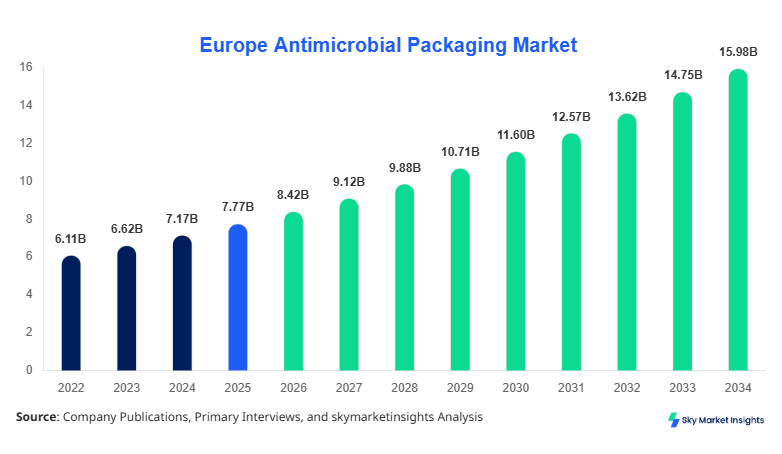
Europe's antimicrobial packaging market size is projected at USD 8.42 billion in 2026 and is expected to hit USD 15.98 billion by 2034 with a CAGR of 8.34%. The market recorded an estimated valuation of USD 7.79 billion in 2025, while shipment volume exceeded 18.6 million metric tons across Europe during the base year. Increasing demand for contamination-resistant packaging in healthcare, food processing, and pharmaceutical logistics is accelerating investment activities across Germany, the United Kingdom, France, Spain, Italy, and Russia. Competitive benchmarking indicates that over 240 regional manufacturers and converters are operating in the antimicrobial materials ecosystem, with top players collectively accounting for nearly 42% revenue concentration. The report further evaluates segment-wise penetration, manufacturing capacities, pricing analysis, trade flows, and procurement structures shaping Europe's antimicrobial packaging market size.
The antimicrobial packaging industry refers to advanced packaging systems integrated with antimicrobial agents such as silver ions, organic acids, zinc oxide, and bioactive polymers to inhibit microbial growth and extend shelf life. Europe produced more than 11.8 million tons of antimicrobial-enabled flexible and rigid packaging materials in 2025, supported by rising packaged food consumption and healthcare sterilization standards. Adoption penetration in food applications surpassed 58%, while pharmaceutical packaging contributed approximately 24% of overall consumption volume. Consumer behavior patterns reveal that nearly 67% of European consumers prefer food products with extended freshness labels, and 49% are willing to pay premium pricing between 8% and 14% for contamination-resistant packaging solutions. Healthcare facilities across Europe consumed over 3.2 billion antimicrobial blister packs and medical-grade pouches during 2025 due to infection control requirements. Technical metrics such as oxygen transmission rates below 0.8 cc/m²/day and antimicrobial efficacy exceeding 99.5% are becoming standardized across premium packaging categories. Food & beverage applications represented 56% market contribution, healthcare accounted for 28%, and personal care held 11% share, reinforcing Europe Antimicrobial Packaging market share.
In the United Kingdom, the antimicrobial packaging market accounted for nearly 27% of Europe’s total revenue generation in 2025, supported by more than 160 specialized packaging production facilities and 70 antimicrobial additive suppliers. The country processed approximately 3.4 million tons of active packaging materials during the year, with food packaging applications contributing 52% of national demand. Healthcare and pharmaceutical packaging represented 31%, while cosmetics and personal care accounted for 9%. Adoption of silver-ion-based antimicrobial films increased by 18.6% year-over-year due to growing food safety regulations and NHS sterilization requirements. Smart packaging technologies integrated with antimicrobial coatings achieved penetration rates above 38% among premium retail chains. More than 64% of frozen food producers in the UK shifted toward antimicrobial flexible packaging solutions to reduce spoilage losses by nearly 21%. In pharmaceutical logistics, antimicrobial blister packaging utilization surpassed 1.1 billion units annually. The expansion of sustainable biopolymer packaging, combined with increasing retail shelf-life optimization, continues to reinforce Europe's antimicrobial packaging market growth.
Antimicrobial Packaging Market Trends
Explore more data points, trends and opportunities Download Free Sample Report
Antimicrobial Packaging Market Trends
Rising Integration of Nanotechnology-Based Antimicrobial Systems
Nanotechnology integration has become one of the strongest developments influencing the antimicrobial packaging ecosystem across Europe. In 2025, more than 2.6 million tons of packaging materials incorporated nano-silver, nano-copper, or zinc oxide antimicrobial compounds. Flexible packaging manufacturers in Germany and the United Kingdom increased nanotechnology-enabled production capacity by 22% compared with 2024 levels. Food producers reported spoilage reduction rates between 18% and 27% when using nanocomposite antimicrobial films for dairy and meat packaging. Approximately 46% of premium packaged meat products in Western Europe adopted active packaging technologies incorporating controlled antimicrobial release systems. Demand from pharmaceutical cold-chain logistics also accelerated, with over 620 million nano-coated sterile packs produced during 2025. Advanced multilayer films offering antimicrobial protection for more than 180 days are increasingly replacing conventional packaging formats, strengthening Europe's antimicrobial packaging market trend.
Expansion of Sustainable Biopolymer Packaging Materials
Sustainability-oriented material innovations are significantly transforming production structures throughout the region. Europe generated nearly 1.9 million tons of biopolymer antimicrobial packaging materials in 2025, reflecting a 19% annual increase. Biodegradable antimicrobial films derived from starch, cellulose, and polylactic acid represented approximately 14% of new packaging launches across food retail channels. More than 52% of European retailers implemented sustainability mandates requiring reduced plastic intensity and recyclable antimicrobial structures. France and Spain jointly accounted for 31% of total bio-based antimicrobial packaging production volume in 2025. Technical improvements in compostable barrier films increased moisture resistance by 24% and oxygen barrier performance by 17% compared with earlier product generations. Consumer surveys indicate that nearly 71% of urban consumers prefer recyclable antimicrobial packaging for fresh produce and ready-to-eat meals. These developments continue shaping the European antimicrobial packaging market trend.
Growing Demand from E-commerce and Pharmaceutical Logistics
The rapid expansion of e-commerce grocery distribution and pharmaceutical logistics networks is accelerating demand for antimicrobial secondary and tertiary packaging systems. Europe processed more than 7.8 billion e-commerce food delivery packages in 2025, of which approximately 18% incorporated antimicrobial packaging layers. Pharmaceutical exports from Germany, the United Kingdom, and Italy collectively exceeded USD 298 billion, increasing requirements for contamination-resistant transit packaging. Antimicrobial corrugated packaging production rose by 16%, while insulated antimicrobial pouches recorded shipment growth of 21%. Smart sensors integrated with antimicrobial coatings improved cold-chain monitoring efficiency by nearly 13%. Hospital procurement spending on sterile antimicrobial transport packaging surpassed USD 1.7 billion in 2025. These advancements are supporting Europe's antimicrobial packaging market demand.
Europe Antimicrobial Packaging Market Drivers
Rising Food Safety Regulations and Shelf-Life Optimization Requirements
Stringent European food safety frameworks and increasing packaged food consumption are primary drivers accelerating antimicrobial packaging adoption. Europe generated over 362 million tons of packaged food products during 2025, while food wastage exceeded 58 million tons annually. Food manufacturers are increasingly adopting antimicrobial films and active barrier technologies to reduce spoilage losses between 15% and 28%. More than 63% of supermarket chains in Germany, France, and the United Kingdom implemented mandatory contamination-reduction packaging guidelines for ready-to-eat foods. Regulatory agencies also expanded packaging compliance standards for microbial resistance and migration safety thresholds below 10 mg/dm². Antimicrobial flexible packaging penetration in dairy products reached 41%, while bakery packaging adoption exceeded 36%. Shelf-life extension ranging from 5 to 20 additional days has encouraged adoption across meat and seafood segments. Investments in food-safe antimicrobial additives increased by 17% year-over-year, while automated antimicrobial coating lines expanded by nearly 11% across Europe. These factors continue driving Europe's antimicrobial packaging market growth.
Europe Antimicrobial Packaging Market Restraints
High Production Costs and Regulatory Compliance Complexities
Despite rising demand, the market faces substantial operational and regulatory barriers associated with antimicrobial additives and advanced packaging integration. Production costs for antimicrobial films remain 18% to 35% higher than conventional packaging structures due to expensive active compounds such as silver nanoparticles and bioactive polymers. Compliance testing expenditures for antimicrobial migration and toxicity validation increased by nearly 22% in 2025. Small and medium-sized packaging manufacturers account for over 54% of European converters, yet many lack the capital required for high-performance coating systems and nano-material integration. Recycling challenges also persist, particularly for multilayer antimicrobial composites that reduce recyclability efficiency by nearly 14%. Russia and parts of Eastern Europe reported lower adoption levels due to limited infrastructure and fluctuating raw material prices. Furthermore, antimicrobial certification timelines frequently extend beyond 12 months, delaying commercialization and reducing investment flexibility. These limitations continue constraining Europe's antimicrobial packaging market growth.
Europe Antimicrobial Packaging Market Opportunities
Expansion of Smart Healthcare Packaging and Sustainable Material Innovation
The rapid modernization of healthcare logistics and sustainable material engineering is creating substantial opportunities across the European antimicrobial packaging landscape. Pharmaceutical packaging demand surpassed 4.5 billion sterile units in 2025, while healthcare-associated infection prevention spending increased by 13%. Hospitals and pharmaceutical companies are increasingly investing in antimicrobial blister packs, sterile pouches, and active medical transport containers with microbial inhibition efficiency above 99%. Biopolymer packaging research funding across Europe exceeded USD 920 million during 2025, supporting innovations in compostable antimicrobial coatings and plant-derived active agents. Smart packaging integrated with RFID and freshness monitoring sensors is projected to achieve penetration rates above 26% by 2030. Italy and Spain recorded double-digit expansion in antimicrobial cosmetic packaging applications, driven by premium skincare exports. Collaborative R&D programs between packaging manufacturers and biotechnology firms rose by 21%, accelerating commercialization of sustainable active packaging technologies. These developments are expected to create long-term European antimicrobial packaging market demand.
Challenges in Europe Antimicrobial Packaging Market
Material Compatibility and Recycling Infrastructure Limitations
One of the most significant challenges facing the market is balancing antimicrobial performance with recyclability and material compatibility. Approximately 39% of antimicrobial packaging products in Europe still rely on multilayer plastic structures that complicate recycling processes. Recycling recovery rates for antimicrobial flexible packaging remain below 46%, compared with over 68% for conventional mono-material packaging. Packaging converters frequently encounter difficulties maintaining antimicrobial efficacy during high-temperature processing above 220°C, particularly in polyethylene and polypropylene applications. In addition, compatibility issues between antimicrobial additives and food-contact polymers can reduce shelf-life performance by nearly 12%. Europe generated over 29 million tons of plastic packaging waste during 2025, intensifying scrutiny from sustainability regulators and environmental organizations. Small manufacturers also face technical barriers associated with antimicrobial dispersion uniformity and migration testing compliance. These operational complexities continue challenging Europe's antimicrobial packaging market growth.
Report Scope
| Report Metric | Details |
|---|---|
| Market Size in 2025 | USD 7.77 Billion |
| Market Size in 2026 | USD 8.42 Billion |
| Market Size in 2034 | USD 15.98 Billion |
| CAGR | 8.34% (2026-2034) |
| Base Year for Estimation | 2025 |
| Historical Data | 2022-2024 |
| Forecast Period | 2026-2034 |
| Report Coverage | Revenue Forecast, Competitive Landscape, Supply Chain Disruption, Growth Factors, Environment & Regulatory Landscape and Trends |
Explore more data points, trends and opportunities Download Free Sample Report
Antimicrobial Packaging Market Segmentation
The European antimicrobial packaging ecosystem is segmented by material type and application, with plastic-based materials accounting for approximately 51% market dominance in 2025. Food & beverage remained the leading application segment with 56% revenue contribution due to rising packaged food consumption and cold-chain expansion. Biopolymer-based antimicrobial materials are witnessing rapid commercialization, while healthcare applications continue gaining traction due to pharmaceutical sterilization requirements.
BY TYPE
Plastic-based antimicrobial packaging represented nearly 51% of total regional revenue in 2025 due to its superior barrier properties, low production costs, and compatibility with active antimicrobial additives. Europe produced approximately 9.4 million tons of antimicrobial plastic packaging materials during the year, dominated by polyethylene, polypropylene, and PET substrates. Flexible pouches, thermoformed trays, and vacuum-sealed films collectively accounted for over 62% of plastic-based product demand. Oxygen transmission rates below 1 cc/m²/day and moisture vapor transmission improvements of 18% enabled extended shelf-life performance in dairy and meat applications. Germany and the United Kingdom jointly contributed nearly 44% of antimicrobial plastic packaging production. Advanced silver-ion antimicrobial films achieved microbial reduction efficiencies above 99.4%, supporting pharmaceutical and ready-to-eat food packaging. Plastic-based packaging also achieved adoption rates above 48% in frozen food logistics due to durability and low-temperature stability. These factors continue supporting Europe's antimicrobial packaging market share.
Paperboard-based antimicrobial packaging accounted for approximately 24% market contribution in 2025, supported by increasing sustainability mandates and rising demand for recyclable packaging structures. Europe manufactured nearly 3.1 million tons of antimicrobial paperboard materials, with France and Spain emerging as key producers. Antimicrobial corrugated boxes and coated paper trays recorded demand increases exceeding 16% year-over-year due to e-commerce grocery expansion. Water-based antimicrobial coatings improved bacterial inhibition rates by nearly 91%, while enhancing recyclability performance compared with multilayer plastic alternatives. Retail shelf-ready packaging accounted for over 38% of paperboard consumption volume. Major food retailers implemented recyclable antimicrobial carton programs, reducing plastic use by approximately 22%. Paperboard packaging also demonstrated strong thermal insulation capabilities for bakery and fresh produce distribution. Increasing adoption in organic food packaging continues supporting segment expansion across Europe.
Biopolymer-based antimicrobial packaging represented nearly 14% of total market revenue in 2025 and remains the fastest-growing material category across Europe. Production volume exceeded 1.9 million tons, driven by rising investment in biodegradable packaging technologies. Polylactic acid, cellulose-based films, and starch-derived antimicrobial materials recorded adoption increases above 21%. Compostable antimicrobial packaging demonstrated shelf-life extension improvements ranging between 12% and 18% for fresh produce applications. Italy and France collectively accounted for approximately 36% of European biopolymer antimicrobial manufacturing capacity. Research investments in plant-extract antimicrobial agents and bioactive nanofibers exceeded USD 380 million during 2025. Technical advancements improved tensile strength by 15% and moisture resistance by 13% compared with earlier biodegradable packaging generations. Sustainable food retail channels increasingly prioritize bio-based antimicrobial structures, accelerating Europe's antimicrobial packaging market demand.
BY APPLICATION
Food & beverage remained the largest application segment with nearly 56% market contribution in 2025 due to rising packaged food consumption and food safety regulations. Europe utilized more than 10.2 million tons of antimicrobial packaging materials across dairy, bakery, meat, seafood, frozen foods, and ready-to-eat meals. Meat and seafood applications represented approximately 31% of food-related antimicrobial packaging demand because of high contamination sensitivity and perishability. Shelf-life extension ranging from 7 to 20 days significantly reduced spoilage losses across retail supply chains. Modified atmosphere antimicrobial packaging adoption exceeded 42% among premium supermarket chains in Germany and the United Kingdom. Antimicrobial flexible pouches and vacuum-sealed trays collectively surpassed 4.6 billion units shipped during 2025. Consumer preference for minimally preserved foods further accelerated demand for active antimicrobial packaging systems with microbial inhibition efficiency above 99%. These trends continue supporting Europe's antimicrobial packaging market growth.
Healthcare accounted for approximately 28% market share during 2025, supported by rising pharmaceutical manufacturing, hospital sterilization standards, and infection prevention initiatives. Europe consumed nearly 3.2 billion antimicrobial blister packs, sterile pouches, and medical transport packaging units during the year. Germany, France, and the United Kingdom represented over 61% of healthcare packaging demand due to advanced pharmaceutical production infrastructure. Antimicrobial medical packaging reduced contamination risks by nearly 32% during cold-chain transportation and hospital handling operations. Active pharmaceutical packaging utilizing silver-ion coatings and oxygen scavenging systems recorded adoption growth above 17%. Technical performance requirements, including microbial reduction rates above 99.5%, moisture control, and tamper resistance, continue driving innovation across healthcare packaging applications. Expanding biologics distribution and vaccine logistics further strengthen segment expansion across Europe.
Personal care applications contributed approximately 11% of market revenue in 2025 due to increasing demand for contamination-resistant cosmetic and skincare packaging. Europe processed over 1.4 billion antimicrobial cosmetic containers, dispensers, and sachets during the year. France and Italy accounted for nearly 48% of cosmetic packaging demand due to strong premium beauty product exports. Antimicrobial packaging adoption in skincare products increased by 14% as consumers prioritized hygiene and product stability. Packaging manufacturers introduced active antimicrobial dispensing systems capable of reducing microbial contamination by over 95% after repeated consumer usage. Refillable antimicrobial cosmetic packaging also gained traction, with sustainability-focused beauty brands reducing virgin plastic consumption by approximately 18%. Technical developments in UV-resistant antimicrobial coatings improved product preservation and shelf-life stability for sensitive cosmetic formulations.
Europe Antimicrobial Packaging Market Segmentations
Material Type
- Plastic-based
- Paperboard-based
- Biopolymer-based
Application
- Food & Beverage
- Healthcare
- Personal Care
Europe Antimicrobial Packaging Market Regional Outlook
United Kingdom
The United Kingdom represented approximately 27% of regional market revenue during 2025 due to advanced food processing, pharmaceutical manufacturing, and retail packaging infrastructure. National antimicrobial packaging production exceeded 3.4 million tons, while flexible packaging applications accounted for nearly 58% of domestic consumption. Food & beverage remained the leading segment with a 52% contribution, followed by healthcare at 31%. More than 64% of frozen food manufacturers adopted antimicrobial multilayer films to reduce spoilage and contamination risks. Smart antimicrobial packaging integrated with QR tracking and freshness indicators achieved penetration rates above 22%. Pharmaceutical sterile packaging demand surpassed 1.1 billion units due to increasing NHS procurement and biologics transportation requirements.
Germany
Germany accounted for nearly 24% of Europe’s antimicrobial packaging revenue and maintained the largest manufacturing capacity in the region during 2025. Production volume exceeded 3.8 million tons, supported by more than 190 advanced packaging facilities and strong industrial automation adoption. Food packaging represented 49% of national demand, while healthcare applications contributed 33%. Germany exported over USD 42 billion in pharmaceutical products during the year, significantly increasing antimicrobial sterile packaging consumption. Nanotechnology-enabled antimicrobial films achieved adoption rates above 41% among premium food retailers. Recyclable antimicrobial packaging investments increased by 19%, driven by sustainability mandates and circular economy initiatives.
France
France contributed approximately 15% of regional revenue generation in 2025 and demonstrated strong expansion in sustainable antimicrobial packaging production. National output exceeded 2.1 million tons, with biopolymer antimicrobial materials accounting for nearly 18% of domestic production. Food & beverage applications held 54% market contribution, while personal care and cosmetics represented 14%. France’s luxury cosmetic industry processed over 480 million antimicrobial skincare packaging units during 2025. Government-backed sustainable packaging programs increased biodegradable antimicrobial material investments by 17%. Retail shelf-life optimization technologies improved fresh produce waste reduction by approximately 16%.
Spain
Spain accounted for around 11% of Europe’s antimicrobial packaging market revenue during 2025, supported by growing agricultural exports and packaged food manufacturing. Production volume surpassed 1.6 million tons, while antimicrobial fresh produce packaging applications represented 39% of national demand. Seafood and meat exports significantly increased utilization of antimicrobial vacuum packaging systems capable of extending shelf life by up to 14 days. Biodegradable antimicrobial packaging adoption grew by 18%, particularly in fruit and vegetable logistics. Spain also witnessed rising investment in recyclable paperboard antimicrobial packaging for e-commerce grocery distribution.
Italy
Italy represented approximately 10% of regional market revenue during 2025, driven by premium food exports, pharmaceutical production, and cosmetic packaging demand. National antimicrobial packaging production exceeded 1.5 million tons. Food packaging contributed 47% of demand, while cosmetics and personal care accounted for 16%. Italy exported nearly USD 18 billion worth of cosmetics and skincare products, increasing demand for contamination-resistant packaging systems. Sustainable antimicrobial biopolymers achieved adoption growth above 20% due to eco-friendly retail packaging initiatives. Advanced active packaging technologies integrating moisture-control barriers also gained traction among specialty food exporters.
Russia
Russia contributed approximately 8% of regional antimicrobial packaging revenue during 2025, with production volume reaching nearly 1.2 million tons. Food preservation applications accounted for 61% of domestic demand due to long-distance logistics and frozen food distribution requirements. Antimicrobial flexible packaging consumption increased by 13% year-over-year, particularly in dairy and processed meat categories. Healthcare packaging represented 19% of national demand, while local pharmaceutical production increased sterile antimicrobial packaging requirements by 11%. Infrastructure modernization and regional manufacturing expansion are expected to improve market penetration during the forecast period.
Top players in the European antimicrobial packaging market
- Amcor plc
- Mondi Group
- Sonoco Products Company
- Berry Global Inc.
- Sealed Air Corporation
- BASF SE
- DS Smith Plc
- BioCote Limited
- Huhtamaki Oyj
- Clondalkin Group
- AptarGroup Inc.
- Coveris Holdings S.A.
- Winpak Ltd.
- Constantia Flexibles
- Smurfit Kappa Group
Amcor plc
-
Holds approximately 14% regional market share in antimicrobial flexible packaging solutions.
-
Operates more than 40 packaging manufacturing facilities across Europe.
-
Focuses heavily on recyclable antimicrobial films and pharmaceutical blister packaging.
-
Invested over USD 210 million in sustainable antimicrobial packaging R&D between 2023 and 2025.
-
Strong presence in food & beverage packaging with over 5 billion antimicrobial packages supplied annually.
Mondi Group
-
Accounts for nearly 11% of Europe’s antimicrobial packaging revenue.
-
Major supplier of antimicrobial paperboard and sustainable flexible packaging.
-
Operates integrated manufacturing facilities across Germany, the United Kingdom, and Eastern Europe.
-
Expanded antimicrobial corrugated packaging capacity by approximately 18% during 2025.
-
Strong positioning in e-commerce grocery packaging and recyclable active packaging technologies.
Investment Analysis
Investment allocation toward antimicrobial packaging technologies accelerated significantly across Europe during 2025, with total industry investments exceeding USD 4.8 billion. Approximately 37% of capital expenditure focused on sustainable biopolymer packaging development, while 29% targeted nanotechnology-enabled antimicrobial coatings. Food & beverage applications attracted nearly 46% of total investment activity due to rising packaged food demand and food waste reduction initiatives. Germany and the United Kingdom collectively accounted for 49% of regional antimicrobial packaging investment inflows. Venture capital funding in active packaging startups increased by 18%, particularly for smart packaging integrated with microbial monitoring sensors.
Mergers, acquisitions, and collaborative agreements also intensified across the industry. Packaging manufacturers entered more than 48 strategic collaborations with biotechnology firms during 2025 to commercialize bioactive antimicrobial compounds and recyclable packaging structures. Cross-border acquisitions involving flexible packaging converters exceeded USD 1.3 billion across Europe. Pharmaceutical companies increasingly partnered with antimicrobial packaging providers to strengthen sterile transport packaging capabilities. Approximately 21% of investment activity targeted healthcare logistics applications, while cosmetic packaging innovations represented 9%. Sustainability-driven investment mandates and circular economy policies are expected to continue driving long-term capital deployment.
New Product Developments
Manufacturers introduced a significant number of new antimicrobial packaging products during 2025, with nearly 28% of total packaging launches incorporating active antimicrobial functionality. Smart antimicrobial films integrated with oxygen scavengers and freshness indicators improved shelf-life performance by up to 24% for meat and seafood products. Compostable antimicrobial trays developed from cellulose and plant-based polymers reduced carbon emissions by approximately 19% compared with traditional plastic packaging.
Advanced nano-coated antimicrobial blister packaging introduced for pharmaceutical applications achieved microbial reduction efficiencies exceeding 99.7%. More than 160 new sustainable antimicrobial packaging patents were filed across Europe during 2025, particularly related to biodegradable active coatings and recyclable multilayer structures. Flexible packaging manufacturers also improved puncture resistance by nearly 14% and moisture barrier performance by 11% in newly launched antimicrobial film solutions.
Recent Developments in Europe Antimicrobial Packaging Market
- 2025: Amcor expanded antimicrobial flexible packaging production capacity in Germany by approximately 17%, enabling annual output to exceed 620,000 tons. The expansion focused on recyclable multilayer antimicrobial films for meat and dairy packaging applications. The company also introduced silver-ion barrier technologies capable of extending shelf life by nearly 20% in chilled food applications.
- 2025: Mondi Group launched a new recyclable antimicrobial paperboard packaging portfolio across the United Kingdom and France. Production capacity increased by approximately 15%, while packaging recyclability improved by nearly 22% compared with previous product generations. The initiative primarily targeted e-commerce grocery and fresh produce applications.
Research Methodology
The European antimicrobial packaging market assessment was developed through a combination of primary and secondary research methodologies to ensure accurate market forecasting and competitive benchmarking. The research process included extensive evaluation of production capacities, trade statistics, company financials, regulatory frameworks, and technological innovations across the United Kingdom, Germany, France, Spain, Italy, and Russia. Primary research involved interviews with packaging manufacturers, raw material suppliers, pharmaceutical distributors, food processors, and retail procurement managers. More than 120 industry participants contributed quantitative insights regarding pricing trends, production volume, demand fluctuations, and technology adoption rates. Secondary research sources included company annual reports, packaging association databases, customs statistics, sustainability reports, and industrial publications. Market size estimation was conducted using bottom-up and top-down analytical approaches integrating production output, shipment volumes, consumption trends, and pricing structures. Forecast models evaluated macroeconomic indicators, consumer purchasing behavior, food safety regulations, pharmaceutical logistics expansion, and sustainable packaging investments to derive long-term market projections for the European antimicrobial packaging industry analysis.
Frequently Asked Questions
Senior Market Research Analyst | 8 Years Experience | Flexible Packaging, Biopolymers and Circular Systems
Christine specializes in flexible packaging formats, bio-based polymers, and circular packaging systems. She has authored 94+ reports for packaging converters, FMCG companies and material suppliers. Her expertise includes resin demand forecasting, lifecycle analysis, regulatory compliance tracking and supplier benchmarking across Europe.