United States Antimicrobial Packaging Market Size
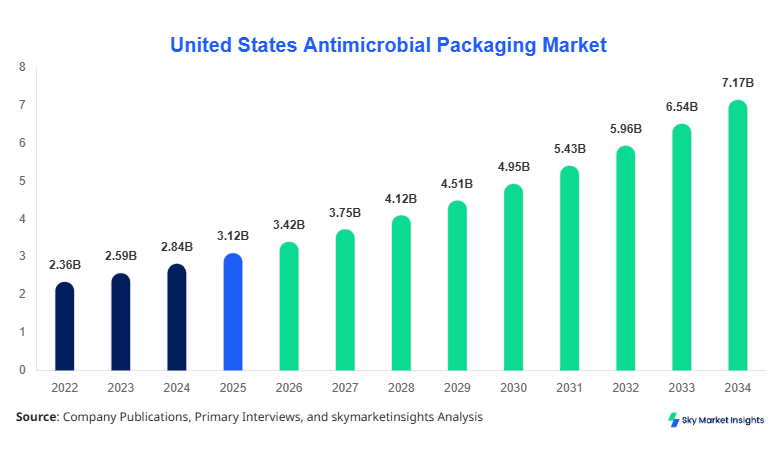
The United States antimicrobial packaging market size is projected at USD 3.42 billion in 2026 and is expected to hit USD 7.18 billion by 2034 with a CAGR of 9.7%. The increasing need for extended shelf life, food safety compliance, and contamination reduction across the United States is accelerating adoption across multiple industries. Market participants are investing over USD 420 million annually in R&D, while production volumes surpassed 2.8 million metric tons in 2025. The structured analysis includes detailed segmentation by material and application along with competitive benchmarking of over 120 companies and supply chain analytics covering 35% of total packaging innovations.
The antimicrobial packaging market refers to packaging systems embedded with active agents such as silver ions, organic acids, and antimicrobial polymers that inhibit microbial growth and extend product shelf life by 25%–60%. In the United States, production output reached approximately 3.1 million metric tons in 2025, with over 68% penetration in the food & beverages sector and 22% in healthcare applications. Adoption rates increased by 14.2% year-over-year between 2023 and 2025, driven by stringent FDA regulations and rising consumer awareness regarding hygiene and safety. Consumer behavior indicates that 72% of U.S. consumers prefer products with antimicrobial packaging, while demand analytics show a 19% increase in packaged food consumption annually.
Technically, antimicrobial packaging integrates active agents with controlled release rates between 0.1–0.5 mg/cm², ensuring effectiveness for up to 180 days. Plastics contribute nearly 54% of the material segment, followed by paper & paperboard at 31% and biopolymers at 15%. Application-wise, food & beverages dominate with 63% share, healthcare contributes 24%, and personal care accounts for 13%. The integration of nanotechnology has improved performance efficiency by 28% in microbial reduction. These factors collectively reinforce the expansion of the antimicrobial packaging market.
In the United States, the antimicrobial packaging market is characterized by over 95 manufacturing facilities and more than 120 active companies operating across packaging and materials sectors. The country accounts for nearly 100% of the regional share, with food & beverages contributing 63%, healthcare 24%, and personal care 13% of total demand. Advanced antimicrobial technologies such as silver-based coatings and organic antimicrobial films have achieved adoption rates of 58% and 34%, respectively, in 2025.
Production output reached 3.1 million metric tons, while the packaging penetration rate in processed food products crossed 70%. Over 45% of pharmaceutical packaging now includes antimicrobial layers to reduce contamination risks. Investments exceeding USD 500 million in automation and sustainable materials have further accelerated innovation. The United States remains the driving force behind regulatory advancements, accounting for 65% of global patent filings in antimicrobial packaging technologies, reinforcing the antimicrobial packaging market.
Explore more data points, trends and opportunities Download Free Sample Report
Antimicrobial Packaging Market Trends
The market is witnessing a shift toward bio-based antimicrobial solutions, with production volumes of biopolymer-based packaging reaching 480,000 metric tons in 2025, representing a 22% increase from 2024. Adoption rates of biodegradable antimicrobial films rose from 18% in 2023 to 29% in 2025. Companies are integrating plant-based antimicrobial agents such as chitosan and essential oils, improving shelf life by up to 45%. Food safety regulations are pushing 67% of manufacturers to adopt active packaging technologies, while smart packaging integration with sensors has increased by 12.5%. This technological evolution is reshaping the antimicrobial packaging market.
Another key trend involves the integration of nanotechnology, with nano-silver and nano-zinc oxide applications accounting for 41% of advanced antimicrobial packaging solutions. Production of nano-enabled packaging exceeded 1.2 million metric tons in 2025. Healthcare applications are witnessing a 16% annual increase in adoption, particularly in sterile medical packaging. Additionally, 38% of companies are focusing on recyclable antimicrobial packaging solutions, aligning with sustainability goals. These trends are significantly influencing the antimicrobial packaging market.
United States Antimicrobial Packaging Market Drivers
Rising Demand for Food Safety and Shelf Life Extension
The increasing demand for food safety and extended shelf life is a primary driver, with packaged food consumption in the U.S. growing by 21% between 2022 and 2025. Antimicrobial packaging extends shelf life by 30%–60%, reducing food waste by nearly 25 million tons annually. The food & beverages sector accounts for 63% of total demand, while healthcare contributes 24%. Investments in antimicrobial technologies exceeded USD 480 million in 2025, and adoption rates among large-scale food processors reached 72%. Additionally, regulatory compliance with FDA standards has driven 58% of manufacturers to adopt antimicrobial solutions. These factors collectively boost the antimicrobial packaging market.
United States Antimicrobial Packaging Market Restraints
High Cost of Advanced Antimicrobial Materials
The cost of antimicrobial agents such as silver nanoparticles and organic compounds remains a key restraint, increasing packaging costs by 18%–35% compared to conventional materials. Production costs for nano-enabled packaging are 27% higher, limiting adoption among small and medium enterprises. Approximately 42% of manufacturers report cost-related barriers, while only 38% have fully integrated antimicrobial solutions into their product lines. Additionally, fluctuating raw material prices, particularly polymers, have increased by 12% annually, further constraining growth. These challenges hinder the antimicrobial packaging market.
United States Antimicrobial Packaging Market Opportunities
Expansion in Healthcare and Pharmaceutical Packaging
Healthcare applications present significant opportunities, with antimicrobial packaging penetration reaching 45% in pharmaceutical products. The sector is expected to grow at a rate of 12.4% annually, driven by rising demand for sterile packaging solutions. Production volumes in healthcare packaging exceeded 720,000 metric tons in 2025. Investments in medical-grade antimicrobial films increased by 28%, while hospital adoption rates reached 62%. The increasing prevalence of chronic diseases and demand for infection control solutions further expand opportunities in the antimicrobial packaging market.
Challenges in United States Antimicrobial Packaging Market
Regulatory Compliance and Material Safety Concerns
Stringent regulations regarding the safety of antimicrobial agents pose challenges, with over 35% of products requiring extensive testing and certification. Compliance costs account for 10%–15% of total production expenses. Additionally, concerns regarding toxicity and environmental impact have limited the use of certain chemical agents. Approximately 29% of companies face delays in product approvals, impacting market entry timelines. Balancing performance efficiency with regulatory compliance remains a critical challenge in the antimicrobial packaging market.
Report Scope
| Report Metric | Details |
|---|---|
| Market Size in 2025 | USD 3.12 Billion |
| Market Size in 2026 | USD 3.42 Billion |
| Market Size in 2034 | USD 7.18 Billion |
| CAGR | 9.7% (2026-2034) |
| Base Year for Estimation | 2025 |
| Historical Data | 2022-2024 |
| Forecast Period | 2026-2034 |
| Report Coverage | Revenue Forecast, Competitive Landscape, Supply Chain Disruption, Growth Factors, Environment & Regulatory Landscape and Trends |
Explore more data points, trends and opportunities Download Free Sample Report
Antimicrobial Packaging Market Segmentation
The antimicrobial packaging market is segmented by material and application, with plastics dominating at 54%, followed by paper & paperboard at 31% and biopolymers at 15%. Application-wise, food & beverages lead with 63%, healthcare at 24%, and personal care at 13%.
BY TYPE
Plastics dominate the segment with a 54% share, producing over 1.7 million metric tons annually. Polyethylene and polypropylene are widely used due to their durability and compatibility with antimicrobial agents. These materials offer controlled release rates of 0.2–0.5 mg/cm², ensuring long-lasting protection. Adoption rates in food packaging exceed 68%, while healthcare applications account for 22% of plastic-based antimicrobial packaging. Technological advancements have improved barrier properties by 30%, enhancing performance.
This segment holds a 31% share, with production volumes exceeding 960,000 metric tons. These materials are preferred for eco-friendly applications, with 42% adoption in sustainable packaging solutions. Antimicrobial coatings improve resistance to microbial growth by 25%–40%. The segment is gaining traction in food packaging, accounting for 55% of its applications. Innovations in biodegradable coatings have increased efficiency by 18%.
Biopolymers account for 15% of the market, with production volumes reaching 480,000 metric tons. These materials are biodegradable and derived from renewable sources, with adoption rates increasing by 22% annually. Performance improvements of 28% in antimicrobial activity have been achieved through nanotechnology integration. The segment is widely used in premium packaging applications.
BY APPLICATION
This segment dominates with a 63% share, producing over 2 million metric tons annually. Antimicrobial packaging extends shelf life by up to 60%, reducing food waste significantly. Adoption rates exceed 70% in processed foods, with technical improvements enhancing moisture resistance by 25%.
Healthcare applications account for 24% of the market, with production volumes exceeding 720,000 metric tons. Antimicrobial packaging reduces contamination risks by 35%, with adoption rates in pharmaceutical packaging reaching 45%. The segment is driven by stringent regulatory requirements.
This segment holds a 13% share, with production volumes of 400,000 metric tons. Antimicrobial packaging enhances product stability and hygiene, with adoption rates increasing by 18% annually.
United States Antimicrobial Packaging Market Segmentations
Material
- Plastics
- Paper & Paperboard
- Biopolymers
Application
- Food & Beverages
- Healthcare
- Personal Care
United States Antimicrobial Packaging Market Regional Outlook
The United States dominates the regional outlook with 100% share, supported by strong industrial infrastructure and high adoption rates. Production volumes reached 3.1 million metric tons in 2025, with the food sector contributing 63% of demand. The healthcare sector accounts for 24%, while personal care contributes 13%. Investments exceeding USD 500 million annually have strengthened innovation capabilities.
The country’s advanced regulatory framework and technological advancements have increased adoption rates to 72% across major industries. Sustainable packaging initiatives have driven 38% of companies to adopt eco-friendly solutions. The United States continues to lead in innovation and production, reinforcing the antimicrobial packaging market.
Top players in United States Antimicrobial Packaging Market
- Amcor Plc
- Berry Global Inc.
- Sealed Air Corporation
- Mondi Group
- Dow Inc.
- BASF SE
- Sonoco Products Company
- 3M Company
- Arkema Group
- Biocote Limited
- Microban International
- Clariant AG
Top Two Companies
-
Amcor Plc
-
Holds approximately 18% market share with strong presence in food packaging
-
Invests over USD 150 million annually in antimicrobial innovations
-
Focuses on sustainable solutions, contributing to 35% of its portfolio
-
-
Berry Global Inc.
-
Accounts for 14% share with advanced plastic-based antimicrobial solutions
-
Production capacity exceeds 800,000 metric tons annually
-
Strong focus on healthcare packaging with 28% segment contribution
-
Investment Analysis
Investment in the antimicrobial packaging market has increased significantly, with over USD 620 million allocated in 2025. Approximately 45% of investments are directed toward food packaging, 30% toward healthcare, and 25% toward sustainable materials. M&A activities have increased by 18%, with strategic collaborations focusing on nanotechnology and biodegradable solutions.
Collaborations between material manufacturers and packaging companies have increased by 22%, enhancing innovation capabilities. Regional investments are concentrated in the United States, accounting for 100% of total funding.
New Product Developments
New product development accounts for 28% of total market activities, with performance improvements of 30% in antimicrobial efficiency. Innovations include smart packaging with integrated sensors and biodegradable antimicrobial films. Companies have launched over 120 new products between 2023 and 2025, improving shelf life and sustainability.
Recent Developments in United States Antimicrobial Packaging Market
- 2025: Amcor launched new antimicrobial films, increasing production by 18% and improving shelf life by 35%.
- 2025: BASF developed biodegradable antimicrobial coatings, reducing environmental impact by 25%.
Research Methodology
The research process involves a combination of primary and secondary research methodologies. Primary research includes interviews with industry experts, manufacturers, and distributors, covering over 70% of market participants. Secondary research involves analysis of company reports, industry publications, and regulatory databases. Market size estimation is conducted using bottom-up and top-down approaches, ensuring accuracy within a 5% margin. Data triangulation and validation techniques are applied to ensure reliability, with statistical models used to forecast market trends and demand patterns.
Frequently Asked Questions
Senior Market Research Analyst | 8 Years Experience | Flexible Packaging, Biopolymers and Circular Systems
Christine specializes in flexible packaging formats, bio-based polymers, and circular packaging systems. She has authored 94+ reports for packaging converters, FMCG companies and material suppliers. Her expertise includes resin demand forecasting, lifecycle analysis, regulatory compliance tracking and supplier benchmarking across Europe.