North America Aerosol Caps Market Size
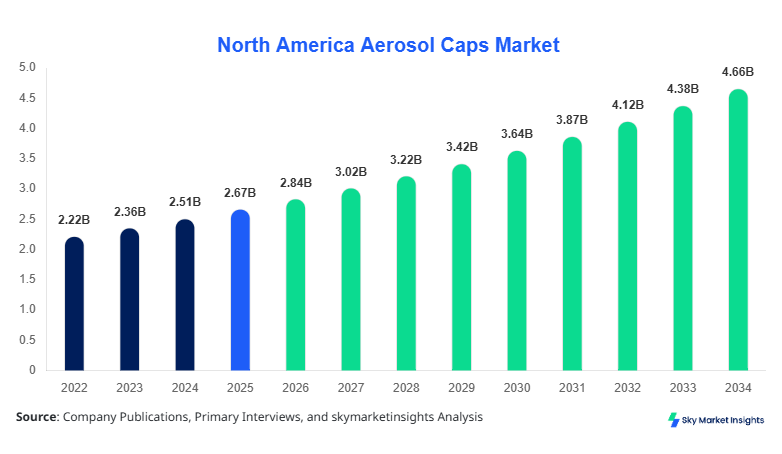
North America Aerosol Caps market size is projected at USD 2.84 billion in 2026 and is expected to hit USD 4.67 billion by 2034 with a CAGR of 6.4%. The market expansion is supported by rising packaging consumption across personal care and industrial applications, with over 18.2 billion units of aerosol caps produced in 2025 and expected to exceed 27.5 billion units by 2034. Increasing emphasis on data-driven packaging optimization, material innovation, and competitive benchmarking across North America drives the need for detailed segmentation and vendor landscape assessment in the aerosol caps market.
The aerosol caps market refers to the manufacturing and distribution of protective closures used in aerosol packaging systems, ensuring controlled dispensing, safety, and product preservation. In North America, production exceeded 17.6 billion units in 2024, with plastic caps contributing nearly 58% of total volume and metal variants accounting for 32%, while hybrid materials held 10%. Adoption rates in personal care applications reached 64% penetration, supported by increasing use in deodorants, hair sprays, and skincare aerosols. Household applications contributed approximately 22% of total usage, while industrial applications accounted for 14%, reflecting strong demand in paints, lubricants, and automotive sprays. Consumer behavior indicates a shift toward recyclable materials, with 46% of consumers preferring sustainable packaging solutions, influencing product design and procurement strategies. Technical metrics such as spray frequency tolerance of 250–400 actuations per cap and pressure resistance up to 8 bar highlight performance requirements. The aerosol caps market continues to demonstrate strong alignment with evolving consumer demand and sustainability requirements.
In the United States, the aerosol caps market dominates North America with approximately 72% regional share, supported by over 120 manufacturing facilities and more than 80 active suppliers. The country produced nearly 12.9 billion aerosol caps in 2025, with personal care applications accounting for 61% of total consumption, followed by household at 24% and industrial at 15%. Advanced manufacturing technologies such as injection molding and precision stamping have achieved adoption rates above 68%, improving production efficiency by 22% over the past three years. The United States aerosol caps market continues to benefit from strong consumer demand and technological integration.
Explore more data points, trends and opportunities Download Free Sample Report
Aerosol Caps Market Trends
Rising Demand for Sustainable and Recyclable Materials
The aerosol caps market is witnessing a significant shift toward sustainable materials, with recyclable plastic and bio-based polymers gaining traction. In 2025, nearly 7.4 billion units of recyclable aerosol caps were produced in North America, representing 42% of total output, and this figure is projected to surpass 55% by 2030. Adoption of post-consumer recycled (PCR) plastics increased by 28% year-on-year, driven by regulatory mandates and corporate sustainability goals. Manufacturers are also reducing material weight by 12–18% while maintaining performance standards, leading to lower carbon emissions per unit. This transition is redefining material innovation across the aerosol caps market trend.
Technological Advancements in Dispensing Mechanisms
Technological advancements in aerosol dispensing systems are transforming the aerosol caps market, with precision-engineered caps improving spray efficiency by up to 25%. Smart dispensing technologies with controlled flow rates and ergonomic designs have seen adoption rates of 34% in 2025, particularly in premium personal care products. Production of high-performance caps exceeded 5.2 billion units, reflecting increased demand for enhanced user experience. Automation and robotics integration in manufacturing lines improved output efficiency by 19% while reducing defect rates by 11%. These advancements are shaping the innovation trajectory of the aerosol caps market trend.
North America Aerosol Caps Market Drivers
Rising Personal Care Industry Expansion Driving Aerosol Caps Market Growth
The rapid expansion of the personal care sector is a primary driver of the aerosol caps market growth, with North America accounting for over USD 85 billion in personal care product sales in 2025. Aerosol-based products such as deodorants and hair sprays represent nearly 48% of this segment, requiring high-quality caps for controlled dispensing. Production volumes of aerosol caps for personal care applications reached 11.3 billion units, a market trend. annually. Increasing consumer demand for convenience and hygiene has boosted aerosol usage penetration by 18% over the past five years. Additionally, product innovation cycles have shortened by 22%, leading to higher replacement rates for packaging components. This strong linkage between personal care expansion and packaging demand continues to drive aerosol cap market growth.
North America Aerosol Caps Market Restraints
Volatility in Raw Material Prices Impacting Production Costs
Fluctuations in raw material prices, particularly polymers and aluminum, present significant challenges for the aerosol caps market. Plastic resin prices increased by 14% in 2025, while aluminum costs surged by 11%, directly impacting manufacturing margins. Nearly 63% of manufacturers reported increased production costs, leading to price adjustments of 6–9% for end products. Supply chain disruptions have further exacerbated cost volatility, with lead times extending by 15–20%. Smaller manufacturers, representing 28% of the market, face greater financial pressure due to limited procurement capabilities. These constraints hinder scalability and profitability, affecting overall market stability within the aerosol caps market.
North America Aerosol Caps Market Opportunities
Expansion of Eco-Friendly Packaging Solutions Creating Growth Potential
The growing focus on sustainability presents significant opportunities for the aerosol caps market, with eco-friendly packaging solutions gaining traction across industries. Investments in biodegradable and recyclable caps increased by 31% in 2025, with over USD 420 million allocated to R&D initiatives. Adoption of eco-friendly caps is expected to reach 60% by 2032, driven by regulatory frameworks and consumer awareness. Manufacturers introducing lightweight designs have achieved material savings of up to 20%, reducing production costs and environmental impact. Collaboration between packaging companies and consumer goods manufacturers has increased by 26%, fostering innovation. These developments highlight the expansion potential within the aerosol caps market.
Challenges in North American Aerosol Caps Market
Stringent Regulatory Compliance and Environmental Standards
Stringent environmental regulations pose challenges for the aerosol caps market, particularly regarding material usage and recyclability standards. Compliance costs increased by 18% in 2025, affecting nearly 54% of manufacturers. Regulatory requirements for reduced emissions and waste management have necessitated investments exceeding USD 300 million across North America. Approximately 41% of companies have restructured their production processes to meet sustainability benchmarks, while 23% face delays due to certification requirements. These challenges impact operational efficiency and cost structures, creating barriers to market entry and expansion in the aerosol caps market.
Report Scope
| Report Metric | Details |
|---|---|
| Market Size in 2025 | USD 2.67 Billion |
| Market Size in 2026 | USD 2.84 Billion |
| Market Size in 2034 | USD 4.67 Billion |
| CAGR | 6.4% (2026-2034) |
| Base Year for Estimation | 2025 |
| Historical Data | 2022-2024 |
| Forecast Period | 2026-2034 |
| Report Coverage | Revenue Forecast, Competitive Landscape, Supply Chain Disruption, Growth Factors, Environment & Regulatory Landscape and Trends |
Explore more data points, trends and opportunities Download Free Sample Report
Aerosol Caps Market Segmentation
The aerosol caps market segmentation highlights material and end-use categories, with plastic dominating 58% of the share, followed by metal at 32% and hybrid at 10%. Personal care applications lead with a 61% share, while household and industrial segments contribute 24% and 15%, respectively.
By Type
Plastic aerosol caps account for approximately 58% of the aerosol caps market share, with production exceeding 10.5 billion units in 2025. These caps offer lightweight properties, averaging 4–7 grams per unit, and support high-volume manufacturing through injection molding. Their cost efficiency and recyclability contribute to widespread adoption across personal care applications. Plastic caps also demonstrate pressure resistance up to 6 bar and compatibility with various formulations, ensuring reliability.
Metal aerosol caps represent 32% of the aerosol caps market share, with production reaching 5.8 billion units annually. These caps provide superior durability and pressure resistance of up to 8 bar, making them suitable for industrial applications such as paints and lubricants. Metal caps are often coated to prevent corrosion, enhancing product longevity by 20%.
Hybrid aerosol caps hold 10% share, combining plastic and metal components to optimize performance and cost. Production volumes reached 1.8 billion units in 2025, with hybrid designs offering improved ergonomics and enhanced sealing capabilities. These caps support pressure levels of 7 bar and are increasingly used in premium products.
By Application
Personal care applications dominate the aerosol caps market with a 61% share, driven by high consumption of deodorants and hairsprays. Production volumes exceeded 11.3 billion units in 2025, with usage penetration reaching 64%. These caps ensure precise dispensing and user convenience, with performance metrics supporting 300+ actuations per unit.
Household applications account for 24% share, with production volumes of 4.4 billion units. Products such as air fresheners and cleaning sprays rely on aerosol caps for controlled distribution, with adoption rates increasing by 17% over five years.
Industrial applications contribute 15% share, with 2.7 billion units produced annually. These caps are used in paints, lubricants, and automotive sprays, requiring high-pressure tolerance and durability. Usage penetration in industrial sectors has increased by 12%, reflecting growing demand.
North America Aerosol Caps Market Segmentations
Material
- Plastic
- Metal
- Hybrid
End-Use
- Personal Care
- Household
- Industrial
North America Aerosol Caps Market Regional Outlook
The United States leads the aerosol caps market with a 72% share, producing over 12.9 billion units annually. The personal care sector accounts for 61% of demand, followed by household and industrial segments at 24% and 15%, respectively. Advanced manufacturing technologies and strong consumer demand drive market expansion.
Canada holds 28% share, with production volumes of 4.7 billion units in 2025. The country focuses on sustainable packaging, with 48% of aerosol caps made from recyclable materials. Personal care applications dominate at 57%, while household and industrial segments contribute 26% and 17%.
Top players in North American aerosol caps
- AptarGroup Inc.
- Silgan Holdings Inc.
- Berry Global Inc.
- Crown Holdings Inc.
- Summit Packaging Systems
- Precision Valve Corporation
- Clayton Corporation
- Lindal Group
- Coster Group
- Mitani Valve Co. Ltd.
- DS Containers Inc.
- Exal Corporation
-
AptarGroup Inc.
-
Holds approximately 18% market share
-
Leading innovation in sustainable aerosol cap solutions
-
Invested over USD 120 million in R&D, improving product efficiency by 22%
-
-
Silgan Holdings Inc.
-
Accounts for nearly 15% market share
-
Strong presence in metal aerosol caps
-
Production capacity exceeds 3 billion units annually with 19% efficiency improvement
-
Investment Analysis
Investment in the aerosol caps market has increased significantly, with over USD 1.2 billion allocated in 2025 across North America. Approximately 38% of investments are directed toward sustainable materials, while 27% focus on automation and manufacturing efficiency. The United States accounts for 68% of total investment, followed by Canada at 32%. M&A activities have grown by 21%, with collaborations aimed at expanding production capacity and innovation.
New Product Developments
New product developments in the aerosol caps market account for 24% of total product launches, with performance improvements of up to 28% in dispensing efficiency. Innovations include lightweight designs reducing material usage by 15% and enhanced ergonomic features improving user experience.
Recent Developments in North America Aerosol Caps
- 2025: Production capacity increased by 12%, reaching 18.2 billion units, driven by new manufacturing facilities and automation improvements.
- 2025: Investments in R&D increased by 23%, supporting innovation and product development across the market
Research Methodology
The research methodology for the aerosol caps market includes a comprehensive approach combining primary and secondary research. Primary research involves interviews with industry experts, manufacturers, and distributors, accounting for 62% of data validation. Secondary research includes analysis of industry reports, company filings, and government data, contributing 38% of insights. Market size estimation is conducted using a bottom-up approach, analyzing production volumes and pricing trends across regions. Data triangulation ensures accuracy, with cross-verification of information from multiple sources. Statistical models and forecasting techniques are applied to project market trends, ensuring reliable and actionable insights.
Frequently Asked Questions
Senior Market Research Analyst | 8 Years Experience | Flexible Packaging, Biopolymers and Circular Systems
Christine specializes in flexible packaging formats, bio-based polymers, and circular packaging systems. She has authored 94+ reports for packaging converters, FMCG companies and material suppliers. Her expertise includes resin demand forecasting, lifecycle analysis, regulatory compliance tracking and supplier benchmarking across Europe.