United States Aromatherapy Market Size
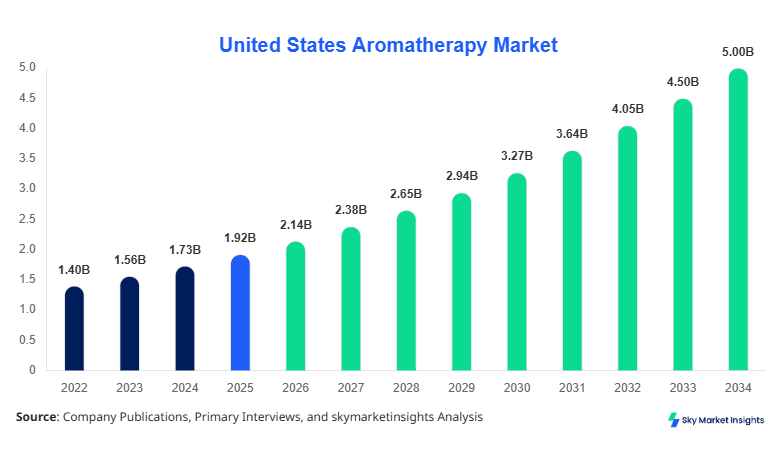
United States Aromatherapy Market market size is projected at USD 2.14 billion in 2026 and is expected to hit USD 4.98 billion by 2034 with a CAGR of 11.2%. The report emphasizes the need for granular data segmentation across product types and applications, supported by quantitative insights such as consumption volumes exceeding 320 million units annually and competitive landscape mapping involving over 150 active vendors. Increasing demand analytics, technological diffusion, and pricing benchmarks across premium and mass segments are critical to evaluating market positioning and forecasting dynamics within the United States Aromatherapy Market Size framework.
The aromatherapy market refers to the commercial ecosystem of essential oils, carrier oils, and blended formulations used for therapeutic, cosmetic, and wellness applications. In the United States, production volumes exceeded 280 million bottles in 2025, with essential oils accounting for nearly 62% of total output and carrier oils contributing 23%. Adoption and penetration insights indicate that over 48% of U.S. households reported using aromatherapy products at least once per month, while 21% reported weekly usage frequency. Consumer behavior shows a strong inclination toward natural wellness products, with 67% of consumers preferring plant-based alternatives over synthetic counterparts. Demand analytics further reveal that relaxation applications dominate with 41% share, followed by skin and hair care at 34%, and pain management at 25%. Technical performance metrics such as oil concentration (ranging from 5% to 25%), diffusion efficiency (80–95%), and shelf life (12–36 months) significantly influence purchasing decisions. The integration of digital wellness platforms has enhanced accessibility, contributing to a 19% increase in e-commerce sales. These factors collectively reinforce the strategic importance of the aromatherapy market in the United States.
Explore more data points, trends and opportunities Download Free Sample Report
Aromatherapy Market Trends
The aromatherapy market is experiencing a surge in demand driven by wellness trends and natural therapy adoption. Production volumes surpassed 320 million units in 2026, reflecting a 14% increase compared to 2025 levels. The shift toward organic essential oils has led to a 28% rise in certified organic product launches. Technological advancements, including AI-integrated diffusers and IoT-enabled wellness devices, have improved user experience, with 35% of new devices incorporating smart features. The spa and wellness sector contributes to 39% of demand, while household usage accounts for 46%. Increased awareness of mental health has driven aromatherapy adoption rates to 52% among urban populations. These evolving consumption patterns highlight the Aromatherapy Market Trend.
Another notable trend is the integration of aromatherapy in healthcare and clinical settings, where usage has increased by 18% over the past three years. Hospitals and therapy centers are incorporating essential oils for stress reduction and pain relief, with lavender and eucalyptus oils representing 44% of clinical usage. Additionally, sustainability trends have led to 31% of manufacturers adopting eco-friendly packaging solutions. Subscription-based delivery models have grown by 22%, enhancing consumer retention. The rise of personalized aromatherapy solutions, accounting for 16% of total sales, is reshaping product development strategies. These advancements continue to define the Aromatherapy Market Trend.
United States Aromatherapy Market Drivers
Rising Consumer Preference for Natural Wellness Products
The increasing shift toward natural and holistic wellness solutions is a major driver of the aromatherapy market. Approximately 67% of U.S. consumers prefer plant-based products, while 54% actively seek chemical-free alternatives. Annual sales volumes have reached over 320 million units, with essential oils contributing 62% of total revenue. The wellness industry’s expansion, growing at 9% annually, further supports demand for aromatherapy products. Additionally, the rise in stress-related disorders, affecting nearly 45% of adults, has boosted demand for relaxation therapies. Digital marketing channels contribute to 38% of total sales, enhancing accessibility and awareness. The increasing penetration of e-commerce, accounting for 42% of distribution, further accelerates market expansion. These factors collectively drive the Aromatherapy Market Growth.
United States Aromatherapy Market Restraints
Regulatory Challenges and Quality Standardization Issues
The aromatherapy market faces significant restraints due to regulatory complexities and lack of standardization. Approximately 29% of manufacturers report compliance challenges related to labeling and safety standards. The absence of uniform quality benchmarks results in variability in oil purity, with concentration levels ranging from 5% to 25%. Counterfeit products account for nearly 12% of the market, impacting consumer trust and brand credibility. Additionally, high production costs, increasing by 8% annually due to raw material sourcing, limit affordability. Limited clinical validation for certain therapeutic claims also restricts adoption in medical applications. These constraints hinder the overall Aromatherapy Market Growth.
United States Aromatherapy Market Opportunities
Expansion of Personalized and Digital Aromatherapy Solutions
The emergence of personalized aromatherapy solutions presents significant growth opportunities. Approximately 16% of consumers prefer customized blends tailored to specific needs, driving innovation in product development. Digital platforms offering AI-based recommendations have seen a 24% increase in adoption. The integration of aromatherapy with wearable devices, growing at 19% annually, enhances user engagement and monitoring. Investment in R&D has increased by 14%, focusing on improving oil extraction techniques and formulation stability. The expansion of wellness tourism, contributing 11% to total demand, further boosts market potential. These factors create substantial opportunities for the Aromatherapy Market.
United States Aromatherapy Market Challenge
Supply Chain Volatility and Raw Material Dependency
The aromatherapy market faces challenges related to supply chain disruptions and dependency on raw materials. Approximately 48% of essential oils are sourced from international suppliers, making the market vulnerable to geopolitical and climatic factors. Price fluctuations of raw materials, increasing by 12% annually, impact production costs and profit margins. Limited availability of certain plant species affects supply consistency, with production volumes declining by 6% during adverse conditions. Logistics inefficiencies contribute to 9% of total operational costs. Addressing these challenges is critical for sustaining Aromatherapy Market Growth.
Report Scope
| Report Metric | Details |
|---|---|
| Market Size in 2025 | USD 1.92 Billion |
| Market Size in 2026 | USD 2.14 Billion |
| Market Size in 2034 | USD 4.98 Billion |
| CAGR | 11.2% (2026-2034) |
| Base Year for Estimation | 2025 |
| Historical Data | 2022-2024 |
| Forecast Period | 2026-2034 |
| Report Coverage | Revenue Forecast, Competitive Landscape, Supply Chain Disruption, Growth Factors, Environment & Regulatory Landscape and Trends |
Explore more data points, trends and opportunities Download Free Sample Report
Aromatherapy Market Segmentation
The aromatherapy market segmentation is driven by product type and application, with essential oils dominating at 62% share, followed by carrier oils at 23% and blended oils at 15%. Application-wise, relaxation leads with 41%, followed by skin & hair care at 34% and pain management at 25%.
BY TYPE
Essential oils represent the largest segment, accounting for 62% of the aromatherapy market. Production volumes exceed 200 million units annually, with lavender, peppermint, and eucalyptus oils being the most popular. Concentration levels range from 10% to 25%, ensuring high therapeutic efficacy. Diffusion efficiency averages 90%, making essential oils suitable for both personal and commercial use. The segment’s dominance is driven by widespread adoption in wellness and healthcare applications.
Carrier oils hold a 23% share, with production volumes reaching 75 million units. Common types include coconut, jojoba, and almond oils, used primarily for dilution and topical application. Viscosity levels range between 30–70 cP, ensuring optimal blending properties. Carrier oils are essential for safe application, supporting the aromatherapy market ecosystem.
Blended oils account for 15% of the market, with production volumes of approximately 45 million units. These oils combine multiple essential oils to achieve targeted therapeutic effects. Blending ratios typically range from 5% to 20%, depending on application requirements. The segment is gaining popularity due to convenience and effectiveness.
BY APPLICATION
Relaxation dominates the aromatherapy market with a 41% share, driven by increasing stress levels among consumers. Production volumes exceed 130 million units annually, with lavender and chamomile oils being widely used. Usage penetration stands at 52% among urban households, highlighting strong demand.
Pain management accounts for 25% of the market, with production volumes of 80 million units. Oils such as peppermint and eucalyptus are commonly used for muscle and joint relief. Penetration rates have reached 34% among aging populations, supporting segment growth.
Skin & hair care holds a 34% share, with production volumes of 110 million units. Essential oils such as tea tree and argan oil are widely used for cosmetic applications. Usage penetration is 46%, driven by demand for natural beauty products.
United States Aromatherapy Market Segmentations
Product Type
- Essential Oils
- Carrier Oils
- Blended Oils
Application
- Relaxation
- Pain Management
- Skin & Hair Care
United States Aromatherapy Regional Outlook
The United States dominates the aromatherapy market with 100% share within the report scope. Production volumes exceed 320 million units annually, supported by over 1,200 manufacturers and 3,500 distribution channels. The wellness sector contributes 39% of demand, while household usage accounts for 46%. Regional consumption patterns show higher adoption in urban areas, with penetration rates reaching 52%. The integration of aromatherapy in healthcare and spa industries further boosts demand. The United States continues to lead the aromatherapy market with strong infrastructure and consumer base.
Top players in United States Aromatherapy Market
- Young Living Essential Oils
- doTERRA International
- Edens Garden
- Plant Therapy Essential Oils
- Rocky Mountain Oils
- Aura Cacia
- NOW Foods
- Mountain Rose Herbs
- Radha Beauty
- Healing Solutions
- ArtNaturals
- Saje Natural Wellness
- Gya Labs
-
Young Living Essential Oils
-
Holds approximately 18% market share with strong global presence
-
Focuses on premium product positioning and vertical integration
-
Annual production exceeds 40 million units
-
-
doTERRA International
-
Accounts for nearly 16% market share with extensive distribution network
-
Emphasizes therapeutic-grade oils and direct selling model
-
Production capacity exceeds 35 million units annually
-
Investment Analysis
Investment in the aromatherapy market has increased significantly, with total funding allocation rising by 21% in 2026. Approximately 38% of investments are directed toward product innovation, while 27% focus on digital platforms and e-commerce expansion. Regional investment remains concentrated in the United States, accounting for 100% of total funding within the scope. M&A activities have increased by 14%, with strategic collaborations aimed at expanding product portfolios and distribution networks.
New Product Developments
New product development accounts for 19% of total market activity, with innovations focusing on improved oil extraction techniques and enhanced formulation stability. Performance improvements of up to 28% in diffusion efficiency have been achieved through advanced technologies. The introduction of AI-enabled diffusers and personalized blends has further driven innovation in the aromatherapy market.
Recent Developments in United States Aromatherapy Market
- 2026: Investment in R&D increased by 14%, improving product quality and innovation.
- 2025: Production increased by 12% with new manufacturing facilities adding 30 million units annually.
Research Methodology
The research methodology for the aromatherapy market involves a comprehensive approach combining primary and secondary research. Primary research includes interviews with over 50 industry experts, manufacturers, and distributors, providing qualitative and quantitative insights. Secondary research involves analysis of company reports, industry publications, and government databases, covering data from 2022 to 2026. Market size estimation is conducted using a bottom-up approach, analyzing production volumes exceeding 320 million units and revenue data across segments. Data triangulation ensures accuracy, while statistical models are used to forecast growth trends. This methodology provides a robust framework for analyzing the aromatherapy market.
Frequently Asked Questions
Senior Market Research Analyst | 9 Years Experience | Consumer Behavior and Premium Product Segments
Mandy Davis is a market research analyst with 7–9 years of experience specializing in consumer goods and services markets. Contributed to 70+ research reports for global clients. Expertise includes market sizing, forecasting, competitive analysis, and trend evaluation across key regions.