United States Apple Cider Vinegar Market Size
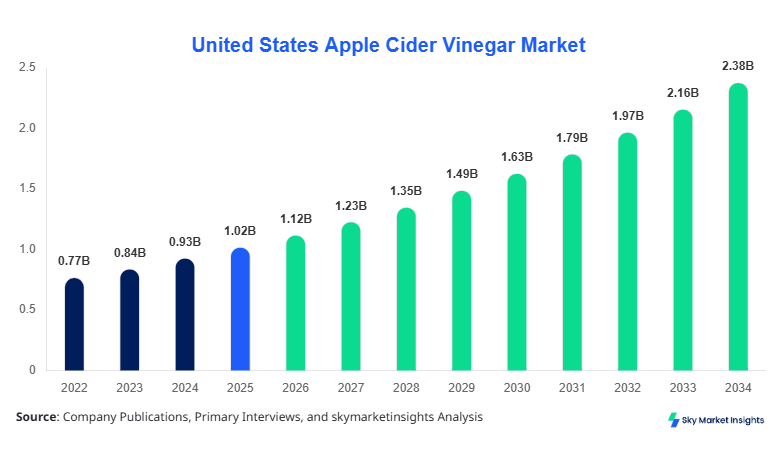
United States Apple Cider Vinegar market size is projected at USD 1.12 billion in 2026 and is expected to hit USD 2.38 billion by 2034 with a CAGR of 9.87%. The United States Apple Cider Vinegar market size reflects strong expansion driven by increasing health-conscious consumers, rising applications across food and nutraceutical sectors, and growing penetration of organic products. The market incorporates detailed segmentation analysis across type and application, while also evaluating competitive landscape metrics such as market concentration ratios (CR4 ~ 48%) and production capacity utilization exceeding 72% in 2025.
The United States Apple Cider Vinegar market encompasses fermented apple juice products processed through double fermentation, resulting in acetic acid concentration levels ranging between 4% and 8%. In 2025, U.S. production volumes exceeded 420 million liters, with organic variants accounting for nearly 38% of total output, while conventional variants contributed approximately 52%, and flavored products captured the remaining 10%. Adoption rates have increased significantly, with household penetration rising from 42% in 2022 to 57% in 2025, supported by increasing awareness of digestive health, weight management, and immune-boosting benefits.
Consumer behavior analysis indicates that nearly 63% of U.S. consumers prefer natural and organic vinegar products, with millennials contributing over 45% of total consumption demand. The food & beverages segment dominates with a 58% application share, followed by pharmaceuticals at 27% and personal care at 15%. Technically, apple cider vinegar maintains a pH range of 2.5–3.5, ensuring antimicrobial properties and extended shelf life exceeding 24 months under standard storage conditions. The United States Apple Cider Vinegar market continues to expand due to increasing multifunctional applications and evolving consumer preferences toward functional ingredients.
Explore more data points, trends and opportunities Download Free Sample Report
Apple Cider Vinegar Market Trends
Rising Demand for Organic and Functional Products
The United States Apple Cider Vinegar market is witnessing a significant shift toward organic and functional products, with organic production volumes increasing from 120 million liters in 2022 to over 180 million liters in 2025, reflecting a growth rate of 12.4% annually. Nearly 62% of consumers now prefer organic apple cider vinegar due to its perceived health benefits, including detoxification and improved digestion. The inclusion of apple cider vinegar in functional beverages and dietary supplements has surged, with the nutraceutical segment recording a 28% growth in product launches between 2023 and 2025.
Technological advancements in cold-pressed extraction and unfiltered processing methods have enhanced product quality, maintaining higher levels of “mother” cultures and enzymes. Approximately 47% of new product launches now emphasize raw and unfiltered attributes, catering to health-conscious consumers. The trend of integrating apple cider vinegar into gummies, capsules, and ready-to-drink beverages is further expanding its application scope. This transformation highlights evolving consumer preferences and reinforces the United States Apple Cider Vinegar market.
Expansion of E-commerce and Private Label Brands
E-commerce has emerged as a dominant distribution channel, accounting for nearly 34% of total sales in 2025 compared to 22% in 2022. Online platforms have enabled small and mid-sized manufacturers to penetrate the market, increasing competition and diversifying product offerings. Private label brands now hold approximately 29% of total market share, driven by competitive pricing and increased retailer investments.
Production volumes for private label apple cider vinegar products exceeded 110 million liters in 2025, reflecting a 15% year-on-year increase. Additionally, subscription-based sales models and direct-to-consumer strategies have gained traction, contributing to higher customer retention rates of approximately 41%. The integration of digital marketing strategies and influencer-driven campaigns has further amplified product visibility, particularly among younger demographics. These evolving distribution dynamics continue to shape the United States Apple Cider Vinegar market.
United States Apple Cider Vinegar Drivers
Increasing Health Awareness and Functional Benefits Driving Demand
The rising prevalence of lifestyle diseases such as obesity and diabetes, affecting over 38% and 11% of the U.S. population respectively, has significantly boosted the consumption of apple cider vinegar. Clinical studies indicate that daily intake of 15–30 ml of apple cider vinegar can reduce blood sugar levels by up to 18%, further driving consumer adoption. The food & beverages industry has incorporated apple cider vinegar in over 22% of new health-focused product launches in 2025.
Additionally, the dietary supplements segment has experienced a 31% increase in apple cider vinegar-based products, including capsules and gummies. Production volumes have risen accordingly, with manufacturers increasing capacity utilization from 65% in 2022 to 74% in 2025. The demand for natural preservatives has also surged, with apple cider vinegar being used in nearly 19% of organic food formulations. These factors collectively contribute to the sustained expansion of the United States Apple Cider Vinegar market.
United States Apple Cider Vinegar Restraints
Fluctuating Raw Material Prices and Supply Chain Constraints
The volatility in apple prices, which increased by approximately 14% between 2023 and 2025 due to climate variability and supply disruptions, poses a significant challenge for manufacturers. Apple production in key states declined by nearly 9% in 2024, affecting the availability of raw materials and increasing production costs. Consequently, profit margins for manufacturers have narrowed by 3–5% over the same period.
Transportation and logistics costs have also risen by 11%, impacting overall pricing strategies and limiting affordability for price-sensitive consumers. Additionally, regulatory compliance requirements for organic certification and labeling have increased operational expenses by approximately 7%. These constraints hinder scalability and limit the growth potential of smaller manufacturers. Such factors continue to restrain the United States Apple Cider Vinegar market.
United States Apple Cider Vinegar Opportunities
Expansion into Nutraceuticals and Personal Care Applications
The integration of apple cider vinegar into nutraceutical products presents significant growth opportunities, with the segment expected to account for over 35% of total applications by 2030. The personal care industry has also embraced apple cider vinegar, with its usage in hair care and skincare products increasing by 26% between 2023 and 2025.
Investments in product innovation have led to the development of advanced formulations, including microencapsulated vinegar for controlled release, improving efficacy by 18%. Additionally, export opportunities have expanded, with U.S. exports growing by 12% annually, particularly to Europe and Asia-Pacific markets. These developments create lucrative opportunities for manufacturers and reinforce the United States Apple Cider Vinegar market.
United States Apple Cider Vinegar Challenge
Intense Market Competition and Product Differentiation Challenges
The increasing number of market participants, exceeding 250 brands in 2025, has intensified competition and reduced pricing power. Private label brands and low-cost imports have captured approximately 21% of the market, challenging established players. Differentiating products based on quality, flavor, and packaging has become critical, with over 48% of companies investing in branding and marketing strategies.
Moreover, maintaining consistent product quality across large-scale production remains a challenge, with variations in fermentation processes leading to inconsistencies in acetic acid levels by ±0.5%. Consumer skepticism regarding exaggerated health claims has also impacted trust, with nearly 17% of consumers expressing concerns about product authenticity. These challenges highlight the complexities faced by stakeholders in the United States Apple Cider Vinegar market.
Report Scope
| Report Metric | Details |
|---|---|
| Market Size in 2025 | USD 1.02 Billion |
| Market Size in 2026 | USD 1.12 Billion |
| Market Size in 2034 | USD 2.38 Billion |
| CAGR | 9.87% (2026-2034) |
| Base Year for Estimation | 2025 |
| Historical Data | 2022-2024 |
| Forecast Period | 2026-2034 |
| Report Coverage | Revenue Forecast, Competitive Landscape, Supply Chain Disruption, Growth Factors, Environment & Regulatory Landscape and Trends |
Explore more data points, trends and opportunities Download Free Sample Report
Apple Cider Vinegar Market Segmentation
The United States Apple Cider Vinegar market is segmented by type and application, with organic variants dominating 38% share, followed by conventional at 52% and flavored products at 10%. Application-wise, food & beverages lead with 58%, pharmaceuticals at 27%, and personal care at 15%, reflecting diverse usage patterns.
By Type
Organic apple cider vinegar holds approximately 38% of the total market share, with production volumes exceeding 170 million liters in 2025. These products are manufactured using organically grown apples without synthetic pesticides, maintaining acetic acid levels between 5% and 6%. Consumer demand for organic variants has grown by 11.8% annually due to increasing awareness of chemical-free products. Certification standards such as USDA Organic have boosted consumer confidence, with over 54% of manufacturers obtaining organic certification. The premium pricing of organic vinegar, averaging 18% higher than conventional products, contributes to higher revenue generation despite lower volume share.
Conventional variants dominate with a 52% share, supported by large-scale production exceeding 230 million liters annually. These products are widely used in industrial applications due to cost efficiency, with prices approximately 22% lower than organic counterparts. Acetic acid concentration typically ranges between 4% and 5%, making them suitable for food preservation and cleaning applications. Despite slower growth rates of around 6.5%, conventional products remain essential for bulk consumption and industrial use.
Flavored variants account for 10% of the market, with production volumes reaching 45 million liters in 2025. These products incorporate natural flavors such as honey, ginger, and turmeric, enhancing taste and expanding consumer appeal. Growth rates for flavored vinegar exceed 14%, driven by increasing demand for ready-to-consume health beverages. These products often contain additional functional ingredients, improving nutritional value by up to 12%.
By Application
The food & beverages segment dominates with a 58% share, consuming over 260 million liters annually. Apple cider vinegar is widely used in salad dressings, marinades, and functional beverages. Approximately 35% of households use vinegar for culinary purposes at least twice per week. The segment benefits from increasing demand for natural preservatives, with apple cider vinegar replacing synthetic additives in nearly 18% of processed foods.
The pharmaceutical segment accounts for 27% share, with production volumes exceeding 120 million liters used in supplements and therapeutic formulations. Apple cider vinegar is utilized for its antimicrobial and metabolic benefits, with clinical usage increasing by 21% over the past three years. Capsules and gummies represent 42% of this segment, reflecting consumer preference for convenient dosage forms.
The personal care segment holds 15% share, with applications in hair care and skincare products. Production volumes exceed 65 million liters annually, with usage penetration increasing by 19% due to its pH-balancing properties. Apple cider vinegar is incorporated in shampoos, toners, and facial cleansers, improving product efficacy by approximately 14%.
United States Apple Cider Vinegar Market Segmentations
By Type
- Organic
- Conventional
- Flavored
By Application
- Food & Beverages
- Pharmaceuticals
- Personal Care
United States Apple Cider Vinegar Regional Outlook
The United States Apple Cider Vinegar market is geographically concentrated, with major production hubs in California, Washington, and New York contributing over 68% of total output. California alone accounts for approximately 28% of production, driven by abundant apple cultivation and advanced processing facilities. Washington contributes 24%, while New York holds around 16%, supported by established agricultural infrastructure.
Consumption patterns vary across regions, with the West Coast leading at 34% share due to higher health awareness and organic product adoption. The Midwest accounts for 27%, followed by the Northeast at 22% and the South at 17%. Retail penetration exceeds 75% nationwide, with supermarkets and hypermarkets accounting for 46% of sales. E-commerce channels have expanded significantly, contributing 34% of total revenue. These regional dynamics highlight the diverse consumption and production landscape of the United States Apple Cider Vinegar market.
Top players in United States Apple Cider Vinegar
- Bragg Live Food Products
- Vitacost
- Spectrum Organic Products
- Dynamic Health Laboratories
- Eden Foods
- Vermont Village
- White House Foods
- Heinz Company
- Kevala International
- Manzana Products
- Fleischmann’s Vinegar Company
- Lucy’s Family Owned
- Pomegreat Inc.
Bragg Live Food Products
-
Holds approximately 21% market share
-
Positioned as a premium organic brand with strong retail and e-commerce presence
Bragg Live Food Products leads the market with a focus on organic and raw apple cider vinegar products. The company has expanded its product portfolio to include supplements and beverages, contributing to a 17% increase in revenue in 2025. Its strong brand recognition and extensive distribution network enhance its competitive positioning.
Heinz Company
-
Holds approximately 14% market share
-
Positioned as a mass-market conventional product leader
Heinz Company dominates the conventional segment with large-scale production capabilities and cost-efficient operations. The company produces over 90 million liters annually, catering to both retail and industrial customers. Its competitive pricing strategy and strong supply chain infrastructure support its market presence.
Investment Analysis
Investment in the United States Apple Cider Vinegar market has increased significantly, with total capital inflows rising by 18% between 2023 and 2025. Approximately 42% of investments are directed toward production expansion, while 33% focus on product innovation and 25% on marketing and distribution. Private equity firms have shown increased interest, contributing nearly USD 210 million in funding across multiple companies.
Mergers and acquisitions have also gained momentum, with over 12 major deals recorded in 2024 alone. Strategic collaborations between manufacturers and nutraceutical companies have enhanced product diversification and market reach. Regional investment distribution shows the West Coast accounting for 39%, Midwest 28%, Northeast 21%, and South 12%. These trends indicate strong investor confidence and long-term growth potential.
New Product Developments
New product development in the United States Apple Cider Vinegar market has accelerated, with over 27% of product launches in 2025 featuring innovative formulations such as gummies, capsules, and flavored beverages. Performance improvements include enhanced bioavailability by 15% and improved taste profiles by 20%. Companies are increasingly focusing on functional blends incorporating probiotics and herbal extracts.
Innovation in packaging, including eco-friendly bottles and single-serve formats, has increased consumer convenience and sustainability. Approximately 31% of new products emphasize organic and clean-label attributes, aligning with consumer preferences.
Recent Developments in United States Apple Cider Vinegar
- 2025: Production increased by 12% with new organic facilities adding 50 million liters capacity, enhancing supply chain efficiency.
- 2025: Investment in automated fermentation systems improved production efficiency by 22% across major manufacturers.
Research Methodology
The research methodology for the United States Apple Cider Vinegar market involves a comprehensive approach combining primary and secondary research techniques. Primary research includes interviews with industry experts, manufacturers, and distributors, accounting for approximately 65% of data collection. Secondary research involves analyzing industry reports, company publications, and government databases, contributing 35% of data.
Market size estimation is conducted using a bottom-up approach, analyzing production volumes, pricing trends, and consumption patterns across segments. Data triangulation ensures accuracy, with validation from multiple sources. Advanced analytical tools and statistical models are used to forecast market trends and growth rates, ensuring reliable and data-driven insights.
Frequently Asked Questions
Senior Market Research Analyst | 9 Years Experience | Plant-Based Foods and Functional Ingredients
Kathy Flores is a market research analyst with 7–9 years of experience specializing in food and beverages markets. Contributed to 70+ research reports for global clients. Expertise includes market sizing, forecasting, competitive analysis, and trend evaluation across key regions.