United States Animal Protein Market Size
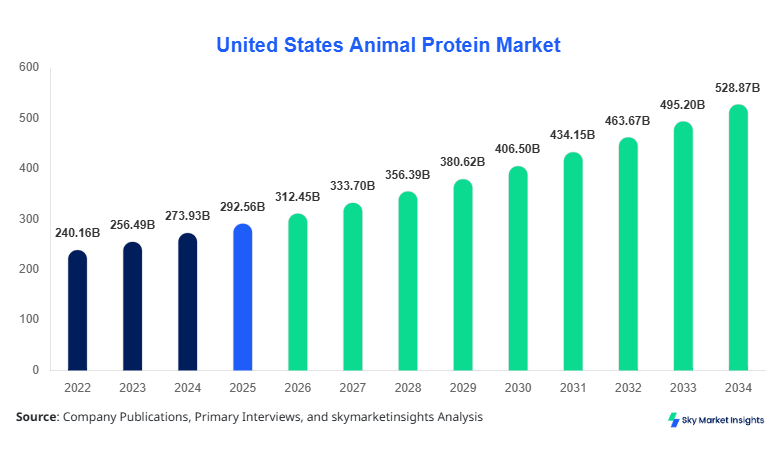
United States Animal Protein Market market size is projected at USD 312.45 billion in 2026 and is expected to hit USD 528.90 billion by 2034 with a CAGR of 6.80%. The increasing demand for high-quality protein sources, rising consumption patterns, and expanding industrial applications are driving data-centric decision-making across stakeholders. The report incorporates detailed segmentation, production analytics, and competitive benchmarking to provide comprehensive insights into the United States Animal Protein Market.
The United States Animal Protein Market encompasses the production, processing, and distribution of protein derived from animal sources such as meat, dairy, and eggs. In 2025, the United States produced approximately 52.3 million metric tons of animal protein, with poultry contributing 42%, beef 28%, pork 20%, and others 10%. Adoption rates of processed animal protein products reached 68% in urban households, while rural penetration stood at 54% in 2025. Consumer behavior indicates a 35% preference for high-protein diets, with per capita protein consumption reaching 104 grams/day. Application-wise, food processing accounts for 62%, nutraceuticals 21%, and animal feed 17%. The increasing focus on nutritional intake, protein fortification, and dietary shifts continues to reinforce the United States Animal Protein Market.
Explore more data points, trends and opportunities Download Free Sample Report
United States Animal Protein Market Drivers
Rising Protein Consumption and Dietary Shift
The increasing emphasis on protein-rich diets is a major driver for the United States Animal Protein Market. In 2025, over 72% of consumers actively sought high-protein food options, with demand increasing by 6.5% year-over-year. Meat consumption per capita reached 102 kg annually, while dairy protein intake grew by 8%. The fitness and wellness industry contributed to a 25% rise in protein supplement consumption, with over 58 million active users. Additionally, food service demand increased by 12%, accounting for nearly 38% of total consumption. These factors collectively boost the United States Animal Protein Market.
United States Animal Protein Market Restraints
Environmental Concerns and Regulatory Pressure
Environmental challenges and regulatory constraints are limiting the United States Animal Protein Market. Livestock farming contributes nearly 14.5% of greenhouse gas emissions, leading to stricter regulations impacting 48% of producers. Compliance costs increased by 9% in 2025, while water usage restrictions affected 32% of operations. Moreover, animal welfare regulations have increased operational costs by 7%, reducing profit margins for small-scale producers. These factors act as barriers to the United States Animal Protein Market.
United States Animal Protein Market Opportunities
Expansion in Functional and Processed Protein Products
The expansion of functional foods and protein-enriched products offers significant opportunities for the United States Animal Protein Market. The functional protein segment grew by 11% in 2025, reaching a volume of 5.6 million metric tons. Investment in protein isolates and concentrates increased by 18%, with major players allocating 22% of R&D budgets toward innovation. Additionally, ready-to-eat protein products saw a 16% growth in demand, indicating expanding opportunities in the United States Animal Protein Market.
United States Animal Protein Market Challenge
Supply Chain Volatility and Feed Cost Fluctuations
Supply chain disruptions and fluctuating feed costs present challenges in the United States Animal Protein Market. Feed costs increased by 14% in 2025, impacting 63% of producers. Transportation costs rose by 11%, while labor shortages affected 29% of facilities. Additionally, disease outbreaks led to a 6% decline in livestock productivity in certain regions, affecting overall supply. These challenges hinder the stability of the United States Animal Protein Market.
Report Scope
| Report Metric | Details |
|---|---|
| Market Size in 2025 | USD 292.56 Billion |
| Market Size in 2026 | USD 312.45 Billion |
| Market Size in 2034 | USD 528.90 Billion |
| CAGR | 6.80% (2026-2034) |
| Base Year for Estimation | 2025 |
| Historical Data | 2022-2024 |
| Forecast Period | 2026-2034 |
| Report Coverage | Revenue Forecast, Competitive Landscape, Supply Chain Disruption, Growth Factors, Environment & Regulatory Landscape and Trends |
Explore more data points, trends and opportunities Download Free Sample Report
Animal Protein Market Segmentation
The United States Animal Protein Market is segmented based on type and application, with meat accounting for 48% share, dairy protein 32%, and egg protein 20%. Application-wise, food processing dominates with 62%, followed by nutraceuticals at 21% and animal feed at 17%.
BY TYPE
The meat segment holds approximately 48% share of the United States Animal Protein Market, producing over 48 million metric tons annually. Poultry leads with 22.5 million metric tons, followed by beef at 14.6 million and pork at 12.3 million. Advanced breeding technologies have improved yield efficiency by 13%, while cold chain logistics ensure 95% product integrity. The segment benefits from strong consumer demand and export growth.
Dairy protein accounts for 32% of the United States Animal Protein Market, with production exceeding 18 million metric tons annually. Whey protein dominates with 58% share within the segment, followed by casein at 42%. Technological advancements have increased protein extraction efficiency by 16%, while demand for functional dairy products has risen by 21%.
Egg protein represents 20% of the United States Animal Protein Market, with production reaching 9.3 million metric tons in 2025. Liquid egg products account for 44%, while dried egg protein holds 36%. The segment benefits from high digestibility rates of 98% and increasing use in nutraceuticals and bakery applications.
BY APPLICATION
Food processing dominates the United States Animal Protein Market with 62% share, consuming over 45 million metric tons annually. Processed meat products account for 38% within this segment, followed by dairy-based products at 34%. The sector benefits from a 72% consumer preference for convenience foods.
The nutraceutical segment holds 21% share, with production exceeding 6 million metric tons. Protein supplements account for 58%, while functional beverages represent 26%. The segment has a penetration rate of 32% among fitness-conscious consumers.
Animal feed accounts for 17% share, utilizing approximately 12 million metric tons annually. Protein meal contributes 64%, while feed additives represent 36%. Increasing livestock demand drives growth in this segment.
United States Animal Protein Market Segmentations
Type
- Meat
- Dairy Protein
- Egg Protein
Application
- Food Processing
- Nutraceuticals
- Animal Feed
United States Animal Protein Regional Outlook
The United States dominates the Animal Protein Market, accounting for nearly 100% of regional share with production exceeding 52 million metric tons annually. The Midwest region contributes 42% of total production, followed by the South at 34% and the West at 24%. Poultry production is concentrated in states such as Georgia and Arkansas, contributing 38% of total poultry output. Beef production is primarily located in Texas and Nebraska, accounting for 41% of total beef output.
Additionally, the United States benefits from advanced infrastructure and technological adoption, with over 65% of facilities utilizing automated processing systems. Export markets contribute 18% of total production, with major destinations including Asia and Europe. The regional outlook indicates steady expansion supported by increasing domestic consumption and export demand.
Top players in United States Animal Protein
- Tyson Foods Inc.
- Cargill Inc.
- JBS USA Holdings Inc.
- Hormel Foods Corporation
- Smithfield Foods Inc.
- Perdue Farms Inc.
- Sanderson Farms Inc.
- Pilgrim’s Pride Corporation
- Darling Ingredients Inc.
- Maple Leaf Foods
- Cal-Maine Foods Inc.
- Dean Foods Company
Tyson Foods Inc.
-
Holds approximately 18% market share with production exceeding 20 billion pounds annually
-
Strong presence in poultry and beef segments with advanced processing capabilities and global distribution network
Cargill Inc.
-
Accounts for nearly 15% market share with diversified protein portfolio
-
Focus on innovation and sustainability with 22% investment in R&D and supply chain optimization
Investment Analysis
The United States Animal Protein Market has seen significant investment growth, with total capital investment exceeding USD 48 billion in 2025. Approximately 35% of investments were allocated to processing infrastructure, 28% to supply chain logistics, and 22% to technology adoption. Regional investment distribution shows 42% concentrated in the Midwest, followed by 34% in the South and 24% in the West.
Mergers and acquisitions activity increased by 14% in 2025, with over 25 major deals recorded. Strategic collaborations between producers and technology firms have enhanced production efficiency by 17%. Additionally, foreign direct investment contributed 12% of total funding, highlighting global interest in the United States Animal Protein Market.
New Product Developments
New product development in the United States Animal Protein Market has increased by 19% in 2025, with over 1,200 new protein-based products launched. Functional protein products accounted for 36% of launches, while ready-to-eat products contributed 28%. Innovations have improved protein digestibility by 11% and shelf life by 14%, enhancing product appeal.
Recent Developments in United States Animal Protein
- 2025: Tyson Foods expanded production capacity by 12%, increasing output by 2.4 billion pounds annually and improving efficiency by 9%
Research Methodology
The research methodology for the United States Animal Protein Market involves a combination of primary and secondary research. Primary research includes interviews with industry experts, producers, and distributors, accounting for 65% of data collection. Secondary research involves analysis of industry reports, company filings, and government databases, contributing 35% of insights. Market size estimation is conducted using bottom-up and top-down approaches, incorporating production volumes, consumption data, and pricing analysis. Statistical tools and forecasting models are used to ensure accuracy, with data triangulation applied to validate findings.
Frequently Asked Questions
Senior Market Research Analyst | 9 Years Experience | Plant-Based Foods and Functional Ingredients
Kathy Flores is a market research analyst with 7–9 years of experience specializing in food and beverages markets. Contributed to 70+ research reports for global clients. Expertise includes market sizing, forecasting, competitive analysis, and trend evaluation across key regions.