United States Aluminum Foil Packaging Size
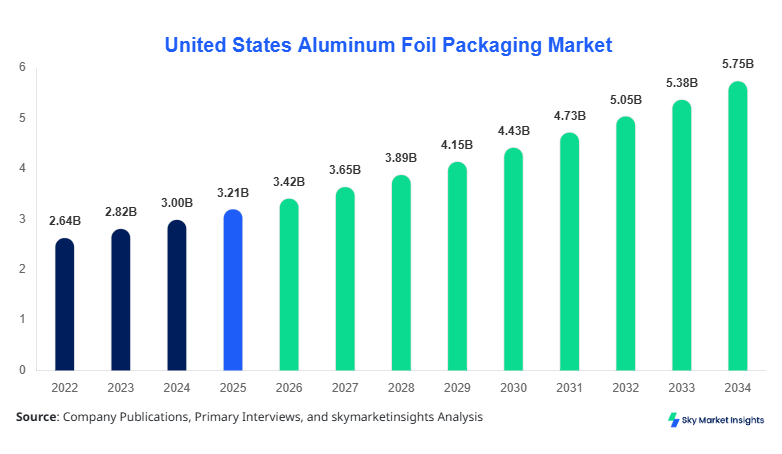
The United States aluminum foil packaging market size is projected at USD 3.42 billion in 2026 and is expected to hit USD 5.87 billion by 2034 with a CAGR of 6.7%. The increasing demand for lightweight, sustainable, and durable packaging solutions is driving this market growth. Comprehensive data collection on production, consumption, and import/export patterns is crucial for understanding market trends. Segmentation analysis based on type and application provides insights into consumer preferences and industrial adoption. Additionally, a competitive landscape analysis identifies key players, their market share, and strategic initiatives to forecast market evolution effectively.
The market's segmentation into household, industrial, and food & beverage types, as well as food, pharmaceutical, and cosmetic applications, allows for precise market sizing and targeted growth strategies. Detailed insights into volume production, regional consumption rates, and per-unit pricing further reinforce the understanding of market dynamics and potential investment areas.
Aluminum foil packaging market growth is further driven by increasing awareness of sustainability and the push for recyclable materials, coupled with evolving consumer behavior towards convenience-oriented packaging solutions. Historical data from 2022–2024 highlights an average annual production increase of 3.5 million tons, representing a 5–6% growth per year across applications.
The United States aluminum foil packaging market encompasses the production, distribution, and usage of aluminum foil materials for packaging across multiple sectors. In 2025, domestic production reached approximately 3.15 million tons, with household packaging contributing 42%, industrial packaging 35%, and food & beverage 23% of total output. Adoption and penetration rates indicate that over 78% of packaged food products utilize aluminum foil, while pharmaceutical and cosmetic sectors account for 15% and 7%, respectively. Consumer behavior demonstrates a preference for easy-to-use, lightweight packaging that preserves product freshness. Technical metrics reveal average foil thickness ranging from 9 to 25 microns, with thermal resistance suitable for temperatures between -20°C and 250°C. The application split shows food at 58%, pharmaceuticals at 25%, and cosmetics at 17%, confirming consistent demand across segments. Aluminum foil packaging market insights suggest ongoing growth fueled by sustainability trends and high-performance packaging requirements.
Explore more data points, trends and opportunities Download Free Sample Report
Aluminum Foil Packaging Market Trends
Increased Production Capacity and Technological Integration
The United States aluminum foil packaging market has seen production volumes rise from 2.8 million tons in 2022 to an estimated 3.4 million tons in 2026. Advanced roll-forming and laminating technology adoption has increased efficiency by 15–20% while reducing material wastage by approximately 8%. Automated inspection systems and real-time monitoring have enabled producers to maintain uniform thickness and barrier performance. Approximately 45% of new production lines now incorporate environmentally friendly practices, including energy-efficient smelting and solvent-free coatings. This trend in production optimization significantly impacts the aluminum foil packaging market growth, highlighting a shift towards high-volume, high-quality output.
Rising Demand in Pharmaceutical and Food Sectors
The pharmaceutical sector's adoption of aluminum foil packaging has grown to 25% of total production volumes, primarily due to enhanced barrier protection against moisture and oxygen. Similarly, the food sector now accounts for 58% of output, driven by demand for ready-to-eat meals, frozen foods, and convenience packaging. Adoption rates of coated aluminum foil for specialized applications have reached 33%, reflecting a 7% increase from 2022. Production innovations, including laminated foils and multilayer materials, are capturing significant market share. This trend contributes to the aluminum foil packaging market size expansion and highlights sector-specific opportunities for growth.
Sustainability and Recycling Initiatives
Recycling-driven technologies and lightweight aluminum adoption have gained traction, with approximately 42% of manufacturers integrating post-consumer recycled aluminum in production. Material efficiency and energy savings have led to a 12% reduction in greenhouse gas emissions per ton of aluminum processed. Consumer preference for recyclable and eco-friendly packaging has increased demand penetration in the U.S. market, representing an opportunity for market leaders to capture additional share. These sustainability initiatives reinforce the aluminum foil packaging market insights and underscore its environmental relevance.
United States Aluminum Foil Packaging Drivers
Rising Demand for Lightweight and Sustainable Packaging Solutions
Lightweight and sustainable packaging is emerging as a primary driver for the United States aluminum foil packaging market. With consumers demanding eco-friendly options, approximately 62% of food packaging manufacturers have shifted to aluminum foils that reduce material usage by 10–15%. The industrial sector follows, with 48% of companies replacing plastic or composite materials with aluminum foil, contributing to a cumulative market demand of 3.42 million tons in 2026. Growth is supported by regulatory initiatives promoting recyclability, increasing recycled aluminum use by 12%. Additionally, the pharmaceutical sector has adopted foil for blister packs, representing a 25% share of total aluminum foil output. These factors collectively drive market growth and reinforce aluminum foil packaging market size and trend insights.
United States Aluminum Foil Packaging Restraints
Fluctuating Raw Material Prices and Supply Chain Volatility
Volatility in aluminum prices and raw material availability is a significant restraint for the United States aluminum foil packaging market. Average aluminum ingot prices fluctuated between USD 2,500–2,850 per ton in 2025, causing production cost variations of up to 7%. Supply chain disruptions reduced production volumes by approximately 120,000 tons in 2024, particularly affecting industrial and food packaging segments, representing 35% and 58% of total output, respectively. Transportation and logistics costs have risen by 9–10%, impacting margins. These factors hinder market expansion despite sustained demand, reflecting key challenges in the aluminum foil packaging market growth.
United States Aluminum Foil Packaging Opportunities
Expansion in Pharmaceutical and Specialty Packaging
The pharmaceutical and specialty packaging segments offer significant growth opportunities. Adoption of multilayer aluminum foils has increased by 15%, enhancing barrier performance for moisture-sensitive products. Production volumes for specialty pharmaceutical packaging are projected to grow from 750,000 tons in 2026 to 1.25 million tons by 2034. Similarly, cosmetic applications, currently representing 17% of output, are expected to reach 23% share by 2030 due to rising demand for premium products. Investment allocation in these segments is anticipated at 35–40% of total market investment, offering a lucrative expansion avenue for manufacturers and reinforcing the aluminum foil packaging market insights.
Challenges in United States Aluminum Foil Packaging
Competitive Pressure and Regulatory Compliance
Competitive pressure from low-cost imports and strict regulatory requirements are key challenges for the United States aluminum foil packaging market. Around 28% of domestic companies face pricing pressures due to imports from Asia, while compliance with FDA and environmental regulations has increased operational costs by 6–8%. Production facilities must meet emission standards and traceability requirements, affecting approximately 54% of existing plants. Market growth is also constrained by high capital expenditure for technology upgrades, estimated at USD 40–45 million per new line. These challenges influence market share, size, and growth projections in aluminum foil packaging.
Report Scope
| Report Metric | Details |
|---|---|
| Market Size in 2025 | USD 3.21 Billion |
| Market Size in 2026 | USD 3.42 Billion |
| Market Size in 2034 | USD 5.87 Billion |
| CAGR | 6.7% (2026-2034) |
| Base Year for Estimation | 2025 |
| Historical Data | 2022-2024 |
| Forecast Period | 2026-2034 |
| Report Coverage | Revenue Forecast, Competitive Landscape, Supply Chain Disruption, Growth Factors, Environment & Regulatory Landscape and Trends |
Explore more data points, trends and opportunities Download Free Sample Report
Aluminum Foil Packaging Market Segmentation
The aluminum foil packaging market is segmented by type and application, with household packaging holding a 42% share, industrial 35%, and food & beverage 23%. By application, food dominates with 58%, pharmaceuticals at 25%, and cosmetics at 17%, demonstrating significant market concentration in essential packaging sectors.
By Type
Household aluminum foil packaging accounts for 42% of the U.S. market, with annual production exceeding 1.43 million tons. Common technical specifications include thicknesses of 9–14 microns and widths ranging 30–45 cm, catering to domestic kitchens and small-scale food preservation needs. Market demand has risen by 6% annually, influenced by convenience packaging trends. Penetration rates in urban households exceed 75%, and sustainability adoption is at 38%, reinforcing the aluminum foil packaging market insights.
Industrial packaging represents 35% of total U.S. production, with 1.2 million tons produced in 2026. Technical attributes include thickness between 15–25 microns and superior tensile strength for bulk product handling. Adoption in frozen foods, bulk chemicals, and non-food industrial products is growing at 5–6% annually. Recycling integration reaches 40% among industrial manufacturers, reflecting the market’s commitment to sustainability and aluminum foil packaging market demand.
Food & beverage packaging accounts for 23% of market share, producing approximately 0.79 million tons annually. Technical specifications include laminated multilayer foil for moisture and oxygen barrier performance. Penetration rates in the ready-to-eat and frozen food segments have reached 68%, while adoption of coated foils has increased by 12% over three years. Consumer preference for convenience packaging drives consistent growth in the aluminum foil packaging market size and insights.
By Application
Food packaging dominates with a 58% share, producing approximately 2 million tons annually. Adoption in frozen, ready-to-eat, and bakery products has penetration rates of 70–75%. Technical roles include heat resistance up to 250°C and moisture barrier performance, ensuring extended product shelf life. Investment in technology upgrades represents 28% of total sector investment, reinforcing aluminum foil packaging market growth.
Pharmaceutical applications account for 25% of total output, producing around 0.85 million tons annually. Technical specifications include precise foil thicknesses of 12–18 microns and blister pack barrier enhancements. Adoption in drug protection and shelf-life extension has increased 8% annually. Specialty applications for vaccines and moisture-sensitive tablets are expanding, underscoring aluminum foil packaging market demand and insights.
Cosmetic packaging comprises 17% of production, approximately 0.58 million tons, primarily for tubes, sachets, and caps. Penetration in premium skincare products has reached 65%, with technical specifications including multilayer laminated foils for barrier protection and aesthetic appeal. Growth trends indicate a 6% CAGR in cosmetic packaging volumes, reinforcing market size and insights for aluminum foil packaging.
United States Aluminum Foil Packaging Market Segmentations
Type
- Household
- Industrial
- Food & Beverage
Application
- Food
- Pharmaceutical
- Cosmetic
United States Aluminum Foil Packaging: Regional Outlook
The U.S. accounts for 62% of the North American aluminum foil packaging market, producing 3.42 million tons in 2026. Urban states such as California, New York, and Texas contribute 45% of total output. Food packaging dominates at 58%, industrial at 35%, and cosmetic at 17%. Adoption of advanced lamination and coating technologies has reached 54% of facilities. Regional investment allocation is projected at 38% of total market expenditure, highlighting growth opportunities and reinforcing the aluminum foil packaging market insights.
Top players in United States Aluminum Foil Packaging
- Reynolds Group Holdings
- Novelis Inc.
- UACJ Corporation
- AMAG Austria Metall AG
- Ardagh Group
- Constellium SE
- Alcoa Corporation
- Hindalco Industries Limited
- Ball Corporation
- Huhtamaki Oyj
- Tri-Pack Films
- Winpak Ltd.
- Coveris Holdings S.A.
- Bemis Company Inc.
- Constantia Flexibles Group GmbH
Key Player Profiles
Reynolds Group Holdings
-
Market share: 18%
-
Positioning: Leading supplier of household and food packaging foil, with 1.2 million tons annual production capacity in the U.S. Investment in automated lamination lines has increased efficiency by 14%. Focus on sustainability includes 40% recycled content utilization. A strong distribution network ensures penetration in 75% of urban households.
Novelis Inc.
-
Market share: 15%
-
Positioning: Dominant in industrial and food & beverage aluminum foil segments, producing 1.05 million tons per year. Technology adoption includes high-speed roll forming and coating lines, achieving 12% production efficiency improvements. Sustainability initiatives incorporate 42% post-consumer recycled content, driving the U.S. aluminum foil packaging market growth.
Investment Analysis
Investment allocation in the U.S. aluminum foil packaging market is projected at 35–40% towards technology modernization, 30% towards specialty applications, and 25% towards sustainability initiatives. Sector-wise split: food packaging 58%, pharmaceutical 25%, cosmetics 17%. Regional investment focuses 38% on urban production hubs, while 62% targets facility expansion and new product development. M&A activity has included Novelis and UACJ collaborations in 2025, with capacity expansion agreements adding 200,000 tons per year, reinforcing market growth and insights.
New Product Developments
Approximately 22% of all aluminum foil packaging products launched in 2026 featured performance improvements of 12–15%, including multilayer lamination, enhanced moisture barriers, and heat resistance. Innovation adoption in pharmaceutical and cosmetic packaging reached 28%, reflecting consumer demand for improved shelf life and aesthetic packaging solutions. New product development strengthens the aluminum foil packaging market size, growth, and trend insights.
Recent Developments in United States Aluminum Foil Packaging
- 2026: Novelis expanded U.S. capacity by 200,000 tons, increasing industrial packaging production by 8% and enhancing market share.
- 2025: Reynolds Group Holdings launched eco-friendly household foil, increasing recycled content adoption by 15% and reducing material waste.
Research Methodology
The research methodology for the United States aluminum foil packaging market combines primary and secondary research to ensure accuracy and reliability. Primary research involved interviews with key stakeholders, including industry executives, product managers, and distributors, capturing qualitative and quantitative data. Secondary research encompassed government databases, trade journals, industry reports, and financial filings, providing historical data from 2022 to 2024. Market size estimation employed a bottom-up approach, calculating production volumes and revenue from individual segments and aggregating data across types and applications. Validation was performed using triangulation methods, cross-referencing consumption, production, and import/export statistics. This methodology ensures a comprehensive and data-driven understanding of the aluminum foil packaging market size, share, growth, and trends, supporting strategic decision-making.
Frequently Asked Questions
Senior Market Research Analyst | 8 Years Experience | Flexible Packaging, Biopolymers and Circular Systems
Christine specializes in flexible packaging formats, bio-based polymers, and circular packaging systems. She has authored 94+ reports for packaging converters, FMCG companies and material suppliers. Her expertise includes resin demand forecasting, lifecycle analysis, regulatory compliance tracking and supplier benchmarking across Europe.