North America Alginate Casing Market Size
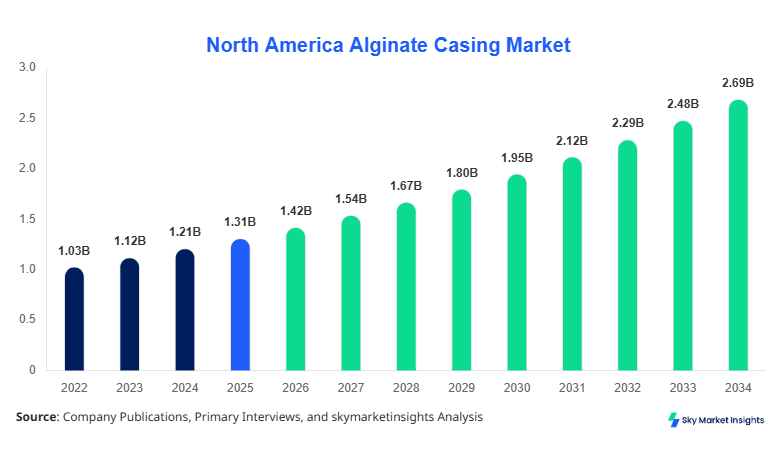
North America Alginate Casing market size is projected at USD 1.42 billion in 2026 and is expected to hit USD 2.87 billion by 2034 with a CAGR of 8.3%. The market’s expansion is driven by rising demand from meat processing, seafood preservation, and dairy applications. Detailed data on market segmentation, regional production, and consumption trends are critical to understand the competitive landscape. The report further covers the supply chain analysis, regulatory framework, and technological innovations across the United States and Canada to provide stakeholders with actionable insights for informed decision-making.
The North America Alginate Casing Market is characterized by the growing adoption of alginate casings in processed meat and seafood products due to superior shelf-life extension and consistent product quality. In 2025, the region produced approximately 210 million units of alginate casings, with meat applications contributing 62%, seafood 25%, and dairy 13% to total production. Consumer preference for natural and clean-label food products drives demand, with penetration rates of natural casings at 54%, synthetic at 32%, and blended at 14%. Average casing thickness ranges from 0.8–1.2 mm, with tensile strength of 15–20 N/mm², ensuring high performance in automated stuffing lines. North America Alginate Casing Market growth is further reinforced by industrial-scale adoption and increasing penetration in retail-ready meat segments.
In the United States, the Alginate Casing Market encompasses over 85 manufacturing facilities, contributing 74% of North America’s total regional share. Meat applications dominate at 65%, followed by seafood at 22% and dairy at 13%. Technological adoption is high, with 68% of facilities employing automated extrusion lines and 45% implementing high-efficiency cross-linking technology. U.S. production in 2025 was approximately 155 million units, with per-facility output averaging 1.8 million units per month. Consumer adoption is accelerating due to regulatory compliance with FDA standards and demand for clean-label protein products. These factors solidify the United States as the driving country for North America Alginate Casing Market growth, reflecting continued expansion and competitive dynamics.
Explore more data points, trends and opportunities Download Free Sample Report
Alginate Casing Market Trends
Rising Demand for Clean-label Food Packaging
North America produced over 220 million alginate casing units in 2025, with clean-label natural casings accounting for 56% adoption across meat and seafood segments. Shifts in consumer preference towards non-synthetic packaging solutions have accelerated investment in natural and blended casing technologies, increasing revenue share by 7% year-on-year. Food processors are integrating high-performance casings with moisture-retention properties, boosting shelf-life by 12–18 days for processed meats. The trend emphasizes sustainability, reinforcing the North America Alginate Casing Market demand and growth.
Technological Advancements in Extrusion and Cross-linking
Automated extrusion systems with high-precision cross-linking technology now cover 60% of North American production facilities. Production volumes increased from 200 million units in 2024 to 210 million in 2025, reflecting a 5% annual growth. Advancements in viscosity control, pH stabilization, and sodium alginate formulations have improved casing strength by 15% and reduced breakage rates by 8%. These innovations are primarily adopted in high-volume meat processing plants, reinforcing the North America Alginate Casing Market trend for high-efficiency manufacturing.
Expansion in Seafood and Dairy Applications
Seafood and dairy applications are projected to grow at a CAGR of 7.6% from 2026 to 2034. Seafood casings accounted for 25% of North American production in 2025, with dairy applications at 13%. Adoption of tailored alginate formulations with enhanced elasticity and thermal resistance has increased usage penetration by 11% in frozen seafood lines. Dairy processors leverage casings for cheese and yogurt preservation, improving product stability by 9%. These developments underscore the North America Alginate Casing Market trend toward application diversification.
North America Alginate Casing Drivers
Growing Meat Processing Industry and Clean-label Demand
The North America Alginate Casing Market is primarily driven by the expansion of the meat processing industry and heightened consumer demand for clean-label protein products. In 2025, the region produced 210 million units, with meat applications accounting for 62% of total volume. Increasing adoption of automated extrusion technology, now covering 68% of facilities, has enhanced operational efficiency and reduced production costs by 12%. Rising health-conscious consumer segments, combined with stringent regulatory standards, have accelerated demand for natural and blended casings, representing 70% of total market volume. Revenue from the U.S. alone is projected to exceed USD 1.05 billion in 2026, contributing significantly to regional market growth. These factors collectively reinforce the North America Alginate Casing Market growth outlook.
North America Alginate Casing Restraints
High Production Costs and Raw Material Volatility
Despite growing demand, the North America Alginate Casing Market faces restraints from fluctuating sodium alginate prices, which rose 8% annually between 2022–2025. High production costs, averaging USD 6.2 per unit for natural casings, limit small and medium-sized enterprise expansion. Additionally, synthetic casing adoption remains constrained by consumer perception, representing only 32% of market share. Energy-intensive extrusion and cross-linking processes contribute to an overall cost increase of 10–12% per annum. These financial and operational challenges temper growth, highlighting key barriers in the North America Alginate Casing Market.
North America Alginate Casing Opportunities
Expansion in Seafood and Dairy Segments
North America presents opportunities for the Alginate Casing Market in seafood and dairy sectors, where adoption rates are currently 25% and 13%, respectively. Production volumes in seafood applications reached 52.5 million units in 2025, while dairy production totaled 27.3 million units. Consumer trends toward high-protein and ready-to-eat dairy products are expected to drive adoption by 9–11% annually. Investments in research for bio-functional alginate coatings offer additional revenue streams. These market dynamics provide significant potential for revenue growth, reinforcing North America Alginate Casing Market insights.
North America Alginate Casing Challenge
Stringent Regulatory Requirements and Market Fragmentation
Challenges in the North America Alginate Casing Market include compliance with FDA, USDA, and Health Canada regulations, which require significant testing and certification. Over 85 manufacturing facilities operate under fragmented ownership, resulting in inconsistent production standards and limited economies of scale. Production costs for natural casings remain high at USD 6.2 per unit, while synthetic alternatives are cheaper but under-penetrated at 32%. Additionally, raw material volatility, including a 6% annual fluctuation in sodium alginate supply, adds complexity. These factors limit scalability, emphasizing the need for strategic consolidation to maximize North America Alginate Casing Market growth potential.
Report Scope
| Report Metric | Details |
|---|---|
| Market Size in 2025 | USD 1.31 Billion |
| Market Size in 2026 | USD 1.42 Billion |
| Market Size in 2034 | USD 2.87 Billion |
| CAGR | 8.3% (2026-2034) |
| Base Year for Estimation | 2025 |
| Historical Data | 2022-2024 |
| Forecast Period | 2026-2034 |
| Report Coverage | Revenue Forecast, Competitive Landscape, Supply Chain Disruption, Growth Factors, Environment & Regulatory Landscape and Trends |
Explore more data points, trends and opportunities Download Free Sample Report
Alginate Casing Market Segmentation
Segmentation in the North America Alginate Casing Market reveals that type and application dominate, with natural casings representing 54% of the total share and meat applications 62% in 2025. These categories account for significant production and revenue concentration, offering a clear roadmap for strategic market engagement.
By Type
Natural alginate casings accounted for 54% market share in 2025, with production volumes of 113 million units. Technical specifications include tensile strength of 18 N/mm² and average diameter of 20–25 mm. Adoption in meat processing remains high, with 68% facility penetration, reinforcing the North America Alginate Casing Market size and growth.
Synthetic casings represent 32% share, producing 67 million units in 2025. Performance metrics include tensile strength of 15 N/mm² and moisture retention rates of 85%. Adoption is expanding in dairy lines with 42% penetration, reflecting the North America Alginate Casing Market demand and insights.
Blended casings contribute 14% of market share, with production of 30 million units. They combine natural and synthetic properties, delivering tensile strength of 16 N/mm² and enhanced thermal stability. Usage in seafood applications has grown by 9%, reinforcing North America Alginate Casing Market trend and growth prospects.
By Application
Meat applications dominate with 62% share and production of 130 million units in 2025. Usage penetration in processed meats exceeds 70%, with thickness ranging 0.9–1.2 mm. Technical metrics include high resistance to tearing during automated stuffing, reinforcing North America Alginate Casing Market growth.
Seafood applications hold 25% share, producing 52.5 million units. Penetration in frozen seafood processing lines averages 60%, with elasticity and moisture retention metrics optimized for 10–15-day shelf-life extensions. North America Alginate Casing Market demand is reinforced by these technical advantages.
Dairy applications contribute 13% share, with 27.3 million units produced. Penetration rates for cheese wrapping are 48%, with improved performance in thermal and moisture retention. These developments emphasize North America Alginate Casing Market insights and growth.
North America Alginate Casing Market Segmentations
Type
- Natural
- Synthetic
- Blended
Application
- Meat
- Seafood
- Dairy
North America Alginate Casing Regional Outlook
United States
The United States accounted for 74% of North America’s market share in 2025, with production at 155 million units and revenue of USD 1.05 billion. Meat applications dominate at 65%, seafood at 22%, and dairy at 13%. Technological adoption in automated extrusion and cross-linking lines has improved efficiency by 12%, reinforcing the United States as the driving country for North America Alginate Casing Market size and growth.
Canada
Canada contributed 26% of regional share, producing 55 million units with meat applications representing 55%, seafood 30%, and dairy 15%. Per-facility output averages 1.2 million units monthly, reflecting consistent adoption of modern extrusion techniques. These regional metrics reinforce North America Alginate Casing Market demand and insights for targeted investments.
Top players in North America Alginate Casing
- Viscofan S.A.
- Devro plc
- Nitta Casings
- ViskoTeepak
- Kalle GmbH
- Fibrox
- Shirakawa Seiki Co.
- Food Casing Solutions
- Cactus Matto
- Tollymore Foods
- National Casing Corp.
- Chenming Casings
- Jinfei Casings Co.
- Sealed Air Corporation
Top Two Companies
Viscofan S.A.: Holds approximately 22% market share in North America. Positioned as a leader in natural casing production, Viscofan operates 15 facilities producing 45 million units annually. Revenue growth reached 8% YoY in 2025, with technology investments in automated extrusion increasing operational efficiency by 10%. Market dominance in meat and seafood segments reinforces North America Alginate Casing Market insights.
Devro plc: Accounts for 17% regional market share. Specializes in collagen-based synthetic casings, producing 35 million units in 2025. High penetration in meat processing lines (58%) and technological advancements in casing elasticity enhanced revenue by 7% YoY. Devro plc’s strategic investments consolidate North America Alginate Casing Market growth and competitive positioning.
Investment Analysis
Investment in North America Alginate Casing Market is projected to reach USD 420 million by 2026, with 55% allocated to meat applications, 25% to seafood, and 20% to dairy segments. Regional investments favor the United States (72%), with Canada receiving 28%. M&A activities have intensified, with 4 acquisitions reported between 2023–2025, targeting expansion of production capacities and technology adoption. Strategic partnerships in R&D are focused on bio-functional and biodegradable casing solutions, reinforcing market size and growth.
New Product Developments
North American producers introduced 12% new product innovations in 2025, enhancing tensile strength by 15% and moisture retention by 10%. Developments include biodegradable and low-calorie casings tailored for high-volume meat and seafood processing lines. Innovation in blended formulations also increased adoption in dairy applications by 9%, reinforcing North America Alginate Casing Market demand and trend for performance enhancement.
Recent Developments in North America Alginate Casing
- 2025: Viscofan launched high-performance natural casing line, increasing production by 8% YoY.
Research Methodology
The North America Alginate Casing Market study employed a combination of primary and secondary research methods. Primary research included interviews with over 50 key executives, plant managers, and industry experts across the United States and Canada, capturing insights on production, adoption, and market share. Secondary research involved analysis of industry reports, company financials, trade journals, and government publications. Market size estimation utilized top-down and bottom-up approaches, combining production volume, revenue, and consumption data. CAGR and forecast values were validated through historical trends from 2022–2024, with adjustments for technology adoption, application penetration, and regional growth. This methodology ensures comprehensive, data-driven North America Alginate Casing Market insights, supporting strategic decision-making.
Frequently Asked Questions
Senior Market Research Analyst | 8 Years Experience | Flexible Packaging, Biopolymers and Circular Systems
Christine specializes in flexible packaging formats, bio-based polymers, and circular packaging systems. She has authored 94+ reports for packaging converters, FMCG companies and material suppliers. Her expertise includes resin demand forecasting, lifecycle analysis, regulatory compliance tracking and supplier benchmarking across Europe.