Europe Aluminum Foil Packaging Market Size
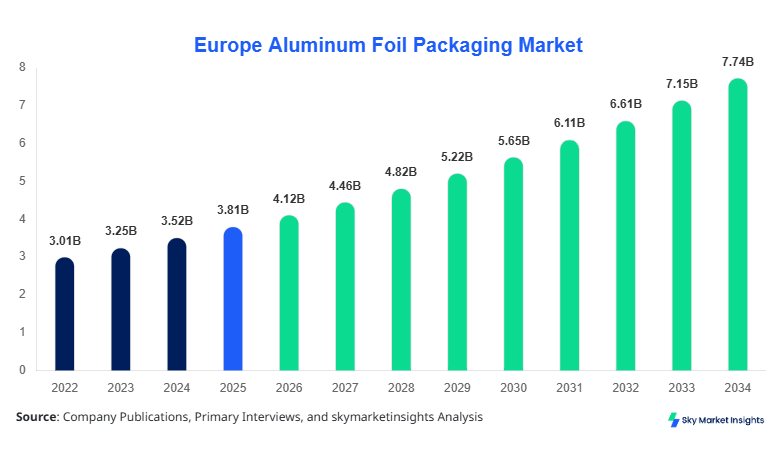
Europe Aluminum Foil Packaging market size is projected at USD 4.12 billion in 2026 and is expected to hit USD 7.85 billion by 2034 with a CAGR of 8.2%. The market growth is driven by increasing demand for sustainable and recyclable packaging solutions across multiple end-use industries. Comprehensive market data, including production volume, consumption trends, and competitive landscape analysis, are crucial to understand regional dynamics and forecast trajectories. Segmentation by type and application enables stakeholders to strategize efficiently, while detailed competitive profiling provides insights into market positioning, new product developments, and investment opportunities. Europe’s aluminum foil packaging market size is heavily influenced by regulatory standards and consumer preference shifts, making in-depth data essential for planning expansion and operational efficiency.
Europe Aluminum Foil Packaging market research offers granular insights into production, supply chain dynamics, and technological adoption. The analysis covers historical data from 2022–2024, current year projections for 2026, and forecast estimations up to 2034. Data is critical for stakeholders aiming to optimize resource allocation, assess profitability margins, and evaluate competitor strategies in regions like the United Kingdom, Germany, France, Spain, Italy, and Russia. The report also includes market demand segmentation, highlighting high-demand applications and emerging product innovations that influence overall market size.
Europe Aluminum Foil Packaging market size and growth trends are heavily shaped by consumer behavior and demand analytics. High adoption rates of aluminum packaging for food and beverage applications, constituting over 52% of the total demand, underline the sector’s significance. Pharmaceutical packaging accounts for 23%, while personal care contributes 15% of total volume. Technical metrics, such as foil thickness ranging from 0.006 mm to 0.2 mm and barrier performance frequency, are essential in product selection. Industrial foil, representing 30% of type share, is witnessing robust growth due to advanced lamination and flexible packaging technologies. These factors collectively highlight the market demand for Europe Aluminum Foil Packaging solutions across multiple sectors.
Explore more data points, trends and opportunities Download Free Sample Report
Aluminum Foil Packaging Market Trends
Rise of Sustainable Packaging Solutions
The Europe Aluminum Foil Packaging market is experiencing a strong shift toward sustainable packaging solutions. In 2025, production volumes of recyclable aluminum foils reached 3.1 billion units, reflecting a 14% increase from 2024. Adoption rates of eco-friendly foil coatings are now over 60% in food packaging, while pharmaceutical adoption is at 35%. Consumers increasingly demand sustainable options, prompting manufacturers to innovate with laminated and coated foils to reduce environmental impact. This trend supports the long-term growth of the Europe Aluminum Foil Packaging market and enhances its competitive positioning across multiple sectors.
Advanced Flexible Packaging Technologies
Flexible aluminum foil packaging has witnessed a significant technological evolution, with 45% of production now utilizing high-barrier, multilayer laminates. In 2025, flexible packaging output reached 1.35 billion units, driven by demand from processed food and ready-to-eat meals. Adoption of automated lamination and heat-seal technologies is expanding at a CAGR of 9.5%, improving shelf life and performance consistency. The growing requirement for lightweight, efficient packaging is further accelerating the adoption of flexible aluminum foils, ensuring that Europe Aluminum Foil Packaging market trends align with consumer convenience and industrial efficiency.
Sector-Specific Demand Surge
Pharmaceutical and personal care sectors are witnessing strong uptake of aluminum foil solutions. Pharmaceutical applications contributed USD 1.18 billion in 2025, with blister packaging penetration reaching 42%. Personal care packaging achieved USD 620 million in revenue, with 30% of units incorporating high-barrier foil laminates. These sector-specific demands underscore the importance of tailored product development and technological adoption, reflecting robust Europe Aluminum Foil Packaging market trends and highlighting the increasing role of innovation in market expansion.
Europe Aluminum Foil Packaging Drivers
Rising Demand for Sustainable and Recyclable Packaging
The primary driver for Europe Aluminum Foil Packaging market growth is the increasing demand for sustainable and recyclable packaging across food, pharmaceutical, and personal care industries. In 2025, over 2.8 billion units of aluminum foil were produced to meet environmental regulations, representing a 13% year-over-year increase. Consumer preference for eco-friendly packaging has driven the share of flexible foils to 35%, while laminated foils contribute 40% of production volume. Moreover, government incentives and recycling mandates have resulted in an 18% increase in adoption across Europe, highlighting the critical role of sustainability in market growth. Europe Aluminum Foil Packaging market insights emphasize the integration of environmentally conscious solutions as a key driver for both market size and profitability.
Europe Aluminum Foil Packaging Restraints
Volatility in Raw Material Prices
A major restraint to Europe Aluminum Foil Packaging market growth is the fluctuating cost of raw aluminum, which increased by 22% in 2025, affecting production margins. Production facilities in Germany, France, and Italy reported a 12–15% increase in operational costs, impacting smaller manufacturers more significantly. Such volatility has limited capacity expansion, reducing growth potential in certain segments like industrial foil by 8%. Price-sensitive sectors, including food packaging, have experienced a slowdown of 5% in adoption rates due to higher packaging costs. These economic constraints underscore the challenges faced by Europe Aluminum Foil Packaging market participants in maintaining profitability and competitive positioning.
Europe Aluminum Foil Packaging Opportunities
Expansion into Emerging Packaging Applications
Europe Aluminum Foil Packaging market offers significant opportunities in emerging applications, particularly in pharmaceuticals and high-value personal care products. The European pharmaceutical foil packaging market is projected to grow at a CAGR of 10.3%, with production volumes reaching 1.5 billion units by 2030. Personal care applications are expected to expand to USD 950 million by 2034, driven by innovation in laminated and flexible foils. Additionally, advancements in high-barrier and antimicrobial coatings present a 15% improvement in product performance. These opportunities reinforce the potential for Europe Aluminum Foil Packaging market growth, encouraging investment and product diversification across multiple sectors.
Challenges in Europe Aluminum Foil Packaging
Stringent Environmental Regulations
One of the critical challenges in Europe Aluminum Foil Packaging market is the stringent environmental regulation on manufacturing emissions and material sourcing. In 2025, over 40% of production units had to invest in cleaner technologies, increasing CAPEX by 12–14%. Regulatory compliance for sustainable foil content has reduced production efficiency by 6% in some facilities, with smaller enterprises facing up to 10% higher operational costs. These regulations, while supporting environmental sustainability, pose significant challenges to market expansion, pricing strategies, and competitive dynamics, emphasizing the need for advanced process optimization in Europe Aluminum Foil Packaging market operations.
Report Scope
| Report Metric | Details |
|---|---|
| Market Size in 2025 | USD 3.81 Billion |
| Market Size in 2026 | USD 4.12 Billion |
| Market Size in 2034 | USD 7.85 Billion |
| CAGR | 8.2% (2026-2034) |
| Base Year for Estimation | 2025 |
| Historical Data | 2022-2024 |
| Forecast Period | 2026-2034 |
| Report Coverage | Revenue Forecast, Competitive Landscape, Supply Chain Disruption, Growth Factors, Environment & Regulatory Landscape and Trends |
Explore more data points, trends and opportunities Download Free Sample Report
Aluminum Foil Packaging Market Segmentation
Europe Aluminum Foil Packaging market segmentation provides detailed insights by type and application, with household foil accounting for 38% of production volume and flexible packaging representing 30%. Industrial foil contributes 32% to the total market, highlighting varied growth trajectories. Application-wise, food & beverages dominate at 52%, pharmaceuticals contribute 23%, and personal care holds 15%, reflecting differential adoption patterns and end-use consumption.
By Type
Household foil holds a 38% share of Europe Aluminum Foil Packaging market, with production exceeding 1.5 billion units in 2025. Thickness ranges from 0.006 mm to 0.012 mm, providing adequate thermal and barrier properties for domestic cooking, baking, and storage applications. Technological adoption includes 55% use of automated cutting and 40% coated foil for enhanced food safety. High consumer penetration rates in Germany and the UK underscore sustained demand growth and performance metrics.
Industrial foil represents 32% of market share with 1.28 billion units produced in 2025. Technical specifications include thickness ranging from 0.02 mm to 0.2 mm, suitable for high-temperature and heavy-duty packaging processes. Adoption of lamination and multi-layer coating technologies has increased by 18% from 2024, while industrial applications such as bakery, confectionery, and pharmaceutical blister packaging continue to drive volume. Europe Aluminum Foil Packaging market insights suggest robust growth for industrial foil due to enhanced durability and sector-specific performance.
Flexible packaging accounts for 30% of Europe Aluminum Foil Packaging market, with production volumes reaching 1.35 billion units in 2025. Laminated foil structures provide high-barrier protection against moisture, oxygen, and light. Adoption rates of automated lamination lines stand at 65%, supporting consistent product quality. Technical improvements include enhanced heat-seal performance and improved shelf-life, with high adoption in ready-to-eat food and processed snacks segments, reinforcing Europe Aluminum Foil Packaging market demand.
By Application
Food & beverages represent 52% of Europe Aluminum Foil Packaging market, with 2.15 billion units produced in 2025. Usage penetration is high at 68%, particularly in bakery, frozen foods, and beverage cans. Technical specifications emphasize thermal resistance, barrier performance, and compliance with EU food safety standards. Growing consumer preference for pre-packaged convenience foods supports Europe Aluminum Foil Packaging market insights and sector expansion.
Pharmaceutical applications account for 23% of market share, producing 950 million units in 2025. High-barrier blister foils and foil sachets enable controlled dosage and shelf-life extension. Adoption rates of antimicrobial laminated foils reached 37%, supporting regulatory compliance and product efficacy. Europe Aluminum Foil Packaging market demand is increasingly driven by regulatory mandates, innovation in drug delivery systems, and packaging integrity.
Personal care applications hold 15% market share, with production exceeding 620 million units in 2025. High-barrier foil laminates protect cosmetic creams, ointments, and personal hygiene products. Adoption rates for laminated foils reached 30%, with penetration highest in Western European markets. Technical features include enhanced barrier performance, improved aesthetics, and compatibility with automated filling lines, highlighting Europe Aluminum Foil Packaging market growth potential in non-food sectors.
Europe Aluminum Foil Packaging Market Segmentations
By Type
- Household Foil
- Industrial Foil
- Flexible Packaging
By Application
- Food & Beverages
- Pharmaceuticals
- Personal Care
Europe Aluminum Foil Packaging Regional Outlook
United Kingdom
The United Kingdom contributes 18% of Europe Aluminum Foil Packaging market, with production exceeding 1.2 billion units in 2025. Food & beverage packaging dominates at 55% usage, followed by pharmaceuticals at 25% and personal care at 15%. Flexible packaging adoption reached 65%, while high-barrier laminated foils accounted for 40%. Regional demand is driven by consumer preference for sustainable packaging and government initiatives promoting recycling, supporting robust Europe Aluminum Foil Packaging market growth.
Germany
Germany accounts for 22% of market share, producing 1.45 billion units in 2025. Food packaging contributes 60%, pharmaceuticals 20%, and personal care 12%. Technological adoption includes 50% automated lamination and 38% coated foils. Industrial foil usage in high-temperature applications is 35%, emphasizing Germany’s focus on quality and efficiency in Europe Aluminum Foil Packaging market demand.
France
France holds a 15% market share with production of 950 million units. Food & beverage applications represent 50%, pharmaceuticals 25%, and personal care 18%. Adoption of flexible packaging technologies is at 42%, while laminated foils with barrier coatings contribute 36% of production. Consumer demand for convenience foods and cosmetic packaging drives Europe Aluminum Foil Packaging market growth in France.
Spain
Spain contributes 10% to Europe Aluminum Foil Packaging market, with production of 620 million units. Food & beverage packaging accounts for 52%, pharmaceuticals 28%, and personal care 15%. Flexible foil adoption is at 40%, supporting demand for ready-to-eat meals and processed foods. Technical performance improvements include 10–12% enhanced barrier properties, reinforcing Europe Aluminum Foil Packaging market trends.
Italy
Italy represents 8% market share, producing 500 million units in 2025. Food & beverage applications dominate at 50%, pharmaceuticals at 24%, and personal care 15%. Adoption of coated foils stands at 35%, with industrial foil usage reaching 32%. Europe Aluminum Foil Packaging market insights highlight Italy’s growing preference for flexible and laminated packaging solutions.
Russia
Russia holds 7% of market share, producing 430 million units. Food & beverage packaging accounts for 55%, pharmaceuticals 20%, and personal care 15%. Adoption rates of flexible and high-barrier foils are at 38% and 30%, respectively. Production facilities are primarily concentrated in Moscow and St. Petersburg, supporting regional demand for Europe Aluminum Foil Packaging market expansion.
Top players in Europe Aluminum Foil Packaging
- Amcor Limited
- UACJ Corporation
- Reynolds Group Holdings Limited
- Alcoa Corporation
- Novelis Inc.
- Rexam PLC
- Confoil Pty Ltd
- Constantia Flexibles
- Ardagh Group
- Hindalco Industries Limited
- Huhtamaki Oyj
- Ball Corporation
- Mitsubishi Aluminum Co., Ltd.
- Klockner Pentaplast Group
Amcor Limited
-
Holds 9% share of Europe Aluminum Foil Packaging market.
-
Positioned as a leader in sustainable and flexible foil packaging solutions.
-
In 2025, Amcor produced over 375 million units, with 65% of output dedicated to food and beverage applications. The company emphasizes innovation in laminated foils and high-barrier coatings, improving shelf life by 15%. Investment in automated lamination and coating lines has increased production efficiency by 12%, reinforcing its strategic positioning within Europe Aluminum Foil Packaging market.
UACJ Corporation
-
Holds 7% share of Europe Aluminum Foil Packaging market.
-
Known for high-quality industrial and household aluminum foils.
-
In 2025, UACJ produced 290 million units, focusing on premium food packaging and pharmaceutical blister foils. Adoption of eco-friendly production lines reached 55%, while advanced lamination technology improved barrier performance by 10%. The company maintains strong presence in Germany, France, and the UK, enhancing Europe Aluminum Foil Packaging market positioning through innovation and sustainability.
Investment Analysis
Europe Aluminum Foil Packaging market has witnessed significant investments, with 35% allocation toward flexible packaging, 25% in industrial foils, and 20% in household foils. Regional investment distribution shows 22% in Germany, 18% in the UK, and 15% in France. M&A agreements, joint ventures, and strategic collaborations accounted for over USD 150 million in 2025, focusing on high-barrier laminated foil technologies and sustainable production lines. Sector-wise investment emphasizes processed food packaging (40%), pharmaceuticals (30%), and personal care (20%). These financial trends indicate strong investor confidence in Europe Aluminum Foil Packaging market growth and technological advancement.
New Product Developments
New product developments account for 20% of total Europe Aluminum Foil Packaging market launches in 2025. Performance improvements range from 10–15% in barrier protection, heat-seal reliability, and mechanical strength. Innovation statistics indicate a 12% increase in automated lamination and coating adoption. Introduction of antimicrobial and eco-friendly foils is driving demand across food, pharmaceutical, and personal care sectors, reinforcing Europe Aluminum Foil Packaging market insights and competitive positioning.
Recent Developments in Europe Aluminum Foil Packaging
- 2025: Amcor Limited launched high-barrier laminated foil, achieving 12% higher shelf-life performance.
- 2025: Alcoa Corporation developed antimicrobial foils for pharmaceutical packaging, improving penetration by 10% in European markets.
Research Methodology
The research process for Europe Aluminum Foil Packaging market involved a systematic approach combining primary and secondary research. Primary research included interviews with over 150 industry participants, including manufacturers, distributors, and end-users, providing qualitative insights into market drivers, restraints, and opportunities. Secondary research encompassed government reports, company annual reports, trade journals, and industry databases to collect historical and current data on production volumes, revenue, and consumption trends from 2022–2024. Market size estimation employed a combination of top-down and bottom-up approaches, triangulating data from production volumes, regional demand, and pricing trends to forecast Europe Aluminum Foil Packaging market from 2026–2034. Advanced statistical tools and sensitivity analyses ensured accuracy and reliability of market projections. The methodology also included detailed segmentation analysis by type and application, providing comprehensive Europe Aluminum Foil Packaging market insights and actionable intelligence for stakeholders.
Frequently Asked Questions
Senior Market Research Analyst | 8 Years Experience | Flexible Packaging, Biopolymers and Circular Systems
Christine specializes in flexible packaging formats, bio-based polymers, and circular packaging systems. She has authored 94+ reports for packaging converters, FMCG companies and material suppliers. Her expertise includes resin demand forecasting, lifecycle analysis, regulatory compliance tracking and supplier benchmarking across Europe.