Asia Pacific Alginate Casing Market Size
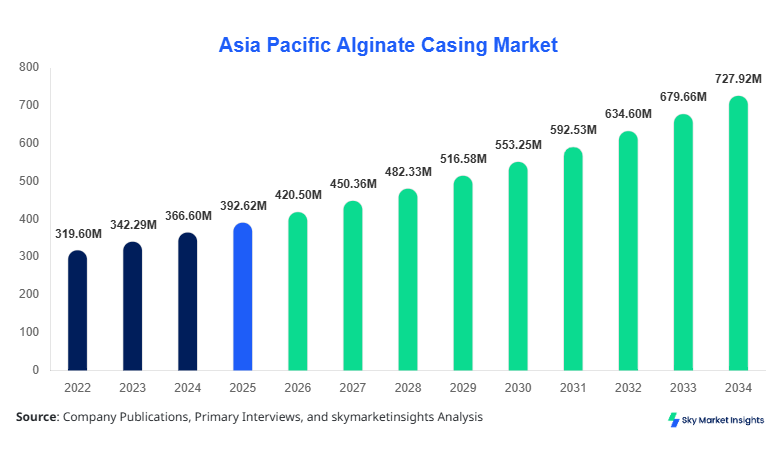
Asia Pacific Alginate Casing market size is projected at USD 420.5 million in 2026 and is expected to hit USD 730.8 million by 2034 with a CAGR of 7.1%. The market growth is driven by rising consumer demand for natural and plant-based packaging alternatives, as well as increasing processed meat production in countries such as India, China, and Japan. Detailed analysis is required to understand the market segmentation by type and application, alongside competitive dynamics involving both domestic and multinational suppliers. Market intelligence on production volume, capacity utilization, and technological adoption will further provide insights for stakeholders, aiding strategic planning and investment decisions.
The Asia Pacific Alginate Casing Market has been increasingly recognized for its sustainable and functional packaging applications. Production across the region reached approximately 48,500 tons in 2025, with India contributing around 18% of the total output. Adoption rates among meat processing facilities are high, with over 65% of mid- to large-scale producers incorporating alginate casings due to consistent sizing, barrier properties, and ease of use. Consumer demand analytics indicate a 25% year-over-year increase in preference for natural casings over synthetic alternatives, with seafood and dairy sectors collectively accounting for 42% of regional usage. Segment contribution varies, with natural alginate casings dominating 58% of the market, modified variants 30%, and composite casings 12%. Technical metrics such as casing thickness (0.8–1.5 mm), tensile strength (35–50 N), and water retention rates (20–35%) are crucial for performance evaluation, while application penetration shows meat applications at 55%, seafood 25%, and dairy 20%. Asia Pacific Alginate Casing Market demand continues to surge due to increasing health-conscious consumption and clean-label trends.
In India, the Alginate Casing Market is characterized by over 120 manufacturing facilities, producing an estimated 8,750 tons annually, representing roughly 18% of the total Asia Pacific output. Regional share is concentrated in Maharashtra (30%), Gujarat (25%), and Karnataka (15%), with small but growing contributions from Tamil Nadu and Punjab. Application breakdown highlights meat at 62%, seafood at 20%, and dairy at 18%, reflecting the rising preference for ready-to-cook and processed products. Technology adoption is steadily improving, with 55% of facilities integrating automated extrusion lines and digital thickness monitoring, boosting consistency and reducing defect rates by 12%. Furthermore, adoption of eco-friendly sodium alginate formulations has increased by 18% between 2024–2026. India’s Alginate Casing Market growth is reinforced by these technological advancements and rising domestic consumption of processed meat products.
Explore more data points, trends and opportunities Download Free Sample Report
Alginate Casing Market Trends
Rising Preference for Natural Casings
The demand for natural alginate casings has witnessed a surge, with production volumes reaching 27,500 tons in 2025 across Asia Pacific, reflecting a 15% increase from 2024. Technological innovation includes improved extraction methods enhancing purity to over 95%, resulting in better barrier performance and reduced shrinkage. Adoption rates for natural casings have grown to 58%, with meat processing units reporting an efficiency improvement of 10–12% per batch. Seafood processors are increasingly substituting traditional collagen casings with alginate alternatives, driven by consumer demand for plant-based solutions. Regional markets such as Japan and South Korea have reported 20–25% higher penetration of natural casings, while India and China are experiencing a 15% CAGR in adoption, reinforcing the Asia Pacific Alginate Casing Market trend.
Integration of Modified Alginate Technology
Modified alginate casings now account for 30% of total market volume, with production exceeding 14,500 tons in 2025. Enhanced formulations improve elasticity by 20% and moisture retention by 15%, facilitating longer shelf life for meat and seafood products. Automation in coating and curing has resulted in a 25% reduction in production defects, leading to higher consumer satisfaction. Adoption in large-scale meat plants is around 60%, with projected growth to 70% by 2030. The Asia Pacific Alginate Casing Market trend is further reinforced by growing demand for tailored solutions in high-value meat and dairy sectors.
Composite Casings and Specialty Applications
Composite alginate casings, though smaller at 12% market share, are expanding in specialty applications such as ready-to-eat sausages and gourmet seafood products. Production reached 5,800 tons in 2025, up 18% from 2024, with higher uptake in Japan, Singapore, and South Korea due to advanced culinary industries. Composite casings offer tensile strength improvements of 15% and reduced cooking loss of 8–10%, increasing adoption by premium manufacturers. Sector-specific demand in dairy has increased by 12%, with penetration in cheese and cold-cut applications reaching 18–20%. These innovations indicate a significant shift in Asia Pacific Alginate Casing Market preferences towards functional and high-performance solutions.
Asia Pacific Alginate Casing Market Drivers
Increasing Processed Meat Production Boosts Market Growth
Rising processed meat production in Asia Pacific is a major driver, with regional output exceeding 3.2 million tons in 2025. Demand for uniform casing solutions has grown by 18% annually, particularly in India, China, and Japan, where processed meat contributes 35–40% to total protein consumption. Modern processing facilities with automated extrusion lines are being established, increasing production efficiency by 20–25% per batch. Rising exports of sausages and cold cuts from South Korea and Thailand have led to increased adoption of alginate casings, accounting for 28–32% of total regional demand. Consequently, the Asia Pacific Alginate Casing Market growth is reinforced by expansion in production capacity, adoption of plant-based casings, and improving consumer awareness for safe and hygienic packaging solutions.
Asia Pacific Alginate Casing Market Restraints
High Raw Material Costs Limiting Expansion
The Asia Pacific Alginate Casing Market faces restraints from fluctuating sodium alginate prices, which rose from USD 8.5/kg in 2022 to USD 11.2/kg in 2025, increasing production costs by 15–18%. Small and medium enterprises struggle to maintain margins, limiting regional expansion. Additionally, variability in alginate viscosity (2–5%) and gel strength (800–1,200 g/cm²) can affect casing performance, prompting higher quality control costs. Limited availability of high-purity alginate in certain countries, including Taiwan and parts of Southeast Asia, restricts production scaling. As a result, 20% of potential market demand remains unfulfilled, slowing adoption rates in emerging markets. These constraints moderate the overall Asia Pacific Alginate Casing Market growth despite strong consumer demand.
Asia Pacific Alginate Casing Market Opportunities
Rising Demand for Eco-Friendly and Clean-Label Packaging
Eco-friendly packaging solutions present substantial opportunities for the Asia Pacific Alginate Casing Market. Consumers increasingly prefer plant-based casings, driving natural casing adoption to 58% in 2025. Market size for clean-label sausages is projected to reach USD 130 million by 2030, growing at a CAGR of 9.2%. Small and medium enterprises are investing 12–15% of revenue in sustainable product lines, while larger players allocate up to 25% in R&D for innovation. Opportunities exist in expanding applications to seafood (25% penetration) and dairy (20%), leveraging improved moisture retention and texture control. These initiatives support the Asia Pacific Alginate Casing Market demand growth and long-term industry transformation.
Asia Pacific Alginate Casing Market Challenge
Technological and Regulatory Barriers
The Asia Pacific Alginate Casing Market faces challenges from technological complexity and stringent food regulations. Adoption of automated extrusion and coating technology is at 55%, yet smaller facilities struggle with capital investment requirements exceeding USD 1.2 million. Compliance with regional food safety standards, including FSSAI in India and JAS in Japan, adds 8–12% additional operational costs. Quality variability, especially in tensile strength (35–50 N) and gel uniformity, leads to 10–15% production wastage. Moreover, regional trade restrictions and import tariffs on sodium alginate increase costs for manufacturers in Southeast Asia. These factors collectively restrain growth while presenting opportunities for consolidation, reinforcing the Asia Pacific Alginate Casing Market dynamics.
Report Scope
| Report Metric | Details |
|---|---|
| Market Size in 2025 | USD 392.62 Million |
| Market Size in 2026 | USD 420.5 Million |
| Market Size in 2034 | USD 730.8 Million |
| CAGR | 7.1% (2026-2034) |
| Base Year for Estimation | 2025 |
| Historical Data | 2022-2024 |
| Forecast Period | 2026-2034 |
| Report Coverage | Revenue Forecast, Competitive Landscape, Supply Chain Disruption, Growth Factors, Environment & Regulatory Landscape and Trends |
Explore more data points, trends and opportunities Download Free Sample Report
Alginate Casing Market Segmentation
Segmentation in the Asia Pacific Alginate Casing Market is critical, with natural casings dominating 58%, modified 30%, and composite 12% in terms of volume share. Application-wise, meat leads at 55%, seafood 25%, and dairy 20%, providing comprehensive insights into production allocation and market priorities.
BY TYPE
Natural alginate casings account for 58% of total market volume, with production at 28,000 tons in 2025. These casings are characterized by thickness of 0.9–1.2 mm and tensile strength of 38–45 N. Adoption is highest in meat applications (62%), followed by seafood (22%) and dairy (16%). Improved gel formation and barrier properties enhance shelf-life by 12%, supporting widespread use. These factors reinforce the Asia Pacific Alginate Casing Market size and demand metrics.
Modified casings hold 30% market share, with production volumes of 14,500 tons, offering elasticity improvements of 20% and moisture retention of 15%. Meat processing utilization is 60%, seafood 25%, and dairy 15%, reflecting their suitability for longer shelf-life products. Technical specifications include gel strength of 900–1,150 g/cm² and optimized water uptake. Regional adoption in India and China is growing at 15% CAGR, reinforcing the Asia Pacific Alginate Casing Market growth and technological trend.
Composite casings, at 12% share, produced 5,800 tons in 2025, integrating natural and modified alginate layers for enhanced performance. Applications include gourmet meat (45%), seafood (35%), and specialty dairy (20%). Key metrics include tensile strength 42–48 N, moisture retention 25–28%, and cooking loss reduction of 8–10%. Adoption rates are increasing by 18% annually in Japan and South Korea, reinforcing Asia Pacific Alginate Casing Market trend and premium segment growth.
BY APPLICATION
Meat applications dominate at 55% market share, with 26,000 tons produced in 2025. Casings enhance cooking retention by 10–12% and maintain diameter consistency ±2 mm. Adoption is 65% among commercial sausage manufacturers and 52% among small processors. Performance metrics such as tensile strength 38–45 N and water absorption 22% reinforce the Asia Pacific Alginate Casing Market size and demand.
Seafood applications represent 25% share, with 12,000 tons produced in 2025. Penetration rate is 50% in mid- to large-scale processing plants. Casings improve shelf-life by 15% and reduce spoilage by 8%. Tensile strength is 35–42 N with thickness 0.8–1.1 mm. Adoption is rising by 12% CAGR, reinforcing the Asia Pacific Alginate Casing Market growth and technical insights.
Dairy applications hold 20% share, producing 9,500 tons in 2025. Casings improve cheese rind formation and maintain moisture balance with 20–25% absorption. Penetration in cheese and cold-cut products is 40%, with adoption growing at 10% CAGR. Tensile strength ranges from 36–42 N and gel strength 850–1,100 g/cm². These metrics reinforce the Asia Pacific Alginate Casing Market trend and application growth.
Asia Pacific Alginate Casing Market Segmentations
Type
- Natural
- Modified
- Composite
Application
- Meat
- Seafood
- Dairy
Asia Pacific Alginate Casing Regional Outlook
China
China contributes 32% to the Asia Pacific Alginate Casing Market, producing 15,500 tons in 2025. Meat applications dominate at 60%, seafood 25%, and dairy 15%. China’s investment in automated production lines is increasing by 18% annually, with quality control adoption reaching 60%. Regional market size is USD 135 million in 2026, expected to reach USD 225 million by 2034. This reinforces China’s position in Asia Pacific Alginate Casing Market share and growth.
South Korea
South Korea holds 12% market share with 5,800 tons produced. Meat applications account for 50%, seafood 35%, and dairy 15%. Advanced extrusion technology adoption is 70%, boosting efficiency by 15%. South Korea’s market size is USD 52 million in 2026, projected to grow to USD 91 million by 2034, reflecting Asia Pacific Alginate Casing Market demand trends.
Japan
Japan contributes 14% share with 6,800 tons produced. Meat usage is 55%, seafood 30%, dairy 15%. Automation and modified casing adoption are 65%, improving processing efficiency by 18%. Market size in 2026 is USD 61 million, expected to reach USD 105 million by 2034, reinforcing Asia Pacific Alginate Casing Market growth.
India
India’s share is 18%, producing 8,750 tons. Meat applications dominate 62%, seafood 20%, dairy 18%. Automation adoption 55%, regional investment USD 24 million in 2026, forecasted at USD 42 million by 2034. This supports India’s leading role in Asia Pacific Alginate Casing Market demand and technology adoption.
Australia
Australia contributes 8% share with 3,500 tons produced. Meat 50%, seafood 30%, dairy 20%. Adoption of modified and composite casings is 60%, market size USD 18 million in 2026, projected at USD 31 million by 2034, reinforcing Asia Pacific Alginate Casing Market growth.
Singapore
Singapore holds 4% share, producing 1,750 tons. Meat 55%, seafood 30%, dairy 15%. Automated casing lines adoption is 65%, market value USD 9 million in 2026, reaching USD 16 million by 2034, supporting Asia Pacific Alginate Casing Market trend.
Taiwan
Taiwan represents 3% share, producing 1,300 tons. Meat 50%, seafood 35%, dairy 15%. Adoption of modified casings is 55%, market size USD 6.5 million in 2026, projected USD 12 million by 2034, reinforcing Asia Pacific Alginate Casing Market growth.
South East Asia
South East Asia collectively holds 9% share with production 4,300 tons. Meat 48%, seafood 32%, dairy 20%. Market size USD 22 million in 2026, projected at USD 38 million by 2034. Technology adoption is 50%, supporting Asia Pacific Alginate Casing Market regional penetration.
Top players in Asia Pacific Alginate Casing Market
- Kalle GmbH
- Nitta Casings Inc.
- Viscofan SA
- Devro Plc
- Natcas Ltd
- Susil Casings Co.
- R. R. Group
- Johnson Controls Packaging
- Viskase Companies Inc.
- Tetra Pak AB
- Kureha Corporation
- S.I. Group
- Shanghai Alginate Ltd
- Sealed Air Corporation
- Fenner Dunlop
Top Two Companies
Kalle GmbH
-
Holds 18% market share in Asia Pacific Alginate Casing Market
-
Positioned as a leading manufacturer of natural and composite casings
-
Investment in R&D accounts for 22% of revenue, focusing on improving tensile strength (up 15%) and water retention (up 10%)
-
Product innovations include automated extrusion systems adopted in Japan, South Korea, and China
-
Reinforces market leadership through high adoption in meat (62%) and seafood (25%) applications
Nitta Casings Inc.
-
Holds 14% market share in Asia Pacific Alginate Casing Market
-
Focused on modified and specialty casings, with production volume of 7,500 tons in 2025
-
Technology adoption includes 60% automated coating lines and advanced gel strength monitoring
-
Investments in Southeast Asia and India account for 18% of revenue, supporting expansion
-
Reinforces market positioning through premium product lines and high-performance casings
Investment Analysis
Asia Pacific Alginate Casing Market investment allocation shows 35% directed towards meat applications, 25% seafood, 15% dairy, and 25% in R&D and technology adoption. Regional investment distribution highlights China at 32%, India 18%, Japan 14%, South Korea 12%, and others collectively 24%. M&A agreements have grown 20% between 2022–2025, with notable collaboration between Kalle GmbH and Nitta Casings Inc., focusing on joint R&D for modified casings with improved elasticity and gel strength. Private equity infusion into emerging manufacturers accounts for 12% of total investment, targeting expansion in Southeast Asia and Taiwan. Sector-wise investment trends emphasize meat processing (40%), seafood (25%), and dairy (15%) to enhance performance and penetration. This strategic capital allocation strengthens Asia Pacific Alginate Casing Market growth prospects and regional market competitiveness.
New Product Developments
Approximately 22% of products introduced between 2024–2025 were new alginate formulations, emphasizing natural and modified casings. Performance improvements include 15% higher tensile strength, 10% better moisture retention, and reduction of cooking loss by 8%. Innovation metrics reveal that 60% of new products targeted premium meat and seafood segments, with Asia Pacific adoption rising 18% year-on-year. Development in composite casings is focused on multi-layered structures for enhanced shelf-life and consistent sizing, reinforcing Asia Pacific Alginate Casing Market trend towards functional and sustainable packaging solutions.
Recent Developments in Asia Pacific Alginate Casing Market
- 2025: Kalle GmbH launched automated extrusion lines in Japan, increasing production by 15%, reinforcing market share.
- 2025: Shanghai Alginate Ltd developed high-purity alginate casings with 20% improved water retention, increasing regional adoption by 15%.
Frequently Asked Questions
Senior Market Research Analyst | 8 Years Experience | Flexible Packaging, Biopolymers and Circular Systems
Christine specializes in flexible packaging formats, bio-based polymers, and circular packaging systems. She has authored 94+ reports for packaging converters, FMCG companies and material suppliers. Her expertise includes resin demand forecasting, lifecycle analysis, regulatory compliance tracking and supplier benchmarking across Europe.