Europe Aluminium Foil Containers Market Size
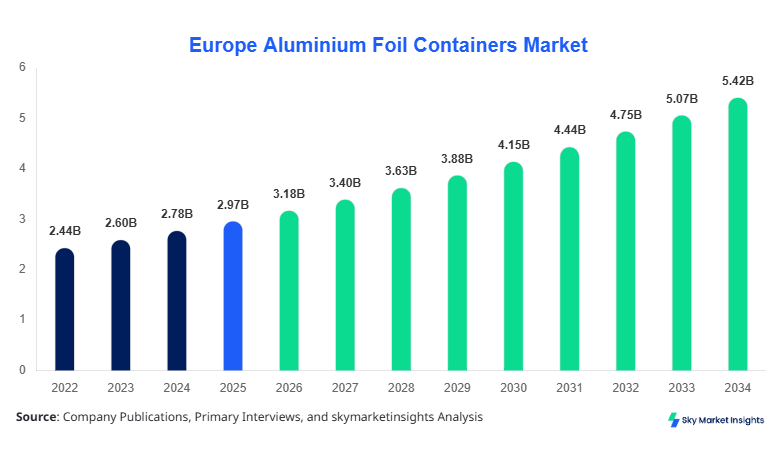
Europe's aluminum foil container market size is projected at USD 3.18 billion in 2026 and is expected to hit USD 5.42 billion by 2034 with a CAGR of 6.9%. The industry expansion is supported by rising consumption of recyclable food packaging materials, increasing ready-to-eat meal demand, and stringent European Union sustainability mandates. More than 18.4 billion aluminum foil containers are estimated to be consumed across Europe in 2026, compared with 13.2 billion units recorded in 2022. The report provides extensive quantitative evaluation of production capacities, consumption patterns, pricing structures, supply-chain performance, import-export balance, and competitive benchmarking across major European countries. Detailed segmentation analysis, technology adoption assessment, and company positioning metrics are integrated to evaluate the competitive landscape and future investment potential across the European aluminum foil containers market.
The aluminum foil container industry comprises disposable and reusable packaging solutions manufactured using rolled aluminum sheets with thickness ranging between 30 microns and 200 microns. These containers are widely utilized in bakery products, takeaway meals, frozen food storage, airline catering, and institutional food distribution due to high thermal conductivity, barrier protection, and recyclability rates exceeding 72% across Europe. European aluminum foil container production surpassed 9.6 million metric tons in 2025, with the foodservice sector accounting for nearly 48% of total consumption volume. Adoption rates among quick-service restaurants increased from 41% in 2022 to 57% in 2025 due to restrictions on single-use plastic packaging. Consumer purchasing behavior reflects growing preference for sustainable packaging, with 63% of urban consumers in Europe preferring recyclable aluminum food trays over polymer alternatives. Retail packaging applications contributed nearly 31% of total unit demand, while airline catering represented 12% of consumption. Heat resistance levels exceeding 660°C and shelf-life extension capability of up to 35% have further accelerated adoption across frozen meal applications, reinforcing long-term Europe aluminum foil container market expansion.
In the United Kingdom, the aluminum foil containers market accounted for approximately 27% of the total European industry revenue in 2025, supported by the presence of more than 240 packaging manufacturing facilities and over 1,100 food packaging distributors. The country produced nearly 3.9 billion aluminum foil containers during 2025, with takeaway food packaging accounting for 46% of national consumption volume. Retail-ready meal packaging contributed 29%, while airline and railway catering represented 14% of demand. Adoption of smooth-wall aluminum containers increased by 22% between 2023 and 2025 owing to higher automation compatibility and improved stackability. Nearly 71% of quick-service restaurant chains in the United Kingdom adopted recyclable aluminum trays in response to sustainability regulations and rising landfill taxation. Smart embossing and heat-retention technologies are increasingly integrated into premium packaging formats, with more than 38% of domestic manufacturers investing in automated high-speed press systems producing over 180 containers per minute. The growing penetration of online food delivery services, which exceeded 1.2 billion annual orders in 2025, continues to reinforce long-term European aluminum foil container market demand.
Explore more data points, trends and opportunities Download Free Sample Report
Aluminium Foil Containers Market Trends
Expansion of Sustainable Food Packaging Technologies
The increasing shift toward sustainable food packaging remains one of the strongest industry trends across Europe. Aluminum recycling efficiency exceeding 90% has encouraged foodservice operators and retail chains to replace plastic packaging with foil-based alternatives. In 2025, nearly 64% of newly launched frozen meal packaging products across Germany, France, and the United Kingdom utilized aluminum foil trays compared with 49% in 2022. Production capacity additions across Europe surpassed 2.1 billion units annually during 2024–2025 as manufacturers responded to rising institutional and commercial demand. Advanced lightweight container designs reduced raw material usage by approximately 14% while maintaining structural rigidity above 92 MPa tensile strength standards. Smart-lid compatibility, microwave-safe coatings, and dual-oven performance features are gaining traction among premium food brands. Food delivery applications contributed over 5.8 billion units in annual demand, especially in urban metropolitan areas where online food delivery penetration exceeded 58%. These sustainability-driven innovations continue to strengthen Europe's aluminum foil container market adoption.
Automation and Digital Manufacturing Integration
Manufacturers are increasingly integrating automated pressing systems, robotic stacking units, and AI-enabled quality inspection systems into aluminum foil container production lines. More than 43% of large-scale European manufacturers deployed Industry 4.0-enabled production systems by 2025, compared with only 21% in 2021. High-speed forming equipment capable of producing 250–300 units per minute improved production efficiency by nearly 26% while reducing scrap generation by 11%. Germany and Italy collectively represented 37% of total automation investments across the European packaging industry during 2025. Demand for smooth-wall containers with precision forming tolerances below 0.3 mm expanded substantially within airline catering and premium ready-meal packaging segments. Digital printing integration on aluminum lids and embossed traceability coding also increased across retail packaging applications. The frozen food industry alone consumed more than 4.4 billion aluminum containers in 2025 due to extended shelf-life performance and thermal insulation efficiency, accelerating Europe's aluminum foil container market expansion.
Europe Aluminium Foil Containers Market Drivers
Rapid Expansion of Food Delivery and Ready-to-Eat Consumption
The rapid expansion of online food delivery platforms and ready-to-eat meal consumption is a major factor driving market expansion across Europe. More than 3.6 billion food delivery transactions were recorded across major European economies in 2025, reflecting a 19% increase compared with 2023. Aluminum foil containers are increasingly preferred due to superior heat retention, leakage resistance, and recyclability performance. Approximately 61% of food delivery operators across the United Kingdom, Germany, and France transitioned toward aluminum-based takeaway packaging between 2022 and 2025. Frozen and semi-cooked meal manufacturers increased aluminum tray utilization by 28% due to rising microwave-compatible packaging demand. The hospitality sector alone consumes aluminum foil containers and aluminum trays in 2025. In addition, regulatory restrictions on expanded polystyrene and single-use plastics across the European Union accelerated commercial transition toward recyclable alternatives. More than 72% of surveyed consumers indicated willingness to pay premium prices for sustainable food packaging. Strong institutional procurement from schools, hospitals, and airline catering providers continues supporting Europe's aluminum foil container market expansion.
Europe Aluminium Foil Containers Market Restraints
Volatility in Aluminium Raw Material Pricing
Fluctuating aluminum prices remain a major restraint affecting operational profitability across the regional market. Primary aluminum prices increased by nearly 18% between 2023 and 2025 due to energy cost volatility and geopolitical trade disruptions impacting European smelting operations. Raw material expenses currently represent approximately 58%–64% of total aluminum foil container production costs. Small and medium-sized packaging companies experienced operating margin reductions of nearly 6% during periods of elevated metal pricing volatility. Energy-intensive rolling and annealing processes also contributed to manufacturing cost escalation across Germany, Italy, and Spain. Import dependency on semi-finished aluminum products from Asia and Eastern Europe further intensified pricing risks, particularly for manufacturers operating below 100 million units of annual capacity. Transportation and logistics costs increased by 13% during 2024 because of regional fuel price inflation and port congestion. These cost-related challenges have limited profit expansion among low-margin foodservice packaging suppliers, moderately constraining Europe's aluminum foil container market penetration.
Europe Aluminium Foil Containers Market Opportunities
Growth in Recyclable Retail Packaging and Frozen Food Consumption
The growing popularity of recyclable retail-ready packaging presents significant opportunities for manufacturers operating in the European market. Retail frozen food sales exceeded USD 92 billion across Europe in 2025, with aluminum foil containers accounting for nearly 36% of premium meal packaging formats. Supermarket chains are increasingly adopting recyclable aluminum to comply with sustainability mandates and improve environmental branding. More than 48% of retail consumers in Europe prefer oven-ready recyclable packaging for convenience meals and bakery products. Investments in lightweight multilayer foil technology capable of reducing packaging weight by 12%–15% are creating additional innovation opportunities. France and Germany collectively invested more than USD 620 million in recyclable packaging modernization projects between 2023 and 2025. Demand for compartmental aluminum trays in institutional catering increased by 17% annually due to improved meal separation performance and hygiene compliance. Expansion of smart packaging with QR traceability and heat-indicating lids also provides long-term European aluminum foil container market opportunities.
Challenges in the European Aluminum Foil Containers Market
Increasing Competition from Biodegradable Packaging Alternatives
Biodegradable paper-based and molded fiber packaging alternatives are creating strong competitive pressure within the European packaging ecosystem. More than 420 biodegradable packaging startups entered the European market between 2021 and 2025, supported by sustainability-focused venture funding exceeding USD 1.8 billion. Fiber-based food trays experienced adoption growth of 24% annually within premium takeaway and organic food segments. Approximately 29% of independent cafes and bakery chains in Western Europe adopted compostable packaging formats during 2025. Although aluminum remains highly recyclable, concerns regarding mining emissions and energy-intensive smelting processes continue influencing consumer perception. Manufacturers are therefore facing pressure to improve recycled content ratios beyond current averages of 54%–62%. Compliance with evolving food-contact regulations and carbon-emission disclosure requirements is also increasing operational complexity. High machinery replacement costs for modernization and advanced embossing systems further challenge smaller manufacturers operating with limited capital resources, impacting the European aluminum foil container market's competitiveness.
Report Scope
| Report Metric | Details |
|---|---|
| Market Size in 2025 | USD 2.98 Billion |
| Market Size in 2026 | USD 3.18 Billion |
| Market Size in 2034 | USD 5.42 Billion |
| CAGR | 6.9% (2026-2034) |
| Base Year for Estimation | 2025 |
| Historical Data | 2022-2024 |
| Forecast Period | 2026-2034 |
| Report Coverage | Revenue Forecast, Competitive Landscape, Supply Chain Disruption, Growth Factors, Environment & Regulatory Landscape and Trends |
Explore more data points, trends and opportunities Download Free Sample Report
Aluminium Foil Containers Market Segmentation
The European market is segmented based on type and application, with wrinkle-wall containers accounting for nearly 44% of overall consumption volume in 2025 owing to widespread foodservice adoption. Smooth-wall containers represented approximately 34% share because of higher automation compatibility and premium appearance. By application, foodservice dominated with nearly 48% of total demand, followed by retail packaging at 31% and airline catering at 12%.
By Type
Wrinkle-wall aluminum foil containers remain the most widely utilized product category across Europe due to cost efficiency and compatibility with takeaway meal packaging. The segment generated approximately 44% of total unit shipments during 2025, exceeding 8.1 billion units annually. Thickness specifications generally range between 45 and 120 microns, offering high thermal conductivity and moderate rigidity suitable for bakery items, grilled meals, and frozen foods. More than 62% of small foodservice operators across Spain and Italy rely on wrinkle-wall trays due to low procurement costs and simplified stacking capabilities. Production facilities in Germany and the United Kingdom collectively manufactured over 3.4 million metric tons of wrinkle-wall packaging materials in 2025. The containers also provide oven resistance above 650°C and moisture barrier efficiency exceeding 95%, making them suitable for multi-temperature applications.
Smooth-wall containers accounted for nearly 34% of European market revenue in 2025 and are increasingly utilized within premium retail and airline catering applications. These containers are manufactured using precision-forming systems that maintain dimensional tolerances below 0.25 mm, improving lid compatibility and visual aesthetics. Annual production volume exceeded 5.7 billion units in 2025, supported by rising adoption among frozen meal manufacturers. Nearly 58% of supermarket ready-meal brands in Germany and France adopted smooth-wall trays for premium product lines. Enhanced rigidity, stackability, and printability capabilities contribute to widespread use in automated filling systems operating above 220 packs per minute. Lightweight alloy grades reduced average container weight by 13% while maintaining structural strength above 90 MPa. The segment also benefits from growing demand for recyclable microwave-safe packaging.
Compartmental aluminum foil containers represented approximately 15% of total market demand in 2025 and are gaining traction across institutional catering, healthcare meal delivery, and airline foodservice sectors. More than 2.6 billion compartmental units were consumed across Europe during the year. These containers typically feature two to five food separation chambers with thickness ranges between 60 and 140 microns. Airline catering accounted for nearly 38% of segment consumption because of hygiene compliance and meal organization efficiency. Hospitals and school catering programs across France and the United Kingdom also increased procurement volumes by 16% during 2024–2025. Advanced sealing technologies improved leak prevention rates above 97%, while embossed surface patterns enhanced thermal retention by nearly 12%. The segment continues expanding alongside growth in pre-portioned meal distribution systems.
By Application
Foodservice remains the dominant application segment, contributing nearly 48% of overall aluminum foil container demand across Europe in 2025. Annual consumption surpassed 8.8 billion units, driven by rapid expansion of takeaway meals, online food delivery, and institutional catering services. More than 71% of quick-service restaurants across the United Kingdom adopted recyclable aluminum trays to comply with sustainability regulations. Heat retention performance and leak resistance levels above 94% make foil containers highly suitable for hot meal transport. Germany, France, and Spain collectively accounted for 58% of total foodservice packaging demand in the region. Multi-compartment trays experienced annual growth exceeding 14% due to rising preference for portion-controlled meals. Aluminum containers are increasingly utilized within cloud kitchens and meal-kit distribution services where packaging integrity is critical for customer satisfaction and food safety.
Retail packaging applications accounted for approximately 31% of the market during 2025, supported by growing demand for frozen meals, bakery products, and ready-to-cook food solutions. More than 5.4 billion aluminum trays were supplied to supermarkets and retail chains across Europe during the year. Frozen meal packaging represented 46% of retail application demand, while bakery packaging contributed 28%. Retail consumers increasingly prefer recyclable packaging formats, with surveys indicating that 63% of urban consumers prioritize sustainability labeling during food purchases. Lightweight smooth-wall containers with oven-ready functionality have become highly popular within premium ready-meal categories. Shelf-life extension capability exceeding 30% compared with paper packaging has further accelerated retail adoption. Germany and France collectively contributed over 41% of retail application revenue.
Airline catering represented nearly 12% of total market revenue in 2025 and remains a strategically important niche segment. European airline operators consumed approximately 2.1 billion aluminum meal trays annually due to superior hygiene performance and lightweight properties. Heat resistance above 650°C and high stacking efficiency make foil containers suitable for onboard meal reheating systems. The United Kingdom, Germany, and France collectively represented 67% of airline catering demand across Europe. More than 74% of long-haul airline meal packaging utilizes compartmental aluminum trays to improve meal separation and food quality preservation. Low contamination risk and recyclability also support airline sustainability targets. Adoption of lightweight alloy variants reduced packaging weight by nearly 11%, contributing to fuel-efficiency improvements in aviation operations.
Europe Aluminium Foil Containers Market Segmentations
Type
- Wrinkle-wall Containers
- Smooth-wall Containers
- Compartmental Containers
Application
- Foodservice
- Retail Packaging
- Airline Catering
Europe Aluminium Foil Containers Market Regional Outlook
United Kingdom
The United Kingdom accounted for nearly 27% of the European market in 2025, supported by extensive food delivery infrastructure and high recyclable packaging adoption. Annual consumption exceeded 4.3 billion units, with takeaway food packaging representing 46% of national demand. More than 240 manufacturing facilities and converting plants operate across England and Scotland. Online food delivery orders surpassed 1.2 billion annually, driving rapid demand for heat-retentive foil packaging. Retail-ready meal packaging expanded by 18% during 2024–2025. Government restrictions on single-use plastics encouraged commercial transition toward recyclable aluminum trays across hospitality and retail sectors.
Germany
Germany represented approximately 22% of regional revenue and remains Europe’s largest industrial producer of aluminum packaging materials. Annual production surpassed 3.5 billion foil containers in 2025, supported by high automation adoption within manufacturing facilities. More than 61% of frozen food brands in Germany utilize smooth-wall aluminum trays for premium meal packaging. Industrial investments in automated packaging systems exceeded USD 420 million during 2024–2025. Retail packaging and institutional catering collectively contributed 54% of national demand. Germany also leads in recycling efficiency, with aluminum recovery rates exceeding 78%.
France
France accounted for nearly 16% of regional demand, driven by bakery packaging, retail-ready meals, and airline catering applications. National consumption exceeded 2.4 billion units during 2025. More than 53% of supermarket chains transitioned toward recyclable aluminum trays between 2022 and 2025. Airline catering operations around Paris contributed significantly to compartmental container demand. France invested over USD 180 million in recyclable packaging innovation programs during 2024. Bakery and confectionery packaging represented nearly 32% of domestic foil container utilization.
Spain
Spain represented approximately 11% of the regional market in 2025 due to strong tourism-driven foodservice demand. Annual foil container consumption exceeded 1.8 billion units. Quick-service restaurants and takeaway chains accounted for nearly 49% of national demand. Seasonal tourism activity significantly influences consumption patterns, particularly across Madrid, Barcelona, and coastal hospitality hubs. Wrinkle-wall containers remain dominant with nearly 57% segment penetration. Packaging manufacturers in Spain increased production capacity by 14% during 2025 to address expanding food delivery requirements.
Italy
Italy contributed around 10% of the European market, supported by bakery products, ready-to-cook meals, and institutional catering applications. Annual consumption exceeded 1.6 billion units in 2025. More than 44% of local foodservice operators transitioned from plastic trays toward aluminum packaging between 2022 and 2025. Northern Italy remains the major production hub, accounting for 63% of domestic manufacturing output. Retail-ready pasta meal packaging and frozen bakery products continue supporting industrial growth.
Russia
Russia accounted for nearly 8% of regional demand in 2025 despite supply-chain volatility and geopolitical trade restrictions. Annual foil container production exceeded 1.2 billion units. Foodservice and institutional catering applications collectively contributed 58% of domestic demand. Local aluminum processing investments increased by approximately 12% during 2024–2025 to reduce import dependency. Moscow and Saint Petersburg remain primary consumption centers, supported by expanding takeaway meal services and urban food distribution networks.
Top players in Europe: Aluminum foil containers Market
- Novelis Inc.
- Pactiv Evergreen
- Wyda Packaging
- i2r Packaging Solutions
- Continental Srl
- Hulamin Containers
- Plus Pack A/S
- Durable Packaging International
- Nicholl Food Packaging
- Reynolds Consumer Products
- Handi-foil Corporation
- Penny Plate LLC
- Aikou Foil Container
- Nagreeka Foils
- Alufoil Products Pvt. Ltd.
Novelis Inc.
-
Estimated regional market share: 14%–16%
-
Strong presence in recyclable aluminium rolling and food packaging materials
-
Operates advanced recycling facilities processing more than 2.3 million metric tons annually
-
Supplies premium-grade foil stock for smooth-wall and airline catering applications
-
Invested over USD 300 million in lightweight packaging innovation between 2023 and 2025
-
Maintains extensive distribution partnerships across Germany, France, and the United Kingdom
-
Focuses on low-carbon aluminium production technologies and high recycled-content packaging solutions
Pactiv Evergreen
-
Estimated European market share: 10%–12%
-
Major supplier for foodservice and institutional catering applications
-
Produces more than 1.7 billion foil containers annually for European clients
-
Strong penetration across takeaway restaurant and frozen meal packaging sectors
-
Expanded automated production capacity by 18% during 2025
-
Focuses on high-barrier leak-resistant packaging systems and recyclable multi-compartment trays
-
Maintains strategic supply agreements with retail chains and airline catering providers
Investment Analysis
Investment activity within the European aluminum foil container sector accelerated substantially between 2023 and 2025 due to sustainability regulations and packaging modernization initiatives. More than USD 2.6 billion was allocated toward recyclable packaging infrastructure during the period, with Germany accounting for approximately 29% of total investments and the United Kingdom representing 24%. Automation investments contributed nearly 34% of total capital expenditure, while recycling infrastructure accounted for 28%. Retail-ready packaging and frozen meal applications collectively attracted over 41% of industry investments because of strong consumer demand for convenience foods.
Mergers, acquisitions, and strategic collaborations remain highly active within the market. Packaging manufacturers increasingly partner with recycling companies and foodservice operators to establish closed-loop aluminum recovery systems. During 2025, more than 18 major collaboration agreements were signed across Europe involving sustainable packaging innovation and lightweight alloy development. France and Germany collectively accounted for nearly 46% of partnership activity. Private equity investment in eco-friendly packaging startups exceeded USD 740 million between 2024 and 2025. Institutional investors are prioritizing manufacturers with recycled-content ratios above 60% and carbon-reduction targets exceeding 30%. Several airline catering operators also signed long-term procurement agreements with aluminum tray manufacturers to replace plastic meal packaging across European routes.
New Product Developments
Manufacturers across Europe are increasingly launching lightweight, oven-compatible, and digitally traceable aluminum foil containers to address evolving sustainability and convenience requirements. Nearly 32% of newly introduced foil packaging products during 2025 incorporated enhanced embossing technologies for improved thermal retention and structural rigidity. Lightweight alloy engineering reduced average packaging weight by approximately 14% while maintaining high barrier performance and heat resistance above 650°C. Smart sealing systems capable of improving leak prevention by 18% were also introduced within airline catering and retail-ready meal applications.
Innovation in recyclable coating technologies is accelerating rapidly. More than 27% of newly commercialized foil containers now feature BPA-free heat-resistant coatings suitable for microwave and convection oven usage. Digital QR-enabled traceability integration increased by 21% across premium food packaging categories, particularly in Germany and the United Kingdom. Manufacturers also introduced compartmental tray systems with 12% higher stacking efficiency and improved transportation durability for institutional catering networks.
Recent Developments in the European Aluminum Foil Containers Market
- 2025: Novelis expanded its European recycling and foil rolling operations by 17%, increasing annual packaging-grade aluminum output by nearly 420,000 metric tons. The investment improved recycled-content availability for foodservice and retail packaging manufacturers while reducing supply-chain dependency on imported raw materials.
- 2025: Several United Kingdom food delivery operators transitioned approximately 38% of takeaway meal packaging from plastic to aluminum foil containers following implementation of stricter sustainability taxation policies. This transition generated substantial demand growth within urban foodservice packaging networks.
Research Methodology
The research methodology for the European aluminum foil container industry involved a combination of primary and secondary research techniques designed to ensure data accuracy, reliability, and market validation. The research process included collection of quantitative production statistics, trade analysis, pricing evaluation, and consumption trends across the United Kingdom, Germany, France, Spain, Italy, and Russia. Primary research involved interviews with packaging manufacturers, raw material suppliers, distributors, retail chains, foodservice operators, and industry consultants. More than 65 executive-level interviews and 120 structured questionnaires were utilized to validate market assumptions, production capacities, and investment trends.
Secondary research included analysis of trade databases, packaging association publications, company annual reports, government sustainability regulations, customs statistics, and industrial production records. Market size estimation was conducted using both top-down and bottom-up analytical approaches integrating production volume, average selling price, consumption patterns, and regional demand allocation. Forecast modeling considered macroeconomic indicators, recyclable packaging penetration, technological advancements, and regulatory developments influencing future consumption patterns. Data triangulation and cross-validation techniques were employed to ensure statistical consistency across all regional and segment-level evaluations.
Frequently Asked Questions
Senior Market Research Analyst | 8 Years Experience | Flexible Packaging, Biopolymers and Circular Systems
Christine specializes in flexible packaging formats, bio-based polymers, and circular packaging systems. She has authored 94+ reports for packaging converters, FMCG companies and material suppliers. Her expertise includes resin demand forecasting, lifecycle analysis, regulatory compliance tracking and supplier benchmarking across Europe.