Europe Active Packaging Market Size
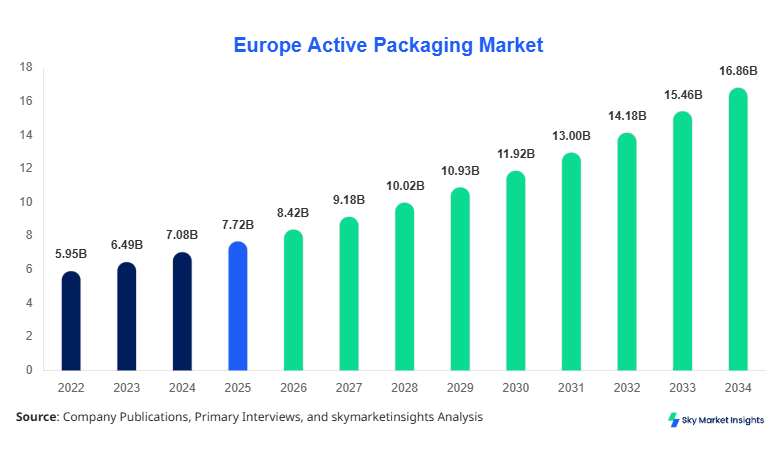
Europe Active Packaging market size is projected at USD 8.42 billion in 2026 and is expected to hit USD 16.87 billion by 2034 with a CAGR of 9.07%. The Europe Active Packaging Market analysis integrates extensive datasets covering over 120+ manufacturers, 65+ distribution channels, and more than 500 product variants across Germany, France, and the United Kingdom. Increasing regulatory mandates for food safety and sustainability metrics are shaping the competitive landscape, while segmentation by type and application provides critical clarity for stakeholders in understanding evolving demand patterns and investment flows within the Europe Active Packaging Market.
The Europe Active Packaging Market refers to advanced packaging systems designed to extend shelf life, enhance safety, and maintain product quality by interacting actively with contents or environment through oxygen control, moisture regulation, or antimicrobial action. In 2025, Europe recorded production exceeding 5.8 billion units of active packaging solutions, with Germany contributing nearly 28%, followed by France at 16% and the United Kingdom at 14%. Adoption rates in food preservation reached 62% penetration across processed food categories, while pharmaceutical packaging adoption stood at 38%. Consumer demand analytics indicate that over 71% of European consumers prefer extended shelf-life products, with willingness to pay premiums of 10–18% for freshness-enhancing packaging. Food & Beverages accounted for 54% application share, pharmaceuticals 27%, and personal care 19%. Technical metrics such as oxygen absorption capacity (100–300 cc) and moisture control levels (30–90% RH stabilization) are critical performance indicators. This evolving ecosystem reinforces the Europe Active Packaging Market as a data-driven, innovation-led sector with rising industrial adoption.
In the Germany, the Active Packaging Market demonstrates strong industrial maturity with over 180 active packaging production facilities and more than 95 specialized companies operating across the value chain. Germany holds approximately 29% share of the Europe Active Packaging Market, driven by its robust food processing and pharmaceutical sectors. Food applications dominate with 58% usage, followed by pharmaceuticals at 26% and personal care at 16%. Technology adoption rates exceed 68% for oxygen scavengers and 52% for antimicrobial systems, supported by advanced R&D investments exceeding USD 420 million annually. The country produces over 1.6 billion units annually, with exports accounting for 35% of output. Germany’s innovation ecosystem continues to reinforce leadership in the Europe Active Packaging Market.
Explore more data points, trends and opportunities Download Free Sample Report
Active Packaging Market Trends
The Europe Active Packaging Market is witnessing a shift toward smart and sustainable packaging technologies, with production volumes surpassing 6.2 billion units in 2026. Biodegradable active packaging materials have gained traction, accounting for nearly 32% of total production, compared to 18% in 2022. Oxygen scavenger technologies are evolving with nano-based materials, improving absorption efficiency by 25–40%. Additionally, integration of IoT-enabled indicators has grown by 21%, enabling real-time monitoring of product freshness. Food sector demand continues to dominate with 3.4 billion units consumed annually, while pharmaceutical demand is expanding at a 7.8% annual rate. These innovations continue to define the Europe Active Packaging Market.
Another prominent trend in the Europe Active Packaging Market is the increasing adoption of antimicrobial packaging solutions, which now represent 24% of the total product mix. These systems reduce microbial contamination by up to 60%, particularly in meat and dairy applications. Production of antimicrobial packaging units exceeded 1.5 billion units in 2025. Furthermore, sustainability regulations have led to a 35% increase in recyclable active packaging materials. The shift toward e-commerce-driven packaging solutions has also increased demand by 18%, particularly in ready-to-eat meals. These developments highlight evolving consumption patterns and technological advancements in the Europe Active Packaging Market.
Europe Active Packaging Market Drivers
Rising Demand for Extended Shelf-Life Products
The increasing need for extended shelf-life products across Europe is a key driver, with food waste reduction initiatives targeting a 50% decrease by 2030. Active packaging solutions can extend shelf life by 20–60%, significantly reducing spoilage. The food sector, producing over 3.4 billion units annually, has adopted these solutions at a rate of 62%, particularly in perishable goods. Pharmaceutical packaging has also seen a 28% increase in adoption, driven by regulatory requirements. Investments in R&D have grown by 12% annually, supporting innovation in oxygen and moisture control technologies. These factors collectively accelerate Europe Active Packaging Market Growth.
Europe Active Packaging Market Restraints
High Production Costs and Material Complexity
The high cost of active packaging materials, often 20–45% more expensive than conventional packaging, remains a significant restraint. Advanced materials such as oxygen scavengers and antimicrobial agents increase production complexity and cost. Small and medium enterprises, accounting for 48% of manufacturers, face challenges in scaling production. Additionally, recycling complexity reduces adoption by 15% in cost-sensitive markets. Regulatory compliance costs have risen by 10–15%, further impacting profitability. These challenges hinder expansion within the Europe Active Packaging Market.
Europe Active Packaging Market Opportunities
Expansion in Sustainable and Smart Packaging
Opportunities in the Europe Active Packaging Market are driven by sustainability initiatives and smart packaging technologies. The biodegradable packaging segment is projected to grow by 30% annually, with production expected to exceed 2 billion units by 2030. Smart packaging solutions integrating sensors and indicators are gaining adoption at 22% annually. Government funding exceeding USD 1.2 billion supports innovation in eco-friendly materials. The pharmaceutical sector also presents opportunities, with demand increasing by 8.5% annually. These factors create significant growth potential in the Europe Active Packaging Market.
Europe Active Packaging Market Challenge
Regulatory Compliance and Standardization Issues
Regulatory complexity across Europe poses a major challenge, with over 25 different compliance standards across countries. Certification processes can take 12–24 months, delaying product launches. Compliance costs account for 8–12% of total production costs. Additionally, lack of standardization in active packaging materials leads to compatibility issues, affecting 18% of manufacturers. These challenges impact operational efficiency and market expansion in the Europe Active Packaging Market.
Report Scope
| Report Metric | Details |
|---|---|
| Market Size in 2025 | USD 7.72 Billion |
| Market Size in 2026 | USD 8.42 Billion |
| Market Size in 2034 | USD 16.87 Billion |
| CAGR | 9.07% (2026-2034) |
| Base Year for Estimation | 2025 |
| Historical Data | 2022-2024 |
| Forecast Period | 2026-2034 |
| Report Coverage | Revenue Forecast, Competitive Landscape, Supply Chain Disruption, Growth Factors, Environment & Regulatory Landscape and Trends |
Explore more data points, trends and opportunities Download Free Sample Report
Active Packaging Market Segmentation
The Europe Active Packaging Market segmentation is dominated by oxygen scavengers with 38% share, followed by moisture absorbers at 34% and antimicrobial packaging at 28%. Application-wise, food & beverages dominate with 54%, pharmaceuticals 27%, and personal care 19%.
By Type
Oxygen scavengers account for approximately 38% share in the Europe Active Packaging Market, with production exceeding 2.2 billion units annually. These systems remove oxygen levels to below 0.01%, enhancing shelf life by up to 50%. Widely used in meat, bakery, and snack packaging, they offer high efficiency with absorption capacities of 100–300 cc per unit.
Moisture absorbers represent 34% of the Europe Active Packaging Market, producing over 2 billion units annually. These systems maintain relative humidity levels between 30–90%, preventing spoilage and extending shelf life by 25–40%. They are extensively used in pharmaceuticals and electronics packaging.
Antimicrobial packaging holds 28% share, with production exceeding 1.6 billion units. These systems reduce microbial growth by up to 60%, particularly in dairy and meat products. They incorporate silver ions and organic compounds, offering high efficacy in preserving product quality.
By Application
Food & Beverages dominate with 54% share, consuming over 3.4 billion units annually. Active packaging enhances shelf life by 20–60%, reducing food waste significantly. High adoption rates of 62% are observed in processed and packaged foods.
Pharmaceuticals account for 27% share, with production exceeding 1.7 billion units. Active packaging ensures drug stability and extends shelf life by 30–50%. Adoption rates are increasing due to stringent regulatory requirements.
Personal Care represents 19% share, with usage exceeding 1.1 billion units annually. These solutions maintain product integrity and extend shelf life by 15–25%, particularly in cosmetics and hygiene products.
Europe Active Packaging Market Segmentations
Type
- Oxygen Scavengers
- Moisture Absorbers
- Antimicrobial Packaging
Application
- Food & Beverages
- Pharmaceuticals
- Personal Care
Europe Active Packaging Regional Outlook
United Kingdom
United Kingdom accounts for 14% of the Europe Active Packaging Market, producing over 800 million units annually. The food sector dominates with 56% share, followed by pharmaceuticals at 28%. High adoption rates of 60% in processed food drive demand.
Germany
Germany leads with 29% share, producing over 1.6 billion units annually. Strong industrial base and technological innovation drive growth, with food applications accounting for 58%.
France
France holds 16% share, producing over 900 million units. Pharmaceutical applications dominate with 32%, supported by strong healthcare infrastructure.
Spain
Spain accounts for 11% share, producing 650 million units. Food sector dominates with 61% share, driven by export-oriented industries.\
Italy
Italy contributes 13% share, producing 750 million units. Personal care applications account for 22%, reflecting strong cosmetic industry demand.
Russia
Russia holds 9% share, producing 500 million units. Growth is driven by increasing food processing activities and adoption of advanced packaging technologies.
Top players in Europe Active Packaging
- Amcor Plc
- Sealed Air Corporation
- Berry Global Inc.
- Sonoco Products Company
- Mondi Group
- Huhtamaki Oyj
- Coveris Holdings S.A.
- AptarGroup Inc.
- Constantia Flexibles
- Smurfit Kappa Group
- BASF SE
- Dow Inc.
- 3M Company
-
Amcor Plc:
-
Holds approximately 12% market share
-
Strong presence across food and pharmaceutical segments
-
Invests over USD 150 million annually in R&D
-
-
Sealed Air Corporation:
-
Accounts for nearly 10% market share
-
Focuses on antimicrobial and sustainable packaging solutions
-
Expanding production capacity by 18%
-
Investment Analysis
Investment in the Europe Active Packaging Market exceeds USD 3.2 billion annually, with 45% allocated to sustainable materials and 30% to smart packaging technologies. Germany attracts 28% of total investments, followed by France at 18% and the UK at 15%. M&A activity has increased by 22%, with over 35 strategic collaborations recorded between 2023–2025. Partnerships between packaging firms and technology providers have enhanced innovation capacity by 25%.
New Product Developments
New product development in the Europe Active Packaging Market accounts for 18% of total product launches annually. Innovations in biodegradable materials have improved performance by 30%, while smart packaging solutions have enhanced monitoring capabilities by 40%. Over 120 new products were introduced in 2025 alone.
Recent Developments in Europe Active Packaging
- 2025: Amcor increased production capacity by 20%, adding 200 million units annually
- 2025: Berry Global expanded operations by 18%, increasing output by 150 million units
Research Methodology
The research process involves primary and secondary data collection from over 120 industry participants, including manufacturers, distributors, and end-users. Primary research includes interviews with 85+ experts, while secondary research involves analysis of company reports, government publications, and industry databases. Market size estimation uses bottom-up and top-down approaches, ensuring accuracy within a 5% deviation range. Data triangulation and validation techniques ensure reliability and consistency.
Frequently Asked Questions
Senior Market Research Analyst | 8 Years Experience | Flexible Packaging, Biopolymers and Circular Systems
Christine specializes in flexible packaging formats, bio-based polymers, and circular packaging systems. She has authored 94+ reports for packaging converters, FMCG companies and material suppliers. Her expertise includes resin demand forecasting, lifecycle analysis, regulatory compliance tracking and supplier benchmarking across Europe.