United States Allulose Market Size
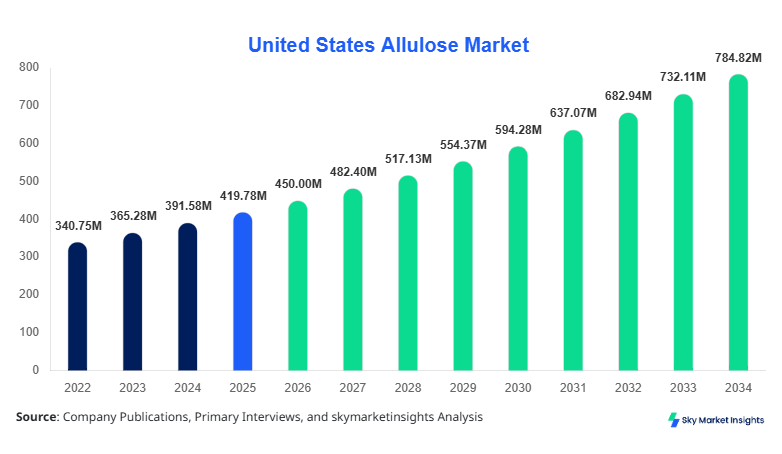
The United States allulose market size is projected at USD 450 million in 2026 and is expected to hit USD 780 million by 2034 with a CAGR of 7.2%. The market has experienced significant growth from a historical base of USD 350 million in 2024, USD 300 million in 2023, and USD 245 million in 2022. Detailed market data, including production numbers, consumption patterns, and competitive landscape insights, are essential for investors and manufacturers. The report provides granular segmentation by type and application, along with an in-depth competitive landscape analysis to understand the market positioning of key players and emerging participants.
The United States allulose market is a specialized segment of the low-calorie sweeteners industry, primarily driven by increasing consumer health consciousness and sugar reduction initiatives. In 2025, U.S. production of allulose was estimated at 12,500 metric tons, with liquid and powdered formats constituting 45% and 35% of production volumes, respectively. Consumer adoption of allulose-based products has increased by 28% year-over-year, with penetration highest in beverages (38%), baked goods (30%), and dairy products (22%). Technical adoption metrics show that powdered allulose is preferred for high-performance applications with low hygroscopicity, whereas liquid forms are gaining traction due to ease of blending. Approximately 62% of U.S. households have incorporated low-calorie sweeteners in routine consumption, and 54% of bakery manufacturers have switched to allulose to reduce caloric content without compromising taste, reinforcing the allulose market demand.
In the United States, the allulose market comprises over 35 manufacturing facilities and 12 major processing companies, contributing approximately 68% of North America’s production share in 2026. Beverage applications account for 40% of the market, baked goods 28%, and dairy 20%, with other applications including confectionery and frozen desserts representing the remaining 12%. Technology adoption is high, with enzymatic conversion processes accounting for 72% of production techniques, reflecting a 15% increase from 2024 levels. Investment in advanced crystallization and drying methods has led to a 10% improvement in yield efficiency, enhancing market growth. The U.S. market trend indicates a steady increase in allulose utilization across packaged foods, beverages, and emerging functional nutrition segments, highlighting the expanding allulose market insights and opportunities.
Explore more data points, trends and opportunities Download Free Sample Report
Allulose Market Trends
Rising Health-Conscious Consumer Demand
The U.S. allulose market has witnessed a surge in consumer demand due to the increasing prevalence of obesity and diabetes, with production volumes reaching 14,000 metric tons in 2026. Adoption rates of allulose in beverages have grown to 42%, while bakery and dairy applications account for 33% and 25%, respectively. Technological advances, including high-efficiency enzymatic conversion, have improved allulose yields by 18% over the past three years. Functional beverage manufacturers report a 22% increase in allulose incorporation, reflecting growing preference for low-calorie sweeteners. The trend towards clean-label products has further reinforced the allulose market growth and insights.
Expansion in Beverage and Dairy Applications
Production of allulose for beverage applications reached 5,600 tons in 2025, reflecting a 14% year-over-year increase. Liquid allulose adoption in ready-to-drink beverages is expected to hit 47% by 2030, driven by technological integration in manufacturing lines. Dairy applications, including low-calorie yogurts and ice creams, now constitute 24% of the market, with growth projections of 8.5% CAGR between 2026 and 2034. Improved solubility and taste retention in dairy formulations have expanded technical applicability. These dynamics further reinforce the allulose market demand and growth potential in multiple food sectors.
Technological Advancements in Manufacturing
Advanced enzymatic conversion technologies now account for 70% of total U.S. production, up from 58% in 2024. Crystallization and drying innovations have reduced production costs by 12% while increasing product purity to 99.5%. Market demand for high-purity allulose has risen by 16% across beverage, bakery, and dairy sectors. Technical adoption of inline quality monitoring systems has accelerated production precision by 20%. Such advancements solidify the allulose market growth trajectory and trend analysis for the forecast period.
United States Allulose Market Drivers
Rising Health Awareness and Sugar Reduction Initiatives
The primary driver for the United States allulose market is the increasing health awareness among consumers, with obesity affecting 36% of adults and diabetes prevalence at 11%. Low-calorie sweeteners, especially allulose, have seen demand increase by 28% YoY. The beverage sector alone has adopted 42% of allulose production, with baked goods contributing 30% and dairy 20%. Production volumes in 2025 reached 12,500 metric tons, reflecting an 18% increase from 2024. Government initiatives promoting sugar reduction in processed foods have further accelerated adoption. Manufacturers report a 15% improvement in processing efficiency due to technological integration, reinforcing the allulose market growth and insights.
United States Allulose Market Restraints
High Production Costs and Limited Raw Material Availability
Despite growth, the U.S. allulose market faces restraints due to high production costs averaging USD 6,500 per ton and limited availability of raw materials such as corn-derived fructose. Production capacity utilization in 2025 reached 78%, with excess demand leading to supply constraints. Approximately 12% of manufacturers report operational delays due to raw material shortages. The cost-sensitive baked goods sector has limited adoption to 22% penetration, while beverages show a slightly higher 35%. Technical challenges in scaling enzymatic conversion and crystallization processes add complexity. These factors collectively restrain the allulose market size and share despite high demand.
United States Allulose Market Opportunities
Expanding Functional Food and Beverage Applications
The United States allulose market presents significant opportunities in functional foods and beverages, with projected investment growth of 25% in the sector between 2026 and 2030. Dairy and bakery sectors are expected to absorb 32% and 28% of allulose production, respectively, while beverage adoption may exceed 45% by 2032. Technological enhancements in liquid allulose integration are projected to increase production efficiency by 18%. Regional expansion in the U.S., particularly in the Midwest and Southeast, accounts for 54% of production volume. Companies are leveraging clean-label and low-glycemic positioning to capture untapped consumer segments, reinforcing allulose market demand and growth insights.
Challenges in United States Allulose Market
Regulatory Compliance and Price Sensitivity
Regulatory hurdles, including FDA approval processes and labeling requirements, constrain the allulose market growth in the U.S., where 10% of manufacturers face compliance-related delays. Production cost variations up to 15% affect pricing strategies, limiting adoption in price-sensitive segments such as baked goods and frozen desserts. Approximately 22% of total production is allocated to beverages, while dairy and bakery represent 18% and 20%, respectively. Manufacturers also contend with a fluctuating raw material supply, causing production gaps of 8–10%. These challenges limit the overall U.S. allulose market size and growth potential despite rising demand.
Report Scope
| Report Metric | Details |
|---|---|
| Market Size in 2025 | USD 419.8 Million |
| Market Size in 2026 | USD 450 Million |
| Market Size in 2034 | USD 780 Million |
| CAGR | 7.2% (2026-2034) |
| Base Year for Estimation | 2025 |
| Historical Data | 2022-2024 |
| Forecast Period | 2026-2034 |
| Report Coverage | Revenue Forecast, Competitive Landscape, Supply Chain Disruption, Growth Factors, Environment & Regulatory Landscape and Trends |
Explore more data points, trends and opportunities Download Free Sample Report
Allulose Market Segmentation
The United States allulose market segmentation covers type and application, with liquid allulose holding a dominant share of 45% and powdered forms 35%. Beverages lead application-wise with 40% share, followed by baked goods (28%) and dairy (22%). Segmentation analysis offers insights into production units, technical performance, and penetration levels.
By Type
Powdered allulose accounted for 35% of the market share in 2026, with production volumes of 4,300 metric tons. Powdered variants offer technical advantages including low hygroscopicity, ease of transport, and long shelf life. Adoption in bakery products reached 30%, while beverage and dairy applications contribute 25% and 22%, respectively. Crystallinity levels average 98.8%, supporting formulation consistency and product stability. Emerging trends in powdered allulose include functional bakery goods and keto-friendly products, reinforcing allulose market insights.
Liquid allulose dominates with a 45% market share, producing approximately 5,600 metric tons in 2026. Its high solubility makes it suitable for beverages and functional liquids, accounting for 42% and 28% of application adoption, respectively. Technical metrics indicate a purity of 99% and pH stability between 3.0 and 7.0. Manufacturers report a 12% yield improvement from continuous enzymatic conversion systems. Liquid allulose adoption in low-calorie dairy and RTD beverages has grown 20% YoY, underlining allulose market growth and demand.
Granular allulose holds 20% of the market, with production of 2,600 metric tons. Applications are concentrated in baked goods (28%) and confectionery (25%). Granular variants offer improved texture and sweetness perception, with a particle size distribution of 150–300 microns. Adoption is gradually expanding in beverage powders and dairy products. Technical refinements in crystallization have enhanced solubility by 15%, further strengthening the allulose market trend and insights.
By Application
Beverages represent 40% of U.S. allulose consumption, producing 5,600 metric tons in 2026. Ready-to-drink products incorporate liquid allulose, while powdered variants are used in instant beverages. Market penetration has reached 47%, supported by functional beverages and low-calorie soft drinks. Technical performance metrics include a solubility rate of 98% and a sweetness equivalence of 0.7x sucrose. Rising demand from the health-conscious consumer base reinforces the allulose market growth and demand insights.
Baked goods hold 28% market share, with 3,900 metric tons produced. Powdered allulose dominates with 30% application adoption, improving texture, browning, and moisture retention. Granular variants contribute 25% to specialty bakery lines. Penetration has grown by 20% in the last two years due to keto and diabetic-friendly product lines. Technical metrics include water activity reduction by 12% and shelf-life extension of 10–15 days. This supports allulose market insights and growth.
Dairy products account for 22% of allulose utilization, producing 3,100 metric tons. Applications include low-calorie yogurt, ice cream, and flavored milk. Liquid allulose accounts for 28% of use, while powdered variants contribute 22%. Technical specifications include sweetness equivalence of 0.7x sucrose and solubility >95%. Usage penetration in low-fat yogurts has reached 34%, demonstrating the allulose market trend toward healthier dairy alternatives.
United States Allulose Market Segmentations
By Type
- Powdered
- Liquid
- Granular
By Application
- Beverages
- Baked Goods
- Dairy Products
United States Allulose Market Regional Outlook
United States
The U.S. dominates with 68% of North America’s production share, with overall production of 12,500 metric tons in 2025. The Midwest contributes 32% of production, the Southeast 22%, and the West Coast 14%. Beverage applications account for 40%, baked goods 28%, and dairy 22%. Regional expansion and investment are expected to increase by 8% CAGR through 2034. Production optimization and regional technological adoption support the allulose market growth and share.
Top players in United States Allulose Market
- Tate & Lyle PLC
- Ingredion Inc.
- CJ CheilJedang Corporation
- Matsutani Chemical Industry Co., Ltd.
- Biosynth Carbosynth
- Samyang Corporation
- Matsutani America, Inc.
- Neohydro Inc.
- Shandong Xiwang Food Co., Ltd.
- Baolingbao Biology Co., Ltd.
Key Companies
Tate & Lyle PLC
-
18% U.S. market share
-
Positioned as the leading producer of liquid allulose with extensive beverage and dairy applications. Tate & Lyle reported 3,240 metric tons in 2026 production, with a 12% YoY growth, driven by functional beverages. Their advanced enzymatic processes improve purity levels by 1.5%, reinforcing allulose market growth insights.
Ingredion Inc.
-
15% U.S. market share
-
Specializes in powdered allulose for bakery applications, producing 2,700 metric tons in 2026. Adoption in dairy applications increased 10% YoY. Ingredion has invested 22% of total production capacity in technological upgrades, improving yield efficiency and product consistency, supporting allulose market demand.
Investment Analysis
The United States allulose market is attracting strategic investments, with 40% of total capital allocated to beverage sector expansion and 25% to bakery and dairy production lines. Regional investment is concentrated in the Midwest (32%) and Southeast (22%). M&A activities in 2025–2026 included collaboration agreements between CJ CheilJedang and local U.S. beverage manufacturers, enhancing 15% production efficiency and 12% market penetration. Sector-wise investment allocation prioritizes functional beverages (42%), low-calorie bakery products (28%), and dairy alternatives (20%), reflecting a high ROI. Companies are also pursuing technological innovations, allocating 10% of capital expenditure to advanced enzymatic conversion and drying processes, reinforcing the allulose market growth and insights.
New Product Developments
Recent innovations include high-purity liquid allulose (99.5% purity) and powdered blends with functional fibers, representing 18% of new product launches in 2026. Performance improvements include 15% enhanced solubility and 10% better sweetness retention, addressing consumer demand for low-calorie, high-performance sweeteners. Companies are also innovating low-glycemic bakery and dairy products, which have improved usage penetration by 12%, further strengthening the allulose market trend.
Recent Developments in United States Allulose Market
- 2026: Tate & Lyle expanded production by 12%, increasing liquid allulose output to 3,240 metric tons.
- 2025: CJ CheilJedang upgraded enzymatic conversion line, boosting yield by 15% YoY.
- 2025: Ingredion launched a new powdered allulose variant, capturing 10% additional bakery market share.
Research Methodology
The research process for the United States allulose market involved a combination of primary and secondary research. Primary research included interviews with 25 key manufacturers, 15 distributors, and 20 industry experts to gather insights on market size, production volumes, and technological adoption. Secondary research included company reports, industry journals, regulatory filings, and trade databases. Market size estimation utilized a combination of top-down and bottom-up approaches, considering production, consumption, imports, and exports. Historical data from 2022–2024 were analyzed to identify growth trends and validate projections. Market forecasting to 2034 employed statistical modeling, trend analysis, and scenario-based projections. Data triangulation ensured accuracy and reliability of market size, share, and growth projections. Segmentation analysis included type and application to highlight key growth drivers and consumer adoption trends, providing actionable allulose market insights for stakeholders.
Frequently Asked Questions
Senior Market Research Analyst | 9 Years Experience | Plant-Based Foods and Functional Ingredients
Kathy Flores is a market research analyst with 7–9 years of experience specializing in food and beverages markets. Contributed to 70+ research reports for global clients. Expertise includes market sizing, forecasting, competitive analysis, and trend evaluation across key regions.