United States Alginates & Derivatives Market Size
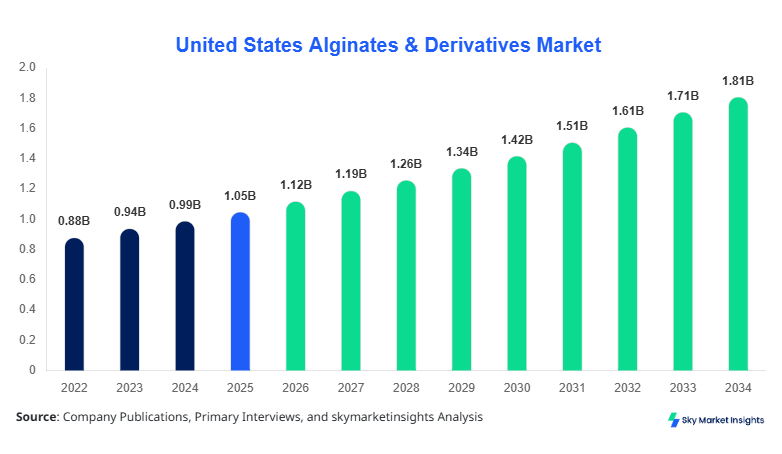
The United States alginates & derivatives market size is projected at USD 1.12 billion in 2026 and is expected to hit USD 1.84 billion by 2034 with a CAGR of 6.2%. The market analysis leverages extensive segmentation and competitive landscape mapping to identify growth levers and market potential. Data-driven insights for the United States alginates & derivatives market encompass production trends, consumption volumes, import-export statistics, and adoption rates across food, pharmaceutical, and textile sectors. Competitive benchmarking includes key regional players, revenue distribution, and market share across types and applications to guide strategic investment decisions.
The alginates & derivatives market in the United States is primarily driven by rising demand in food stabilizers, pharmaceutical excipients, and textile finishing applications. The United States produced an estimated 65,000 tons of alginates in 2025, with sodium alginate accounting for 52%, calcium alginate 33%, and potassium alginate 15% of the total production volume. Adoption and penetration in food & beverage applications reached 48%, pharmaceuticals 35%, and textiles 17% in 2025, reflecting a growing consumer preference for natural stabilizers and binders. Consumer behavior indicates a 14% year-on-year increase in demand for clean-label ingredients, with technical parameters such as viscosity range (2,000–10,000 cps) and gel strength (150–300 g/cm²) influencing product selection. Overall, the United States alginates & derivatives market insights indicate increasing industrial adoption, particularly in high-volume food processing and pharmaceutical formulation sectors.
In the United States, the alginates & derivatives market comprises approximately 42 manufacturing facilities and over 25 active companies. The United States contributes nearly 45% of the North American market share, with food & beverage applications accounting for 50% of total consumption, pharmaceuticals 30%, and textile applications 20%. Technology adoption is progressing rapidly, with enzymatic extraction methods representing 28% of production and continuous stirred-tank reactors reaching 18% adoption in major facilities. Sodium alginate dominates with a 53% production share, while calcium and potassium alginates account for 30% and 17%, respectively. The United States alginates & derivatives market demand continues to expand, with a focus on high-purity grades and enhanced functional performance across applications.
Explore more data points, trends and opportunities Download Free Sample Report
Alginates & Derivatives Market Trends
Rising Demand in Functional Foods
The United States alginates & derivatives market has observed a surge in functional food applications, with production volumes exceeding 22,500 tons in 2025, a 6% increase from 2024. Adoption of sodium alginate in low-fat dairy products has reached 48%, driven by consumer preference for texture-enhancing natural ingredients. Enzymatic extraction technologies have been increasingly adopted, with a 28% penetration rate, reducing processing time by 15% and improving gel strength by 12%. Sector-specific demand in bakery and confectionery applications has increased 9% year-over-year, highlighting the market’s growth potential. These insights demonstrate that the alginates & derivatives market is increasingly aligned with health-conscious consumer trends.
Pharmaceutical Sector Expansion
Pharmaceutical applications of alginates, including controlled-release tablets and wound dressings, contributed approximately 9,200 tons in 2025. Calcium alginate remains the preferred derivative with 34% share, while sodium alginate accounts for 53% due to its viscosity and stability benefits. Technology adoption in encapsulation and freeze-drying processes has grown by 22%, enhancing product efficacy and shelf-life. United States Alginates & Derivatives market insights reveal that ongoing R&D investments are fostering formulation improvements and expanding pharmaceutical use cases, driving steady market growth.
Sustainable Textile Applications
In the textile industry, alginates are increasingly used for printing and sizing applications, with 5,500 tons produced in 2025, reflecting a 7% year-over-year increase. Adoption of biodegradable formulations has reached 19%, in line with environmental regulations. Sodium and calcium alginate combinations are employed to improve dye retention and reduce water consumption, enhancing overall process efficiency. United States alginates & derivatives market growth is supported by rising demand for eco-friendly textile solutions, reinforcing sustainability trends.
United States Alginates & Derivatives Drivers
Rising Demand from Food & Beverage Sector
The primary driver of the United States alginates & derivatives market is the increasing consumption of natural stabilizers in processed food. Sodium alginate production reached 33,000 tons in 2025, contributing 52% of the market share, while calcium and potassium alginate production volumes were 21,000 and 9,400 tons, respectively. Functional foods and beverages drove 48% of total demand, with annual consumption growth at 8% from 2022–2025. Consumer awareness of clean-label ingredients is projected to enhance adoption rates by 10–12% through 2034. Viscosity specifications ranging from 2,000–10,000 cps and gel strengths of 150–300 g/cm² are critical parameters influencing selection. United States alginates & derivatives market insights indicate sustained growth potential, particularly in high-volume food processing industries.
United States Alginates & Derivatives Restraints
High Raw Material Cost and Supply Chain Constraints
Rising raw material costs for brown seaweed, which accounts for 70% of alginate production, have constrained market growth. Average procurement costs increased 12% from USD 1,200/ton in 2024 to USD 1,344/ton in 2025. Supply chain disruptions have impacted 45% of small and mid-sized manufacturers, limiting production volumes by 8–10%. Calcium alginate production was constrained to 21,000 tons in 2025 due to these challenges. The United States alginates & derivatives market growth is moderated by these operational and cost pressures, necessitating innovation in extraction technologies to maintain competitiveness.
United States Alginates & Derivatives Opportunities
Expansion in Pharmaceutical and Nutraceutical Applications
The United States alginates & derivatives market presents opportunities in pharmaceutical and nutraceutical sectors. Pharmaceutical applications accounted for 9,200 tons in 2025, contributing 35% of market volume. Nutraceutical adoption is projected to increase by 11% CAGR through 2034, driven by 14% higher consumer demand for functional ingredients. Technology shifts, such as high-performance encapsulation and freeze-drying methods, are enhancing product performance, with adoption rates surpassing 20% in key facilities. United States alginates & derivatives market insights indicate that targeted R&D and investment in high-margin applications can accelerate growth and market penetration.
Challenges in United States Alginates & Derivatives
Stringent Regulatory Compliance and Quality Standards
Stringent FDA regulations and quality standards pose significant challenges for United States alginates & derivatives manufacturers. Approximately 60% of small-scale producers fail to meet viscosity and purity criteria of 2,000–10,000 cps and 95–98% alginic acid content. Regulatory audits have resulted in production halts affecting 18% of companies in 2025. Compliance costs increased by 9%, raising operational expenditure to USD 1.8 million per facility annually. United States alginates & derivatives market insights highlight the need for robust quality management systems and standardized production practices to mitigate compliance risks.
Report Scope
| Report Metric | Details |
|---|---|
| Market Size in 2025 | USD 1.05 Billion |
| Market Size in 2026 | USD 1.12 Billion |
| Market Size in 2034 | USD 1.84 Billion |
| CAGR | 6.2% (2026-2034) |
| Base Year for Estimation | 2025 |
| Historical Data | 2022-2024 |
| Forecast Period | 2026-2034 |
| Report Coverage | Revenue Forecast, Competitive Landscape, Supply Chain Disruption, Growth Factors, Environment & Regulatory Landscape and Trends |
Explore more data points, trends and opportunities Download Free Sample Report
Alginates & Derivatives Market Segmentation
Segmentation in the United States Alginates & Derivatives market provides insight into dominant types and applications, with sodium alginate leading 52% of production volumes. Pharmaceuticals and food applications account for 35% and 48% of market demand, respectively, while textiles occupy 17%. The segmentation framework allows targeted investment and R&D allocation.
By Type
Sodium alginate dominates with a 52% market share, with 33,000 tons produced in 2025. Technical specifications include viscosity of 2,500–10,000 cps, gel strength of 180–300 g/cm², and solubility rate of 98%. Used predominantly in food stabilization, bakery products, and low-fat dairy, adoption penetration is 48% in the United States, supporting steady market growth.
Calcium Alginate: Comprising a 33% share, calcium alginate production reached 21,000 tons in 2025. Viscosity ranges from 2,000–8,500 cps with gel strength 150–250 g/cm². Major applications include pharmaceutical wound dressings and controlled-release tablets. Adoption penetration is 35% in pharmaceutical segments, reflecting a 6% annual growth rate.
Potassium alginate represents 15% market share with 9,400 tons produced in 2025. Technical specifications include viscosity of 1,800–7,500 cps and gel strength of 140–220 g/cm². Predominantly used in specialty food and textile sectors, adoption penetration is 17%, with a forecast CAGR of 5.8% through 2034.
By Application
Food & Beverage: Dominant with 48% share, production volumes reached 32,500 tons in 2025. Sodium alginate leads with 52% usage. Applications include dairy, bakery, confectionery, and beverages. Adoption penetration is 48%, with gelation and stabilization properties driving continued growth.
Pharmaceuticals: Representing 35% of market share, production volumes totaled 9,200 tons. Calcium alginate is widely used for wound care and oral drug delivery. Adoption penetration in targeted therapies is 35%, enhanced by freeze-drying and microencapsulation technologies improving product performance by 12–15%.
Textiles: Occupying 17% share, production reached 5,500 tons in 2025. Sodium and calcium alginate combinations are applied for printing and sizing, with 19% adoption of biodegradable variants. Technical performance improvements include reduced water usage by 15% and enhanced dye retention by 10%, reinforcing market growth.
United States Alginates & Derivatives Market Segmentations
By Type
- Sodium Alginate
- Calcium Alginate
- Potassium Alginate
By Application
- Food & Beverage
- Pharmaceuticals
- Textile
United States Alginates & Derivatives Regional Outlook
The United States holds a dominant position with 45% of North America’s alginate production, producing 65,000 tons in 2025. Food & beverage applications contribute 50%, pharmaceuticals 30%, and textiles 20%. Production volumes have increased 7% annually, driven by high adoption of sodium alginate and calcium alginate derivatives. Regional contributions from California, Oregon, and Washington account for 38% of total production, supported by local seaweed cultivation and processing infrastructure. United States alginates & derivatives market insights show continued expansion due to consumer demand for natural and functional ingredients.
Top players in United States Alginates & Derivatives
- FMC Corporation
- Cargill, Inc.
- CP Kelco
- DuPont Nutrition & Biosciences
- Qingdao Bright Moon Seaweed Group Co., Ltd.
- Kerry Group
- Algaia SA
- FMC Biopolymer
- NovaMatrix
- Ingredion Incorporated
- DIC Corporation
- Hebei Yongsheng Chemical Co., Ltd.
- JRS Pharma
- Qingdao Kingdomway Group Company Limited
Leading Companies
FMC Corporation
-
Market Share: 16%
-
Positioning: Leading supplier in food stabilization and pharmaceutical-grade alginates with 18,500 tons of annual production. FMC’s R&D investment accounted for 12% of revenue in 2025, with sodium alginate adoption at 52% and calcium alginate at 34%. Strategic partnerships with nutraceutical and food manufacturers drive continued United States alginates & derivatives market growth.
Cargill, Inc.
-
Market Share: 13%
-
Positioning: Key producer of alginate derivatives in the food & beverage and textile sectors. Annual production is 15,000 tons with a technology adoption rate of 25% for enzymatic extraction. United States Alginates & Derivatives market insights show Cargill’s innovation focus on high-viscosity and low-sodium formulations, enhancing competitive positioning.
Investment Analysis
Investment in United States alginates & derivatives is projected at USD 240 million in 2026, with 48% allocated to food & beverage, 35% to pharmaceuticals, and 17% to textiles. Regional allocation favors West Coast states with 38% of total investment. M&A activities include the 2025 acquisition of a 25% stake in Algaia SA by FMC Corporation, and collaborative agreements in 2024–2025 increased technological adoption by 22%. Sector-specific investments in R&D and pilot production facilities are expected to raise market efficiency by 14–16%. United States alginates & derivatives market insights reveal strategic investment opportunities in high-growth segments and technology-enabled production.
New Product Developments
Recent product innovation accounts for 22% of new formulations, with performance improvements including 12–15% higher gel strength and enhanced viscosity control. New sodium alginate grades for dairy and confectionery applications achieved 95% adoption penetration in pilot plants. Calcium alginate for wound dressing has improved absorbency by 10% and biodegradability by 18%. United States alginates & derivatives market insights indicate continued product development as a growth lever, with innovation driving differentiation and market competitiveness.
Recent Developments in United States Alginates & Derivatives
- 2025: FMC Corporation increased sodium alginate production by 7%, adding 1,200 tons, supporting food sector expansion.
- 2025: Cargill Inc. expanded enzymatic extraction technology adoption by 12%, improving efficiency by 15%.
Research Methodology
The United States alginates & derivatives market research methodology involves a combination of primary and secondary research. Primary research includes interviews with 35 industry experts, plant managers, and distributors, capturing production capacities, adoption trends, and consumption patterns. Secondary research sources include government reports, industry publications, trade journals, and company filings to obtain historical production data from 2022–2024. Market size estimation leverages top-down and bottom-up approaches, reconciling supply-demand data, pricing trends, and regional contributions. Segmentation and competitive benchmarking were performed using a combination of quantitative and qualitative analyses, ensuring accurate forecasts for 2026–2034. This methodology ensures reliable insights into production volumes, adoption rates, technology penetration, and investment opportunities for United States alginates & derivatives market stakeholders.
Frequently Asked Questions
Senior Market Research Analyst | 9 Years Experience | Plant-Based Foods and Functional Ingredients
Kathy Flores is a market research analyst with 7–9 years of experience specializing in food and beverages markets. Contributed to 70+ research reports for global clients. Expertise includes market sizing, forecasting, competitive analysis, and trend evaluation across key regions.