Europe's Argan Oil Market Size
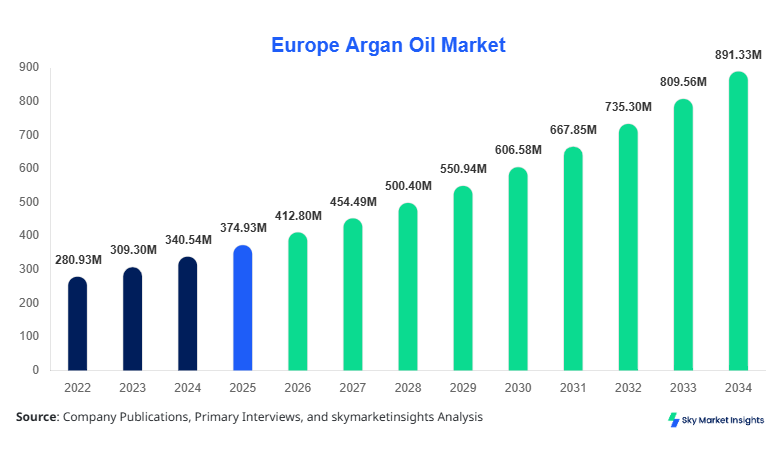
Europe's argan oil market size is projected at USD 412.8 million in 2026 and is expected to hit USD 893.5 million by 2034 with a CAGR of 10.1%. The regional industry continues to expand due to rising demand for organic cosmetic ingredients, increasing penetration of plant-derived oils in pharmaceutical formulations, and expanding consumption of premium food-grade argan oil products across Europe. Growing investments in sustainable sourcing, advanced cold-press extraction technologies, and retail distribution channels are accelerating competitive positioning across Germany, France, the United Kingdom, Spain, Italy, and Russia. Market participants are increasingly focusing on product differentiation, certification standards, and digital retail penetration to strengthen the European argan oil market.
Argan oil is a natural oil extracted from the kernels of the argan tree and is widely used across cosmetics, pharmaceuticals, nutraceuticals, and specialty food applications due to its high vitamin E, antioxidant, and fatty acid composition. Europe accounted for nearly 34.7% of global argan oil imports in 2025, with Germany, France, and the United Kingdom representing more than 61% of total regional consumption volume. The region imported over 18.4 thousand metric tons of argan oil products in 2025, while cosmetic-grade argan oil contributed approximately 58.3% of total application demand. Adoption and penetration rates in premium skincare exceeded 72% among natural beauty product manufacturers, while food-grade argan oil penetration in gourmet retail channels crossed 29%. Consumer behavior across Europe increasingly favors sulfate-free, paraben-free, and organic-certified formulations, resulting in over 64% of consumers preferring botanical ingredient-based cosmetic products. Technical metrics indicate peroxide values below 15 meq O₂/kg and oleic acid content between 42% and 48% in premium-grade oils. Cosmetics and personal care represented nearly 57% application share, food and beverage accounted for 24%, and pharmaceutical usage contributed around 19% in 2025, reinforcing long-term Europe Argan Oil market expansion.
In Germany, the argan oil market accounted for approximately 26.8% of Europe’s total consumption in 2025, supported by the presence of more than 320 natural cosmetics manufacturers and over 180 specialty importers and distributors. Germany imported nearly 4.9 thousand metric tons of argan oil products during 2025, with cosmetic-grade oil accounting for 63% of total domestic demand. The cosmetics and personal care sector represented nearly 59% of national application consumption, followed by food-grade applications at 23% and pharmaceutical formulations at 18%. Organic-certified argan oil adoption among premium skincare manufacturers exceeded 68%, while cold-pressed extraction technology utilization crossed 74% among imported product categories. Germany’s e-commerce sales for argan oil-based products expanded by 18.6% year-over-year in 2025, driven by demand for anti-aging creams, hair serums, and dermatological formulations. More than 41% of German consumers purchased natural beauty oils at least once annually, while vegan-certified cosmetic products using argan oil increased by 22%. These factors continue strengthening Europe's argan oil market penetration across Germany.
Explore more data points, trends and opportunities Download Free Sample Report
Argan Oil Market Trends
Expansion of Organic and Sustainable Product Lines
European manufacturers are increasingly prioritizing organic-certified and ethically sourced argan oil products to meet evolving consumer preferences. In 2025, over 61% of newly launched argan oil cosmetic formulations across Europe carried organic certification labels, while sustainable sourcing partnerships increased by 27%. Production volumes of certified organic argan oil surpassed 7.6 thousand metric tons, with France, Germany, and the United Kingdom accounting for nearly 69% of total organic product consumption. Premium skincare brands introduced over 340 new argan oil-infused formulations in 2025, including anti-aging creams, serums, scalp oils, and hydration masks. Retail penetration of clean-label beauty products exceeded 58% across major European urban markets, while recyclable packaging adoption crossed 46%. Increasing awareness regarding synthetic chemical reduction and eco-friendly sourcing continues to reinforce the European argan oil market expansion.
Rising Technological Advancements in Extraction and Processing
Advanced cold-press extraction technologies and filtration systems are significantly improving product quality and shelf stability across the regional industry. More than 52% of argan oil processors supplying Europe implemented automated extraction systems in 2025, resulting in 19% higher antioxidant retention and 14% improvement in production efficiency. Production losses during processing declined from 11.2% to 7.4% between 2022 and 2025 due to technological optimization. Cosmetic-grade oil purity levels exceeded 98% in premium product segments, while micro-filtration adoption among manufacturers reached 48%. Demand for pharmaceutical-grade argan oil formulations expanded by 16.8%, particularly for dermatological creams and nutraceutical capsules. These innovations are improving product consistency, enabling higher retail pricing, and supporting Europe's argan oil market development.
Growth in Food and Nutraceutical Applications
Argan oil utilization within gourmet food and nutritional supplement categories is witnessing strong growth across Europe. Food-grade argan oil consumption increased by 21% in 2025, with specialty culinary retailers and premium restaurants expanding product usage. Nutraceutical formulations incorporating argan oil rose by 18%, while dietary supplement launches using omega-rich botanical oils exceeded 190 products during the year. Spain and Italy together represented nearly 38% of total regional food-grade consumption due to rising Mediterranean diet preferences. Cold-pressed edible argan oil sales volume surpassed 3.4 thousand metric tons in 2025, while functional food penetration increased by 12%. Growing health consciousness, rising antioxidant awareness, and premium culinary demand continue strengthening Europe's argan oil market adoption.
Europe's Argan Oil Market Drivers
Rising Consumer Preference for Natural and Organic Cosmetic Ingredients
The increasing consumer shift toward botanical-based personal care formulations is a major factor driving industry expansion across Europe. More than 73% of consumers in Germany, France, and the United Kingdom preferred skincare products containing plant-derived ingredients in 2025, while organic cosmetic product sales grew by 16.2% year-over-year. Approximately 58% of premium facial oils launched across Europe incorporated argan oil due to its high vitamin E concentration, unsaturated fatty acid profile, and moisturizing properties. Cosmetic manufacturers increased procurement volumes by 22% between 2023 and 2025, while online sales of argan oil haircare products rose by 28%. Natural ingredient labeling regulations and consumer awareness regarding chemical-free beauty products are further accelerating adoption rates. The personal care segment generated more than USD 238 million in regional revenues during 2025, accounting for the dominant share of overall demand. Rising vegan cosmetics penetration, expanding influencer-driven beauty trends, and increased dermatological product recommendations continue to stimulate Europe's argan oil market expansion.
Europe's Argan Oil Market Restraints
Supply Chain Dependency and Raw Material Price Volatility
The European industry faces substantial operational risks associated with dependence on Moroccan argan kernel production and fluctuating raw material costs. Nearly 88% of Europe’s argan oil supply originates from Morocco, creating sourcing concentration risks and import dependency challenges. Average raw kernel prices increased by 14% between 2023 and 2025 due to climate variability, lower harvest yields, and transportation inflation. Logistics expenses for imported argan oil shipments rose by 11.6% during 2025, while small-scale manufacturers reported procurement cost increases exceeding 17%. Limited cultivation geography and long production cycles continue restricting rapid supply scalability. Counterfeit and diluted products represented nearly 8% of imported retail volumes, negatively impacting consumer trust and premium brand positioning. In addition, certification compliance expenses increased by 9%, affecting smaller regional distributors and startups. These operational and pricing constraints continue limiting the European argan oil market's profitability across mid-tier manufacturers and independent retailers.
Europe's Argan Oil Market Opportunities
Expansion of Pharmaceutical and Nutraceutical Applications
Increasing use of argan oil in pharmaceutical and wellness products presents significant commercial opportunities across Europe. Dermatological formulations using argan oil expanded by 19% during 2025 due to growing demand for anti-inflammatory and skin-repair products. Nutraceutical product launches containing botanical oils increased by 24%, while pharmacy retail penetration for argan-based capsules and topical creams crossed 31%. Clinical studies demonstrating antioxidant and anti-aging properties are improving medical acceptance and consumer confidence. Pharmaceutical-grade argan oil production volumes exceeded 1.8 thousand metric tons in 2025, with Germany and France together accounting for nearly 54% of regional pharmaceutical consumption. Investment in bioactive ingredient research increased by 15%, while wellness-focused dietary supplement sales grew by 20%. The emergence of hybrid cosmetic-pharmaceutical formulations and premium nutraceutical categories is expected to create long-term European argan oil market opportunities.
Challenges in Europe's Argan Oil Market
Regulatory Standardization and Product Authenticity Verification
Maintaining quality consistency and combating counterfeit products remain significant industry challenges. European regulatory agencies intensified inspection procedures during 2025, resulting in over 12% of sampled low-cost imports failing purity compliance standards. Variations in fatty acid profiles, oxidation levels, and extraction quality create inconsistency across retail offerings. Certification and traceability implementation costs increased by 13%, particularly impacting small-scale importers and niche cosmetic manufacturers. Product adulteration involving lower-cost vegetable oils affected nearly 7% of online retail products, reducing consumer confidence and premium pricing capabilities. In addition, laboratory testing expenses for authenticity verification rose by 10.4%, while compliance timelines for organic labeling approvals extended by approximately 18%. Ensuring supply chain transparency, sustainable sourcing, and technical standardization continues to be a major operational challenge influencing the European argan oil market's competitiveness
Report Scope
| Report Metric | Details |
|---|---|
| Market Size in 2025 | USD 375.0 Million |
| Market Size in 2026 | USD 412.8 Million |
| Market Size in 2034 | USD 893.5 Million |
| CAGR | 10.1% (2026-2034) |
| Base Year for Estimation | 2025 |
| Historical Data | 2022-2024 |
| Forecast Period | 2026-2034 |
| Report Coverage | Revenue Forecast, Competitive Landscape, Supply Chain Disruption, Growth Factors, Environment & Regulatory Landscape and Trends |
Explore more data points, trends and opportunities Download Free Sample Report
Argan Oil Market Segmentation
The European industry is segmented by type and application, with cosmetic-grade oil dominating nearly 58% of total volume consumption in 2025. Organic variants represented around 37% of total product sales due to rising premium skincare demand, while food-grade applications continued expanding across gourmet culinary channels. Cosmetics and personal care remained the leading application segment with 57% share, followed by food and beverage at 24% and pharmaceutical applications at 19%.
BY TYPE
Conventional argan oil accounted for approximately 41% of regional consumption in 2025 due to its widespread availability and lower retail pricing compared to certified organic variants. Production volumes exceeded 7.2 thousand metric tons across Europe-focused supply chains, with Spain, Italy, and Russia representing major import destinations for conventional-grade oils. These oils are commonly utilized in mid-range haircare products, massage oils, soaps, and industrial cosmetic formulations. Fatty acid concentration levels generally range between 76% and 82%, while oxidation stability reaches approximately 18 months under standard packaging conditions. Bulk procurement by cosmetic manufacturers increased by 14% in 2025, supported by rising mass-market skincare production. Conventional products maintain strong penetration within commercial hair treatment categories and value-oriented cosmetic retail channels.
Organic argan oil represented nearly a 37% share of regional revenues in 2025 and remains the fastest-expanding product category across Europe. Organic-certified production exceeded 6.1 thousand metric tons, while premium skincare brands allocated more than 46% of botanical ingredient procurement budgets toward certified oils. Germany, France, and the United Kingdom accounted for almost 68% of total organic argan oil imports due to strong consumer demand for clean-label products. Cold-pressed organic oils retain tocopherol concentrations exceeding 620 mg/kg and maintain superior antioxidant performance. Retail prices for organic-certified products remained 18% to 26% higher than conventional oils, supporting premium profitability margins. Increasing demand for sulfate-free, vegan, and cruelty-free cosmetics continues driving product expansion.
Cosmetic-grade argan oil dominated specialized applications with approximately 58% consumption share in 2025. More than 9.3 thousand metric tons of cosmetic-grade oil were utilized across anti-aging creams, scalp treatments, moisturizers, and luxury skincare products. This segment requires purity levels above 98%, low peroxide values below 15 meq O₂/kg, and advanced filtration standards for dermatological compatibility. Cosmetic manufacturers increased product integration rates by 21% between 2023 and 2025, while haircare formulations represented nearly 34% of cosmetic-grade demand. Enhanced refining processes and micro-filtration systems improved shelf stability by 16%, supporting longer export cycles and premium retail positioning throughout Europe.
BY APPLICATION
Cosmetics and personal care remained the largest application segment, with nearly 57% of total European demand in 2025. More than 10.5 thousand metric tons of argan oil were consumed in facial serums, shampoos, conditioners, anti-aging creams, and scalp treatments. Product penetration within premium skincare exceeded 72%, while vegan cosmetic formulations containing argan oil expanded by 24% year-over-year. Haircare applications represented approximately 39% of personal care demand due to increasing preference for hydration and damage-repair products. Germany and France together accounted for over 47% of cosmetic application consumption. Enhanced consumer awareness regarding antioxidants, omega fatty acids, and natural moisturizing properties continues strengthening product demand across beauty and personal care categories.
Food and beverage applications represented around a 24% share of regional demand during 2025. Consumption volumes surpassed 4.2 thousand metric tons, supported by growing demand for gourmet oils and Mediterranean dietary products. Specialty restaurants, premium grocery retailers, and wellness-focused consumers increasingly adopted cold-pressed edible argan oil for salad dressings, dipping oils, and nutritional supplements. Spain and Italy contributed approximately 38% of total food application demand due to culinary integration and rising health-conscious eating patterns. Edible-grade oils maintain acidity levels below 0.8% and are rich in unsaturated fatty acids exceeding 78%, supporting cardiovascular wellness positioning. Growth in functional food consumption continues supporting regional expansion.
Pharmaceutical applications accounted for approximately 19% of Europe’s consumption volume in 2025. Dermatological creams, wound-healing ointments, nutraceutical capsules, and anti-inflammatory formulations increasingly incorporated pharmaceutical-grade argan oil due to its antioxidant and bioactive properties. Germany represented nearly 31% of pharmaceutical application demand, followed by France at 22%. Production volumes exceeded 1.8 thousand metric tons during 2025, while clinical skincare formulations using argan oil increased by 17%. Pharmaceutical-grade products require enhanced microbiological standards, high tocopherol retention, and strict oxidation control. The expansion of medical wellness products and bioactive therapeutic formulations continues driving pharmaceutical application growth.
Europe Argan Oil Market Segmentations
Type
- Conventional Argan Oil
- Organic Argan Oil
- Cosmetic-Grade Argan Oil
Application
- Cosmetics & Personal Care
- Food & Beverage
- Pharmaceutical Applications
Europe's Argan Oil Market: Regional Outlook
United Kingdom
The United Kingdom accounted for approximately 18% of Europe’s total demand in 2025, supported by strong premium beauty product consumption and high e-commerce penetration. Import volumes exceeded 3.1 thousand metric tons, while online retail sales contributed nearly 42% of national argan oil product revenues. Cosmetics and personal care represented around 61% of UK application demand, followed by food-grade products at 22% and pharmaceutical uses at 17%. Vegan-certified beauty products using argan oil expanded by 26% year-over-year, while natural skincare product penetration exceeded 64% among urban consumers.
Germany
Germany represented the largest regional market with a 26.8% share in 2025 and imported approximately 4.9 thousand metric tons of argan-oil products. The country hosts more than 320 natural cosmetics manufacturers and over 180 specialty distributors. Organic-certified products accounted for 48% of domestic sales volume, while premium skincare products represented nearly 54% of national revenues. Technological adoption in cold-press extraction and advanced filtration exceeded 74% among suppliers serving Germany.
France
France contributed nearly 21% of regional revenues in 2025 due to its strong luxury cosmetics industry and premium skincare manufacturing ecosystem. Consumption volumes surpassed 3.7 thousand metric tons, while cosmetic applications represented around 63% of national demand. More than 210 premium skincare brands incorporated argan oil into anti-aging and hydration formulations. Organic product penetration exceeded 58%, while dermatological skincare sales increased by 16%.
Spain
Spain accounted for approximately 12% of regional demand during 2025 and remained a leading food-grade application market. Culinary and gourmet applications represented 34% of national consumption, significantly above the European average. Import volumes exceeded 2 thousand metric tons, while nutraceutical product launches increased by 18%. Mediterranean dietary trends and premium food retail expansion continue strengthening national demand.
Italy
Italy represented nearly 11% of Europe’s total market volume in 2025. Cosmetics applications accounted for approximately 51% of national demand, while gourmet food products represented 29%. Italian luxury skincare manufacturers increased argan oil procurement by 14% during 2025. Organic-certified beauty product penetration crossed 44%, while wellness-focused nutraceutical applications expanded by 15%.
Russia
Russia accounted for approximately 7% share of the regional market in 2025, supported by growing demand for affordable natural cosmetics and expanding pharmacy retail networks. Import volumes exceeded 1.2 thousand metric tons, while haircare applications represented nearly 41% of domestic consumption. Mid-range cosmetic brands increased argan oil integration by 12%, particularly within scalp treatment and moisturizing products.
Top players in the European argan oil market
- OLVEA Morocco
- Zineglob Ltd
- Arganbulk
- Konouz Rayyan
- Biopur
- Malakbio
- Argane Aouzac
- Nexira
- Cyrus Enterprises
- Jedwards International
- Sophim
- Oriental Group SARL AU
- BioProGreen
- Argania Export Company
- Aromatic Natural Skin Care
OLVEA Morocco
-
Holds approximately 11% regional supply positioning across Europe.
-
Operates extensive cold-press extraction facilities with annual processing capacity exceeding 4,500 metric tons.
-
Supplies cosmetic-grade and pharmaceutical-grade oils to more than 160 European personal care manufacturers.
-
Strong presence in Germany, France, and the United Kingdom with high organic certification compliance.
-
Invested nearly 14% of annual operational expenditure into sustainable sourcing and traceability technologies during 2025.
Sophim
-
Accounts for nearly 8% of Europe-focused premium cosmetic argan oil distribution.
-
Supplies botanical ingredients to over 120 skincare and dermatological product companies across Europe.
-
Increased pharmaceutical-grade oil production by 19% in 2025.
-
Maintains strong positioning in luxury skincare and anti-aging formulations.
-
Expanded micro-filtration and oxidation-control processing capabilities by 16% to improve product stability and export quality.
Investment Analysis
Investment activity across the regional industry accelerated significantly during 2025 as cosmetic manufacturers, nutraceutical producers, and specialty ingredient suppliers expanded procurement partnerships and sustainable sourcing initiatives. Nearly 46% of total investments were directed toward organic-certified cosmetic products, while food-grade product development represented 24% of investment allocation. Germany and France together accounted for approximately 52% of total regional investments due to strong premium beauty product demand and advanced retail infrastructure. Investments in automated cold-press extraction technologies increased by 18%, while packaging modernization projects grew by 14%.
Cross-border collaborations and long-term supply agreements between European cosmetic companies and Moroccan producers increased by 22% during 2025. Mergers and acquisition activity focused heavily on sustainable sourcing networks, traceability systems, and organic certification capabilities. More than 31% of investment agreements involved strategic partnerships aimed at improving antioxidant retention and extraction efficiency. Luxury skincare companies expanded R&D expenditure by 17%, while pharmaceutical firms increased botanical formulation investments by 13%. E-commerce and digital retail investments also accelerated, with online sales infrastructure accounting for 19% of regional investment distribution.
New Product Developments
Manufacturers across Europe introduced more than 340 new argan oil-based cosmetic and wellness products during 2025, representing approximately 21% growth compared with 2024. Premium anti-aging creams, hydration serums, scalp-repair formulations, and nutraceutical capsules dominated innovation pipelines. Product performance improvements included 18% higher antioxidant retention, 14% enhanced hydration efficiency, and 11% longer shelf stability through advanced filtration technologies.
Organic-certified formulations represented nearly 57% of all new product launches, while vegan-certified skincare products incorporating argan oil increased by 24%. Haircare innovation remained particularly strong, accounting for approximately 36% of total new product introductions. Pharmaceutical-grade formulations for dermatological treatments and wound-healing applications also expanded by 15% during the year.
Recent Developments in European Argan Oil Market
- 2025: OLVEA Morocco expanded processing capacity by 17% and increased exports to Germany and France by nearly 22%, supporting rising demand for premium cosmetic-grade oils. The company implemented advanced cold-press systems that improved antioxidant retention by 14% while reducing processing losses by approximately 9%. Sustainability-focused sourcing agreements also expanded regional procurement volumes significantly.
- 2025: Sophim launched new pharmaceutical-grade argan oil formulations for dermatological skincare applications across Europe. Production volumes increased by 16%, while clinical skincare partnerships expanded by 21%. Enhanced micro-filtration systems improved purity levels above 98%, enabling broader integration within therapeutic and anti-aging product categories throughout Germany and France.
Research Methodology
The European industry analysis was conducted using a combination of primary research, secondary research, and quantitative market estimation methodologies. The research process involved collecting historical consumption data from 2022 to 2024 and evaluating production, import, export, pricing, and application trends across Germany, France, the United Kingdom, Spain, Italy, and Russia. Primary research included interviews with cosmetic manufacturers, ingredient suppliers, distributors, pharmaceutical companies, and retail executives representing more than 65 organizations across Europe. Secondary research involved company annual reports, trade journals, customs statistics, industry databases, regulatory publications, and sustainability certification records.
Market size estimation incorporated demand-side analysis, production capacity assessments, import-export evaluation, and application-based consumption modeling. Revenue forecasting from 2026 to 2034 utilized CAGR-based analytical frameworks supported by macroeconomic indicators, cosmetic industry expansion rates, organic product penetration, and retail distribution trends. Data triangulation methods were used to validate regional market shares, production volumes, pricing structures, and competitive positioning. Statistical analysis also considered technological advancements, sustainability initiatives, regulatory frameworks, and evolving consumer behavior patterns influencing the European industry outlook.
Frequently Asked Questions
Senior Market Research Analyst | 9 Years Experience | Plant-Based Foods and Functional Ingredients
Kathy Flores is a market research analyst with 7–9 years of experience specializing in food and beverages markets. Contributed to 70+ research reports for global clients. Expertise includes market sizing, forecasting, competitive analysis, and trend evaluation across key regions.