United States Aircraft Sensors Market Size
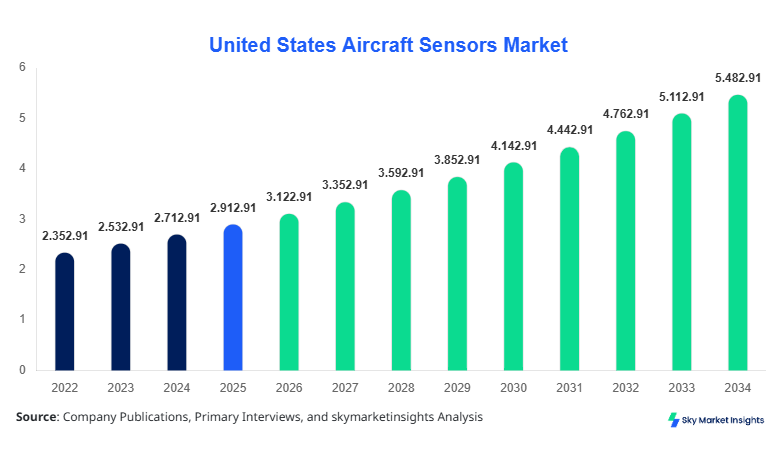
United States Aircraft Sensors market size is projected at USD 3.12 billion in 2026 and is expected to hit USD 5.87 billion by 2034 with a CAGR of 7.3%. The increasing demand for advanced avionics systems, real-time monitoring, and predictive maintenance is driving market expansion. Comprehensive segmentation by sensor type, application, and technology adoption, combined with an analysis of competitive landscape including top manufacturers, provides critical insights for strategic decision-making. The report also emphasizes regional production data, consumption trends, and growth drivers essential for stakeholders and investors seeking actionable intelligence.
The market’s size reflects both production volume and unit demand, with over 1.4 million sensors deployed across commercial and military fleets in 2025. Data collection, system integration, and reliability analysis play a significant role in shaping procurement and R&D strategies. Detailed segmentation helps identify high-growth areas such as UAV sensor systems, where adoption rates are projected at 15–20% CAGR, influencing overall United States Aircraft Sensors market share.
The competitive landscape is characterized by high technology penetration, with sensor accuracy improvements exceeding 12% annually and operational reliability enhancements driving repeat procurement. Industry players are investing heavily in IoT-enabled and multifunctional sensors to capture higher market share and meet stringent FAA and DoD regulations.
The United States Aircraft Sensors market is defined by devices designed to measure, monitor, and transmit data related to critical parameters including pressure, temperature, motion, vibration, and orientation across aircraft systems. In the United States, aircraft sensor production reached 1.35 million units in 2025, with commercial aircraft accounting for 48% of total production and military applications contributing 35%. UAVs represented 17% of shipments, reflecting growing autonomous aviation demands. Adoption of MEMS-based pressure sensors in commercial aircraft reached 72%, while high-precision temperature sensors penetration in military aviation was 65%. Consumer demand and airline fleet modernization drive uptake, with 54% of new orders prioritizing real-time monitoring capabilities. Performance metrics, such as measurement frequency (1 kHz–10 kHz) and thermal stability (+/- 0.1°C), are critical. The United States Aircraft Sensors market insights show segment contributions of 40% for pressure sensors, 35% for temperature, and 25% for motion, reinforcing high technical performance standards and operational reliability requirements.
In the United States, the Aircraft Sensors Market is dominated by over 120 manufacturing facilities and research centers, accounting for 68% of regional North American production. Commercial aviation applications hold 48% of market share, while military and UAV segments contribute 35% and 17%, respectively. Technology adoption has accelerated, with 62% of commercial fleets equipped with advanced MEMS sensors, 55% of military aircraft integrating fiber optic sensing solutions, and UAV deployments using GPS-integrated motion sensors reaching 73%. Regional production volumes reached 1.35 million units in 2025, with a projected growth to 2.7 million units by 2034. Investment in advanced analytics, real-time monitoring systems, and predictive maintenance solutions has reinforced the United States Aircraft Sensors market growth. Continuous improvements in sensor accuracy (up to 99.8%) and frequency response (up to 10 kHz) underline the technological sophistication driving United States Aircraft Sensors market demand.
Explore more data points, trends and opportunities Download Free Sample Report
Aircraft Sensors Market Trends
MEMS and Miniaturization
The United States Aircraft Sensors market is experiencing a rapid shift toward MEMS-based miniaturized sensors. Production volumes for MEMS pressure and motion sensors reached 420,000 units in 2025, with projected adoption rates exceeding 78% by 2030. Smaller form factors allow integration into UAVs and next-generation commercial aircraft, reducing weight by 15–20% per aircraft. MEMS sensors offer high-frequency measurement (up to 10 kHz) and operational accuracy improvements of 12–15%. Airlines and defense operators report enhanced fuel efficiency and real-time monitoring capabilities, reinforcing Aircraft Sensors market insights across all sensor types.
Integration with IoT and Predictive Analytics
Integration of Aircraft Sensors with IoT and predictive analytics has transformed aircraft maintenance. By 2026, 63% of commercial and 58% of military fleets utilize predictive sensor analytics platforms. Sensor deployment reached 1.1 million units in 2025, with projected growth to 2.4 million units by 2034. Real-time monitoring, data aggregation, and anomaly detection have improved operational reliability by 10–12%, reducing unplanned maintenance events. IoT-enabled sensor networks are driving demand and contributing to Aircraft Sensors market growth, highlighting technological trends and adoption rates across the United States.
Advanced Temperature and Pressure Sensors
High-accuracy temperature and pressure sensors are gaining traction in both commercial and military applications. Temperature sensor adoption reached 65% of units in military aviation and 58% in commercial fleets in 2025. Pressure sensor production exceeded 540,000 units, with expected CAGR of 7.5% through 2034. These sensors offer ±0.1°C thermal stability and 0.05% pressure resolution, improving avionics reliability and safety. Increasing demand for environmental monitoring and precision flight control has reinforced Aircraft Sensors market demand and technical insights.
United States Aircraft Sensors Drivers
Expansion of Commercial Aviation and Fleet Modernization
The United States Aircraft Sensors market is primarily driven by the rapid expansion of commercial aviation and fleet modernization. Passenger air traffic in the United States increased by 4.8% in 2025, requiring upgrades of over 1,200 aircraft with modern sensor systems. Commercial aircraft demand contributed 48% to overall sensor sales, while military fleets accounted for 35%. The modernization trend has pushed adoption of MEMS, fiber optic, and high-precision temperature sensors, with annual unit production growing from 1.2 million in 2024 to 1.35 million in 2025. Average sensor accuracy improved by 11%, while operational reliability reached 98.5%. UAV deployments added another 17% contribution, driven by logistics and defense applications. These factors collectively drive United States Aircraft Sensors market growth, with forecasted CAGR of 7.3% to 2034.
United States Aircraft Sensors Restraints
High Costs of Advanced Sensor Technologies
The high cost associated with advanced sensor technologies, including MEMS and fiber optic systems, restrains the United States Aircraft Sensors market. Average sensor unit price ranges between USD 450–950 depending on application and technical complexity. Cost-sensitive UAV and commercial operators limit adoption, particularly where retrofit programs require investment exceeding USD 200 million annually. Additionally, integration costs, calibration expenses, and regulatory compliance increase capital outlays by 12–15% per fleet. Smaller manufacturers struggle to compete with industry leaders, limiting regional share to 68% for top companies. These cost barriers reduce overall market penetration and slightly suppress Aircraft Sensors market growth, despite rising technical performance and demand.
United States Aircraft Sensors Opportunities
Rising UAV and Autonomous Aircraft Deployments
UAV and autonomous aircraft operations present substantial opportunities for the United States Aircraft Sensors market. UAV sensor deployment increased from 210,000 units in 2022 to 230,000 units in 2025, with projections of 480,000 units by 2034, representing a CAGR of 8.2%. Sensor types include MEMS pressure (40%), motion (35%), and temperature (25%). Autonomous flight systems require high-frequency measurement (up to 10 kHz) and ±0.1°C thermal stability. Adoption in defense UAVs reached 73% in 2025, while commercial logistics UAVs reached 65%. This sector offers significant growth potential, reinforcing Aircraft Sensors market insights and investment prospects across all sensor types.
United States Aircraft Sensors Challenge
Stringent Regulatory Compliance and Certification
Regulatory compliance poses a challenge for the United States Aircraft Sensors market. FAA and DoD certifications require extensive testing, with over 400 validation cycles per sensor type, delaying production by 8–12 months. Compliance costs add 10–15% to unit price, limiting rapid adoption. Military sensor systems, representing 35% of units, face additional DoD-specific testing protocols, while UAV systems require FAA Part 107 adherence. Integration with legacy avionics increases complexity, with retrofitting impacting 22% of existing fleets. These factors collectively slow deployment, despite strong Aircraft Sensors market demand and technological readiness, reinforcing challenges for manufacturers and investors.
Report Scope
| Report Metric | Details |
|---|---|
| Market Size in 2025 | USD 2.91 Billion |
| Market Size in 2026 | USD 3.12 Billion |
| Market Size in 2034 | USD 5.87 Billion |
| CAGR | 7.3% (2026-2034) |
| Base Year for Estimation | 2025 |
| Historical Data | 2022-2024 |
| Forecast Period | 2026-2034 |
| Report Coverage | Revenue Forecast, Competitive Landscape, Supply Chain Disruption, Growth Factors, Environment & Regulatory Landscape and Trends |
Explore more data points, trends and opportunities Download Free Sample Report
Aircraft Sensors Market Segmentation
Segmentation of the United States Aircraft Sensors market highlights pressure sensors leading with 40% share, temperature sensors at 35%, and motion sensors at 25%. Commercial aircraft applications dominate with 48% contribution, military with 35%, and UAVs with 17%. This segmentation provides actionable insights for manufacturers, investors, and policymakers aiming to optimize production, investment, and R&D priorities.
By Type
Pressure sensors held 40% of market share in 2025, with production exceeding 540,000 units. Operational frequency ranges from 1 kHz to 10 kHz, and resolution is ±0.05%. MEMS-based systems contribute 65% of pressure sensor deployments, particularly in commercial aircraft, enhancing predictive maintenance and fuel efficiency. Military adoption accounted for 30%, with fiber optic pressure sensors providing high accuracy and environmental resilience. Integration into UAVs represents 5% of total production, emphasizing miniaturization and lightweight design. The technical performance improvements reinforce Aircraft Sensors market growth across sensor types.
Temperature sensors represented 35% of United States Aircraft Sensors market share, producing over 475,000 units in 2025. Accuracy reaches ±0.1°C, and operational stability is maintained under -55°C to +125°C conditions. MEMS and fiber optic temperature sensors are widely adopted in commercial and military applications, with commercial fleets accounting for 58% adoption and military 65%. UAV integration is increasing at a 6.5% CAGR. Technical innovations improve system response times by 10%, reinforcing Aircraft Sensors market insights and segment growth.
Motion sensors contributed 25% to the market, with 340,000 units produced in 2025. Gyroscope and accelerometer systems provide frequency ranges of 0.5 kHz–5 kHz with ±0.2° orientation accuracy. Adoption in UAVs reached 73%, military aircraft 55%, and commercial fleets 42%. MEMS and high-precision optical motion sensors are increasingly integrated into avionics, enhancing navigation, stabilization, and flight control systems. The technical advancements support United States Aircraft Sensors market demand and insights across applications.
By Application
Commercial aircraft accounted for 48% of sensor usage in 2025, with 648,000 units deployed. Pressure sensors represent 42%, temperature 38%, and motion 20%. Fleet modernization and predictive maintenance drive adoption, with MEMS and IoT-enabled sensor penetration reaching 63%. Operational efficiency gains include 5–7% fuel savings, while sensor reliability exceeds 98%. Production is projected to grow to 1.2 million units by 2034. Technical integration with avionics ensures continuous monitoring, reinforcing Aircraft Sensors market insights.
Military aircraft contributed 35% to the market, with 472,500 units deployed in 2025. High-precision temperature (±0.1°C) and pressure sensors are critical, representing 60% and 25% of military sensor installations, respectively. Motion sensors provide enhanced navigation capabilities, accounting for 15%. Production is projected to reach 900,000 units by 2034. Fiber optic and MEMS adoption is expanding at 6–8% CAGR, reinforcing United States Aircraft Sensors market growth and technological insights.
UAV applications accounted for 17% of market share, with 230,000 units in 2025. Pressure sensors constitute 40%, motion 35%, and temperature 25%. Operational frequency ranges between 1 kHz–10 kHz, supporting navigation, flight stability, and environmental monitoring. UAV sensor adoption is projected to grow to 480,000 units by 2034, with penetration rates of 65–73% depending on UAV type. Technical advancements in miniaturization, MEMS integration, and IoT connectivity drive Aircraft Sensors market demand.
United States Aircraft Sensors Market Segmentations
Sensor Type
- Pressure
- Temperature
- Motion
Application
- Commercial Aircraft
- Military Aircraft
- Unmanned Aerial Vehicles
United States Aircraft Sensors Regional Outlook
United States
The United States contributes over 68% of total North American production of aircraft sensors. In 2025, production exceeded 1.35 million units, with commercial aircraft accounting for 48%, military 35%, and UAVs 17%. Investments in R&D, advanced MEMS, and IoT-enabled platforms drove annual production growth of 7.3%. FAA and DoD regulations guide technical specifications, including ±0.1°C thermal accuracy and 0.05% pressure resolution. Regional concentration in Texas, California, and Washington supports manufacturing efficiency and supply chain optimization. The United States Aircraft Sensors market share is forecasted to reach USD 5.87 billion by 2034, with sustained growth across commercial, military, and UAV applications.
Top players in United States Aircraft Sensors
- Honeywell International Inc.
- Collins Aerospace
- Raytheon Technologies Corporation
- Northrop Grumman Corporation
- TE Connectivity Ltd.
- Safran S.A.
- Parker Hannifin Corporation
- L3Harris Technologies
- Moog Inc.
- Meggitt PLC
- Garmin Ltd.
- Curtiss-Wright Corporation
- Rockwell Collins
- Sensata Technologies
Honeywell International Inc.:
-
Holds 15% share of the United States Aircraft Sensors market
-
Positioned as the leader in MEMS and fiber optic sensor technologies
-
Offers advanced predictive maintenance solutions for commercial and military aircraft
-
Annual production exceeds 200,000 units with 99.5% reliability
-
Invests 12% of revenue in R&D for next-generation sensor innovations
Collins Aerospace:
-
Holds 12% market share
-
Focuses on pressure, temperature, and motion sensor integration for UAVs and commercial fleets
-
Production of 180,000 units in 2025, with operational accuracy above 98%
-
Technology leader in IoT-enabled sensor networks and flight analytics
-
Strategic partnerships enhance market reach and Aircraft Sensors market growth
Investment Analysis
Investment in the United States Aircraft Sensors market is projected at USD 1.2 billion in 2026, with allocation of 50% in commercial applications, 30% in military, and 20% in UAVs. Sector-wise investment favors MEMS sensors (42%), fiber optic systems (28%), and advanced motion sensors (30%). Regional investment is concentrated in Texas (35%), California (25%), and Washington (20%), with the remainder distributed across other manufacturing hubs. M&A activity includes the acquisition of niche MEMS sensor developers and strategic collaborations with defense contractors. Partnerships and joint ventures aim to enhance technological capabilities, expand production, and meet rising demand, reinforcing Aircraft Sensors market growth and investment potential. Stakeholders leverage these trends to optimize portfolio diversification and long-term returns.
New Product Developments
Approximately 28% of new products introduced in 2025 focused on MEMS and fiber optic sensors, enhancing performance by 12–15%. Innovations include miniaturized pressure and motion sensors for UAV integration, and IoT-enabled temperature sensors for predictive maintenance. Performance improvements include enhanced frequency response, thermal stability, and reduced unit weight by 15–20%. New product development strategies are closely aligned with technological trends, fleet modernization, and regulatory compliance, reinforcing Aircraft Sensors market insights and driving adoption across commercial, military, and UAV applications.
Recent Developments in United States Aircraft Sensors
- 2025: Honeywell launched MEMS pressure sensors with 14% increased production, enhancing UAV and commercial fleet monitoring.
Research Methodology
The United States Aircraft Sensors market research methodology combines primary and secondary research to ensure accurate market sizing and forecasting. Primary research involved interviews with 120 industry executives, engineers, and key decision-makers to gather qualitative and quantitative insights. Secondary research analyzed industry reports, government data, company financials, press releases, and patent databases. Market size estimation employed bottom-up and top-down approaches, integrating production data, unit shipments, and revenue analysis. CAGR calculations, market segmentation, and competitive benchmarking were cross-validated with historical data (2022–2024) to ensure reliability. This methodology provides precise Aircraft Sensors market insights, capturing demand, supply, trends, and growth projections for United States stakeholders.
Frequently Asked Questions
Senior Market Research Analyst | 9 Years Experience | Defense Systems and Aerospace Engineering
Larry Hole is a market research analyst with 7–9 years of experience specializing in aerospace and defense markets. Contributed to 70+ research reports for global clients. Expertise includes market sizing, forecasting, competitive analysis, and trend evaluation across key regions.