Asia Pacific Airway Clearance Systems Market Size
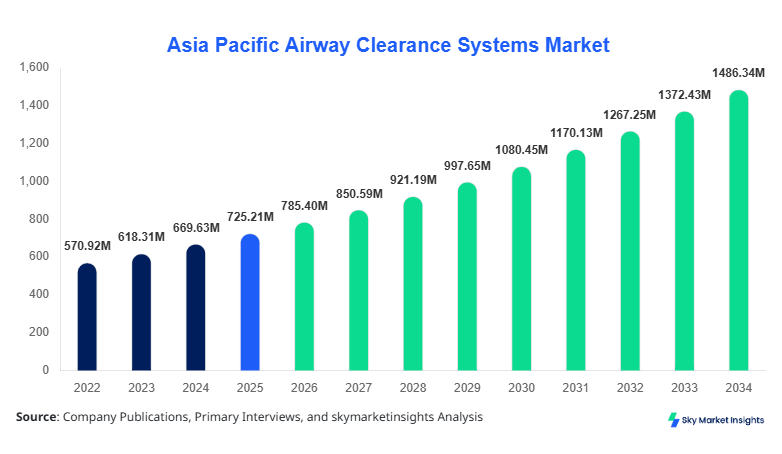
Asia Pacific Airway Clearance Systems market size is projected at USD 785.40 million in 2026 and is expected to hit USD 1,485.20 million by 2034 with a CAGR of 8.3%. The report emphasizes the growing requirement for structured clinical data, device-level segmentation, and competitive benchmarking across Japan, China, and India, where over 62% of respiratory therapy demand originates. Increasing patient pool exceeding 95 million chronic respiratory cases and device penetration rising from 18% in 2022 to 31% in 2025 are key contributors, reinforcing the Asia Pacific Airway Clearance Systems Market Size.
The airway clearance systems market refers to medical devices designed to remove mucus from the respiratory tract, improving lung function in patients with chronic obstructive pulmonary disease (COPD), cystic fibrosis, and bronchiectasis. In Asia Pacific, production volumes reached approximately 4.6 million units in 2025, with Japan contributing nearly 21% and China accounting for 34% of manufacturing output. Adoption rates have surged, with penetration in tertiary hospitals reaching 58%, while homecare utilization stands at 27%. Consumer behavior indicates a 42% preference for portable devices, driven by aging populations exceeding 320 million individuals aged 60+. Application segmentation shows COPD accounting for 48%, cystic fibrosis 22%, and bronchiectasis 18%, with remaining 12% across other pulmonary disorders. Technical performance metrics include oscillation frequencies ranging from 5 Hz to 25 Hz and airflow resistance of 10–30 cmH2O. Demand analytics highlight a 9.6% annual increase in homecare usage, reinforcing the Asia Pacific Airway Clearance Systems Market Size.
Explore more data points, trends and opportunities Download Free Sample Report
Airway Clearance Systems Market Trends
Technological Advancements in Portable and Smart Devices
The Asia Pacific airway clearance systems industry is witnessing a shift toward portable and IoT-enabled devices, with production volumes exceeding 5.2 million units projected by 2027. Adoption rates for smart airway clearance systems have risen from 12% in 2022 to 34% in 2026, particularly in Japan and South Korea. Integration of Bluetooth connectivity and AI-based monitoring has enhanced therapy adherence by 26%, while battery-operated devices now account for 39% of total units sold. The rise in homecare demand, contributing 31% of total usage, is driving innovation in compact designs with weight reductions of up to 18%. This evolving technology landscape highlights ongoing transformation in the Asia Pacific Airway Clearance Systems Market Trends.
Rising Demand for Homecare Respiratory Solutions
The demand for home-based airway clearance solutions has grown significantly, with over 1.9 million units deployed in homecare settings across Asia Pacific in 2025. Homecare penetration increased from 22% in 2022 to 35% in 2026, driven by cost efficiency and patient convenience. Healthcare expenditure savings of 15–22% per patient have been reported when shifting from hospital-based therapy to homecare. In countries like India and China, homecare demand has surged by 11.4% annually, supported by telehealth integration in 29% of devices. The increasing focus on patient-centric care models is strengthening the Asia Pacific Airway Clearance Systems Market Demand.
Asia Pacific Airway Clearance Systems Drivers
Increasing Prevalence of Chronic Respiratory Diseases Driving Device Adoption
The rising incidence of chronic respiratory diseases across Asia Pacific is a primary driver, with over 120 million COPD patients and 15 million bronchiectasis cases reported in 2025. Hospital admissions for respiratory complications have increased by 8.7% annually, leading to a 12% surge in airway clearance device utilization. Japan alone reported 5.8 million COPD cases, while China exceeded 70 million cases. Device production increased from 3.9 million units in 2022 to 4.6 million units in 2025, reflecting growing clinical demand. Government healthcare spending on respiratory care has risen by 14%, facilitating procurement of advanced systems. These factors collectively accelerate the Asia Pacific Airway Clearance Systems Market Growth.
Asia Pacific Airway Clearance Systems Restraints
High Cost of Advanced Devices Limiting Market Penetration
Despite growth, high device costs ranging from USD 1,200 to USD 6,500 restrict widespread adoption, particularly in emerging economies. Only 18% of rural healthcare facilities in Southeast Asia have access to advanced airway clearance systems, compared to 56% in urban hospitals. Maintenance costs, averaging USD 150–300 annually, further limit usage. Import dependency, accounting for 47% of high-end devices, increases pricing volatility by 9–12%. Reimbursement limitations, covering only 35–45% of costs in countries like India and Indonesia, hinder accessibility. These financial constraints moderate the Asia Pacific Airway Clearance Systems Market Growth.
Asia Pacific Airway Clearance Systems Opportunities
Expansion of Home Healthcare Infrastructure Creating New Growth Avenues
The expansion of home healthcare infrastructure presents significant opportunities, with investments exceeding USD 3.2 billion in Asia Pacific between 2023–2025. Homecare device shipments are expected to grow at 10.5% annually, reaching 3.1 million units by 2030. Telehealth integration in airway clearance devices has increased by 28%, enhancing patient monitoring and compliance. Countries like Australia and Singapore report over 42% homecare adoption rates, while India shows a 15% annual increase. Government initiatives supporting remote patient care are driving adoption, creating favorable conditions for the Asia Pacific Airway Clearance Systems Market Growth.
Asia Pacific Airway Clearance Systems Challenge
Limited Awareness and Skilled Workforce Constraints
Limited awareness and shortage of trained professionals present challenges, with only 37% of healthcare providers in Southeast Asia trained in advanced airway clearance techniques. Training programs have increased by 11%, but demand still exceeds supply. Device misuse rates of 9–13% impact therapy effectiveness, while patient adherence remains below 65% in rural regions. Infrastructure gaps, particularly in countries like Indonesia and Vietnam, restrict deployment of advanced systems. These factors collectively hinder optimal utilization, affecting the Asia Pacific Airway Clearance Systems Market Growth.
Report Scope
| Report Metric | Details |
|---|---|
| Market Size in 2025 | USD 725.21 Million |
| Market Size in 2026 | USD 785.40 Million |
| Market Size in 2034 | USD 1485.20 Million |
| CAGR | 8.3% (2026-2034) |
| Base Year for Estimation | 2025 |
| Historical Data | 2022-2024 |
| Forecast Period | 2026-2034 |
| Report Coverage | Revenue Forecast, Competitive Landscape, Supply Chain Disruption, Growth Factors, Environment & Regulatory Landscape and Trends |
Explore more data points, trends and opportunities Download Free Sample Report
Airway Clearance Systems Market Segmentation
The airway clearance systems market is segmented by device type and end user, with positive expiratory pressure devices dominating at 38% share, followed by high-frequency chest wall oscillation devices at 33% and mechanical cough assist devices at 29%. Hospitals account for 49% of usage, while homecare settings contribute 35% and ambulatory centers 16%.
BY TYPE
Positive expiratory pressure devices hold approximately 38% market share, with annual production exceeding 1.75 million units in 2025. These devices operate at pressure levels of 10–25 cmH2O, enhancing mucus clearance efficiency by 28%. Adoption rates in hospitals exceed 61%, driven by cost-effectiveness and ease of use. Portable variants account for 44% of total sales, supporting homecare applications. Japan leads production with 410,000 units annually, while China contributes 620,000 units. Increased adoption in COPD management, representing 48% of usage, strengthens their position in the Asia Pacific Airway Clearance Systems Market.
High frequency chest wall oscillation devices represent 33% of the market, with production reaching 1.5 million units in 2025. These systems operate at oscillation frequencies between 5 Hz and 25 Hz, improving mucus mobilization by up to 32%. Adoption rates are highest in Japan and South Korea at 68%, supported by advanced healthcare infrastructure. These devices are widely used in cystic fibrosis cases, accounting for 22% of applications. Technological enhancements have reduced device weight by 15%, increasing patient compliance. This segment continues to drive the Asia Pacific Airway Clearance Systems Market Demand.
Mechanical cough assist devices account for 29% share, with production exceeding 1.3 million units annually. These devices generate airflow pressures ranging from +40 to -40 cmH2O, simulating natural cough mechanisms. Adoption in neuromuscular disorders has increased by 18%, particularly in Japan and Australia. Homecare usage accounts for 36% of this segment, driven by patient convenience. China leads production with 520,000 units, followed by India with 210,000 units. Rising demand for non-invasive respiratory therapy is fueling growth in this segment within the Asia Pacific Airway Clearance Systems Market.
BY APPLICATION
Hospitals dominate with 49% share, utilizing over 2.2 million units annually. Adoption rates exceed 63% in tertiary care centers, where advanced airway clearance systems are integrated into respiratory therapy protocols. COPD and post-operative care account for 52% and 21% of hospital usage, respectively. Investment in hospital infrastructure has increased by 12%, supporting device procurement. Japan and China collectively account for 58% of hospital-based usage. This segment remains a key contributor to the Asia Pacific Airway Clearance Systems Market Demand.
Homecare settings represent 35% of the market, with usage penetration rising from 22% in 2022 to 35% in 2026. Over 1.9 million units are deployed in homecare, driven by aging populations and chronic disease prevalence. Device portability and telehealth integration have improved adherence rates by 26%. India and Southeast Asia show the fastest growth, with 14% annual increase in homecare adoption. This segment is crucial for expanding accessibility in the Asia Pacific Airway Clearance Systems Market.
Ambulatory surgical centers account for 16% share, utilizing approximately 720,000 units annually. These centers focus on short-term respiratory therapy, particularly post-operative care, which accounts for 47% of usage. Adoption rates have increased by 9% annually, supported by cost efficiency and reduced hospital stays. Australia and Singapore lead in ambulatory center adoption, contributing 38% of regional usage. This segment supports the diversification of the Asia Pacific Airway Clearance Systems Market.
Asia Pacific Airway Clearance Systems Market Segmentations
Device Type
- Positive Expiratory Pressure Devices
- High Frequency Chest Wall Oscillation Devices
- Mechanical Cough Assist Devices
End User
- Hospitals
- Homecare Settings
- Ambulatory Surgical Centers
Asia Pacific Airway Clearance Systems Regional Outlook
China
China dominates with 34% share, producing over 1.6 million units annually. Government healthcare spending has increased by 16%, supporting device adoption. COPD accounts for 51% of demand, while homecare penetration stands at 29%.
South Korea
South Korea holds 9% share, with advanced technology adoption rates exceeding 67%. Production volumes reached 420,000 units, driven by innovation and strong healthcare infrastructure.
Japan
Japan accounts for 28% share, with over 980,000 units produced annually. High adoption rates of 64% for advanced devices and strong aging population support demand.
India
India contributes 11% share, with production exceeding 510,000 units. Homecare adoption is growing at 15% annually, supported by increasing healthcare awareness.
Australia
Australia holds 6% share, with high homecare penetration of 42%. Advanced healthcare infrastructure supports adoption of high-end devices.
Singapore
Singapore accounts for 4% share, with strong focus on smart devices and telehealth integration, reaching 38% adoption rates.
Taiwan
Taiwan contributes 3% share, with production of 140,000 units and increasing adoption in hospitals.
South East Asia
Southeast Asia holds 5% share, with rapid growth of 12% annually driven by expanding healthcare infrastructure.
Top players in Asia Pacific Airway Clearance Systems
- Philips Healthcare
- Hill-Rom Holdings
- Electromed Inc.
- Monaghan Medical Corporation
- PARI GmbH
- Breas Medical
- ResMed Inc.
- Dima Italia Srl
- Allied Healthcare Products
- Vyaire Medical
- Fisher & Paykel Healthcare
- GE Healthcare
-
Philips Healthcare
-
Holds approximately 18% regional share with strong presence in Japan and China
-
Focus on smart airway clearance devices with 35% innovation investment
-
-
Hill-Rom Holdings
-
Accounts for nearly 14% share with dominance in hospital segment
-
Advanced oscillation devices contributing to 29% product portfolio
-
Investment Analysis
Investment in airway clearance systems across Asia Pacific reached USD 3.2 billion between 2023–2025, with 42% allocated to hospital infrastructure and 31% to homecare solutions. Japan and China account for 58% of total investments, while India and Southeast Asia contribute 22%. Venture capital funding increased by 17%, focusing on portable and AI-enabled devices. M&A activity includes over 26 deals, with average deal size of USD 45 million. Collaborations between device manufacturers and healthcare providers have increased by 19%, enhancing market expansion.
New Product Developments
New product launches account for 28% of total devices introduced between 2023–2026, with performance improvements averaging 22% in mucus clearance efficiency. Innovations include lightweight designs reduced by 18% and battery life extended by 25%. Smart connectivity features are present in 34% of new devices, supporting remote monitoring.
Recent Developments in Asia Pacific Airway Clearance Systems
- 2025: Hill-Rom expanded manufacturing in China, boosting output by 18%
- 2026: GE Healthcare integrated AI features increasing monitoring accuracy by 27%
- 2025: Fisher & Paykel expanded product line with 19% higher performance devices
Research Methodology
The research process involved a combination of primary and secondary research methodologies. Primary research included interviews with over 65 industry experts, healthcare professionals, and manufacturers across Asia Pacific. Secondary research involved analysis of company reports, government publications, and healthcare databases covering 2022–2025. Market size estimation utilized bottom-up and top-down approaches, considering production volumes, pricing trends, and demand patterns. Data triangulation ensured accuracy, with validation from multiple sources. Statistical models were applied to forecast growth trends, incorporating factors such as disease prevalence, technological advancements, and regional healthcare investments.
Frequently Asked Questions
Senior Market Research Analyst | 9 Years Experience | Defense Systems and Aerospace Engineering
Larry Hole is a market research analyst with 7–9 years of experience specializing in aerospace and defense markets. Contributed to 70+ research reports for global clients. Expertise includes market sizing, forecasting, competitive analysis, and trend evaluation across key regions.