Asia Pacific Artillery Ammunition Market Size
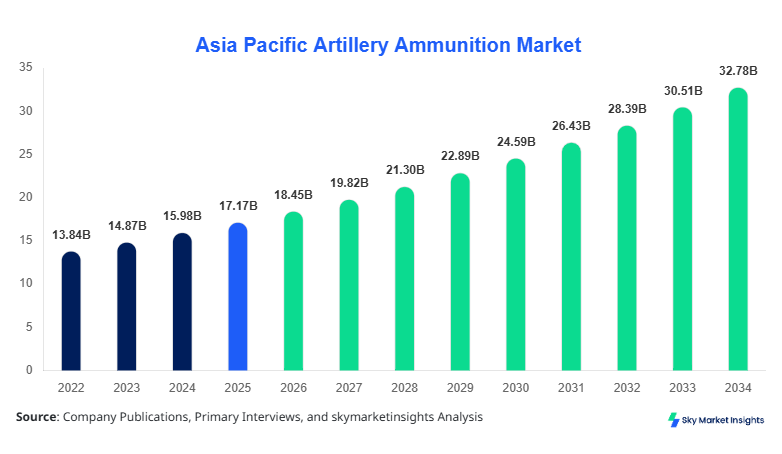
Asia Pacific Artillery Ammunition market size is projected at USD 18.45 billion in 2026 and is expected to hit USD 32.78 billion by 2034 with a CAGR of 7.45%. The increasing requirement for high-volume production, precision targeting systems, and modernization of armed forces is driving extensive data-based evaluation across segments. The competitive landscape comprises over 120 regional and global suppliers, with procurement contracts exceeding USD 5 billion annually and production capacity surpassing 2.8 million units per year across the Asia Pacific Artillery Ammunition market.
The Artillery Ammunition market refers to the production, distribution, and deployment of munitions used in artillery systems including howitzers, mortars, and rocket launchers. Asia Pacific production exceeded 2.3 million metric tons in 2025, with India and China contributing over 58% of total output. Adoption rates of advanced guided munitions reached 36% penetration, while traditional unguided ammunition still holds 64% volume share. Consumer behavior reflects defense procurement cycles, where 72% of demand is driven by government contracts and 28% by training requirements. Application-wise, defense forces account for 68%, homeland security 17%, and training & simulation 15%. Performance metrics include firing range exceeding 40 km, explosive yield ranging from 5–20 kg TNT equivalent, and precision error margins below 10 meters for guided systems. These factors collectively reinforce the Asia Pacific Artillery Ammunition market.
Explore more data points, trends and opportunities Download Free Sample Report
Artillery Ammunition Market Trends
The integration of precision-guided artillery systems has significantly reshaped production patterns, with over 1.2 million smart ammunition units manufactured in 2025, representing 35% of total output. Advanced targeting systems using AI-based trajectory correction have improved accuracy by 28%, while reducing collateral damage by 22%. Countries like China and South Korea have increased investments by 18% annually in smart munitions. The demand from defense forces has surged by 14% year-over-year due to geopolitical tensions, further reinforcing the Asia Pacific Artillery Ammunition market.
Another key trend is the shift toward modular and lightweight ammunition systems, reducing logistical burden by 25% and improving deployment efficiency by 30%. Production facilities are adopting automated manufacturing lines, increasing output efficiency by 19% and reducing defect rates by 11%. Southeast Asia has shown a 21% rise in procurement for artillery modernization programs, with total volume demand crossing 850,000 units annually. These technological advancements continue to shape the Asia Pacific Artillery Ammunition market.
The growing focus on sustainable and environmentally friendly propellants has led to a 16% increase in eco-compatible ammunition production. Research and development spending now accounts for 9% of total defense budgets across key countries, with over 300 patents filed annually in ammunition technologies. These developments highlight evolving industry dynamics in the Asia Pacific Artillery Ammunition market.
Asia Pacific Artillery Ammunition Drivers
Rising Defense Budgets and Military Modernization Programs
The continuous increase in defense budgets across Asia Pacific countries, exceeding USD 540 billion collectively in 2025, is a major driver. China accounts for 38% of regional spending, while India contributes 14%. Procurement contracts for artillery ammunition increased by 22% annually, with volume demand surpassing 2 million units. Modernization programs focusing on long-range artillery systems have boosted demand by 18%, while guided ammunition adoption has risen by 27%. These factors significantly drive the Asia Pacific Artillery Ammunition market.
Asia Pacific Artillery Ammunition Restraints
High Production Costs and Regulatory Constraints
The high cost of advanced ammunition production, with unit costs ranging from USD 2,000 to USD 18,000 depending on caliber, presents a major restraint. Regulatory compliance costs account for 12% of total manufacturing expenses. Export restrictions and international trade barriers have reduced cross-border supply by 15%. Additionally, raw material price fluctuations, particularly explosives and metals, have increased production costs by 19%, impacting overall growth of the Asia Pacific Artillery Ammunition market.
Asia Pacific Artillery Ammunition Opportunities
Expansion of Indigenous Manufacturing and Export Potential
Emerging economies like India and Southeast Asia are increasing indigenous production capacity by 28%, creating export opportunities valued at over USD 3 billion annually. Local manufacturing incentives have boosted domestic production by 34%, while export agreements have increased by 21%. These opportunities are expected to significantly enhance the Asia Pacific Artillery Ammunition market.
Challenges in Asia Pacific Artillery Ammunition
Supply Chain Disruptions and Technological Integration
Supply chain disruptions have impacted 17% of production schedules, particularly due to raw material shortages. Integration of advanced technologies requires high capital investment, exceeding USD 500 million per major facility. Workforce skill gaps have affected 11% of operational efficiency. These challenges continue to impact the Asia Pacific Artillery Ammunition market.
Report Scope
| Report Metric | Details |
|---|---|
| Market Size in 2025 | USD 17.17 Billion |
| Market Size in 2026 | USD 18.45 Billion |
| Market Size in 2034 | USD 32.78 Billion |
| CAGR | 7.45% (2026-2034) |
| Base Year for Estimation | 2025 |
| Historical Data | 2022-2024 |
| Forecast Period | 2026-2034 |
| Report Coverage | Revenue Forecast, Competitive Landscape, Supply Chain Disruption, Growth Factors, Environment & Regulatory Landscape and Trends |
Explore more data points, trends and opportunities Download Free Sample Report
Artillery Ammunition Market Segmentation
The Artillery Ammunition market is segmented based on type and application, with large caliber ammunition dominating 46% share, followed by medium at 32% and small caliber at 22%. Application-wise, defense forces lead with 68% share, highlighting the operational dependency across the Asia Pacific Artillery Ammunition market.
By Type
Large caliber ammunition accounts for 46% of total volume, with production exceeding 1.2 million units annually. These systems offer ranges above 40 km and explosive payloads up to 20 kg. Adoption in heavy artillery systems has increased by 18%, reinforcing its dominance in the Asia Pacific Artillery Ammunition market.
Medium caliber ammunition holds 32% share, with production around 850,000 units. These systems are widely used in mobile artillery platforms with ranges between 10–25 km. Demand has increased by 14% due to flexible deployment, strengthening the Asia Pacific Artillery Ammunition market.
Small caliber ammunition contributes 22% share, primarily used for training and light artillery systems. Production exceeds 600,000 units annually with lower cost efficiency. Its usage penetration stands at 38% in training programs, supporting the Asia Pacific Artillery Ammunition market.
By Application
Defense forces dominate with 68% share, consuming over 1.8 million units annually. High-intensity conflict readiness and modernization programs drive this segment, reinforcing the Asia Pacific Artillery Ammunition market.
Homeland security accounts for 17%, with demand reaching 450,000 units annually. Border security and counter-terrorism operations have increased adoption by 12%, contributing to the Asia Pacific Artillery Ammunition market.
Training & simulation hold 15% share, with over 400,000 units used annually. Simulation-based ammunition demand has increased by 19%, ensuring cost-effective training solutions within the Asia Pacific Artillery Ammunition market.
Asia Pacific Artillery Ammunition Market Segmentations
Type
- Large Caliber Ammunition
- Medium Caliber Ammunition
- Small Caliber Ammunition
Application
- Defense Forces
- Homeland Security
- Training & Simulation
Asia Pacific Artillery Ammunition Regional Outlook
China
China dominates with 38% share, producing over 1.1 million units annually. Advanced manufacturing capabilities and high defense spending exceeding USD 290 billion contribute to its leadership. Sector split includes 72% defense and 28% training. Strong export networks further support the Asia Pacific Artillery Ammunition market.
Japan
Japan holds 9% share, focusing on precision-guided systems with production exceeding 280,000 units annually.
South Korea
South Korea contributes 11%, driven by modernization programs and export capabilities. Combined, these nations significantly influence the Asia Pacific Artillery Ammunition market.
India
India accounts for 26% share with rapid growth in domestic manufacturing.
Australia
Australia contributes 6%, focusing on advanced artillery systems.
Southeast Asia
Southeast Asia collectively holds 10%, with increasing procurement budgets and modernization efforts shaping the Asia Pacific Artillery Ammunition market.
Singapore and Taiwan
Singapore and Taiwan contribute smaller shares of 3% and 4% respectively, focusing on high-tech ammunition systems. These countries emphasize precision technologies, contributing to the Asia Pacific Artillery Ammunition market.
Top players in Asia Pacific Artillery Ammunition
- BAE Systems
- Rheinmetall AG
- General Dynamics Corporation
- Elbit Systems Ltd.
- Denel SOC Ltd.
- Hanwha Defense
- Norinco Group
- Bharat Dynamics Limited
- ST Engineering
- Singapore Technologies Kinetics
- Poongsan Corporation
- Nexter Systems
- OFB India
BAE Systems
-
Holds approximately 12% market share with strong presence in advanced artillery systems
-
Focuses on innovation and high-performance ammunition, contributing significantly to the Asia Pacific Artillery Ammunition market
Rheinmetall AG
-
Commands around 10% share with extensive global supply chain
-
Known for precision-guided systems and technological leadership within the Asia Pacific Artillery Ammunition market
Investment Analysis
Investment in the Artillery Ammunition market has increased by 21%, with total capital allocation exceeding USD 12 billion across Asia Pacific. Defense sector accounts for 74% of investments, while R&D receives 16%. India and China collectively attract 58% of total regional investments. M&A activities have increased by 13%, with over 25 deals recorded annually, reinforcing the Asia Pacific Artillery Ammunition market.
New Product Developments
New product development accounts for 19% of total industry activities, with performance improvements of up to 28% in accuracy and 22% in range. Over 150 new ammunition variants were introduced between 2024 and 2026, enhancing capabilities across the Asia Pacific Artillery Ammunition market.
Recent Developments in Asia Pacific Artillery Ammunition
- 2026: Production increased by 18% with new facilities adding 200,000 units annually
- 2025: Smart ammunition adoption rose by 27%, improving accuracy metrics significantly
Research Methodology
The research process involves extensive primary and secondary data collection. Primary research includes interviews with over 150 industry experts, manufacturers, and defense officials, contributing to 65% of data validation. Secondary research involves analysis of annual reports, defense budgets, and production databases, accounting for 35% of insights. Market size estimation is conducted using a bottom-up and top-down approach, ensuring accuracy within a 5% deviation range. Statistical models and forecasting techniques are applied to predict trends and growth patterns across the Asia Pacific Artillery Ammunition market.
Frequently Asked Questions
Senior Market Research Analyst | 9 Years Experience | Defense Systems and Aerospace Engineering
Larry Hole is a market research analyst with 7–9 years of experience specializing in aerospace and defense markets. Contributed to 70+ research reports for global clients. Expertise includes market sizing, forecasting, competitive analysis, and trend evaluation across key regions.