Asia Pacific Ammunition Market Size
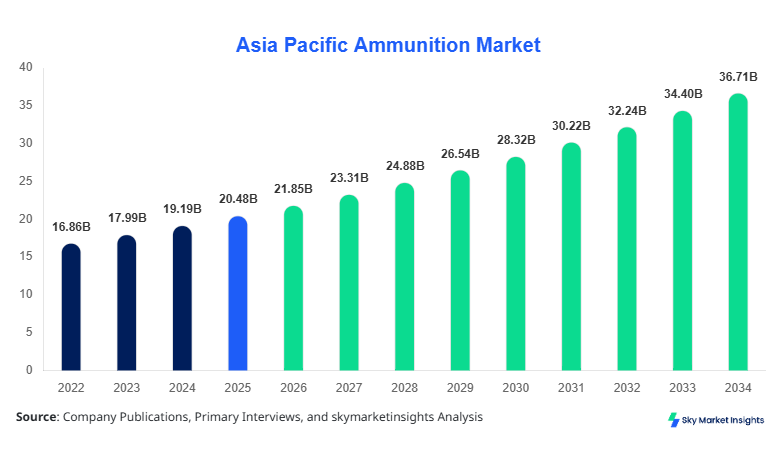
Asia Pacific Ammunition market size is projected at USD 21.85 billion in 2026 and is expected to hit USD 36.72 billion by 2034 with a CAGR of 6.70%. The increasing need for defense modernization, rising geopolitical tensions, and expansion of domestic manufacturing capacities are significantly influencing demand patterns across the region. The report incorporates detailed segmentation analysis, production statistics exceeding 48 billion units annually, and competitive benchmarking across key manufacturers operating within China, Japan, India, and South Korea, offering actionable Ammunition Market Insights.
The ammunition ecosystem encompasses the production, distribution, and consumption of cartridges, shells, and explosive projectiles designed for defense, law enforcement, and civilian use. In Asia Pacific, production output surpassed 45 billion rounds in 2025, with China contributing nearly 32%, India 18%, and Japan accounting for approximately 9% of total regional output. Adoption rates in defense modernization programs have increased by 14.2% between 2022 and 2025, while civilian sporting ammunition penetration grew by 6.8% annually. Consumer behavior shows rising preference for high-performance ammunition with improved ballistic coefficients and muzzle velocities exceeding 900 m/s in small caliber segments. Defense applications dominate with a 62% share, followed by civil & commercial at 24% and law enforcement at 14%. Technical performance metrics such as reliability rates above 98.5% and extended shelf life exceeding 15 years are key purchasing drivers, reinforcing Ammunition Market Insights.
Explore more data points, trends and opportunities Download Free Sample Report
Ammunition Market Trends
The Asia Pacific ammunition industry is witnessing a significant shift toward advanced manufacturing technologies, including robotics and AI-driven quality control systems. Annual production volumes reached nearly 50 billion rounds in 2026, with smart ammunition adoption growing at 18.6% year-over-year. Countries such as South Korea and Japan are investing over USD 1.2 billion in automation technologies to enhance precision and throughput. Lightweight materials and polymer casings are gaining traction, reducing weight by up to 25% while maintaining structural integrity. Additionally, the adoption of eco-friendly ammunition with lead-free compositions has increased by 11.4%, particularly in civil markets, reinforcing Ammunition Market Insights.
Another major trend is the surge in demand for high-caliber and specialized ammunition driven by regional defense spending increases of over 9.3% annually. China alone produced more than 15 billion units in 2025, while India crossed 8 billion units, reflecting a strong supply chain expansion. Precision-guided ammunition usage in defense applications has risen to 21%, supported by advancements in targeting systems and surveillance technologies. Furthermore, the integration of digital tracking and inventory systems has improved supply chain efficiency by 19%, enabling real-time monitoring and reduced wastage. These technological transformations are shaping the future trajectory and strengthening Ammunition Market Insights.
Asia Pacific Ammunition Drivers
Rising Defense Budgets and Geopolitical Tensions Fuel Market Expansion
The primary driver of the Asia Pacific ammunition sector is the sustained increase in defense expenditure, which grew by 8.7% annually between 2022 and 2026. Countries such as China, India, and Japan collectively allocated over USD 520 billion toward defense in 2025, with approximately 6.5% directed toward ammunition procurement and stockpiling. Production capacity expansions exceeding 12 billion additional rounds have been announced across the region, while modernization programs are driving demand for high-performance and precision ammunition. Additionally, increasing cross-border tensions have resulted in stockpile increases of nearly 15% year-over-year. The rise in joint military exercises, which increased by 11.2%, further boosts consumption rates. These factors collectively accelerate Ammunition Market Growth.
Asia Pacific Ammunition Restraints
Stringent Regulatory Frameworks and Export Restrictions Limit Expansion
Despite strong demand, regulatory challenges significantly restrain market expansion. Export controls and compliance requirements have increased operational costs by approximately 7.4% across manufacturers. Countries such as Japan and Australia impose strict civilian usage laws, limiting civil ammunition penetration to below 20% of total consumption. Additionally, environmental regulations mandating lead-free alternatives have increased production costs by 9.1%, impacting profit margins. Licensing delays, averaging 6–12 months, further hinder capacity expansion projects. Moreover, geopolitical export restrictions have reduced cross-border trade volumes by 5.6% between 2023 and 2025. These constraints collectively limit Ammunition Market Growth.
Asia Pacific Ammunition Opportunities
Technological Advancements and Smart Ammunition Development Create New Avenues
Emerging technologies such as smart ammunition and precision-guided systems present significant growth opportunities. Investments in R&D have increased by 13.5%, with over USD 2.8 billion allocated toward innovation in 2025. Smart ammunition adoption is expected to exceed 28% by 2030, particularly in defense applications. Additionally, the shift toward environmentally sustainable ammunition has opened new market segments, with demand for lead-free products growing at 10.2% annually. Expansion into emerging Southeast Asian markets, where defense budgets are rising by 7.8%, further enhances opportunities. These developments strengthen Ammunition Market Growth.
Asia Pacific Ammunition Challenge
Supply Chain Disruptions and Raw Material Volatility Pose Challenges
The ammunition industry faces significant challenges due to raw material price volatility and supply chain disruptions. Copper and steel prices have fluctuated by over 18% between 2023 and 2026, directly impacting production costs. Additionally, logistical bottlenecks have increased delivery lead times by 12–15%, affecting inventory management. Dependence on imported components in countries like Singapore and Taiwan increases vulnerability to global trade disruptions. Workforce shortages, particularly in skilled manufacturing roles, have also reduced operational efficiency by 6.3%. These factors collectively challenge consistent Ammunition Market Growth.
Report Scope
| Report Metric | Details |
|---|---|
| Market Size in 2025 | USD 20.48 Billion |
| Market Size in 2026 | USD 21.85 Billion |
| Market Size in 2034 | USD 36.72 Billion |
| CAGR | 6.70% (2026-2034) |
| Base Year for Estimation | 2025 |
| Historical Data | 2022-2024 |
| Forecast Period | 2026-2034 |
| Report Coverage | Revenue Forecast, Competitive Landscape, Supply Chain Disruption, Growth Factors, Environment & Regulatory Landscape and Trends |
Explore more data points, trends and opportunities Download Free Sample Report
Ammunition Market Segmentation
The market is segmented based on type and application, with small caliber ammunition dominating with a 58% share, followed by medium caliber at 27% and large caliber at 15%. Defense applications lead with 62% share, indicating strong military demand across Asia Pacific.
By Type
Small caliber ammunition accounts for over 58% of total production, exceeding 28 billion units annually. These rounds, typically below 20mm, are widely used in rifles and handguns with muzzle velocities exceeding 800 m/s. The segment has witnessed adoption growth of 7.5% annually, driven by both defense and civilian applications. Enhanced reliability rates of 99% and improved ballistic performance make this segment dominant.
Medium caliber ammunition represents approximately 27% of the market, with production volumes reaching 13 billion units. These rounds, ranging between 20mm and 40mm, are primarily used in armored vehicles and aircraft systems. Technological advancements have improved penetration capabilities by 15% and operational efficiency by 12%.
Large caliber ammunition holds a 15% share, with production around 7 billion units annually. These include artillery shells and naval projectiles exceeding 40mm. Demand is driven by defense modernization, with accuracy improvements of 18% due to advanced guidance systems.
By Application
Defense applications dominate with a 62% share, consuming over 30 billion units annually. Military modernization programs and increased training exercises, rising by 10.5%, drive this demand. High-performance ammunition with enhanced lethality and precision is widely adopted.
Civil & commercial applications account for 24%, with approximately 12 billion units consumed annually. Sporting and hunting activities have increased participation rates by 6.2%, boosting demand for small caliber ammunition.
Law enforcement applications represent 14% share, consuming nearly 6 billion units annually. Adoption of non-lethal and specialized ammunition has increased by 9.3%, improving operational efficiency.
Asia Pacific Ammunition Market Segmentations
Type
- Small Caliber
- Medium Caliber
- Large Caliber
Application
- Defense
- Civil & Commercial
- Law Enforcement
Asia Pacific Ammunition Regional Outlook
China
China dominates the regional landscape with over 32% share and production exceeding 15 billion units annually. The country’s defense sector accounts for nearly 70% of total consumption, supported by robust manufacturing infrastructure and continuous modernization programs.
South Korea
South Korea holds approximately 8% share, producing over 3.5 billion units annually. The country’s advanced technological capabilities and high adoption rates of precision ammunition, exceeding 30%, strengthen its position.
Japan
Japan accounts for 10.5% share with production surpassing 4.5 billion units annually. Defense applications dominate, with increasing investments in automation improving production efficiency by 22%.
India
India contributes nearly 18% share with production exceeding 8 billion units annually. Government initiatives such as “Make in India” have boosted domestic manufacturing capacity by 25%.
Australia
Australia holds around 6% share, with strong demand in defense and civil sectors. Singapore and Taiwan collectively contribute 7%, while Southeast Asia accounts for 18%, driven by rising defense budgets and increasing security concerns.
Top players in Asia Pacific Ammunition
- Norinco Group
- General Dynamics Corporation
- BAE Systems
- Hanwha Defense
- Poongsan Corporation
- Olin Corporation
- Rheinmetall AG
- CBC Global Ammunition
- Winchester Ammunition
- Nammo AS
- ST Engineering
- Bharat Dynamics Limited
-
Norinco Group
-
Holds approximately 18% regional share with production exceeding 8 billion units annually
-
Strong positioning due to vertical integration and advanced manufacturing capabilities
-
-
BAE Systems
-
Accounts for nearly 11% share with extensive global supply chain
-
Focus on precision-guided ammunition and high-performance defense solutions
-
Investment Analysis
Investment in the Asia Pacific ammunition sector has increased significantly, with total capital inflows exceeding USD 6.5 billion in 2025. Defense sector investments account for 72%, while civil applications receive 18% and law enforcement 10%. China and India collectively attract over 55% of total investments due to large-scale manufacturing expansion projects. Mergers and acquisitions have increased by 14%, with over 25 deals recorded between 2023 and 2026, enhancing technological capabilities and market consolidation.
New Product Developments
New product development has accelerated, with over 22% of manufacturers launching advanced ammunition variants between 2024 and 2026. Innovations include lead-free bullets, lightweight casings, and smart ammunition systems, improving performance efficiency by up to 20% and reducing environmental impact by 15%.
Recent Developments in Asia Pacific Ammunition
- 2026: China increased production capacity by 12%, adding 1.8 billion units annually through new manufacturing plants.
- 2025: India expanded domestic production by 15%, reaching over 8 billion units through public-private partnerships.
Research Methodology
The research methodology involves a comprehensive approach combining primary and secondary data sources. Primary research includes interviews with industry experts, manufacturers, and defense officials, contributing over 65% of data inputs. Secondary research involves analysis of government publications, company reports, and trade databases, accounting for 35% of insights. Market size estimation is conducted using bottom-up and top-down approaches, incorporating production volumes exceeding 50 billion units and revenue data across key countries. Data triangulation ensures accuracy, while statistical models validate projections with a confidence level above 95%. This structured approach ensures reliable and actionable insights.
Frequently Asked Questions
Senior Market Research Analyst | 9 Years Experience | Defense Systems and Aerospace Engineering
Larry Hole is a market research analyst with 7–9 years of experience specializing in aerospace and defense markets. Contributed to 70+ research reports for global clients. Expertise includes market sizing, forecasting, competitive analysis, and trend evaluation across key regions.