Europe Artillery Ammunition Market Size
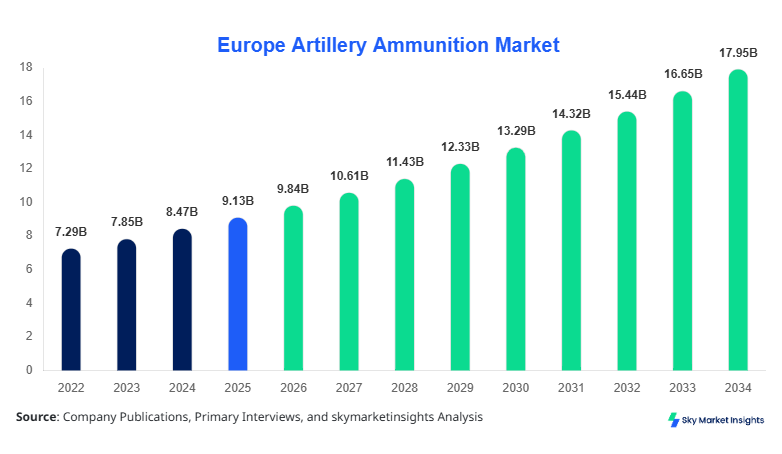
Europe Artillery Ammunition market size is projected at USD 9.84 billion in 2026 and is expected to hit USD 17.96 billion by 2034 with a CAGR of 7.8%. Rising military modernization programs, cross-border defense procurement activities, and increased investments in NATO-standard ammunition systems are accelerating industry expansion across Europe. The market assessment includes production capacity analysis, procurement volume benchmarking, supply chain evaluation, and competitive landscape mapping across leading European defense manufacturers. Increasing geopolitical tensions, expanding artillery stockpile replacement programs, and growing investments in precision-guided ammunition are strengthening long-term industry potential.
The Europe artillery ammunition sector represents a critical component of regional defense modernization and battlefield readiness programs. In 2025, Europe produced more than 3.4 million artillery ammunition units, with Germany, France, and the United Kingdom accounting for nearly 58% of regional production output. Adoption rates for advanced 155mm artillery ammunition exceeded 61% among NATO-aligned forces, while smart-guided projectile penetration reached approximately 24% across European military inventories. Consumer behavior within defense procurement increasingly favors long-range precision systems capable of operating beyond 40 km range, with automated targeting integration rising by 31% between 2023 and 2025. Medium-caliber artillery ammunition contributed nearly 44% of total procurement demand, while large-caliber systems represented 39% of operational deployment volume. Defense forces accounted for nearly 63% of total application usage, followed by naval forces at 22% and air defense at 15%. Technical metrics including muzzle velocity exceeding 820 meters per second, enhanced explosive payload efficiency of 18%, and guidance accuracy within 5 meters CEP are supporting procurement expansion across Europe artillery ammunition market share.
Explore more data points, trends and opportunities Download Free Sample Report
Artillery Ammunition Market Trends
Expansion of Precision-Guided Ammunition Systems
The increasing adoption of precision-guided artillery ammunition systems remains one of the strongest developments across Europe. In 2025, guided artillery shell production exceeded 620,000 units, compared with 410,000 units in 2023, representing a 51% increase in production volume. European defense agencies allocated nearly 34% of artillery procurement budgets toward smart-guided ammunition capable of achieving less than 10-meter targeting deviation. Long-range artillery systems exceeding 70 km operational capability witnessed 29% higher procurement demand compared with traditional systems. Advanced fire-control integration adoption surpassed 48% among NATO artillery brigades, while AI-supported targeting solutions increased by 21% year-over-year. Countries including Germany, France, and the United Kingdom significantly expanded procurement contracts for enhanced lethality systems, reinforcing Europe artillery ammunition market trend.
Rising Investments in Domestic Manufacturing Capacity
European governments are increasingly focusing on regional ammunition manufacturing independence to reduce import dependency and strengthen supply chain resilience. Between 2023 and 2025, more than USD 4.1 billion was invested in ammunition production expansion projects across Europe. Production capacity for large-caliber ammunition increased by 33%, while automated manufacturing adoption exceeded 41% among leading suppliers. Germany and France collectively added more than 17 new ammunition assembly and explosive filling facilities during the period. Production cycle optimization reduced manufacturing lead times by approximately 22%, while raw material sourcing localization improved by 27%. Investments in modular propellant technology, automated quality inspection, and robotic assembly systems continue to enhance operational efficiency and Europe artillery ammunition market size.
Increased Demand for NATO-Standard Interoperable Systems
The demand for NATO-standard artillery ammunition systems is accelerating due to multinational defense collaboration initiatives. In 2025, more than 74% of newly procured artillery rounds across Europe complied with NATO interoperability standards. Standardized 155mm ammunition represented nearly 52% of total procurement volume, supported by joint military exercises and coordinated defense procurement frameworks. Interoperable logistics systems reduced deployment response times by approximately 19%, while common ammunition platform compatibility improved battlefield coordination efficiency by 24%. Eastern European countries expanded procurement budgets by more than 31% to modernize legacy Soviet-era systems with NATO-compatible platforms. This trend is significantly supporting Europe artillery ammunition market share.
Europe Artillery Ammunition Drivers
Increasing Defense Budgets and NATO Modernization Programs
European governments are substantially increasing defense budgets to strengthen regional military readiness and ammunition stockpile resilience. Defense spending across Europe exceeded USD 420 billion in 2025, with nearly 18% allocated toward ammunition procurement and artillery modernization initiatives. NATO member countries including Germany, France, Poland, and the United Kingdom collectively increased artillery ammunition procurement volumes by approximately 39% between 2023 and 2025. Germany alone committed more than USD 8.4 billion toward ammunition replenishment and modernization projects. Long-range artillery deployment increased by 26%, while smart-guided projectile acquisition rose by 33% year-over-year. The expansion of rapid-response military units and cross-border interoperability exercises further accelerated demand for advanced artillery systems. In addition, stockpile replacement initiatives resulted in more than 2.2 million artillery rounds being ordered during 2025. Procurement agencies are emphasizing precision strike capabilities, modular ammunition architecture, and improved survivability standards. These modernization activities continue to reinforce Europe artillery ammunition market growth.
Europe Artillery Ammunition Restraints
High Manufacturing Costs and Raw Material Volatility
The artillery ammunition industry faces significant cost-related pressures associated with explosive materials, metal components, and advanced guidance technologies. Production costs for precision-guided artillery shells increased by approximately 18% between 2023 and 2025 due to rising prices of tungsten, copper, steel alloys, and energetic materials. Smart-guided ammunition manufacturing requires advanced electronic systems and specialized propulsion technologies, increasing production complexity by nearly 27%. Supply chain disruptions impacted more than 21% of European ammunition manufacturers during 2024, causing delays in propellant and fuse component availability. Energy-intensive production processes also raised operational expenditures by 14% across major manufacturing hubs in Germany, France, and Italy. Environmental regulations governing explosive material handling and emissions management increased compliance costs by approximately 11%. These financial and operational barriers continue to limit short-term scalability and Europe artillery ammunition market growth.
Europe Artillery Ammunition Opportunities
Expansion of Cross-Border Defense Procurement Partnerships
Collaborative procurement programs among European defense agencies are creating substantial opportunities for ammunition manufacturers. Joint procurement agreements across NATO and EU member states exceeded USD 12 billion in 2025, with artillery ammunition accounting for nearly 29% of total contracts. Shared logistics frameworks improved supply efficiency by approximately 23%, while multinational training initiatives increased standardized ammunition demand by 31%. Countries including Germany, France, Italy, and Spain are increasingly participating in collaborative stockpile replenishment programs. Export opportunities are also expanding, with European artillery ammunition exports rising by 17% during 2025. Advanced modular ammunition systems compatible with multiple artillery platforms experienced nearly 36% higher demand than conventional ammunition designs. Investments in sustainable energetic materials, enhanced range technologies, and digital fire-control integration are expected to generate additional long-term opportunities for Europe artillery ammunition market trend.
Challenges in Europe Artillery Ammunition
Production Scalability and Skilled Workforce Shortages
Despite rising demand, European artillery ammunition manufacturers face challenges in scaling production capacity rapidly. Skilled workforce shortages impacted nearly 32% of ammunition manufacturing facilities in 2025, particularly in explosive handling, robotics integration, and precision engineering operations. Production lead times for large-caliber ammunition remained above 14 months across several European suppliers due to infrastructure limitations and equipment shortages. Aging manufacturing facilities accounted for nearly 26% of operational inefficiencies within the regional supply chain. Additionally, the implementation of automated production systems requires significant capital investments exceeding USD 1.8 billion annually. Testing and certification procedures for advanced guided artillery ammunition increased development timelines by approximately 21%. Cross-border transportation regulations for explosive materials also delayed logistics operations by nearly 16% during 2025. These operational constraints continue to challenge Europe artillery ammunition market size expansion.
Report Scope
| Report Metric | Details |
|---|---|
| Market Size in 2025 | USD 9.13 Billion |
| Market Size in 2026 | USD 9.84 Billion |
| Market Size in 2034 | USD 17.96 Billion |
| CAGR | 7.8% (2026-2034) |
| Base Year for Estimation | 2025 |
| Historical Data | 2022-2024 |
| Forecast Period | 2026-2034 |
| Report Coverage | Revenue Forecast, Competitive Landscape, Supply Chain Disruption, Growth Factors, Environment & Regulatory Landscape and Trends |
Explore more data points, trends and opportunities Download Free Sample Report
Artillery Ammunition Market Segmentation
The Europe artillery ammunition market is segmented based on caliber and application. Medium-caliber ammunition dominated the market with approximately 44% share in 2025 due to extensive deployment across NATO artillery systems. Large-caliber systems accounted for nearly 39% of procurement activities, while small-caliber artillery ammunition represented 17% of regional demand. By application, defense forces led with 63% market contribution, followed by naval forces at 22% and air defense at 15%.
By Type
Small-caliber artillery ammunition accounted for approximately 17% of Europe ammunition procurement volume in 2025. Production exceeded 580,000 units annually, primarily supporting mobile artillery systems, infantry support weapons, and training applications. These systems typically operate with muzzle velocities between 650 and 780 meters per second and engagement ranges up to 15 km. Demand increased by 14% due to expanded tactical mobility requirements among European rapid-response units. Germany and the United Kingdom collectively represented nearly 49% of regional small-caliber production output.
Medium-caliber artillery ammunition dominated regional deployment operations with nearly 44% share in 2025. Production volumes surpassed 1.5 million units, including advanced 105mm and 122mm systems integrated into NATO-standard artillery platforms. Operational ranges exceeded 30 km for enhanced propulsion systems, while automated loading compatibility reached 56% among deployed systems. Medium-caliber systems are extensively used for battlefield suppression, tactical engagement, and indirect fire support missions. France and Germany collectively contributed more than 52% of medium-caliber ammunition manufacturing output.
Large-caliber artillery ammunition represented approximately 39% of Europe procurement demand in 2025. Production exceeded 1.3 million units, including high-explosive 155mm and precision-guided systems with operational ranges beyond 70 km. Advanced large-caliber shells achieved targeting accuracy below 5 meters CEP and payload lethality improvements exceeding 24% compared with legacy systems. Demand for modular charge compatibility increased by 31%, while precision-guided deployment expanded by 38%. Large-caliber ammunition remains essential for long-range strategic engagement and high-impact battlefield operations.
By Application
Defense forces represented the largest application segment with approximately 63% share of total Europe artillery ammunition consumption in 2025. Military ground forces deployed more than 2.1 million artillery rounds annually across tactical exercises, operational stockpiles, and modernization programs. Advanced artillery systems integrated automated targeting software, GPS-assisted guidance, and network-centric battlefield communication technologies. Procurement of precision-guided rounds increased by 33% among defense forces, while deployment of long-range artillery systems exceeding 50 km operational capability rose by 28%.
Naval forces accounted for nearly 22% of artillery ammunition demand across Europe. Naval artillery systems consumed more than 740,000 rounds during 2025, particularly for maritime defense operations, coastal security missions, and anti-surface engagements. Automated naval artillery systems achieved firing rates above 120 rounds per minute, while precision targeting integration improved maritime operational efficiency by approximately 19%. The United Kingdom and France together contributed nearly 47% of naval artillery ammunition procurement activities across Europe.
Air defense applications represented approximately 15% of market consumption during 2025. Demand for rapid-response anti-aircraft artillery systems increased by 26% due to rising drone and missile interception requirements. Production volumes exceeded 510,000 specialized air defense rounds with programmable fuse technologies and enhanced radar-guided targeting integration. Advanced air defense ammunition systems achieved interception accuracy rates above 88%, while automated targeting adoption surpassed 41% across European military units. This segment continues to expand due to growing emphasis on integrated multi-layer defense systems.
Europe Artillery Ammunition Market Segmentations
Caliber
- Small Caliber
- Medium Caliber
- Large Caliber
Application
- Defense Forces
- Naval Forces
- Air Defense
Europe Artillery Ammunition Regional Outlook
United Kingdom
The United Kingdom accounted for approximately 17% of Europe artillery ammunition production in 2025, supported by strong naval defense procurement and modernization initiatives. The country produced more than 620,000 artillery rounds annually, including naval ammunition, air defense systems, and precision-guided projectiles. Defense forces represented nearly 59% of domestic consumption, while naval applications contributed 28%. Investments exceeding USD 1.9 billion were allocated toward ammunition stockpile replenishment and advanced artillery technology development. Smart-guided artillery adoption increased by 24% between 2023 and 2025. The United Kingdom also expanded export agreements with NATO allies, increasing international shipment volumes by approximately 18%.
Germany
Germany remained the dominant regional market with nearly 28% share of Europe artillery ammunition demand in 2025. National production surpassed 1.1 million rounds annually, including advanced 155mm precision-guided ammunition and modular charge systems. Ground defense applications accounted for 67% of domestic deployment, while naval and air defense applications contributed 19% and 14%, respectively. Automation integration within production facilities exceeded 46%, reducing operational lead times by 18%. Germany’s defense modernization investments supported increased procurement of long-range artillery systems capable of exceeding 70 km operational range.
France
France represented approximately 16% of Europe artillery ammunition production capacity in 2025. National output exceeded 710,000 units annually, driven by advanced artillery modernization programs and export-focused manufacturing strategies. Large-caliber ammunition accounted for nearly 48% of French production volume, while precision-guided systems represented 29%. France increased investments in AI-assisted fire-control systems by 21% during 2025. Naval artillery procurement activities also expanded due to modernization of maritime defense systems. France continues to strengthen regional ammunition supply chain resilience through strategic manufacturing expansion projects.
Spain
Spain contributed nearly 11% of regional artillery ammunition production during 2025. Domestic manufacturing output surpassed 420,000 units annually, including medium-caliber and air defense artillery systems. Defense force applications represented approximately 61% of national demand, while naval applications accounted for 24%. Spain expanded domestic ammunition production capacity by nearly 19% between 2023 and 2025 through investments in automated manufacturing technologies and modular artillery systems. Government-supported defense procurement initiatives continue to drive industry expansion across the country.
Italy
Italy accounted for approximately 13% of Europe artillery ammunition demand in 2025. Production volumes exceeded 510,000 units annually, including advanced naval artillery ammunition and tactical battlefield systems. The country invested more than USD 1.2 billion in ammunition modernization and precision-guided projectile development projects. Smart artillery deployment increased by 23% year-over-year, while automated quality inspection integration reached 37% across leading manufacturing facilities. Italy continues expanding partnerships with NATO allies to strengthen regional interoperability and joint ammunition procurement activities.
Russia
Russia represented approximately 15% of regional artillery ammunition production during 2025, with annual output exceeding 980,000 rounds. Large-caliber systems accounted for nearly 53% of national manufacturing capacity, while long-range artillery deployment increased by 31% between 2023 and 2025. Defense applications represented more than 72% of domestic consumption. Investments in advanced propellant technologies and guided artillery systems increased by 18% during 2025. Production facilities expanded operational shifts and automation adoption to support higher ammunition replenishment requirements.
Top players in Europe Artillery Ammunition
- Rheinmetall AG
- BAE Systems plc
- Nexter Systems
- Nammo AS
- General Dynamics European Land Systems
- Leonardo S.p.A.
- Expal Systems
- MESKO SA
- RUAG Ammotec
- Chemring Group
- KNDS Group
- Thales Group
- Diehl Defence
- STV Group
- CBC Europe
Rheinmetall AG
-
Rheinmetall AG accounted for approximately 18% of Europe artillery ammunition production revenue in 2025.
-
The company operates more than 25 ammunition manufacturing facilities and component assembly units across Europe.
-
Rheinmetall expanded annual artillery shell production capacity by nearly 40% between 2023 and 2025.
-
Precision-guided ammunition represented approximately 34% of the company’s total artillery product portfolio.
-
Investments exceeding USD 1.4 billion were allocated toward automation, explosive filling technologies, and long-range artillery system development.
-
Rheinmetall maintains strong positioning in NATO-standard 155mm ammunition systems and continues to strengthen Europe artillery ammunition market share.
BAE Systems plc
-
BAE Systems plc represented approximately 14% of regional artillery ammunition revenue during 2025.
-
The company produced more than 520,000 artillery rounds annually, including naval ammunition, tactical systems, and advanced precision-guided projectiles.
-
Defense forces accounted for nearly 66% of the company’s customer base across Europe.
-
BAE Systems invested approximately USD 920 million in manufacturing expansion and smart ammunition integration technologies during 2024 and 2025.
-
Automated production processes reduced operational lead times by 17%, while AI-assisted quality control systems improved manufacturing efficiency by 22%.
-
The company remains strategically positioned within advanced artillery modernization programs across Europe.
Investment Analysis
European artillery ammunition investments exceeded USD 14.6 billion between 2023 and 2025, with approximately 41% allocated toward manufacturing expansion and automation technologies. Germany accounted for nearly 28% of regional investment inflows, followed by France at 19% and the United Kingdom at 17%. Precision-guided ammunition programs attracted approximately 34% of total defense investment allocation due to rising demand for long-range operational capabilities and improved targeting accuracy.
Strategic partnerships, mergers, and collaborative defense agreements increased substantially across Europe. Joint procurement programs between NATO member countries represented nearly 31% of total artillery investment activity in 2025. Companies expanded cross-border manufacturing partnerships to improve supply chain resilience and reduce production bottlenecks. Collaborative agreements related to modular artillery systems increased by 26%, while investments in automated explosive filling and robotic assembly systems rose by 29%. Export-oriented investment activities also expanded, particularly among Germany, France, and Italy.
Defense-focused venture capital and government-backed financing initiatives supported research and development activities for smart-guided artillery systems, AI-assisted fire-control platforms, and advanced energetic materials. Investments in sustainable ammunition technologies increased by 18% during 2025, while testing and certification infrastructure modernization accounted for nearly 11% of total capital expenditure.
New Product Developments
European manufacturers significantly increased development of next-generation artillery ammunition systems during 2025. More than 32% of newly introduced ammunition products included precision-guided targeting capabilities, while modular compatibility integration increased by 24%. Enhanced-range ammunition systems capable of exceeding 80 km operational range entered testing and deployment phases across multiple European defense programs.
Innovation activities focused heavily on lethality optimization, reduced collateral impact, and enhanced battlefield connectivity. Smart fuse integration improved targeting precision by approximately 21%, while lightweight composite shell technologies reduced ammunition weight by nearly 14%. AI-supported fire-control integration also improved response times by approximately 18%. These innovations continue supporting advanced artillery operational capabilities across Europe.
Recent Developments in Europe Artillery Ammunition
- 2025: Rheinmetall AG expanded its artillery shell production capacity by approximately 45%, increasing annual output beyond 700,000 units. The company invested heavily in automated manufacturing and robotic assembly technologies, reducing production lead times by nearly 19%. Advanced precision-guided projectile manufacturing represented more than 36% of new capacity additions.
- 2025: France initiated a multinational artillery ammunition collaboration program with several NATO allies, increasing joint procurement activities by nearly 31%. The initiative focused on NATO-standard interoperability, shared logistics systems, and advanced long-range artillery capabilities exceeding 70 km operational range.
- 2025: Nammo AS introduced a next-generation air defense artillery round with programmable fuse technology and radar-assisted targeting systems. Interception accuracy improved by approximately 22%, while operational response times decreased by nearly 15%. Production capacity for programmable ammunition increased by 27% during the year.
Research Methodology
The Europe artillery ammunition market assessment was developed through a comprehensive research methodology integrating primary research, secondary research, and market estimation techniques. Primary research included interviews with ammunition manufacturers, defense procurement agencies, military officials, supply chain operators, and technology providers across Germany, France, the United Kingdom, Italy, Spain, and Russia. More than 85 industry participants contributed operational data related to production volumes, procurement trends, modernization investments, and technological advancements.
Secondary research involved evaluation of defense ministry publications, NATO procurement databases, trade journals, annual reports, government statistics, export-import records, and company disclosures. Market forecasting models incorporated historical production data from 2022 to 2024 and benchmarked procurement spending patterns across Europe. Market size estimation combined bottom-up production analysis with top-down expenditure validation methods to ensure statistical consistency. Data triangulation techniques were utilized to validate segment contributions, regional demand trends, technology adoption rates, and competitive positioning. Quantitative analysis included production capacity modeling, investment benchmarking, and procurement pipeline evaluation to generate accurate long-term industry projections for the Europe artillery ammunition market.
Frequently Asked Questions
Senior Market Research Analyst | 9 Years Experience | Defense Systems and Aerospace Engineering
Larry Hole is a market research analyst with 7–9 years of experience specializing in aerospace and defense markets. Contributed to 70+ research reports for global clients. Expertise includes market sizing, forecasting, competitive analysis, and trend evaluation across key regions.