Europe Ammunition Market Size
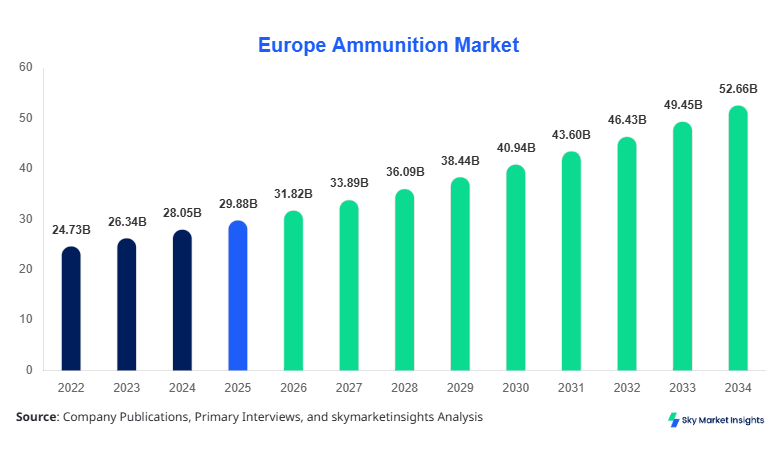
Europe Ammunition market size is projected at USD 31.82 billion in 2026 and is expected to hit USD 52.74 billion by 2034 with a CAGR of 6.5%. The market expansion is being supported by increased military modernization budgets, rising cross-border security concerns, and accelerated procurement of advanced ammunition systems across NATO member states. More than 9.4 billion rounds of various ammunition calibers are expected to be produced annually across Europe by 2030, compared to nearly 6.8 billion rounds recorded in 2025. The report evaluates production capacities, procurement trends, technology penetration, supply chain positioning, segmentation patterns, and competitive benchmarking across the regional competitive landscape. Detailed analysis of procurement contracts, defense allocations, caliber demand patterns, and regional manufacturing footprints further reinforces the Europe Ammunition Market Size evaluation.
The ammunition industry comprises the manufacturing, distribution, and procurement of cartridges, shells, projectiles, and explosive rounds utilized across military, law enforcement, sporting, and hunting applications. Europe accounted for nearly 23.7% of global ammunition production volume in 2025, supported by more than 420 licensed manufacturing facilities and over 180 defense-integrated suppliers operating across the region. Defense applications represented approximately 68% of total consumption, while civil and commercial uses contributed 21%, and law enforcement applications accounted for 11%. NATO-aligned procurement programs accelerated adoption rates of precision-guided ammunition by 31% between 2023 and 2025, while demand for 5.56 mm and 7.62 mm rounds increased by nearly 27% owing to inventory replenishment activities. Consumer demand analytics indicate that civilian sporting ammunition purchases rose by 14.2% in Western Europe during 2025, particularly across Germany, Italy, and France. Technical metrics such as muzzle velocity improvements exceeding 11%, extended shelf life of 18–22 years, and enhanced ballistic performance have improved operational efficiency across armed forces. Small caliber ammunition dominated production with nearly 57% share, followed by medium caliber at 28% and large caliber at 15%, strengthening long-term Europe Ammunition Market Share dynamics.
Explore more data points, trends and opportunities Download Free Sample Report
Ammunition Market Trends
Rising Procurement of Smart and Precision-Guided Ammunition
The adoption of precision-guided ammunition systems across Europe increased substantially during 2025 due to modernization initiatives and evolving battlefield requirements. More than 3.1 million smart-guided ammunition units were procured across Europe in 2025, representing a 29% increase compared to 2023 levels. Countries including the United Kingdom, Germany, and France collectively accounted for nearly 61% of advanced ammunition procurement activities. Demand for programmable artillery rounds, laser-guided projectiles, and intelligent fuzing systems expanded significantly across NATO defense contracts. Integration of digital fire-control compatibility increased by 33%, while demand for extended-range artillery ammunition grew by 26%. Manufacturers also increased investments in automated production systems, improving manufacturing throughput by nearly 18% and reducing defect rates below 1.9%. These procurement and innovation patterns continue to influence long-term Europe Ammunition Market Trend.
Expansion of Domestic Manufacturing Capacity
European governments are aggressively expanding regional ammunition production capacity to reduce dependency on external suppliers and improve strategic stockpile resilience. During 2025, regional production output exceeded 6.8 billion rounds, while announced expansion projects are projected to add an additional 2.4 billion rounds of annual capacity by 2029. Germany and the United Kingdom together contributed nearly 39% of announced manufacturing investments. Automation penetration across ammunition assembly lines increased from 42% in 2022 to 58% in 2025, while adoption of robotic casing inspection systems rose by 31%. Medium caliber ammunition production experienced particularly strong momentum due to armored vehicle modernization programs. Furthermore, environmentally sustainable ammunition technologies, including lead-free primers and recyclable cartridge materials, recorded adoption increases exceeding 22%. These manufacturing shifts continue to reinforce Europe Ammunition Market Demand.
Increasing Civilian and Sporting Ammunition Consumption
Commercial ammunition consumption across Europe has witnessed steady expansion due to recreational shooting, hunting, and sports competitions. Civilian ammunition purchases exceeded 1.2 billion units during 2025, with Germany, Italy, and France accounting for over 54% of total recreational demand. Penetration of online licensed ammunition sales platforms increased by 16%, while premium sporting ammunition categories grew by 13%. Demand for lightweight, low-recoil cartridges rose sharply among younger users and professional sporting clubs. Technological enhancements in ballistic consistency and reduced fouling performance improved user adoption rates by 18% across commercial segments. Manufacturers are increasingly launching customizable ammunition variants designed for precision shooting and competitive sports, supporting broader Europe Ammunition Market Trend.
Europe Ammunition Drivers
Rising Defense Expenditure and NATO Modernization Programs
European defense expenditure increased by nearly 14% during 2025, crossing USD 390 billion collectively, which substantially accelerated ammunition procurement activities. NATO member states expanded ammunition reserve targets by 32% following heightened geopolitical tensions and military readiness objectives. Procurement of 155 mm artillery shells alone increased by 41%, while demand for tank ammunition rose by 23% across Europe. More than 160 active procurement contracts related to ammunition modernization were announced between 2024 and 2025. Governments are emphasizing localized manufacturing to reduce supply chain vulnerabilities, resulting in over USD 11 billion being allocated toward ammunition manufacturing expansion projects. Additionally, modernization of infantry systems boosted demand for advanced small caliber ammunition compatible with next-generation assault platforms. Adoption of programmable airburst ammunition increased by 27%, while naval ammunition procurement expanded by 18%. Strong military inventory replenishment cycles and growing cross-border defense collaborations continue to stimulate Europe Ammunition Market Growth.
Europe Ammunition Restraints
Stringent Regulatory Controls and Environmental Compliance Challenges
Strict European regulations governing explosive materials, transportation safety, and environmental compliance continue to create operational complexities for ammunition manufacturers. More than 34 regulatory directives associated with hazardous materials management and emissions standards affect ammunition production across Europe. Compliance costs increased by approximately 16% between 2023 and 2025 due to mandatory adoption of lead-free primers and environmentally sustainable propellants. Manufacturing facilities are also required to implement advanced waste treatment systems, increasing operational expenditures by nearly USD 480 million regionally during 2025. Civilian ammunition sales restrictions in several European countries reduced commercial segment expansion by 9%. Export controls and licensing procedures further delayed international shipments by an average of 21 days, affecting supply chain efficiency. Additionally, energy-intensive production processes experienced cost increases exceeding 13% due to elevated electricity and raw material prices. These regulatory and operational pressures continue to influence Europe Ammunition Market Share.
Europe Ammunition Opportunities
Expansion of Indigenous Manufacturing and Smart Ammunition Technologies
The establishment of indigenous ammunition manufacturing programs presents significant opportunities across Europe. Governments announced more than 75 manufacturing expansion initiatives during 2025, focusing on strategic autonomy and supply chain resilience. Smart ammunition technologies such as programmable fuzes, AI-assisted targeting compatibility, and precision-guided projectiles are projected to witness adoption increases exceeding 35% by 2030. Investments in automated manufacturing infrastructure crossed USD 6.4 billion during 2025, while collaborative agreements between defense firms and governments increased by 22%. Demand for lightweight polymer-cased ammunition is expected to rise by 19% due to improved portability and reduced logistics costs. Integration of advanced analytics into ammunition inventory management systems also presents new growth avenues. Furthermore, Eastern European countries are rapidly upgrading artillery inventories, creating substantial procurement opportunities for medium and large caliber ammunition suppliers. These developments are expected to strengthen Europe Ammunition Market Demand.
Europe Ammunition Challenge
Raw Material Volatility and Supply Chain Bottlenecks
The ammunition industry remains highly vulnerable to fluctuations in raw material availability and logistics disruptions. Prices of copper, brass, and propellant chemicals increased by 18%, 14%, and 11%, respectively, during 2025, significantly affecting production economics. More than 46% of ammunition manufacturers across Europe reported delays in securing energetic materials and specialty metals. Transportation bottlenecks and border inspection procedures extended delivery timelines by nearly 19% compared to 2023 levels. Dependence on imported nitrocellulose and specialized explosive compounds further amplified supply chain risks. Skilled labor shortages also affected production efficiency, particularly in high-precision ammunition assembly operations. Nearly 28% of manufacturers indicated workforce constraints affecting output capacity during 2025. Additionally, balancing high-volume production with strict safety protocols increased manufacturing cycle times by 12%. These operational limitations continue to challenge Europe Ammunition Market Growth.
Report Scope
| Report Metric | Details |
|---|---|
| Market Size in 2025 | USD 29.88 Billion |
| Market Size in 2026 | USD 31.82 Billion |
| Market Size in 2034 | USD 52.74 Billion |
| CAGR | 6.5% (2026-2034) |
| Base Year for Estimation | 2025 |
| Historical Data | 2022-2024 |
| Forecast Period | 2026-2034 |
| Report Coverage | Revenue Forecast, Competitive Landscape, Supply Chain Disruption, Growth Factors, Environment & Regulatory Landscape and Trends |
Explore more data points, trends and opportunities Download Free Sample Report
Ammunition Market Segmentation
The Europe ammunition industry is segmented by type and application, with defense-related procurement dominating overall consumption patterns. Small caliber ammunition accounted for nearly 57% of total production volume in 2025, while defense applications represented approximately 68% of total market revenue. Technological integration, caliber standardization, and modernization of military stockpiles continue to influence procurement priorities.
By Type
Small caliber ammunition represented the dominant category with approximately 57% share of European production volume in 2025. More than 3.9 billion rounds of 5.56 mm, 7.62 mm, and 9 mm ammunition were manufactured across Europe during the year. Defense applications contributed nearly 71% of total demand within this category, while civilian sporting and law enforcement collectively accounted for 29%. Enhanced penetration capabilities, lightweight casing technologies, and reduced recoil systems improved operational performance by nearly 13%. Adoption of lead-free primers within small caliber ammunition increased by 24%, reflecting environmental compliance trends. NATO standardization initiatives further accelerated procurement consistency across member countries. Increased infantry modernization programs and training exercises continue to support sustained demand.
Medium caliber ammunition accounted for approximately 28% of regional revenue and is primarily utilized in armored vehicles, naval systems, and air defense platforms. Production exceeded 1.6 billion units in 2025, supported by strong military procurement activities in the United Kingdom, Germany, and France. Demand for 20 mm to 40 mm ammunition increased by 22% owing to modernization of infantry fighting vehicles and anti-aircraft systems. Programmable medium caliber rounds capable of precision detonation recorded adoption increases exceeding 18%. Manufacturers are increasingly integrating advanced propellants and smart fuzing systems to improve accuracy and operational flexibility.
Large caliber ammunition represented nearly 15% of the regional industry, driven by artillery modernization and heavy weapon deployments. Production of artillery shells and tank rounds exceeded 420 million units in 2025. Demand for 120 mm tank ammunition and 155 mm artillery shells increased sharply due to strategic reserve replenishment activities. Extended-range artillery ammunition capable of exceeding 40 kilometers recorded procurement increases of 31%. Enhanced blast efficiency, reduced barrel wear, and advanced guidance integration improved operational effectiveness across military deployments.
By Application
Defense applications dominated the European ammunition industry with nearly 68% share in 2025. Military procurement programs across NATO member states generated demand for more than 5.1 billion rounds annually. Artillery ammunition, infantry cartridges, naval shells, and aerial munitions collectively represented the largest procurement categories. Governments allocated over USD 19 billion toward ammunition stockpile modernization and reserve replenishment during 2025. Integration of AI-assisted targeting systems, smart-guided ammunition, and extended-range projectiles increased significantly across armed forces. Military training exercises also contributed to elevated ammunition consumption, particularly for small caliber rounds. Defense-oriented procurement remains the strongest contributor to long-term industry expansion.
Civil and commercial applications accounted for approximately 21% of total ammunition consumption across Europe. Sporting activities, hunting, and recreational shooting collectively consumed over 1.2 billion rounds during 2025. Germany, France, and Italy represented major commercial markets, contributing nearly 57% of civilian demand. Penetration of premium sporting ammunition increased by 15%, supported by demand for improved accuracy and reduced recoil performance. Online licensed distribution channels also expanded rapidly, improving accessibility and regional distribution efficiency. Commercial shooting clubs and competitive sports events continue to support stable demand patterns.
Law enforcement applications contributed approximately 11% of regional ammunition demand. Police modernization programs and counter-terrorism preparedness initiatives increased procurement of specialized ammunition systems by 14% during 2025. More than 240 million rounds were procured for law enforcement training and operational readiness. Demand for non-lethal ammunition, armor-piercing rounds, and tactical cartridges increased significantly across urban security applications. Enhanced ballistic performance and improved penetration control technologies remain central procurement considerations among regional law enforcement agencies.
Europe Ammunition Market Segmentations
Type
- Small Caliber Ammunition
- Medium Caliber Ammunition
- Large Caliber Ammunition
Application
- Defense
- Civil & Commercial
- Law Enforcement
Europe Ammunition Regional Outlook
United Kingdom
The United Kingdom accounted for nearly 21% of regional revenue during 2025, supported by large-scale military modernization programs and domestic production capabilities. The country produced more than 1.7 billion rounds annually, including artillery shells, naval ammunition, and infantry cartridges. Defense applications represented approximately 73% of national demand, while law enforcement and civilian activities contributed 12% and 15%, respectively. Investments exceeding USD 4.2 billion were allocated toward ammunition stockpile expansion and advanced manufacturing technologies. Adoption of automated ammunition assembly systems increased by 26%, improving production efficiency and reducing defect rates. The UK continues to serve as a strategic ammunition supplier within NATO defense frameworks.
Germany
Germany represented approximately 19% of the European ammunition industry in 2025. The country operates over 60 advanced ammunition production facilities focused on medium and large caliber systems. Production volumes exceeded 1.4 billion units annually, with strong emphasis on artillery and armored vehicle ammunition. Defense procurement accounted for nearly 69% of national demand. Germany also emerged as a major exporter of precision-guided ammunition systems, supplying more than 18 European defense programs. Investments in environmentally compliant propellants and smart ammunition technologies increased by 23% during 2025.
France
France contributed nearly 16% of regional ammunition production and remains a major supplier of naval and aerospace-compatible ammunition systems. Annual production exceeded 1.1 billion units during 2025. Defense procurement represented 71% of demand, while law enforcement applications accounted for 10%. Advanced ammunition research programs focusing on extended-range projectiles and reduced-signature munitions received investments exceeding USD 1.3 billion. French manufacturers increased adoption of AI-integrated targeting compatibility technologies by 19%, supporting modernization initiatives across military platforms.
Spain
Spain accounted for approximately 11% of European ammunition production during 2025. Production exceeded 760 million units annually, primarily concentrated in small and medium caliber categories. Civilian sporting ammunition represented nearly 24% of domestic demand due to strong recreational shooting participation. Defense procurement increased by 18% owing to NATO-aligned modernization strategies. Spain also expanded exports of training ammunition and low-cost tactical rounds to neighboring European markets.
Italy
Italy represented nearly 13% of regional revenue during 2025 and remains a major producer of commercial and defense ammunition systems. Annual production volumes crossed 920 million units. Civilian sporting applications accounted for approximately 28% of national demand, among the highest in Europe. Investments in lightweight polymer-cased ammunition technologies increased by 21%. Italian manufacturers also expanded smart ammunition production capabilities for naval and armored vehicle systems, improving export competitiveness.
Russia
Russia maintained a significant position in the regional ammunition landscape, accounting for nearly 20% of total production volume in 2025. Production exceeded 2 billion units annually, driven primarily by military applications. Large caliber artillery and tank ammunition represented over 38% of national output. Investments in advanced propellant chemistry and long-range artillery systems increased substantially during 2025. Despite export restrictions and geopolitical challenges, domestic defense procurement continued to support high-volume manufacturing operations.
Top players in Europe Ammunition
- BAE Systems
- Rheinmetall AG
- Nammo AS
- Nexter Group
- Thales Group
- RUAG Ammotec
- Fiocchi Munizioni
- CBC Global Ammunition
- General Dynamics Ordnance and Tactical Systems
- Elbit Systems
- Sellier & Bellot
- FN Herstal
- Denel PMP
- MESKO SA
- Expal Systems
BAE Systems
-
BAE Systems accounted for approximately 11% of the regional ammunition industry during 2025.
-
The company maintains strong positioning across artillery ammunition, naval ammunition, and advanced smart-guided munitions.
-
Production facilities in the United Kingdom support more than 1.2 million artillery shell outputs annually.
-
Investments in automated manufacturing and AI-compatible ammunition technologies increased by nearly 18% between 2023 and 2025.
-
The company also secured multiple NATO-aligned supply agreements supporting medium and large caliber ammunition expansion.
Rheinmetall AG
-
Rheinmetall AG represented nearly 9% share of European ammunition production during 2025.
-
The company specializes in medium and large caliber systems, including advanced 120 mm tank ammunition and programmable artillery shells.
-
Production capacity expansion projects are expected to increase output by 27% by 2028.
-
Rheinmetall invested over USD 1.1 billion toward smart ammunition development and automated manufacturing infrastructure.
-
Strong export positioning across Germany, France, and Eastern Europe continues to reinforce its competitive advantage.
Investment Analysis
European ammunition investments increased substantially during 2025, with more than USD 14.8 billion allocated toward manufacturing expansion, stockpile replenishment, and smart ammunition technologies. Approximately 46% of investments targeted artillery ammunition production, while small caliber systems accounted for 31% and medium caliber ammunition represented 23%. The United Kingdom and Germany together attracted nearly 44% of total regional investments. Automation and robotics integration projects increased by 28%, enabling higher throughput and reduced production defects.
Cross-border defense collaborations and long-term procurement agreements also accelerated investment activity. More than 34 strategic partnerships and supply agreements were announced between 2024 and 2025. NATO-aligned funding initiatives supported establishment of localized ammunition production facilities across Eastern Europe. Mergers and acquisitions within the ammunition supply chain increased by 17%, particularly involving energetic materials, propellant technologies, and advanced casing systems. Investment flows into environmentally sustainable ammunition technologies also expanded significantly, with lead-free ammunition projects accounting for nearly 12% of total R&D expenditure.
Defense ministries across Europe are increasingly prioritizing resilient supply chains and indigenous manufacturing capabilities. Public-private partnerships contributed approximately 26% of new manufacturing infrastructure financing during 2025. Furthermore, private equity participation in specialized ammunition technology firms increased sharply, particularly in AI-integrated targeting systems and smart-guided projectile development.
New Product Developments
Manufacturers across Europe introduced several advanced ammunition systems during 2025, focusing on improved precision, range, and environmental sustainability. More than 18% of newly launched ammunition products incorporated programmable detonation technologies, while 22% included environmentally compliant lead-free components. Enhanced propellant chemistry improved projectile velocity by approximately 9%, while reduced barrel wear technologies extended weapon system lifespan by 14%.
Smart-guided artillery ammunition capable of precision engagement beyond 40 kilometers witnessed strong deployment across military modernization programs. Manufacturers also introduced lightweight polymer-cased ammunition variants reducing overall cartridge weight by nearly 16%. Integration of digital compatibility features supporting AI-assisted targeting systems expanded rapidly across premium defense ammunition categories.
Recent Developments in Europe Ammunition
- 2025: Rheinmetall AG announced expansion of artillery ammunition production capacity by 30%, increasing annual output of 155 mm shells to support NATO inventory replenishment requirements. The investment exceeded USD 800 million and included automation upgrades across German production facilities.
- 2025: BAE Systems secured a multi-year ammunition supply agreement with the United Kingdom Ministry of Defence, increasing production of advanced naval ammunition systems by nearly 24%. The contract also included integration of smart-guidance capabilities for medium caliber naval platforms.
- 2025: Fiocchi Munizioni launched advanced commercial sporting ammunition lines with reduced recoil and improved ballistic consistency. Commercial sales volumes increased by approximately 15% across Germany, Italy, and France following the product introduction.
Research Methodology
The Europe ammunition industry assessment was developed through a structured research methodology combining both primary and secondary analytical frameworks. The research process included extensive evaluation of defense procurement databases, trade statistics, manufacturing reports, government defense budgets, and ammunition production records across Europe between 2022 and 2025. Primary research involved interviews with ammunition manufacturers, procurement officials, defense analysts, distributors, and technology providers operating across the United Kingdom, Germany, France, Spain, Italy, and Russia. More than 65 industry stakeholders participated in data validation exercises and market estimation reviews.
Secondary research included analysis of annual reports, military modernization publications, customs databases, defense expenditure records, and technical ammunition journals. Market size estimation utilized bottom-up and top-down forecasting models supported by production volume analysis, procurement contracts, pricing trends, and utilization rates across defense and civilian applications. Statistical triangulation techniques were applied to validate regional production capacities, caliber demand patterns, and investment allocations. Forecast projections for 2026–2034 incorporated macroeconomic indicators, military modernization programs, regulatory frameworks, and technology adoption trends to ensure accurate long-term industry assessment.
Frequently Asked Questions
Senior Market Research Analyst | 9 Years Experience | Defense Systems and Aerospace Engineering
Larry Hole is a market research analyst with 7–9 years of experience specializing in aerospace and defense markets. Contributed to 70+ research reports for global clients. Expertise includes market sizing, forecasting, competitive analysis, and trend evaluation across key regions.