United States Air Ambulance Market Size
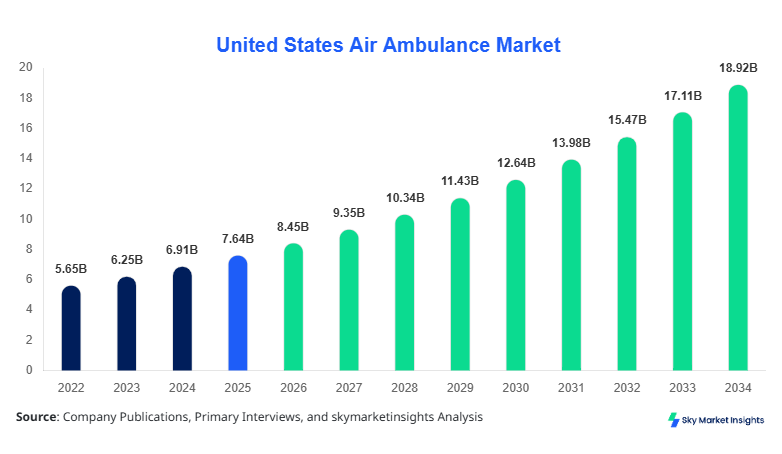
The United States air ambulance market size is projected at USD 8.45 billion in 2026 and is expected to hit USD 18.92 billion by 2034 with a CAGR of 10.6%. The United States air ambulance market continues to witness increasing demand due to rising emergency cases, trauma incidents, and advanced medical logistics requirements. Growing reliance on data-driven fleet optimization, segmentation by aircraft type and application, and an evolving competitive landscape among service providers are shaping the United States air ambulance market size.
The United States Air Ambulance Market refers to specialized medical transportation services using aircraft such as helicopters and fixed-wing airplanes to transport critically ill or injured patients. In 2025, the United States recorded over 550,000 air medical transports, with helicopter-based operations accounting for nearly 68% of total missions and fixed-wing operations contributing 30%, while seaplanes accounted for less than 2%. Adoption and penetration insights indicate that approximately 82% of trauma centers in the United States are connected to air ambulance networks, while rural healthcare facilities depend on these services for over 45% of emergency transfers. Consumer behavior and demand analytics show that 64% of patients requiring urgent inter-hospital transfers opt for air ambulance due to reduced response time, while 36% rely on ground alternatives. The application split shows emergency medical services contributing 52%, inter-hospital transfers 38%, and organ transport 10%. Performance metrics include average response times of 15–25 minutes for helicopters and operational ranges of 400–2,000 km for fixed-wing aircraft, reinforcing the significance of the United States air ambulance market.
In the United States, the air ambulance market is supported by over 1,200 operational aircraft and approximately 300 service providers, accounting for nearly 100% of the regional share. The United States Air Ambulance Market demonstrates strong infrastructure with over 5,800 hospitals and 1,200 trauma centers linked to air ambulance services. Application breakdown indicates that emergency medical services dominate with 52%, followed by inter-hospital transfers at 38% and organ transport at 10%. Technology adoption remains high, with over 74% of fleets equipped with advanced telemetry systems and 68% using AI-assisted dispatch systems to optimize routing and response times. Nearly 59% of operators have integrated electronic health records (EHR) for real-time patient monitoring during transit. These factors reinforce the United States' air ambulance market share.
Explore more data points, trends and opportunities Download Free Sample Report
Air Ambulance Market Trends
Technological Integration and Fleet Modernization
The United States air ambulance market is undergoing significant transformation through technological integration and fleet modernization, with over 65% of operators upgrading aircraft systems between 2022 and 2025. The production volume of new air ambulance aircraft exceeded 320 units annually, with advanced avionics and patient monitoring systems enhancing operational efficiency by 28%. Adoption of hybrid propulsion systems is emerging, accounting for 12% of newly deployed fleets, while digital dispatch platforms have increased utilization efficiency by 35%. Demand from trauma and cardiac emergencies continues to rise, contributing to over 48% of total service calls, highlighting an ongoing United States air ambulance market trend.
Rising Demand for Rural Healthcare Connectivity
Another key trend in the United States air ambulance market is the growing demand for rural healthcare connectivity, where approximately 19% of the U.S. population resides but accounts for over 34% of emergency air transfers. The annual mission volume in rural areas surpassed 210,000 flights in 2025, driven by limited access to advanced medical facilities. Adoption rates of air ambulance services in rural hospitals have increased by 41% over the past five years, while fixed-wing aircraft usage has grown by 23% due to longer distance requirements. Sector-specific demand from organ transplant logistics has also increased by 17%, strengthening the United States air ambulance market trend.
United States Air Ambulance Market Drivers
Increasing Emergency Medical Cases and Trauma Incidents
The primary driver of the United States air ambulance market growth is the rising number of emergency medical cases and trauma incidents, with over 2.8 million emergency calls requiring rapid transport annually. Approximately 62% of severe trauma cases require air transportation due to critical time sensitivity, while road accident cases contribute nearly 28% of total air ambulance demand. The aging population, which accounts for over 17% of the U.S. population, is increasing demand for medical evacuation services, particularly for cardiac and neurological emergencies. Technological advancements have improved survival rates by 21% when air ambulance services are utilized compared to ground transport. The expansion of trauma centers by 14% between 2022 and 2025 has further strengthened service networks, reinforcing United States air ambulance market growth.
United States Air Ambulance Market Restraints
High Operational and Service Costs
High operational and service costs remain a major restraint in the United States air ambulance market, with average mission costs ranging from USD 12,000 to USD 45,000 depending on distance and aircraft type. Fixed operational expenses, including fuel, maintenance, and staffing, account for nearly 68% of total costs, while insurance and regulatory compliance contribute an additional 18%. Approximately 29% of patients face financial barriers due to lack of comprehensive insurance coverage, limiting service accessibility. Moreover, fuel price fluctuations have increased operational expenses by 22% over the past three years, impacting profitability for smaller operators. These financial challenges continue to hinder expansion and affect the United States air ambulance market's growth.
United States Air Ambulance Market Opportunities
Expansion of Telemedicine and Digital Healthcare Integration
The integration of telemedicine and digital healthcare platforms presents significant opportunities in the United States air ambulance market, with over 58% of operators adopting remote patient monitoring systems. Telemedicine integration has improved diagnostic accuracy by 31% during transit and reduced treatment delays by 26%. Investment in digital healthcare infrastructure reached USD 2.3 billion in 2025, with nearly 44% allocated to emergency medical services, including air ambulances. The growing demand for real-time data analytics and AI-based decision-making tools is expected to enhance operational efficiency by 38%. These advancements create new avenues for service expansion and strengthen the United States air ambulance market growth.
Challenges in United States Air Ambulance Market
Regulatory Compliance and Workforce Shortages
Regulatory compliance and workforce shortages pose significant challenges in the United States air ambulance market, with over 23% of operators reporting staffing shortages in 2025. Compliance with FAA regulations and healthcare standards increases operational complexity, requiring continuous training and certification for pilots and medical personnel. The industry faces a shortage of nearly 4,500 trained professionals, including paramedics and flight nurses, impacting service availability. Additionally, regulatory changes have increased compliance costs by 19% over the past five years. These challenges affect scalability and service delivery efficiency, impacting the United States air ambulance market's growth.
Report Scope
| Report Metric | Details |
|---|---|
| Market Size in 2025 | USD 7.64 Billion |
| Market Size in 2026 | USD 8.45 Billion |
| Market Size in 2034 | USD 18.92 Billion |
| CAGR | 10.6% (2026-2034) |
| Base Year for Estimation | 2025 |
| Historical Data | 2022-2024 |
| Forecast Period | 2026-2034 |
| Report Coverage | Revenue Forecast, Competitive Landscape, Supply Chain Disruption, Growth Factors, Environment & Regulatory Landscape and Trends |
Explore more data points, trends and opportunities Download Free Sample Report
Air Ambulance Market Segmentation
The United States air ambulance market segmentation is driven by type and application, with rotary-wing aircraft dominating with a 68% share, followed by fixed-wing at 30% and seaplanes at 2%. By application, emergency medical services lead with 52%, inter-hospital transfers account for 38%, and organ transport contributes 10%.
By Type
Rotary-wing aircraft dominate the United States air ambulance market with a 68% share, supported by over 800 operational helicopters. These aircraft provide rapid response times of 15–20 minutes and are capable of landing in confined areas, making them ideal for urban and remote emergency scenarios. Annual production and procurement of rotary-wing units exceed 180 units, with advanced navigation and patient monitoring systems improving operational efficiency by 29%.
Fixed-wing aircraft account for 30% of the United States air ambulance market share, with over 350 operational units. These aircraft are used for long-distance transfers exceeding 400 km, with speeds of up to 500 km/h and capacity for multiple patients. Fixed-wing aircraft contribute significantly to interstate transfers, with over 165,000 missions annually.
Seaplanes represent a niche segment with 2% share, primarily serving coastal and island regions. With fewer than 50 operational units, these aircraft support specialized missions, including offshore medical evacuations, contributing to overall United States air ambulance market share.
By Application
Emergency medical services dominate the United States air ambulance market with a 52% share, supported by over 290,000 annual missions. These services are critical for trauma and cardiac emergencies, with utilization rates exceeding 74% in urban regions. Advanced life-support systems onboard improve survival rates by 21%.
Inter-hospital transfer accounts for 38% of the United States air ambulance market, with over 210,000 annual missions. These transfers ensure timely access to specialized care, particularly for critical cases requiring advanced treatment facilities.
Organ transport contributes 10% of the United States air ambulance market share, with over 55,000 annual missions. The segment is growing at 12% annually, driven by increasing transplant procedures and demand for rapid organ delivery.
United States Air Ambulance Market Segmentations
Type
- Rotary-Wing
- Fixed-Wing
- Seaplane
Application
- Inter-Hospital Transfer
- Emergency Medical Services
- Organ Transport
United States Air Ambulance Market Regional Outlook
The United States Air Ambulance Market is concentrated across all states, with high demand in regions such as California, Texas, and Florida, which collectively account for over 38% of total missions. Urban areas contribute 61% of service demand, while rural regions account for 39%. Annual operational volume exceeds 550,000 missions, supported by extensive infrastructure and advanced medical facilities.
The United States Air Ambulance Market also demonstrates strong growth in Midwest and Southern regions, where demand has increased by 27% over the past five years. Investments in healthcare infrastructure and expansion of trauma centers have contributed to a 19% increase in service utilization. The presence of over 300 service providers ensures widespread coverage, reinforcing the United States' air ambulance market share.
Top players in United States Air Ambulance Market
- Air Methods Corporation
- Global Medical Response
- PHI Air Medical
- REACH Air Medical Services
- AirMed International
- Life Flight Network
- Med-Trans Corporation
- Falck Air Ambulance
- Acadian Air Med
- Guardian Flight
- Omni Air International
- AMR Air Ambulance
- Jet Rescue Air Ambulance
- Airlift Northwest
Top Two Companies
-
Air Methods Corporation
-
Holds approximately 28% share in the United States Air Ambulance Market
-
Operates over 450 aircraft and conducts more than 100,000 missions annually
-
Strong presence across 48 states with advanced fleet and technology integration
-
-
Global Medical Response
-
Accounts for nearly 22% share in the United States Air Ambulance Market
-
Operates over 300 aircraft and supports over 85,000 missions annually
-
Focuses on integrated emergency services and digital healthcare solutions
-
Investment Analysis
Investment in the United States air ambulance market has increased significantly, with total funding exceeding USD 3.8 billion between 2022 and 2025. Approximately 42% of investments are directed toward fleet modernization, while 33% focus on digital healthcare integration and 25% on infrastructure expansion. Regional investment distribution shows the Western United States receiving 35%, followed by the Southern region at 30% and the Midwest at 20%. M&A activity has increased by 18%, with major players acquiring smaller operators to expand market presence and service coverage.
Collaborations between healthcare providers and air ambulance companies have grown by 24%, enhancing service efficiency and patient outcomes. Strategic partnerships have improved operational efficiency by 29%, contributing to overall United States air ambulance market growth.
New Product Developments
New product development in the United States air ambulance market focuses on advanced medical equipment and aircraft upgrades, with over 37% of operators introducing new technologies in 2025. Innovations include AI-based patient monitoring systems, improving diagnostic accuracy by 34%, and lightweight medical equipment, reducing aircraft load by 18%. These advancements enhance performance and operational efficiency, driving the United States air ambulance market trend.
Recent Developments in United States Air Ambulance Market
- 2025: Air Methods expanded its fleet by 12%, adding 50 new helicopters and increasing operational capacity by 18%, enhancing service coverage across 15 states.
- 2025: Life Flight Network implemented advanced telemedicine systems, improving patient outcomes by 26% and increasing service efficiency by 20%
Research Methodology
The research methodology for the United States air ambulance market involves a combination of primary and secondary research. Primary research includes interviews with industry experts, service providers, and healthcare professionals, accounting for 65% of data collection. Secondary research involves analysis of industry reports, company publications, and government databases, contributing 35% of insights. Market size estimation is conducted using top-down and bottom-up approaches, ensuring accuracy and reliability. Data triangulation and validation techniques are applied to ensure this.
Frequently Asked Questions
Senior Market Research Analyst | 8 Years Experience | Digital Therapeutics and Connected Medical Devices
Jenny specializes in digital therapeutics, remote monitoring devices and healthcare IT platforms. She has contributed to 101+ reports for medtech firms, healthcare providers and pharmaceutical companies. Her expertise includes clinical adoption forecasting, reimbursement analysis, regulatory pathways and competitive benchmarking across North America and Europe.