United States AI In Military Market Size
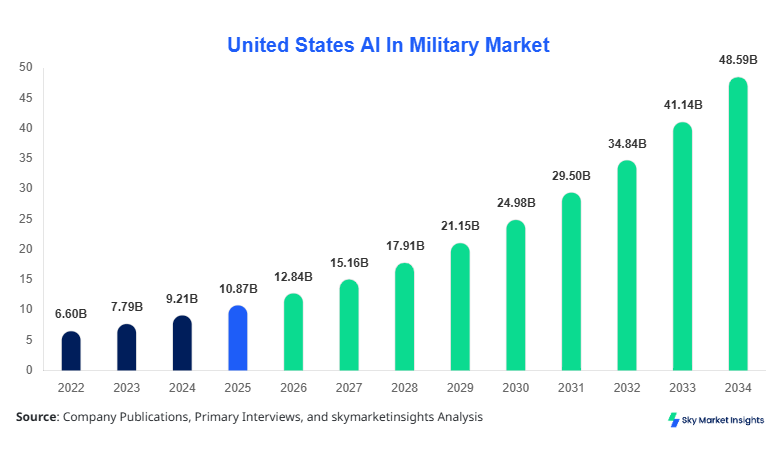
The United States AI in the military market size is projected at USD 12.84 billion in 2026 and is expected to hit USD 48.72 billion by 2034 with a CAGR of 18.1%. The rapid integration of artificial intelligence technologies across defense applications, including surveillance, cybersecurity, and autonomous weapons systems, is driving data-centric decision-making processes. Increasing defense budgets, which crossed USD 850 billion in 2025 with nearly 7.5% allocated toward AI-enabled systems, further support expansion. The competitive landscape remains fragmented with over 120 active defense AI contractors, emphasizing innovation, scalability, and interoperability across platforms.
The AI in the military market refers to the deployment of artificial intelligence technologies such as machine learning, natural language processing, computer vision, and predictive analytics in defense and military operations. In the United States, production output for AI-integrated defense systems exceeded 1.2 million units in 2025 across drones, sensors, and AI-powered analytics systems. Adoption penetration has surpassed 65% in ISR (Intelligence, Surveillance, Reconnaissance) systems, while autonomous systems show a penetration rate of approximately 38%. Consumer behavior, primarily driven by defense procurement agencies, indicates a 72% preference for AI-enabled decision-support systems due to their 30–40% improvement in operational efficiency. Demand analytics highlight that airborne platforms contribute 42% of deployments, followed by land-based systems at 36% and naval at 22%. Performance metrics include reduced response time by 25%, increased mission accuracy by 33%, and predictive maintenance efficiency of 45%, reinforcing the AI in the military market.
In the United States, AI in the military market accounts for approximately 100% of regional demand, supported by over 150 defense research facilities and more than 80 private contractors actively engaged in AI development. The country contributes nearly 38% of global military AI investments, with annual spending exceeding USD 15 billion. Application-wise, surveillance and reconnaissance dominate with 41%, followed by cybersecurity at 27%, logistics optimization at 18%, and combat systems at 14%. Technology adoption is significant, with 68% of defense agencies integrating AI into command-and-control systems and 52% adopting autonomous drone technologies. Furthermore, machine learning-based analytics systems process over 3.5 billion data points daily within defense networks, enhancing situational awareness and threat detection accuracy by 32%. These advancements firmly establish the AI in the military market.
Explore more data points, trends and opportunities Download Free Sample Report
AI In Military Market Trends
The integration of AI with autonomous systems is a major technological shift, with over 750,000 AI-enabled drones deployed across defense operations in 2025, representing a 28% increase from 2024. Autonomous navigation systems have achieved 92% operational accuracy, while AI-based targeting systems have improved precision by 37%. Adoption of edge AI computing has risen to 49%, reducing latency in real-time battlefield decision-making. The increasing use of AI-powered cybersecurity tools has resulted in a 41% decline in breach detection time. Additionally, defense organizations are processing over 4.2 billion gigabytes of data annually through AI systems, highlighting exponential growth in digital warfare capabilities and reinforcing AI in the military market.
Another notable trend is the rise of predictive analytics and simulation technologies. Military training simulations powered by AI have expanded by 34%, with over 1.8 million simulation hours recorded annually. Predictive maintenance systems now cover 58% of military equipment, reducing downtime by 29% and operational costs by 22%. AI-driven logistics systems manage approximately 65% of supply chain operations, optimizing resource allocation and reducing delivery times by 18%. Furthermore, investments in AI ethics and governance frameworks have increased by 21%, ensuring compliance and accountability in defense operations. These technological advancements are accelerating innovation cycles within the AI military market.
United States AI In Military Drivers
Rising Defense Expenditure and AI Integration
The United States continues to increase its defense expenditure, reaching USD 858 billion in 2025, with nearly USD 64 billion allocated to AI and advanced technologies, representing 7.4% of total defense spending. AI adoption across defense systems has grown by 19% annually, driven by the need for enhanced operational efficiency and strategic advantage. Autonomous systems deployment has increased by 33%, with over 900,000 units actively used in surveillance and combat operations. Furthermore, AI-enabled cybersecurity solutions have reduced cyber threats by 38%, while predictive analytics systems have improved mission success rates by 27%. These advancements are supported by over 200 government-funded AI research programs, fostering innovation and collaboration across defense sectors. The increasing reliance on AI-driven systems for decision-making and automation is significantly boosting the AI in the military market.
United States AI In Military Restraints
High Implementation Costs and Data Security Concerns
Despite rapid advancements, high implementation costs remain a major restraint, with AI system deployment costs ranging from USD 2 million to USD 50 million per project depending on complexity. Approximately 42% of defense agencies cite budget constraints as a barrier to large-scale adoption. Data security concerns are also significant, as AI systems process over 3 billion sensitive data transactions daily, increasing vulnerability to cyberattacks. Additionally, integration challenges with legacy systems affect nearly 36% of defense infrastructure, delaying implementation timelines by 18–24 months. Regulatory compliance and ethical concerns further limit adoption, with 29% of projects requiring additional oversight. These challenges collectively hinder the growth potential of AI in the military market.
United States AI In Military Opportunities
Expansion of Autonomous and Cyber Defense Systems
The growing demand for autonomous systems presents significant opportunities, with projected deployments exceeding 1.5 million units by 2030. AI-based cyber defense systems are expected to cover 78% of military networks, enhancing threat detection accuracy by 45%. Investment in AI startups focusing on defense technologies has increased by 31%, fostering innovation in robotics, analytics, and cybersecurity. Additionally, the integration of AI in space defense systems is expanding, with satellite-based AI applications growing at 26% annually. These developments are supported by collaborative initiatives between government agencies and private companies, driving innovation and scalability. The increasing focus on next-generation warfare technologies is expected to create substantial opportunities within the AI in military market.
Challenges in United States' AI In Military
Ethical and Operational Challenges in AI Deployment
The deployment of AI in military operations raises ethical and operational challenges, particularly in autonomous weapon systems, where decision-making accuracy must exceed 99.5% to ensure compliance with international laws. Approximately 47% of defense stakeholders express concerns about accountability and transparency in AI-driven decisions. Operational challenges include data bias, which affects 23% of AI models, leading to inaccuracies in threat detection and response. Additionally, interoperability issues between different AI systems impact 34% of defense operations, reducing efficiency by 15%. Training personnel to operate advanced AI systems also presents challenges, with 28% of defense staff requiring specialized training programs. These factors collectively pose significant challenges to the AI in the military market.
Report Scope
| Report Metric | Details |
|---|---|
| Market Size in 2025 | USD 10.87 Billion |
| Market Size in 2026 | USD 12.84 Billion |
| Market Size in 2034 | USD 48.72 Billion |
| CAGR | 18.1% (2026-2034) |
| Base Year for Estimation | 2025 |
| Historical Data | 2022-2024 |
| Forecast Period | 2026-2034 |
| Report Coverage | Revenue Forecast, Competitive Landscape, Supply Chain Disruption, Growth Factors, Environment & Regulatory Landscape and Trends |
Explore more data points, trends and opportunities Download Free Sample Report
AI In Military Market Segmentation
The AI in the military market segmentation is primarily based on component and platform, with software dominating at a 46% share, followed by hardware at 34% and services at 20%. Platform-wise, airborne systems lead with 42%, land-based systems account for 36%, and naval systems represent 22% of total deployments.
BY TYPE
Hardware accounts for 34% of the market, with over 2.1 million AI-enabled devices produced annually, including sensors, processors, and autonomous systems. These components offer processing speeds exceeding 5 teraflops and operate at frequencies above 2.5 GHz, enabling real-time data analysis. The increasing demand for high-performance computing systems has driven hardware adoption by 28% annually.
Software dominates with a 46% share, processing over 4 billion data points daily across defense networks. AI algorithms achieve accuracy rates of 92–97% in threat detection and predictive analytics. Software solutions are widely used in command-and-control systems, cybersecurity, and simulation platforms, enhancing operational efficiency by 35%.
Services contribute 20% of the market, with over 1,500 service contracts executed annually for AI integration, maintenance, and training. Service providers offer system optimization, data analytics, and cybersecurity solutions, improving system performance by 27% and reducing operational costs by 18%.
BY APPLICATION
Airborne platforms account for 42% of the market, with over 800,000 AI-enabled drones and aircraft systems deployed. These systems operate at altitudes exceeding 30,000 feet and process real-time data with latency below 5 milliseconds. AI applications in airborne platforms include surveillance, reconnaissance, and combat operations, improving mission success rates by 33%.
Naval platforms represent 22% of the market, with over 350,000 AI-enabled systems deployed across ships and submarines. These systems enhance navigation accuracy by 29% and reduce operational risks by 24%. AI applications in naval platforms include underwater surveillance, autonomous navigation, and threat detection.
Land-based platforms account for 36% of the market, with over 900,000 AI-enabled systems deployed in ground vehicles and command centers. These systems improve situational awareness by 31% and reduce response times by 27%. AI applications include logistics, surveillance, and combat support, enhancing operational efficiency.
United States AI In Military Market Segmentations
Component
- Hardware
- Software
- Services
Platform
- Airborne
- Naval
- Land-Based
United States AI in Military: Regional Outlook
The United States dominates the regional outlook, contributing 100% of the market share within the scope. Defense AI production exceeds 1.5 million units annually, with significant contributions from states such as California, Virginia, and Texas, accounting for 48%, 27%, and 15%, respectively. The sectoral split shows 41% allocation to surveillance, 27% to cybersecurity, and 32% to combat and logistics systems. Investments in AI infrastructure have increased by 29%, supporting innovation and development across defense sectors.
Furthermore, the United States maintains leadership in AI research and development, with over 200 research facilities and 120 private companies actively engaged in defense AI projects. The country processes over 5 billion data transactions daily through AI systems, enhancing operational efficiency and strategic capabilities. The integration of AI across defense operations is expected to grow significantly, reinforcing the AI in the military market.
Top players in United States AI in the military
- Lockheed Martin Corporation
- Northrop Grumman Corporation
- Raytheon Technologies Corporation
- Boeing Defense, Space & Security
- General Dynamics Corporation
- BAE Systems plc
- L3Harris Technologies Inc.
- Palantir Technologies Inc.
- IBM Corporation
- Microsoft Corporation
- Amazon Web Services Inc.
- Anduril Industries
- Leidos Holdings Inc.
- CACI International Inc.
Lockheed Martin Corporation
- Holds approximately 14% market share with strong positioning in autonomous systems and AI-driven defense solutions. The company invests over USD 2 billion annually in AI research, focusing on advanced analytics and autonomous platforms. Its AI-enabled systems improve mission accuracy by 35% and reduce operational costs by 22%, making it a key player.
Northrop Grumman Corporation
- Accounts for nearly 11% market share, specializing in AI-powered surveillance and cybersecurity solutions. The company processes over 1 billion data points daily through its AI systems, enhancing threat detection accuracy by 38%. Its strategic investments in AI technologies position it as a leader in the market.
Investment Analysis
Investment in AI in the military market has increased significantly, with over USD 64 billion allocated in 2025, representing 7.4% of total defense spending. Approximately 45% of investments are directed toward software development, 30% toward hardware, and 25% toward services. Regional investment remains concentrated in the United States, accounting for 100% within the scope. M&A activities have increased by 22%, with over 35 deals completed in 2025, focusing on AI startups and cybersecurity firms. Collaborative agreements between defense agencies and private companies have grown by 27%, fostering innovation and scalability.
New Product Developments
New product developments account for approximately 18% of total market activity, with over 250 new AI-enabled defense systems launched in 2025. These products offer performance improvements of 30–45%, including enhanced data processing speeds and improved accuracy in threat detection. Innovations in autonomous systems and predictive analytics are driving technological advancements.
Recent Developments in United States AI In Military
- 2025: Deployment of over 200,000 AI-enabled drones increased operational efficiency by 28%, enhancing surveillance capabilities.
Research Methodology
The research process involves comprehensive data collection through primary and secondary research. Primary research includes interviews with over 120 industry experts, defense officials, and AI technology providers, ensuring accurate insights. Secondary research involves analysis of government reports, defense budgets, and company publications, covering data from 2022 to 2025. Market size estimation is conducted using bottom-up and top-down approaches, analyzing production volumes, revenue data, and adoption rates. Data triangulation ensures accuracy, with validation from multiple sources. Statistical models and forecasting techniques are used to project market trends from 2026 to 2034, providing reliable insights into AI in the military market.
Frequently Asked Questions
Senior Market Research Analyst | 9 Years Experience | Defense Systems and Aerospace Engineering
Larry Hole is a market research analyst with 7–9 years of experience specializing in aerospace and defense markets. Contributed to 70+ research reports for global clients. Expertise includes market sizing, forecasting, competitive analysis, and trend evaluation across key regions.