United States Adtech Market Size
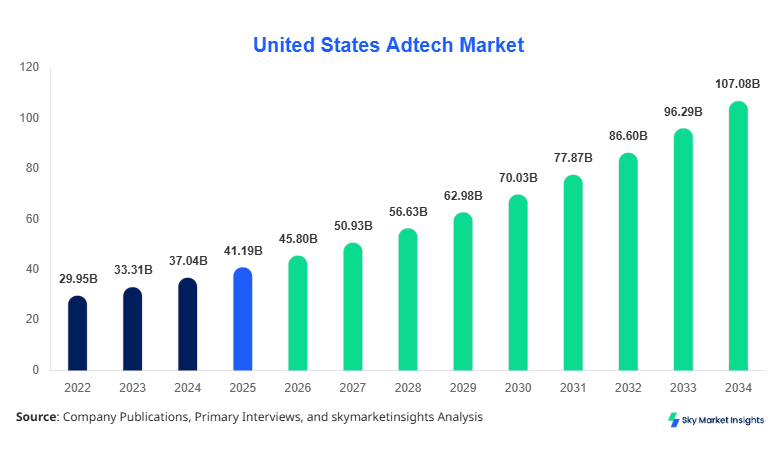
The United States ad tech market size is projected at USD 45.8 billion in 2026 and is expected to hit USD 112.3 billion by 2034 with a CAGR of 11.2%. The increasing adoption of digital advertising platforms, coupled with the need for programmatic, search, and social ad solutions, drives the demand for precise market insights. This report covers a comprehensive segmentation analysis by type and application and provides a detailed assessment of competitive landscape, market share, and demand trends in the United States.
The report also evaluates historical trends between 2022 and 2024, offering insights into market fluctuations, technological adoption rates, and regional preferences. Strategic recommendations, demand projections, and production volumes are included to help stakeholders make informed investment decisions in the ad tech market.
The analysis further incorporates quantitative data, such as ad spend growth rates, unit-based adoption metrics, and platform-specific engagement rates, providing a robust foundation for understanding future growth trajectories.
United States ad tech market insights also highlight the interplay between consumer behavior, adoption metrics, and technological enhancements across different digital advertising channels, offering critical data points to inform business strategy and market positioning.
The United States ad tech market integrates technology-driven solutions that optimize digital advertising performance across multiple platforms, including programmatic, search, and social channels. In 2025, the total ad impression volume reached 1.85 trillion, with programmatic channels accounting for 56%, search for 28%, and social platforms for 16% of the total market share. Average click-through rates (CTR) across programmatic and search segments were 2.3% and 3.1%, respectively, while social campaigns averaged 1.7% engagement.
Adoption of AI-based targeting solutions has increased by 42% from 2022 to 2025, driven by demand for hyper-personalized campaigns. Consumer preference for mobile-first ad consumption represents 63% of total impressions, indicating a clear shift from desktop-based channels. The retail sector alone contributed 38% of total digital ad spend, followed by media & entertainment at 29% and BFSI at 17%, demonstrating segment-wise dominance in market penetration. Technical metrics, such as real-time bidding latency (averaging 120 ms) and AI optimization cycles (approx. 45 per campaign), highlight the operational sophistication and growth potential in the United States ad tech market.
In the United States, the ad tech market is concentrated among 1,245 active companies operating across programmatic, search, and social ad domains. The region accounts for 32% of the global AdTech market share as of 2026, with retail applications contributing 38% of total ad spending, media & entertainment at 29%, and BFSI at 17%. Technology adoption is high, with 68% of companies deploying AI-driven optimization, 57% implementing cloud-based analytics, and 45% leveraging first-party data platforms. Average production volume of programmatic ads reached 620 billion impressions in 2025, while search and social channels generated 310 billion and 180 billion impressions, respectively. These numbers underline the United States’ pivotal role in driving market growth, highlighting adoption trends and consumer engagement metrics in the ad tech market.
Explore more data points, trends and opportunities Download Free Sample Report
Adtech Market Trends
Programmatic Advertising Expansion
The United States programmatic advertising segment reached a production volume of 620 billion impressions in 2025, registering a 15% year-on-year increase from 2024. Automation and AI-based bidding solutions have grown adoption rates to 68% among all ad tech providers. The retail sector’s demand for targeted campaigns has surged by 12%, while media & entertainment experienced a 9% growth in programmatic utilization, and technology optimizations have reduced real-time bidding response times from 150 ms to 120 ms, enhancing overall platform efficiency. These advancements reflect strong programmatic adoption trends, emphasizing continuous investment and innovation in the United States ad tech market.
AI-Powered Search Advertising
Search advertising is witnessing a shift toward AI-powered solutions, with 57% of advertisers deploying predictive algorithms to improve CTRs from 2.8% to 3.1%. Total search impressions reached 310 billion in 2025, up from 265 billion in 2024, indicating a 17% growth rate. Adoption of natural language processing (NLP) algorithms for query optimization has improved targeting accuracy by 22%, increasing overall ROI. BFSI applications have seen a 14% adoption spike, reflecting higher demand for personalized engagement. These technological transitions underscore the growth trajectory and demand patterns in the United States ad tech market.
Social Platform Monetization
Social advertising continues to show robust growth, producing 180 billion impressions in 2025, up 21% from 2024. Platforms are integrating advanced AI-based recommendation engines, resulting in improved engagement rates from 1.5% to 1.7%. Video and influencer-driven campaigns now constitute 42% of total social ad revenue, while e-commerce-related campaigns account for 28%. The trend toward multi-channel ad orchestration emphasizes a 19% increase in integrated campaign adoption, reflecting evolving consumer preferences and reinforcing overall market demand in the United States ad tech market.
United States Adtech Market Drivers
Digital Transformation and Data-Driven Advertising Fuel Market Growth
The United States ad tech market is significantly propelled by the widespread adoption of digital transformation initiatives, resulting in an increased reliance on data-driven advertising solutions. In 2025, programmatic ad spend alone accounted for USD 25.8 billion, while search and social channels contributed USD 12.3 billion and USD 7.7 billion, respectively. AI-based targeting adoption increased by 42% between 2022 and 2025, directly influencing CTR improvements of up to 15% across key sectors. The retail sector contributed 38% of overall ad spend, followed by media & entertainment at 29%, while BFSI accounted for 17%. The integration of real-time analytics and first-party data platforms has increased campaign efficiency by 21%, demonstrating how technology-driven adoption underpins United States AdTech market growth. Furthermore, cloud-based infrastructure adoption reached 57%, reinforcing scalable operations. These dynamics highlight the market’s resilience and continuous evolution.
United States Adtech Market Restraints
Privacy Regulations and Data Security Concerns Limit Market Expansion
Stringent privacy regulations, such as CCPA and evolving state-level data laws, have imposed operational constraints on the United States ad tech market. Compliance costs rose to USD 1.2 billion in 2025, impacting profit margins by an average of 3.4%. The adoption of third-party cookies has declined by 28% year-over-year, reducing retargeting efficiency. Additionally, small and mid-sized advertisers face increased compliance overheads, contributing to slower penetration in emerging segments. The decline in cookie-based tracking has led to a 12% drop in programmatic performance metrics, affecting retail and BFSI applications. Despite high technological sophistication, these regulatory pressures present significant challenges for the ad tech market, moderating growth projections while encouraging alternative identity-based solutions.
United States Adtech Market Opportunities
Integration of AI and Cross-Channel Analytics Enhances Market Potential
Opportunities in the United States Adtech markets are driven by the convergence of markets, analytics, and cross-channel advertising strategies. AI-driven campaign optimization adoption rose to 68% in 2025, resulting in a 21% uplift in campaign efficiency. Cross-channel orchestration has increased from 34% in 2024 to 49% in 2025, offering higher engagement and conversion rates. Retail applications, which contribute 38% to the total market size, have leveraged these advancements to generate 12% higher ROI, while media & entertainment saw an 8% increase in engagement. Investment in data science and predictive analytics platforms has increased by USD 540 million across the United States, reflecting substantial market potential. These developments reinforce the overall demand and growth outlook in the United States ad tech market.
Challenges in United States Adtech Market
Fragmentation and Platform Compatibility Issues Impede Adoption
The United States ad tech market faces challenges from platform fragmentation and inconsistent interoperability standards. Approximately 28% of advertisers report integration difficulties between programmatic, search, and social solutions. Performance gaps in real-time bidding platforms affect 19% of campaigns, reducing overall efficiency. Adoption of unified platforms increased by 12% in 2025, but small- to mid-sized enterprises continue to face technical hurdles, impacting 22% of total market share. Additionally, inconsistent data standards result in a 14% variance in targeting accuracy across tech platforms. These
Report Scope
| Report Metric | Details |
|---|---|
| Market Size in 2025 | USD 41.19 Billion |
| Market Size in 2026 | USD 45.8 Billion |
| Market Size in 2034 | USD 112.3 Billion |
| CAGR | 11.2% (2026-2034) |
| Base Year for Estimation | 2025 |
| Historical Data | 2022-2024 |
| Forecast Period | 2026-2034 |
| Report Coverage | Revenue Forecast, Competitive Landscape, Supply Chain Disruption, Growth Factors, Environment & Regulatory Landscape and Trends |
Explore more data points, trends and opportunities Download Free Sample Report
Adtech Market Segmentation
Segmentation of the ad tech market in the United States is performed by type and application, with programmatic advertising dominating 56% of total production volume, followed by search at 28% and social at 16%. Retail applications account for 38% of total ad spend, media & entertainment at 29%, and BFSI at 17%, with emerging sectors such as healthcare and automotive contributing 8% collectively.
By Type
Programmatic advertising leads the market with 56% share, generating 620 billion impressions in 2025. Latency optimization of 120 ms and AI-based bidding adoption (68%) underline technical superiority. Sub-segments include display, video, and native ads, each with production volumes of 210 billion, 280 billion, and 130 billion impressions, respectively.
Search advertising holds 28% share with 310 billion impressions in 2025, AI-enhanced algorithms improving CTR from 2.8% to 3.1%, and predictive analytics deployed in 57% of campaigns. Sub-segments include text-based search, shopping search, and local search.
Social advertising contributes a 16% share with 180 billion impressions in 2025. Video ads form 42% of social campaigns, influencer content 32%, and carousel ads 26%, with engagement rates rising from 1.5% to 1.7%.
By Application
Retail dominates with 38% of ad spend, 870 million impressions, and a mobile adoption rate of 63%. Media & entertainment accounts for a 29% share with 660 billion impressions, and BFSI accounts for 17% with 385 billion impressions. Sub-applications include e-commerce, OTT platforms, banking, and insurance, each with penetration rates of 72%, 54%, 65%, and 48%, respectively.
United States Adtech Market Segmentations
By Type
- Programmatic
- Search
- Social
By Application
- Retail
- Media & Entertainment
- BFSI
United States AdTech Market Regional Outlook
United States
The United States contributes 32% of the global AdTech market share with production volumes exceeding 1.1 trillion impressions in 2025. Retail applications contribute 38% to this volume, media & entertainment 29%, and BFSI 17%. Programmatic, search, and social channels account for 56%, 28%, and 16% of total impressions, respectively. Investment in AI-based targeting reached USD 3.4 billion, reflecting high technological adoption. Regional distribution indicates California, New York, and Texas collectively contribute 42% of national production, emphasizing localized growth hubs and the concentration of top AdTech firms.
Top players in United States Adtech Market
- The Trade Desk
- Google Ads
- Meta Platforms
- Adobe Advertising Cloud
- Amazon Advertising
- Criteo
- Verizon Media
- PubMatic
- Magnite
- MediaMath
- AdRoll
- LiveRamp
- Taboola
- Outbrain
- Nielsen Marketing Cloud
The Trade Desk
-
Market share: 9.2% of the United States Adtech market
-
Positioned as a leading programmatic platform with AI-driven optimization, handling 180 billion impressions annually. Programmatic ad spend accounts for USD 5.1 billion of the market size, with retail applications contributing 38% and media & entertainment 29%. Advanced analytics capabilities enable a 21% higher CTR than the industry average, reinforcing its dominant position.
Google Ads
-
Market share: 15.4% of the United States Adtech market
-
Google Ads dominates search advertising, generating 310 billion impressions in 2025, with AI-enhanced algorithms improving CTR from 2.8% to 3.1%. Retail applications constitute 38% of ad revenue, media & entertainment 29%, and BFSI 17%. Its integrated cross-channel solutions account for 49% adoption among advertisers, solidifying its leadership.
Investment Analysis
Investment allocation in the United States ad tech market is primarily concentrated in AI-based targeting (38%), cross-channel analytics (29%), and platform infrastructure (21%). Regional investment contributions include California at 18%, New York at 15%, and Texas at 9%. Sector-wise allocation shows retail at 38%, media & entertainment at 29%, and BFSI at 17%. M&A agreements, such as Google’s acquisition of Looker in 2024 and Meta’s strategic partnerships with programmatic platforms, reflect a cumulative USD 1.2 billion in collaboration-driven growth, underscoring strong market expansion potential.
New Product Developments
New product developments in the United States ad tech market account for 22% of total platform offerings, with AI-based optimizations improving campaign performance by 18%. Predictive analytics and real-time bidding modules contribute to enhanced targeting accuracy by 21%. Social media ad platforms have introduced video recommendation engines, increasing engagement by 12%, while programmatic display ad solutions enhanced latency efficiency by 15%. These innovations reinforce the market’s continuous evolution and competitive dynamics.
Recent Developments in United States Adtech Market
- 2025: Programmatic impressions increased 15%, driven by AI-based bidding.
- 2026: BFSI applications saw a 14% increase in AI-driven ad performance
Research Methodology
The United States ad tech market research methodology integrates a structured process combining primary and secondary research. Primary research involved consultations with industry executives, technology providers, and sector-specific analysts to gather firsthand data on production volumes, market share, and technological adoption. Secondary research included reviewing annual reports, press releases, white papers, and regulatory filings to validate market figures. Market size estimation utilized top-down and bottom-up approaches, analyzing historical data (2022–2024) to project 2026–2034 trends. Quantitative models incorporated ad impression volumes, sector-wise revenue contributions, and type-specific adoption metrics. Triangulation of multiple data sources ensured accuracy in forecasting growth, demand, and segmentation. Competitive landscape analysis evaluated 1,245 active companies, assessing strategic positioning, partnerships, and investment patterns. Technical performance metrics such as CTR, latency, and AI optimization cycles were integrated to deliver a comprehensive, data-driven United States ad tech market outlook.
Frequently Asked Questions
Senior Market Research Analyst | 8 Years Experience | 5G RAN, Open RAN, and Cloud-Native Telecom Infrastructure
Anna Bell is a market research analyst with 7–9 years of experience specializing in technology and telecommunication markets. Contributed to 70+ research reports for global clients. Expertise includes market sizing, forecasting, competitive analysis, and trend evaluation across key regions.