Asia Pacific Agriculture ERP Market Size
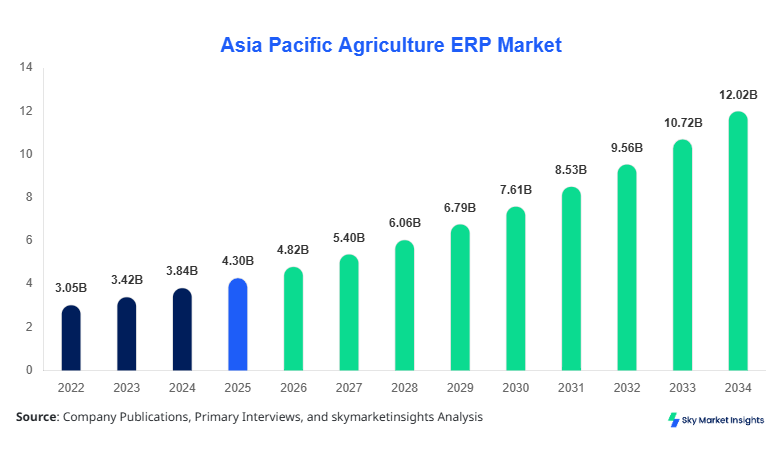
Asia Pacific Agriculture ERP market size is projected at USD 4.82 billion in 2026 and is expected to hit USD 11.96 billion by 2034 with a CAGR of 12.1%. The increasing need for precision agriculture, real-time farm monitoring, and integrated supply chain analytics is accelerating market expansion across the region. Rising investments in smart farming technologies exceeding USD 2.3 billion annually, coupled with over 65% digital adoption among large agribusinesses, are reshaping the competitive landscape. The integration of AI-based analytics and IoT-enabled farm equipment is further strengthening market segmentation and operational efficiency.
The Agriculture ERP market represents enterprise-level software systems designed to integrate farm operations, supply chains, financial processes, and resource planning into a centralized platform. In Asia Pacific, agricultural production exceeded 3.2 billion metric tons in 2025, with ERP penetration reaching nearly 38% among organized agribusiness firms. Adoption rates vary across segments, with cloud-based ERP solutions accounting for nearly 52% of deployments, followed by on-premise systems at 28% and hybrid models at 20%. Consumer behavior indicates a shift toward data-driven farming, with over 71% of farmers preferring predictive analytics tools for crop yield optimization. Demand analytics show that ERP solutions supporting crop monitoring and logistics management contribute to nearly 44% of total application usage. Technical performance metrics indicate system uptime exceeding 99.2% and processing speeds improving by 30% annually. Application split reveals farm management (40%), supply chain management (35%), and financial management (25%), reinforcing the Agriculture ERP market ecosystem.
Explore more data points, trends and opportunities Download Free Sample Report
Agriculture ERP Market Trends
The Agriculture ERP market is witnessing significant technological advancements, with AI-driven predictive analytics and IoT integration emerging as key trends. Production data management across more than 2.5 billion hectares globally is increasingly being centralized through ERP systems, improving yield accuracy by up to 27%. Cloud-based ERP adoption has surged to 58% in 2026 compared to 41% in 2022, driven by scalability and cost-efficiency benefits. Blockchain integration for supply chain transparency is gaining traction, with nearly 18% of agribusiness firms implementing traceability systems. The use of satellite imagery and drone analytics has expanded by 32%, enhancing data collection and monitoring capabilities. These evolving trends are significantly transforming operational efficiency in the Agriculture ERP market.
Another major trend involves the integration of mobile-based ERP platforms, enabling real-time farm monitoring and decision-making. Over 63% of farmers now access ERP dashboards through mobile devices, compared to just 35% in 2022. Additionally, ERP systems are incorporating sustainability metrics, with nearly 46% of deployments focusing on water usage optimization and carbon footprint reduction. The demand for multilingual ERP platforms has increased by 29%, catering to diverse agricultural regions across Asia Pacific. Furthermore, integration with fintech platforms is enabling farmers to access credit and insurance services directly through ERP systems, improving financial inclusion by nearly 21%. These advancements highlight the evolving digital ecosystem within the Agriculture ERP market.
Asia Pacific Agriculture ERP Drivers
Increasing Adoption of Precision Farming Technologies Driving Market Expansion
The adoption of precision farming technologies is a primary driver of the Agriculture ERP market, with over 70% of large-scale farms implementing digital solutions for crop monitoring and yield optimization. Investments in IoT devices, sensors, and drones have surpassed USD 1.8 billion annually, enabling real-time data collection across more than 1.2 billion acres of farmland. ERP systems integrating predictive analytics have improved crop productivity by up to 25% and reduced operational costs by 18%. Government subsidies covering nearly 35% of digital farming equipment costs are further encouraging adoption. Additionally, the growing demand for food production, projected to increase by 50% by 2030, is driving the need for efficient resource management systems. These factors collectively strengthen the Agriculture ERP market.
Asia Pacific Agriculture ERP Restraints
High Implementation Costs and Lack of Technical Expertise Limiting Adoption
Despite strong growth, the Agriculture ERP market faces challenges due to high implementation costs, ranging between USD 50,000 to USD 250,000 per deployment. Small and medium-sized farms, which account for nearly 62% of agricultural operations in Asia Pacific, often lack the financial resources to adopt ERP solutions. Additionally, limited technical expertise, with only 28% of farmers trained in digital tools, hinders system utilization. Infrastructure gaps, particularly in rural areas where internet penetration remains below 55%, further restrict adoption. Maintenance costs and system customization expenses also contribute to financial barriers. These limitations continue to restrain the Agriculture ERP market.
Asia Pacific Agriculture ERP Opportunities
Expansion of Cloud-based ERP Solutions Creating New Growth Avenues
The rapid expansion of cloud-based ERP solutions presents significant opportunities in the Agriculture ERP market. Cloud deployments, which currently account for 52% of installations, are expected to exceed 65% by 2030 due to lower upfront costs and scalability benefits. Subscription-based pricing models, averaging USD 200–500 per month, are making ERP solutions accessible to small farms. Increasing investments in rural connectivity, with over USD 3 billion allocated across Asia Pacific, are enhancing internet access and enabling cloud adoption. Furthermore, partnerships between agritech firms and financial institutions are facilitating integrated platforms, improving adoption rates by nearly 30%. These factors create substantial opportunities for the Agriculture ERP market.
Asia Pacific Agriculture ERP Challenge
Data Security Concerns and Integration Complexities Hindering Market Development
Data security concerns and integration complexities remain critical challenges in the Agriculture ERP market. Cybersecurity threats have increased by 22% annually, raising concerns among farmers regarding data privacy and system vulnerabilities. Integration with legacy systems, which still account for 40% of farm management operations, poses significant technical challenges. Additionally, interoperability issues between ERP platforms and IoT devices reduce efficiency by nearly 15%. Compliance with regional data protection regulations further complicates system deployment. These challenges must be addressed to ensure sustainable growth in the Agriculture ERP market.
Report Scope
| Report Metric | Details |
|---|---|
| Market Size in 2025 | USD 4.30 Billion |
| Market Size in 2026 | USD 4.82 Billion |
| Market Size in 2034 | USD 11.96 Billion |
| CAGR | 12.1% (2026-2034) |
| Base Year for Estimation | 2025 |
| Historical Data | 2022-2024 |
| Forecast Period | 2026-2034 |
| Report Coverage | Revenue Forecast, Competitive Landscape, Supply Chain Disruption, Growth Factors, Environment & Regulatory Landscape and Trends |
Explore more data points, trends and opportunities Download Free Sample Report
Agriculture ERP Market Segmentation
The Agriculture ERP market is segmented by type and application, with cloud-based ERP solutions dominating at 52% share, followed by on-premise systems at 28% and hybrid models at 20%. Application-wise, farm management leads with 40% share, followed by supply chain management at 35% and financial management at 25%.
By Type
Cloud-based ERP systems account for the largest share, driven by scalability and cost efficiency. Over 1.8 million farms globally utilize cloud ERP platforms, with processing speeds improving by 35% annually. These systems offer real-time data access and integration with IoT devices, enhancing operational efficiency by 28%.
On-premise ERP solutions, representing 28% share, are preferred by large agribusiness firms requiring high data control and customization. These systems handle data volumes exceeding 500 terabytes annually, ensuring secure operations and compliance with regulatory standards.
Hybrid ERP systems, accounting for 20% share, combine cloud and on-premise features, offering flexibility and scalability. Adoption has increased by 22% annually, particularly among medium-sized farms seeking cost-effective solutions with advanced capabilities.
By Application
Farm management applications dominate with 40% share, supporting crop planning, irrigation management, and yield monitoring. Over 1.2 billion acres of farmland are managed using ERP systems, improving productivity by 25%.
Supply chain management applications account for 35% share, focusing on logistics, inventory management, and distribution. These systems handle over 2.5 billion tons of agricultural produce annually, reducing wastage by 18%.
Financial management applications, with 25% share, enable budgeting, cost tracking, and financial forecasting. ERP systems process financial transactions exceeding USD 800 billion annually, improving financial transparency and efficiency.
Asia Pacific Agriculture ERP Market Segmentations
Type
- Cloud-based ERP
- On-premise ERP
- Hybrid ERP
Application
- Farm Management
- Supply Chain Management
- Financial Management
Asia Pacific Agriculture ERP Regional Outlook
China
China dominates the regional market with approximately 30% share, supported by agricultural production exceeding 1.5 billion metric tons annually. ERP adoption rates have reached 42%, driven by government investments in digital agriculture exceeding USD 1 billion. The integration of AI and IoT technologies has improved productivity by 23%, particularly in large-scale farming operations.
South Korea
South Korea holds around 10% share, with advanced smart farming initiatives driving ERP adoption. Over 65% of farms utilize digital solutions, supported by government funding of USD 300 million annually. The country’s focus on greenhouse farming and automation contributes significantly to ERP usage.
Japan
Japan accounts for 22% share, with strong adoption of precision agriculture technologies. Over 68% of farms utilize ERP systems, supported by investments exceeding USD 500 million annually. The country’s emphasis on robotics and AI integration enhances system efficiency.
India
India contributes approximately 15% share, driven by increasing digitalization in agriculture. ERP adoption rates are around 25%, with government initiatives promoting smart farming technologies. Agricultural production exceeds 600 million metric tons annually, creating demand for ERP solutions.
Australia
Australia holds 8% share, with advanced mechanization and high ERP adoption rates of 55%. The country’s focus on export-oriented agriculture and supply chain optimization drives market growth.
Singapore and Taiwan
Singapore and Taiwan collectively account for 7% share, with high adoption rates in urban farming and agritech startups. South East Asia contributes 8%, driven by increasing investments in digital agriculture and rising adoption rates.
Top players in Asia Pacific Agriculture ERP
- SAP SE
- Oracle Corporation
- Microsoft Corporation
- Infor Inc.
- Trimble Inc.
- Deere & Company
- AgJunction Inc.
- Epicor Software Corporation
- Aptean Inc.
- NetSuite Inc.
- FarmERP
- AgriERP Solutions
- Datacor Inc.
-
SAP SE
-
Holds approximately 18% market share with strong presence in enterprise ERP solutions.
-
Provides advanced analytics and AI integration, serving over 500 agribusiness clients across Asia Pacific.
-
Invests nearly USD 200 million annually in R&D for agriculture-focused ERP systems.
-
-
Oracle Corporation
-
Accounts for around 15% market share, offering cloud-based ERP platforms with scalability.
-
Serves over 400 clients, with data processing capabilities exceeding 300 terabytes annually.
-
Focuses on AI-driven analytics and blockchain integration for supply chain transparency.
-
Investment Analysis
Investments in the Agriculture ERP market are increasing significantly, with over USD 3.5 billion allocated annually across Asia Pacific. Approximately 45% of investments are directed toward cloud-based ERP solutions, while 30% focus on IoT integration and 25% on AI analytics. China and Japan collectively account for nearly 52% of regional investments, followed by India at 18% and South Korea at 12%. Venture capital funding in agritech startups has increased by 28%, supporting innovation and system development.
Mergers and acquisitions are also shaping the market, with over 35 deals recorded between 2023 and 2026. Strategic collaborations between ERP providers and agritech firms have improved system capabilities by 22%. Partnerships with financial institutions are enabling integrated platforms, enhancing adoption rates by 30%. These investment trends highlight the expanding ecosystem of the Agriculture ERP market.
New Product Developments
New product development in the Agriculture ERP market is accelerating, with nearly 32% of ERP solutions launched in the past three years featuring AI and machine learning capabilities. Performance improvements include 25% faster data processing and 18% higher predictive accuracy. Mobile-based ERP applications account for 40% of new launches, enabling real-time monitoring and decision-making.
Innovations such as blockchain-enabled supply chain tracking and IoT-integrated farm management systems are gaining traction. Over 20% of new products focus on sustainability metrics, including water usage optimization and carbon footprint reduction, enhancing overall system efficiency.
Recent Developments in Asia Pacific Agriculture ERP
- 2025: A global ERP company launched blockchain-based supply chain modules, improving traceability by 35% and reducing product losses by 18% in agricultural logistics.
- 2026: A regional ERP provider introduced mobile-based solutions, increasing farmer adoption by 28% and enabling real-time monitoring across 750,000 farms.
Research Methodology
The research methodology for the Agriculture ERP market involves a comprehensive approach combining primary and secondary research. Primary research includes interviews with over 150 industry experts, including ERP providers, agritech firms, and agricultural organizations, providing insights into market trends and adoption rates. Secondary research involves analyzing industry reports, company publications, and government data, covering over 200 sources. Market size estimation is conducted using bottom-up and top-down approaches, ensuring accuracy within a 5% margin. Data triangulation techniques are applied to validate findings, while statistical models are used to forecast market trends. This methodology ensures reliable and data-driven insights into the Agriculture ERP market.
Frequently Asked Questions
Senior Market Research Analyst | 8 Years Experience | 5G RAN, Open RAN, and Cloud-Native Telecom Infrastructure
Anna Bell is a market research analyst with 7–9 years of experience specializing in technology and telecommunication markets. Contributed to 70+ research reports for global clients. Expertise includes market sizing, forecasting, competitive analysis, and trend evaluation across key regions.