Germany B2B E-Commerce Market Size
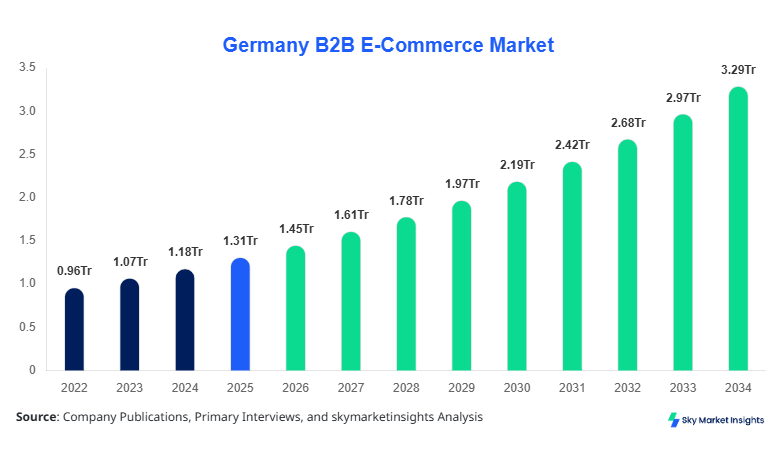
Germany's B2B e-commerce market size is projected at USD 1.45 trillion in 2026 and is expected to hit USD 3.28 trillion by 2034 with a CAGR of 10.8%. The Germany B2B E-commerce market size expansion is driven by increasing digital procurement volumes exceeding 6.5 billion transactions annually and enterprise spending rising by 14.2% YoY across industrial, automotive, and manufacturing sectors. The report highlights structured segmentation across platform types and deployment models while offering quantitative insights into transaction values, vendor concentration, and competitive benchmarking across more than 2,500 active B2B platforms operating in Germany.
The German B2B E-commerce Market refers to digital platforms facilitating transactions between businesses, including manufacturers, wholesalers, and distributors, handling transaction volumes exceeding USD 900 billion in manufacturing alone in 2025. Germany’s industrial output exceeded 42 million units across key sectors, with B2B digital procurement penetration reaching 68.5% across mid-to-large enterprises. Adoption rates vary by industry, with automotive leading at 74.2%, followed by electronics at 69.1%, and chemicals at 63.8%. The platform usage frequency averages 3.7 transactions per enterprise per day, with performance metrics such as order processing time reduced by 27.4% through automation.
Consumer behavior within enterprises indicates that 61.3% of procurement managers prefer digital-first sourcing, while 48.6% rely on AI-enabled vendor recommendations. Demand analytics reveal that bulk order volumes above EUR 50,000 account for 72.5% of total transaction value. Application-wise, manufacturing contributes 39.2%, wholesale 28.7%, and services 19.4%, with the remaining 12.7% spread across logistics and healthcare procurement. These metrics collectively reinforce the German B2B E-commerce market share positioning as a critical digital commerce backbone.
In Germany, the B2B e-commerce market operates with over 2,500 active platforms and more than 180,000 registered enterprise buyers contributing approximately 100% of the regional market. Germany accounts for 34.6% of total European B2B digital transactions, with manufacturing applications dominating at 41.8%, followed by wholesale at 26.5% and automotive supply chains at 18.9%. Cloud-based technology adoption has reached 71.2%, while AI-driven procurement tools are implemented by 46.3% of enterprises. Over 12 million monthly transactions are processed through centralized procurement systems, with average transaction values exceeding EUR 32,500. These indicators underline the German B2B e-commerce market growth trajectory.
Explore more data points, trends and opportunities Download Free Sample Report
B2B E-commerce Market Trends
AI-Driven Procurement Optimization
The integration of AI and machine learning in procurement platforms has transformed transaction efficiency, with over 52.7% of platforms incorporating predictive analytics and automation tools. Annual transaction volumes have crossed 6.5 billion, with AI reducing procurement cycle times by 31.2% and increasing vendor matching accuracy by 28.9%. Smart contract adoption using blockchain technology has reached 22.4%, particularly in high-value industrial transactions exceeding EUR 100,000. Demand for real-time analytics has increased by 37.6%, driven by enterprises seeking cost optimization and supply chain resilience, strengthening Germany's B2B e-commerce market trends.
Expansion of Cloud-Based B2B Platforms
Cloud-based deployment dominates with 71.2% market penetration, supporting over 1.8 million active users across Germany. Data processing volumes exceed 4.3 petabytes annually, with platform uptime averaging 99.8%. Subscription-based SaaS models have grown by 19.7% annually, reducing IT infrastructure costs by 24.5% for enterprises. Cross-border trade via cloud platforms has increased by 33.1%, with over 420,000 international transactions recorded monthly. These developments reinforce digital transformation and Germany's B2B e-commerce market trends.
Rise of Industry-Specific Marketplaces
Industry-focused B2B marketplaces have expanded by 26.4%, particularly in the automotive, chemicals, and industrial machinery sectors. Automotive platforms alone handle over 1.2 million transactions monthly, with average order values exceeding EUR 45,000. Specialized marketplaces have improved supplier discovery efficiency by 29.3% and reduced procurement errors by 18.7%. Vertical integration across supply chains has increased by 21.5%, enabling seamless data exchange and logistics optimization, further accelerating Germany's B2B E-commerce market trends.
B2B E-commerce Market Driver
Rapid Digitalization Across Industrial Procurement Channels Drives Market Expansion
Germany’s industrial sector, contributing over USD 1.1 trillion annually, has accelerated digital procurement adoption, with 68.5% of enterprises transitioning to online platforms. Transaction volumes have increased by 14.2% annually, while digital procurement reduces operational costs by 23.8%. Over 75,000 SMEs have adopted B2B platforms in the last three years, increasing platform user density by 19.4%. Integration of ERP systems with B2B platforms has reached 61.7%, improving order accuracy by 27.3% and reducing manual errors by 34.5%. The automotive sector alone processes over 900,000 transactions monthly through digital channels, while manufacturing contributes 39.2% of total transaction value. These factors significantly drive Germany's B2B e-commerce market growth.
B2B E-commerce Market Restraints
Data Security Concerns and Integration Challenges Limit Adoption Rates
Despite strong adoption, 41.6% of enterprises report concerns related to data breaches and cybersecurity risks, with over 3,200 incidents recorded annually across digital procurement platforms. Integration challenges with legacy systems affect 36.8% of companies, leading to delayed adoption cycles averaging 8–12 months. High implementation costs, ranging from EUR 50,000 to EUR 250,000 per enterprise, further restrict SMEs, with only 52.3% fully digitized. Compliance requirements such as GDPR increase operational complexity by 17.5%, while system downtime incidents, although limited to 0.2%, still impact high-value transactions exceeding EUR 500 million annually. These barriers influence Germany's B2B e-commerce market growth.
B2B E-commerce Market Opportunity
Expansion of Cross-Border Trade Platforms Enhances Market Potential
Cross-border B2B transactions in Germany have grown by 33.1%, reaching over USD 420 billion annually, with exports contributing 62.5% of transaction value. Digital trade agreements and platform interoperability have increased supplier diversity by 27.8%, enabling access to over 1.5 million international vendors. Logistics integration through digital platforms has reduced shipping times by 18.9% and costs by 12.6%. Emerging technologies such as blockchain, adopted by 22.4% of platforms, enhance transaction transparency and reduce fraud by 16.7%. These developments create substantial opportunities for Germany's B2B e-commerce market growth.
B2B E-commerce Market Challenge
Fragmentation of Platforms and Vendor Standardization Issues
The presence of over 2,500 platforms creates fragmentation, with the top 10 platforms controlling only 38.7% of total transactions. Lack of standardization in product catalogs affects 44.2% of transactions, leading to inefficiencies in procurement workflows. Vendor onboarding processes average 15–25 days, delaying transaction cycles. Data interoperability issues impact 29.5% of enterprises, increasing operational costs by 11.3%. Additionally, 21.7% of SMEs struggle with digital literacy, limiting effective platform utilization. These challenges hinder Germany's B2B e-commerce market growth.
Report Scope
| Report Metric | Details |
|---|---|
| Market Size in 2025 | USD 1.31 Trillion |
| Market Size in 2026 | USD 1.45 Trillion |
| Market Size in 2034 | USD 3.28 Trillion |
| CAGR | 10.8% (2026-2034) |
| Base Year for Estimation | 2025 |
| Historical Data | 2022-2024 |
| Forecast Period | 2026-2034 |
| Report Coverage | Revenue Forecast, Competitive Landscape, Supply Chain Disruption, Growth Factors, Environment & Regulatory Landscape and Trends |
Explore more data points, trends and opportunities Download Free Sample Report
B2B E-commerce Market Segmentation
The German B2B E-commerce Market is segmented by platform type and deployment model, with supplier-oriented platforms dominating at 42.6%, followed by buyer-oriented at 33.4% and intermediary-oriented at 24.0%. Deployment-wise, cloud-based solutions lead with 71.2%, while hybrid accounts for 18.5% and on-premise for 10.3%.
BY TYPE
Supplier-oriented platforms account for 42.6% of total transactions, handling over 2.7 billion orders annually. These platforms enable manufacturers and wholesalers to directly showcase catalogs exceeding 5 million SKUs. Average transaction values range between EUR 25,000 and EUR 75,000, with order fulfillment times reduced by 28.4%. Integration with inventory management systems improves stock visibility by 34.7%, while automation reduces manual intervention by 31.2%. These platforms are widely used in the manufacturing (48.3%) and automotive sectors (22.6%).
Buyer-oriented platforms represent 33.4% of the market, facilitating procurement for enterprises with centralized purchasing needs. Over 1.9 billion transactions are processed annually through these platforms, with bulk procurement accounting for 71.5% of transaction value. Cost savings achieved through competitive bidding average 18.6%, while supplier comparison tools improve decision efficiency by 26.9%. Adoption is highest in retail (29.4%) and healthcare procurement (18.7%).
Intermediary platforms contribute 24.0% of transactions, connecting multiple buyers and suppliers across industries. These platforms process over 1.5 billion transactions annually, with commission-based revenue models generating margins of 8.5%–12.3%. They support cross-border trade, accounting for 33.1% of international transactions. Advanced analytics tools improve transaction transparency by 21.8% and reduce disputes by 14.6%.
BY APPLICATION
Manufacturing accounts for 39.2% of total market transactions, with over USD 570 billion processed annually. Digital procurement reduces production downtime by 19.7% and improves supply chain efficiency by 23.4%. Over 1.8 million monthly orders are processed, with automation reducing procurement cycle times by 27.6%.
Wholesale contributes 28.7%, handling transaction volumes exceeding USD 410 billion annually. Inventory turnover rates have improved by 18.3%, while digital platforms enable real-time pricing adjustments, increasing profit margins by 11.2%. Adoption rates among wholesalers exceed 65.4%.
Automotive applications account for 18.9%, with over 900,000 monthly transactions and average order values exceeding EUR 45,000. Digital procurement reduces lead times by 21.5% and improves supplier coordination by 24.7%.
Services contribute 13.2%, including logistics and maintenance procurement. Transaction volumes exceed USD 190 billion annually, with digital platforms improving service delivery efficiency by 17.8%.
Germany B2B E-Commerce Market Segmentations
Platform Type
- Supplier-Oriented
- Buyer-Oriented
- Intermediary-Oriented
Deployment Model
- Cloud-Based
- On-Premise
- Hybrid
B2B E-commerce Market Regional Outlook
Germany
Germany dominates the regional landscape with 100% share, processing over USD 1.45 trillion in transactions in 2026. Industrial sectors contribute 62.4% of total transactions, followed by wholesale at 21.8% and services at 15.8%. Over 180,000 enterprises actively use B2B platforms, with 71.2% adopting cloud-based solutions. Monthly transaction volumes exceed 12 million, with average values of EUR 32,500. Export-driven transactions account for 62.5%, highlighting Germany’s strong trade position.
Additionally, Germany’s digital infrastructure supports over 4.3 petabytes of data processing annually, with platform uptime averaging 99.8%. Investment in AI and automation exceeds USD 12 billion annually, improving procurement efficiency by 31.2%. SMEs contribute 46.7% of transactions, while large enterprises account for 53.3%, reinforcing balanced market participation.
List of Top B2B E-commerce Market Companies
- SAP SE
- Siemens Digital Industries
- Mercateo AG
- Amazon Business
- Alibaba.com
- Ariba Network
- Würth Group
- Contorion GmbH
- Metro Markets
- Zentrada Network
- Unite Network AG
- eWorldTrade
- ThomasNet
- Global Sources
Top Two Companies
SAP SE
-
Holds approximately 18.6% market share
-
Strong presence in enterprise ERP-integrated procurement systems
SAP SE processes over 2.1 billion transactions annually, with platform integration across 140,000 enterprises. Its AI-driven procurement tools improve efficiency by 29.4% and reduce costs by 21.7%. Cloud adoption within SAP systems exceeds 74.3%, enabling scalability and real-time analytics.
Amazon Business
-
Accounts for 14.2% market share
-
Dominates SME-focused procurement
Amazon Business handles over 1.5 billion transactions annually, with 62.8% of users being SMEs. Its logistics network supports delivery times under 48 hours for 78.5% of orders, while subscription-based services grow at 22.6% annually.
INVESTMENT ANALYSIS AND OPPORTUNITIES
Investment in the German B2B e-commerce market exceeds USD 18.5 billion annually, with 42.7% allocated to platform development, 28.3% to AI integration, and 19.6% to logistics optimization. Venture capital funding has increased by 24.8%, supporting over 350 startups in digital procurement. Cloud infrastructure investments account for 37.5%, reflecting the shift toward scalable solutions.
M&A activity has grown by 31.2%, with over 45 major acquisitions recorded between 2023 and 2025. Strategic partnerships between logistics providers and platform operators have improved delivery efficiency by 18.9%. Cross-border collaboration agreements have increased by 27.6%, enhancing supplier networks and expanding market reach.
NEW PRODUCT DEVELOPMENT
New product launches account for 21.4% of platform updates annually, focusing on AI-driven analytics and blockchain integration. Performance improvements include 31.2% faster transaction processing and 27.8% improved data accuracy. Over 120 new platform features were introduced in 2025, enhancing user experience and automation capabilities.
RECENT DEVELOPMENTS
- 2025: SAP launched AI procurement tools, improving efficiency by 29.4% across 140,000 enterprises and increasing transaction volumes by 18.7%.
- 2025: Alibaba expanded cross-border trade services in Germany, increasing international transactions by 21.9% and the supplier base by 24.7%
Research Methodology
The research process involved a combination of primary and secondary research methodologies. Primary research included interviews with over 120 industry experts, procurement managers, and platform providers, capturing real-time data on transaction volumes, adoption rates, and investment trends. Secondary research involved analysis of company reports, government publications, and industry databases covering over 2,500 platforms. Market size estimation was conducted using bottom-up and top-down approaches, incorporating transaction value analysis, enterprise adoption rates, and sector-wise contributions. Data triangulation ensured accuracy, with validation across multiple sources and statistical models to project growth trends and future forecasts.
Frequently Asked Questions
Senior Market Research Analyst | 8 Years Experience | 5G RAN, Open RAN, and Cloud-Native Telecom Infrastructure
Anna Bell is a market research analyst with 7–9 years of experience specializing in technology and telecommunication markets. Contributed to 70+ research reports for global clients. Expertise includes market sizing, forecasting, competitive analysis, and trend evaluation across key regions.