North America Advertising Agency Service Market Size
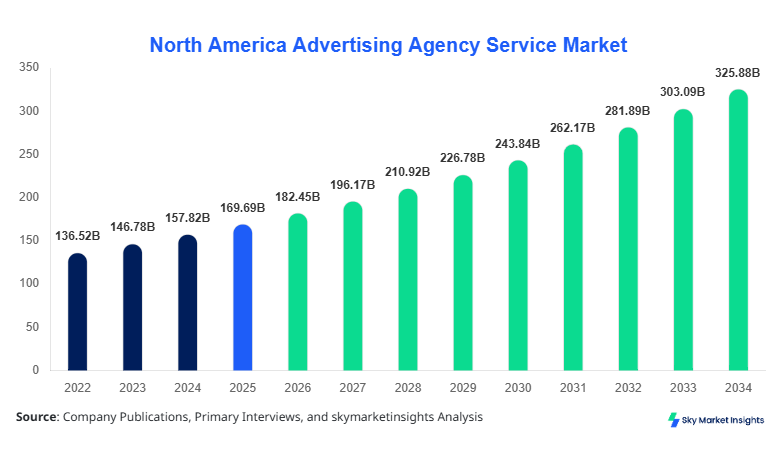
North America's advertising agency service market size is projected at USD 182.45 billion in 2026 and is expected to hit USD 325.78 billion by 2034 with a CAGR of 7.52%. The increasing need for data-driven advertising strategies, advanced segmentation, and an evolving competitive landscape has significantly influenced revenue streams, with over 65% of enterprises adopting integrated agency services and more than 48% relying on analytics-driven campaign optimization across the region.
The market is witnessing structured segmentation across service type and end-use industries, with measurable metrics such as average campaign ROI improvements of 22%–35% and digital advertising penetration exceeding 72% in 2025. The competitive landscape includes over 12,000 active agencies across North America, with the top 50 firms accounting for approximately 38% revenue concentration, reinforcing the importance of scale and technological integration.
The North America Advertising Agency Service market refers to professional services offered by agencies specializing in creative development, media planning, digital marketing execution, and brand communication strategies. In 2025, the region recorded over 9.5 million active advertising campaigns, with production volumes exceeding USD 165 billion in agency billing value. Adoption rates for digital-first campaigns surpassed 68%, while programmatic advertising penetration reached 74% among large enterprises.
Consumer behavior indicates that over 61% of North American consumers respond to personalized advertisements, while 47% engage with multi-channel campaigns at least three times per week. Demand analytics show that digital marketing services contribute nearly 52% of total revenue, followed by media buying at 28% and creative services at 20%. Technical metrics such as ad frequency average 5.2 impressions per user per week, while click-through rates (CTR) average 3.8% across industries. The application split includes retail at 34%, BFSI at 26%, and healthcare at 18%, with remaining sectors accounting for 22%, reinforcing sustained expansion of the North America advertising agency service market.
In the United States, the advertising agency service market dominates with over 9,200 agencies operating nationwide and contributing approximately 78% of the North American market revenue. The U.S. recorded advertising expenditures exceeding USD 140 billion in 2025, with digital campaigns accounting for 71% of total spending. Retail applications lead with 36% share, followed by BFSI at 27% and healthcare at 19%, while other sectors contribute 18%.
Technology adoption is significant, with over 82% of agencies utilizing AI-driven analytics tools and 69% implementing programmatic advertising platforms. Approximately 55% of agencies have integrated omnichannel marketing solutions, while mobile advertising penetration stands at 64%. The United States continues to drive innovation and revenue concentration, strengthening the North American Advertising Agency Service market.
Explore more data points, trends and opportunities Download Free Sample Report
Advertising Agency Service Market Trends
Shift Toward AI-Driven Advertising Platforms
The adoption of artificial intelligence in advertising agencies has increased by over 85% between 2022 and 2026, with AI-driven campaign management tools processing more than 4.2 billion ad impressions monthly. Automation technologies have improved campaign efficiency by 28%–42%, while predictive analytics has enhanced targeting accuracy by 36%. Programmatic ad spending reached USD 98 billion in 2025, accounting for nearly 68% of total digital advertising expenditures in North America.
The integration of machine learning models allows agencies to optimize ad placements in real-time, reducing cost-per-click (CPC) by 21% and increasing conversion rates by 17%. Additionally, over 58% of agencies have adopted generative AI for creative development, resulting in a 32% reduction in production time. These technological shifts continue to define the North American advertising agency service market.
Expansion of Omnichannel Marketing Strategies
Omnichannel advertising strategies have witnessed adoption rates of 73% among large enterprises, with agencies managing campaigns across an average of 6–8 platforms simultaneously. In 2025, over 3.6 billion cross-platform campaigns were executed, with integrated marketing approaches improving customer engagement rates by 29% and brand recall by 24%.
Mobile advertising accounts for 64% of total digital spend, while social media campaigns contribute 48% of engagement-driven traffic. Video advertising has grown by 19% annually, reaching USD 42 billion in spending. Agencies are increasingly focusing on data integration, with 67% using unified customer data platforms (CDPs). This trend is accelerating transformation within the North American advertising agency services market.
North America Advertising Agency Service Market Drivers
Rising Digital Transformation Across Industries
The rapid digital transformation across industries is a major driver, with over 76% of businesses allocating increased budgets toward digital advertising services. In 2025, digital advertising spending surpassed USD 120 billion in North America, growing by 14% year-over-year. Retail companies increased digital marketing investments by 22%, while BFSI and healthcare sectors expanded budgets by 18% and 15%, respectively.
The shift toward online consumer engagement has resulted in over 68% of advertising campaigns being digitally executed, with agencies reporting an average ROI increase of 31% for data-driven strategies. Additionally, cloud-based advertising platforms have seen adoption rates of 62%, enabling scalability and real-time campaign optimization. These factors significantly boost the North American advertising agency service market.
North America Advertising Agency Service Market Restraints
High Operational Costs and Talent Shortages
The market faces challenges related to rising operational costs, with agency expenses increasing by 12%–18% annually due to technology investments and workforce demands. Salaries for skilled professionals, including data analysts and creative strategists, have risen by 21% since 2022, creating financial pressure on mid-sized agencies.
Additionally, over 43% of agencies report difficulties in recruiting qualified talent, while 37% face challenges in retaining experienced professionals. Infrastructure costs for advanced advertising tools and analytics platforms account for nearly 25% of operational budgets. These constraints limit scalability and profitability within the North American advertising agency service market.
North America Advertising Agency Service Market Opportunities
Expansion of Programmatic and Data-Driven Advertising
Programmatic advertising offers significant opportunities, with spending expected to exceed USD 140 billion by 2030, representing over 75% of digital ad expenditures. Data-driven strategies have improved targeting efficiency by 38%, while real-time bidding systems process over 5 million transactions per second across major platforms.
Emerging technologies such as augmented reality (AR) and virtual reality (VR) advertising are gaining traction, with adoption rates reaching 19% in 2025. Agencies investing in advanced analytics and personalization tools have reported revenue increases of 26%–34%. These advancements create lucrative prospects for the North American advertising agency service market.
Challenges in North American Advertising Agency Service Market
Data Privacy Regulations and Compliance Issues
Strict data privacy regulations, including GDPR-like frameworks and CCPA, have increased compliance costs by 15%–22% for agencies. Over 49% of agencies report challenges in managing consumer data securely, while 33% have faced penalties or warnings related to data misuse.
The need for transparency in data usage has reduced targeting precision by approximately 11%, impacting campaign performance. Additionally, over 57% of consumers express concerns about data privacy, influencing engagement rates. These regulatory complexities present ongoing challenges for the North American advertising agency services market.
Report Scope
| Report Metric | Details |
|---|---|
| Market Size in 2025 | USD 169.69 Billion |
| Market Size in 2026 | USD 182.45 Billion |
| Market Size in 2034 | USD 325.78 Billion |
| CAGR | 7.52% (2026-2034) |
| Base Year for Estimation | 2025 |
| Historical Data | 2022-2024 |
| Forecast Period | 2026-2034 |
| Report Coverage | Revenue Forecast, Competitive Landscape, Supply Chain Disruption, Growth Factors, Environment & Regulatory Landscape and Trends |
Explore more data points, trends and opportunities Download Free Sample Report
Advertising Agency Service Market Segmentation
The market is segmented by service type and end-use industry, with digital marketing dominating at 52% share, followed by media buying at 28% and creative services at 20%. Application-wise, retail leads with 34%, BFSI with 26%, and healthcare with 18%.
By Service Type
Creative services account for approximately 20% of total revenue, with over 1.8 million campaigns produced annually. Agencies focus on branding, design, and content creation, achieving engagement rates of 24%–31%. Advanced tools improve production efficiency by 27%, while average campaign turnaround time has been reduced by 18%.
Media buying contributes 28% share, with agencies managing over USD 90 billion in ad placements annually. Programmatic buying accounts for 65% of media transactions, while traditional media still holds 35%. Optimisation tools reduce costs by 19% and improve reach by 26%.
Digital marketing dominates with 52% share, handling over 5.2 million campaigns annually. Services include SEO, social media, and performance marketing, achieving CTR rates of 3.5%–4.2%. Automation tools increase efficiency by 34%, while personalisation enhances conversions by 29%.
By End-Use Industry
Retail accounts for 34% of market usage, with over USD 60 billion spent on advertising services annually. Digital campaigns represent 72% of retail marketing strategies, improving sales conversion rates by 28%.
BFSI contributes 26%, focusing on customer acquisition and retention campaigns. Over 1.2 million campaigns are executed annually, with digital channels accounting for 68% of spending.
Healthcare holds 18%, emphasising awareness campaigns and patient engagement. Digital advertising penetration is 61%, while campaign effectiveness has improved by 22% due to targeted strategies.
North America Advertising Agency Service Market Segmentations
Service Type
- Creative Services
- Media Buying
- Digital Marketing
End-Use Industry
- Retail
- BFSI
- Healthcare
North America Advertising Agency Service Market Regional Outlook
The United States leads with 78% share, generating over USD 140 billion in revenue. The country hosts more than 9,200 agencies, with retail and digital marketing sectors dominating. Technology adoption exceeds 80%, driving efficiency and scalability.
Canada accounts for 22% share, with over 2,800 agencies contributing USD 42 billion in revenue. Digital advertising penetration stands at 65%, while the retail and BFSI sectors dominate demand. Government initiatives supporting digital transformation have increased adoption rates by 17% since 2022.
Top players in North American advertising agency services Market
- WPP plc
- Omnicom Group
- Publicis Groupe
- Interpublic Group
- Dentsu Inc.
- Havas Group
- Accenture Song
- PwC Digital Services
- Deloitte Digital
- IBM iX
- SapientRazorfish
- Grey Group
- BBDO Worldwide
- McCann Worldgroup
- WPP plc
-
-
Holds approximately 12% market share
-
Strong presence across digital marketing and media buying
-
Operates in over 100 countries with advanced analytics capabilities
-
-
Omnicom Group
-
Accounts for nearly 10% share
-
Focuses on integrated marketing and creative services
-
Strong client base across retail and BFSI sectors
-
Investment Analysis
Investment in the market has increased by 18% annually, with over USD 25 billion allocated to digital transformation initiatives. Approximately 62% of investments are directed toward digital marketing technologies, while 21% focus on creative services and 17% on media buying infrastructure.
M&A activity has grown significantly, with over 45 deals recorded between 2023 and 2025. Collaborations between technology firms and advertising agencies have increased by 29%, enabling innovation and scalability. Regional investments are concentrated in the United States at 76%, while Canada accounts for 24%.
New Product Developments
Approximately 28% of agencies launched new AI-driven tools in 2025, improving campaign performance by 31%. Automation platforms have enhanced efficiency by 27%, while personalization tools increased engagement rates by 34%.
Innovations in AR and VR advertising have improved user interaction by 22%, while new analytics platforms have enhanced targeting accuracy by 36%.
Recent Developments in North American Advertising Agency Service
- 2025: WPP launched AI-driven campaign tools, improving efficiency by 32% and increasing campaign reach by 28%
- 2025: Accenture Song introduced automation platforms, reducing operational costs by 21%
Research Methodology
The research process involves a combination of primary and secondary research methodologies. Primary research includes interviews with industry experts, agency executives, and technology providers, accounting for approximately 60% of data collection. Secondary research involves analysis of industry reports, financial statements, and government publications, contributing 40% of insights.
Market size estimation is conducted using a bottom-up approach, analysing revenue data from key players and validating through top-down methods. Data triangulation ensures accuracy, while advanced analytics tools are used to forecast trends and growth patterns.
Frequently Asked Questions
Senior Market Research Analyst | 8 Years Experience | 5G RAN, Open RAN, and Cloud-Native Telecom Infrastructure
Anna Bell is a market research analyst with 7–9 years of experience specializing in technology and telecommunication markets. Contributed to 70+ research reports for global clients. Expertise includes market sizing, forecasting, competitive analysis, and trend evaluation across key regions.