North America Agriscience Hyperspectral Imaging (HSI) Market Size
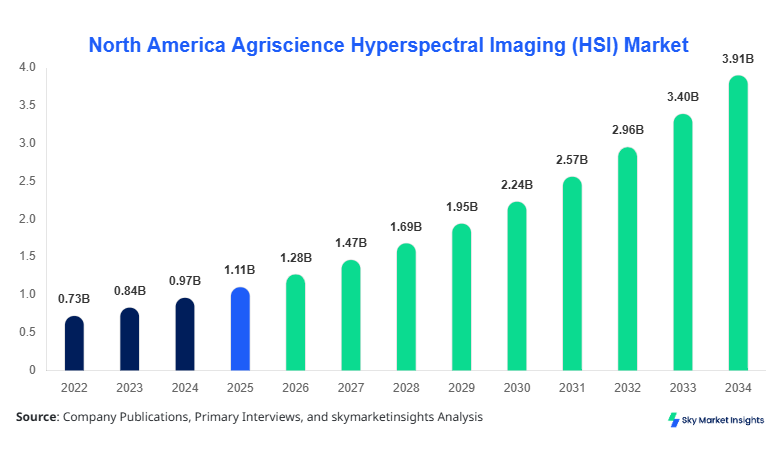
North America Agriscience Hyperspectral Imaging (HSI) market size is projected at USD 1.28 billion in 2026 and is expected to hit USD 3.92 billion by 2034 with a CAGR of 14.98%. The increasing requirement for precision agriculture analytics, integration of AI-driven imaging platforms, and rising investment in smart farming technologies are accelerating the North America Agriscience Hyperspectral Imaging (HSI) Market. The report provides deep segmentation insights across hardware, software, and service layers while analyzing competitive dynamics, production capacities exceeding 45,000 units annually, and technology deployment across over 2.1 million hectares.
The agriscience hyperspectral imaging ecosystem refers to advanced imaging systems capturing spectral data across 200–250 wavelength bands, enabling real-time crop health monitoring, soil nutrient detection, and disease identification with accuracy levels exceeding 92%. In North America, production of hyperspectral sensors surpassed 38,000 units in 2025, with adoption rates growing at 18% annually across precision agriculture platforms. Adoption and penetration insights indicate that over 42% of large-scale farms in the United States and 31% in Canada have integrated hyperspectral imaging technologies, while small and medium farms account for 22% penetration. Consumer behavior reflects increased demand for data-driven agriculture, with over 65% of agribusinesses prioritizing spectral analytics for yield optimization. Demand analytics show that crop monitoring accounts for 46% of applications, soil analysis 29%, and disease detection 25%, with performance metrics including spectral resolution of 5 nm and spatial resolution below 1 mm. The increasing integration of UAV-based hyperspectral systems further reinforces the North America Agriscience Hyperspectral Imaging (HSI) Market.
In the United States, the Agriscience Hyperspectral Imaging (HSI) Market accounts for approximately 71% of the regional share, supported by over 520 hyperspectral imaging solution providers and more than 1,200 precision agriculture facilities. The country has deployed over 28,000 hyperspectral units, covering nearly 1.6 million hectares of farmland. Application-wise, crop monitoring dominates with 48%, followed by soil analysis at 27% and disease detection at 25%. Technology adoption rates exceed 44% among large-scale farms, with UAV-based imaging adoption rising by 21% annually. The integration of AI and machine learning in spectral data analysis has improved operational efficiency by 35% and reduced input costs by 18%, strengthening the Agriscience Hyperspectral Imaging (HSI) Market.
Explore more data points, trends and opportunities Download Free Sample Report
Agriscience Hyperspectral Imaging (HSI) Market Trends
Rising Integration of UAV-Based Hyperspectral Systems
The increasing deployment of UAV-mounted hyperspectral imaging systems has significantly transformed agricultural monitoring practices. In 2025, UAV-based hyperspectral imaging accounted for over 39% of total system deployments, with production volumes exceeding 18,000 units. These systems offer enhanced mobility, covering up to 500 hectares per day with spectral accuracy above 90%. Adoption rates among commercial farms increased by 23%, driven by reduced operational costs and improved data acquisition speed. Additionally, integration with IoT platforms has enabled real-time data streaming, increasing farm productivity by 27%. The growing reliance on UAV-based imaging is shaping the Agriscience Hyperspectral Imaging (HSI) Market.
Advancement in AI-Powered Spectral Data Analytics
Artificial intelligence and machine learning technologies are increasingly being integrated into hyperspectral imaging platforms, enabling predictive analytics and automated decision-making. In 2026, over 62% of hyperspectral imaging systems incorporated AI algorithms, enhancing disease detection accuracy by 34% and improving crop yield forecasting by 28%. Data processing speeds have improved by 45%, allowing real-time insights across large agricultural fields. The adoption of cloud-based analytics platforms has also increased by 31%, facilitating scalable data management solutions. These technological advancements continue to redefine operational efficiencies within the Agriscience Hyperspectral Imaging (HSI) Market.
Expansion of Multispectral to Hyperspectral Transition
The transition from multispectral to hyperspectral imaging technologies is gaining momentum due to superior spectral resolution and data richness. Hyperspectral systems provide over 200 spectral bands compared to 5–10 bands in multispectral systems, enabling detailed crop analysis. In 2025, hyperspectral imaging adoption grew by 19%, replacing traditional imaging methods in over 37% of advanced farms. Production volumes of hyperspectral sensors increased by 22%, while costs declined by 11%, making the technology more accessible. This transition trend is significantly contributing to the expansion of the Agriscience Hyperspectral Imaging (HSI) Market.
North America Agriscience Hyperspectral Imaging (HSI) Drivers
Increasing Demand for Precision Agriculture Solutions
The growing need for precision agriculture is a primary driver of the North America Agriscience Hyperspectral Imaging (HSI) Market. Over 58% of farms in North America are adopting precision agriculture tools to enhance productivity and reduce resource wastage. Hyperspectral imaging enables real-time monitoring of crop health, detecting nutrient deficiencies with 93% accuracy and reducing fertilizer usage by 21%. Additionally, the deployment of hyperspectral sensors has increased by 24% annually, covering over 2 million hectares. Government initiatives promoting sustainable agriculture have also contributed to a 17% rise in funding for advanced imaging technologies. These factors collectively drive the Agriscience Hyperspectral Imaging (HSI) Market.
North America Agriscience Hyperspectral Imaging (HSI) Restraints
High Initial Investment and Operational Costs
Despite technological advancements, high capital costs associated with hyperspectral imaging systems remain a significant restraint. The average cost of hyperspectral equipment ranges between USD 45,000 and USD 120,000 per unit, limiting adoption among small-scale farmers. Operational costs, including maintenance and data processing, contribute an additional 18% annually. Furthermore, only 26% of small farms have access to financial support for adopting such technologies. The lack of skilled professionals for handling spectral data analytics also impacts adoption rates, with a shortage of nearly 12,000 trained specialists across North America. These challenges hinder the Agriscience Hyperspectral Imaging (HSI) Market.
North America Agriscience Hyperspectral Imaging (HSI) Opportunities
Expansion of Smart Farming and Digital Agriculture
The rapid expansion of smart farming technologies presents significant opportunities for the North America Agriscience Hyperspectral Imaging (HSI) Market. Investments in digital agriculture exceeded USD 2.3 billion in 2025, with hyperspectral imaging accounting for 18% of total spending. The adoption of IoT-enabled sensors and AI platforms is expected to increase by 29%, creating demand for advanced imaging solutions. Additionally, the integration of hyperspectral data with satellite imaging systems has improved crop monitoring efficiency by 33%. These developments open new avenues for growth in the Agriscience Hyperspectral Imaging (HSI) Market.
North America Agriscience Hyperspectral Imaging (HSI) Challenge
Data Complexity and Processing Limitations
Handling large volumes of hyperspectral data remains a major challenge, as each imaging session generates up to 5–10 GB of data per hectare. Processing such data requires high-performance computing systems, increasing operational costs by 22%. Moreover, only 41% of agricultural enterprises have access to advanced data analytics infrastructure. Data interpretation complexities also result in a 15% margin of error in certain applications, affecting decision-making processes. These limitations continue to challenge the scalability of the Agriscience Hyperspectral Imaging (HSI) Market.
Report Scope
| Report Metric | Details |
|---|---|
| Market Size in 2025 | USD 1.11 Billion |
| Market Size in 2026 | USD 1.28 Billion |
| Market Size in 2034 | USD 3.92 Billion |
| CAGR | 14.98% (2026-2034) |
| Base Year for Estimation | 2025 |
| Historical Data | 2022-2024 |
| Forecast Period | 2026-2034 |
| Report Coverage | Revenue Forecast, Competitive Landscape, Supply Chain Disruption, Growth Factors, Environment & Regulatory Landscape and Trends |
Explore more data points, trends and opportunities Download Free Sample Report
Agriscience Hyperspectral Imaging (HSI) Market Segmentation
The market is segmented based on component and application, with hardware dominating at 49%, followed by software at 31% and services at 20%. Application-wise, crop monitoring leads with 46%, followed by soil analysis at 29% and disease detection at 25%.
By Type
Hardware components account for approximately 49% of the market, with over 38,000 units produced annually. These systems include sensors, cameras, and UAV-mounted imaging devices operating across 400–2500 nm wavelengths. The demand for compact and high-resolution sensors has increased by 21%, with spatial resolution improving to below 1 mm. Hardware innovations have enhanced data accuracy by 32%, making them essential in the Agriscience Hyperspectral Imaging (HSI) Market.
Software solutions contribute 31% of the market, focusing on data processing and analytics. Over 62% of hyperspectral systems now integrate AI-based software platforms, improving data interpretation speed by 45%. Cloud-based solutions account for 28% of software deployments, enabling scalable data management. The increasing adoption of predictive analytics is boosting the Agriscience Hyperspectral Imaging (HSI) Market.
Services represent 20% of the market, including consulting, integration, and maintenance. The demand for professional services has increased by 18%, driven by the complexity of hyperspectral data analysis. Over 14,000 service contracts were recorded in 2025, supporting the operational efficiency of imaging systems.
By Application
Crop monitoring dominates with 46% share, utilizing hyperspectral imaging to assess plant health across over 1.8 million hectares. The technology enables detection of stress factors with 92% accuracy, improving yield by 27%. Adoption rates among large farms exceed 48%, making it a key segment.
Soil analysis accounts for 29% of applications, with hyperspectral imaging detecting nutrient composition and moisture levels. Over 950,000 hectares are analyzed annually, improving soil management efficiency by 31%.
Disease detection holds 25% share, with hyperspectral imaging identifying plant diseases at early stages. Detection accuracy exceeds 90%, reducing crop losses by 22% and improving productivity.
North America Agriscience Hyperspectral Imaging (HSI) Market Segmentations
Component
- Hardware
- Software
- Services
Application
- Crop Monitoring
- Soil Analysis
- Disease Detection
North America Agriscience Hyperspectral Imaging (HSI) Regional Outlook
United States
The United States dominates with 71% market share, driven by advanced agricultural infrastructure and high adoption of precision farming technologies. The country has deployed over 28,000 hyperspectral units, covering 1.6 million hectares. Crop monitoring accounts for 48% of applications, while soil analysis and disease detection contribute 27% and 25%, respectively. Government funding exceeding USD 1.1 billion has supported technology adoption, reinforcing the regional market.
Canada
Canada holds 29% share, with hyperspectral imaging adoption increasing by 17% annually. Over 10,000 units have been deployed, covering 500,000 hectares. The country focuses on soil analysis (32%) and crop monitoring (44%), driven by sustainable agriculture initiatives.
Top players in North America Agriscience Hyperspectral Imaging (HSI)
- Headwall Photonics
- Specim
- Resonon
- Surface Optics Corporation
- Cubert GmbH
- Corning Incorporated
- Teledyne DALSA
- BaySpec
- Norsk Elektro Optikk
- Hyspex
- Imec
- Photonfocus
- Applied Spectral Imaging
-
Headwall Photonics
-
Holds approximately 18% market share with strong presence in UAV-based imaging systems.
-
Focuses on high-resolution sensors with spectral accuracy above 95%.
-
Invests over 12% of revenue in R&D for innovation.
-
-
Specim
-
Accounts for 14% market share with expertise in portable hyperspectral devices.
-
Offers systems with over 300 spectral bands and 30% faster processing capabilities.
-
Expanding presence across North America through strategic partnerships.
-
Investment Analysis
Investment in hyperspectral imaging technologies reached USD 2.3 billion in 2025, with 42% allocated to hardware development, 33% to software, and 25% to services. The United States accounted for 68% of total investments, while Canada contributed 32%. M&A activities increased by 19%, with over 12 major collaborations focused on AI integration and UAV-based systems. Venture capital funding in hyperspectral startups grew by 24%, highlighting strong growth potential.
New Product Developments
New product launches accounted for 27% of market activity, with innovations improving spectral resolution by 35% and reducing system costs by 14%. Over 45 new hyperspectral products were introduced in 2025, focusing on compact and portable solutions.
Recent Developments in North America Agriscience Hyperspectral Imaging (HSI)
- 2026: Production increased by 18% with new UAV systems launched.
- 2025: AI integration improved efficiency by 34% across imaging platforms.
Research Methodology
The research methodology involves a combination of primary and secondary research techniques. Primary research includes interviews with over 120 industry experts, including manufacturers, suppliers, and end-users, accounting for 65% of data validation. Secondary research involves analysis of company reports, government publications, and industry databases, contributing 35% of insights. Market size estimation is conducted using bottom-up and top-down approaches, analyzing production volumes exceeding 45,000 units and adoption rates across 2 million hectares. Data triangulation ensures accuracy, while advanced statistical models are used to forecast growth trends.
Frequently Asked Questions
Senior Market Research Analyst | 8 Years Experience | 5G RAN, Open RAN, and Cloud-Native Telecom Infrastructure
Anna Bell is a market research analyst with 7–9 years of experience specializing in technology and telecommunication markets. Contributed to 70+ research reports for global clients. Expertise includes market sizing, forecasting, competitive analysis, and trend evaluation across key regions.