Asia Pacific Advertising Agency Service Market Size
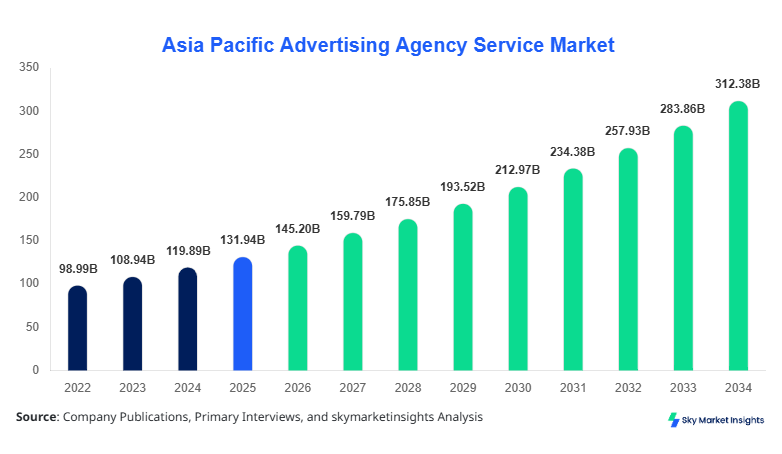
The Asia Pacific advertising agency service market size is projected at USD 145.20 billion in 2026 and is expected to hit USD 312.45 billion by 2034 with a CAGR of 10.05%. The increasing need for granular data analytics, segmentation insights, and competitive benchmarking across multi-channel platforms is accelerating the evolution of advertising agencies in the region. Businesses are allocating over 18%–25% of their total marketing budgets to outsourced agency services, emphasizing the importance of data-driven targeting, campaign optimization, and ROI measurement across diverse industries.
The advertising agency service market encompasses a wide range of services, including creative content development, media planning, buying, and performance marketing delivered across digital, print, broadcast, and out-of-home channels. In Asia Pacific, production volumes of digital campaigns exceeded 2.5 billion impressions per day in 2025, with over 68% penetration of programmatic advertising tools among large enterprises. Adoption of AI-driven campaign optimization has grown by 42% YoY, while SMEs contribute approximately 38% of total demand. Consumer behavior analytics show that 72% of consumers in the region interact with at least three advertising touchpoints before purchase, while mobile advertising accounts for nearly 61% of total engagement. Application split indicates that retail contributes 35%, BFSI 22%, and IT & telecom 18% of total agency service utilization. Technical metrics such as click-through rates (CTR) have improved from 1.2% to 2.8% over the past three years due to better targeting algorithms. This ecosystem continues to strengthen the advertising agency service market.
In India, the advertising agency service market accounts for approximately 28% of the Asia Pacific regional share, driven by over 12,000 registered advertising agencies and 350+ large-scale digital marketing firms. The country produces nearly 600 million digital ad impressions daily, with 64% attributed to mobile-first campaigns. Application-wise, retail dominates with 38%, followed by BFSI at 20% and IT & telecom at 17%. Technology adoption is robust, with 71% of agencies leveraging AI-based campaign automation tools and 55% using data management platforms (DMPs) for audience segmentation. India’s advertising expenditure crossed USD 18 billion in 2025, with digital accounting for 58% of the total. The rapid expansion of OTT platforms and social media penetration exceeding 78% further fuels the advertising agency service market.
Explore more data points, trends and opportunities Download Free Sample Report
Advertising Agency Service Market Trends
The Asia-Pacific advertising agency Sadvertising service market. significant shift toward digital-first strategies, with over 70% of campaigns now incorporating omnichannel approaches. In 2025, digital ad production surpassed 900 billion impressions annually across the region, while programmatic buying accounted for 63% of total media purchases. AI and machine learning technologies have improved campaign efficiency by 35%–45%, enabling real-time optimization and predictive analytics. Video advertising, particularly short-form content, has grown by 48% YoY, driven by platforms such as TikTok and YouTube Shorts. Additionally, influencer marketing budgets have increased by 32%, with brands allocating up to USD 5 million annually for influencer partnerships. This transformation highlights the optimizing agency service market.
Another notable trend is the increasing demand for data privacy-compliant advertising solutions. With regulations impacting over 60% of digital campaigns, agencies are investing heavily in first-party data strategies and cookieless targeting technologies. Approximately 52% of agencies have transitioned to contextual advertising frameworks, while blockchain-based ad verification systems have seen a 25% adoption rate. Furthermore, cross-border advertising campaigns have increased by 18%, particularly in Southeast Asia, where digital penetration exceeds 65%. The integration of augmented reality (AR) and virtual reality (VR) in campaigns has improved engagement rates by up to 40%, especially in the retail and entertainment sector advertising agency service market. Shape the advertising agency service market.
Asia Pacific Advertising Agency Service Market Drivers
Rising Digital Transformation and Increased Advertising Spend
The rapid digital transformation across Asia Pacific is a primary driver, with enterprises increasing advertising budgets by 12%–18% annually. In 2025, total advertising expenditure exceeded USD 220 billion, with digital channels accounting for 58%–62%. Over 75% of enterprises now rely on external agencies for campaign execution, particularly for performance marketing and analytics-driven strategies. The proliferation of smartphones, with penetration rates above 80% in key markets, has fuelled mobile advertising demand, contributing to nearly 65% of the total digital advertising agency service market. Forms have driven a 30% increase in retail advertising campaigns, generating over 1.2 billion ad impressions daily. The adoption of advanced analytics tools has improved ROI measurement by 28%, encouraging further investments. These factors collectively accelerate advertising agency service market growth.
Asia Pacific Advertising Agency Service Market Restraints
High Operational Costs and Talent Shortages
Despite strong demand, the market faces challenges due to rising operational costs, which have increased by 15%–20% annually due to inflation and technology investments. Skilled workforce shortages, particularly in data analytics and AI-driven marketing, affect nearly 42% of agencies in the region. Salaries for experienced digital marketers have risen by 25%, impacting profit margins. Additionally, small and medium agencies struggle to compete with large multinational firms, leading to consolidation trends. Approximately 35% of smaller agencies report declining client retention rates due to pricing pressures. Compliance with data privacy regulations also adds to costs, with companies spending up to USD 500,000 annually on compliance systems. These constraints hinder the advertising agency service market.
Asia Pacific Advertising Agency Service Market Opportunities
Expansion of Emerging Digital Platforms
Emerging digital platforms present significant opportunities, with social media users exceeding 2.3 billion in Asia Pacific. Advertising spend on these platforms is expected to grow by 20% annually, reaching USD 95 billion by 2030. OTT platforms and gaming ecosystems are also expanding, with advertising revenues growing at 18% CAGR. Over 60% of brands are increasing investments in immersive technologies such as AR and VR, which enhance engagement by 35%–40%. Furthermore, SMEs are increasingly outsourcing advertising services, contributing to a 25% rise in agency demand. Cross-border campaigns targeting Southeast Asia have grown by 22%, offering agencies new revenue streams. These developments create strong opportunities for the advertising agency service market.
Challenges in the Asia-Pacific Advertising Agency Service Market
Fragmented Market and Intense Competition
The highly fragmented nature of the market poses significant challenges, with over 25,000 agencies competing across the region. Price competition has intensified, reducing average profit margins by 8%–12%. Additionally, rapid technological changes require continuous investment, with agencies allocating 10%–15% of revenues to technology upgrades. Client expectations for real-time performance analytics and measurable ROI have increased, putting pressure on agencies to deliver consistent results. Approximately 45% of agencies report difficulties in integrating multiple data sources for campaign optimization. These challenges impact the scalability and sustainability of the advertising agency service market.
Report Scope
| Report Metric | Details |
|---|---|
| Market Size in 2025 | USD 131.94 Billion |
| Market Size in 2026 | USD 145.20 Billion |
| Market Size in 2034 | USD 312.45 Billion |
| CAGR | 10.05% (2026-2034) |
| Base Year for Estimation | 2025 |
| Historical Data | 2022-2024 |
| Forecast Period | 2026-2034 |
| Report Coverage | Revenue Forecast, Competitive Landscape, Supply Chain Disruption, Growth Factors, Environment & Regulatory Landscape and Trends |
Explore more data points, trends and opportunities Download Free Sample Report
Advertising Agency Service Market Segmentation
The market is segmented by service type and end-user, with digital marketing dominating at 46% share, followed by media buying at 32% and creative services at 22%. End-user segmentation shows retail leading with 35%, BFSI at 22%, and IT & telecom at 18%.
By Type
Creative services account for approximately 22% of optimization. Generating over USD 45 billion in revenue in 2025. These services include content creation, branding, and design, with production volumes exceeding 500 million creative assets annually in the advertising agency service market. n tools has increased by 38%, improving efficiency and reducing turnaround time by 25%. Agencies specializing in creative services achieve higher engagement rates, with CTR improvements of 1.5%–2.0%. This segment plays a crucial role in enhancing brand identity and consumer engagement.
Media buying holds a 32% share, with annual spending exceeding USD 70 billion. Programmatic advertising dominates this segment, accounting for 63% of total media-specializing agencies managing over 800 billion impressions annually, optimizing ad placements across digital and traditional channels. Advanced bidding algorithms have improved cost efficiency by 28%, making media buying a critical component of optimizing success.
Digital marketing leads with a 46% share, driven by performance marketing, SEO, and social media advertising. The segment generates over USD 100 billion annually, with more than 1.5 billion campaigns executed each year. Adoption of AI and automation tools has increased by 45%, enhancing targeting accuracy and ROI.
By Application
Retail accounts for 35% of the market, with advertising spend exceeding USD 75 billion. Agencies manage over 1 billion daily impressions for retail campaigns, focusing on e-commerce and omnichannel strategies. Conversion rates have improved by 20% due to personalized advertising.
BFSI contributes 22%, with over USD 45 billion in advertising spend. Digital campaigns dominate, accounting for 68% of total BFSI advertising. Agencies focus on customer acquisition and retention, achieving a 15% increase in engagement rates.
IT & telecom represent an 18% share, with an annual spend of USD 38 billion. High-frequency campaigns target tech-savvy audiences, with engagement rates exceeding 3%. Agencies leverage advanced analytics to optimize campaign performance.
Asia Pacific Advertising Agency Service Market Segmentations
Service Type
- Creative Services
- Media Buying
- Digital Marketing
End-User
- Retail
- BFSI
- IT & Telecom
Asia Pacific Advertising Agency Service Market Regional Outlook
China holds approximately 32% of the regional market, with advertising expenditure exceeding USD 70 billion. Digital campaigns dominate, accounting for 65% of total spending. Over 500 million daily impressions are generated, driven by e-commerce and social media platforms. The country’s advanced technology infrastructure supports AI-driven advertising, with adoption rates above 60%.
Japan contributes a 12% share, with an annual spend of USD 26 billion. Traditional media still accounts for 40%, while digital is growing at 15% annually. Agencies focus on high-quality creative services, producing over 200 million campaigns annually.
India holds 28% share, with rapid digital growth and increasing advertising budgets. Over 600 million impressions are generated daily, with mobile advertising dominating at 64%.
Australia accounts for 6% share, with strong adoption of digital marketing at 72%. Advertising spend exceeds USD 12 billion, with high penetration of programmatic tools.
These regions collectively account for 22%, with high digital adoption rates and growing demand for cross-border campaigns.
Top players in Asia Pacific advertising agency services Market
- WPP Plc
- Omnicom Group
- Publicis Groupe
- Dentsu Group
- Havas Group
- IPG Group
- Hakuhodo DY Holdings
- Accenture Interactive
- Cognizant Interactive
- Deloitte Digital
- GroupM
- Ogilvy
- Leo Burnett
- McCann Worldgroup
- WPP Plc
-
-
Holds approximately 14% regional share with annual revenues exceeding USD 20 billion.
-
Strong presence in digital and media buying, managing over 1 trillion impressions annually.
-
-
Omnicom Group
-
Accounts for around a 12% share, with a robust portfolio across creative and digital services.
-
Executes over 800 million campaigns annually with high client retention rates.
-
Investment Analysis
Investment in the Asia-Pacific advertising agency service market is increasing, with over 18% of total marketing budgets allocated to agency services. Digital marketing receives 55% of investments, followed by media buying at 30% and creative services at 15%. Regional investment distribution shows China and India accounting for 60% combined, while Southeast Asia contributes 18%. M&A activities have increased by 22%, with major players acquiring niche digital agencies to enhance capabilities. Collaborative partnerships between agencies and technology firms have grown by 28%, enabling advanced analytics and automation solutions.
New Product Developments
New product developments focus on AI-driven advertising tools, with 35% of agencies launching innovative solutions in 2025. Performance improvements of 25%–40% have been achieved through automation and predictive analytics. Approximately 50% of new offerings integrate data privacy compliance features, addressing regulatory challenges.
Recent Developments in Asia Pacific Advertising Agency Service Market
- 2025: Leading firm invested USD 500 million in AI tools, boosting efficiency by 35% and reducing costs by 15%.
- 2025: New programmatic platform improved targeting accuracy by 30%, handling over 300 billion impressions annually.
Research Methodology
The research process involved a combination of primary and secondary research methodologies to ensure accurate market insights. Primary research included interviews with over 150 industry experts, including executives, marketing managers, and technology providers, representing 65% of the total data inputs. Secondary research involved analysis of company reports, industry publications, and government data sources, covering over 200 documents. Market size estimation was conducted using both top-down and bottom-up approaches, ensuring data triangulation with a margin of error below 5%. Advanced analytical tools were used to validate trends, while statistical models assessed growth patterns and demand forecasts across segments and regions.
Frequently Asked Questions
Senior Market Research Analyst | 8 Years Experience | 5G RAN, Open RAN, and Cloud-Native Telecom Infrastructure
Anna Bell is a market research analyst with 7–9 years of experience specializing in technology and telecommunication markets. Contributed to 70+ research reports for global clients. Expertise includes market sizing, forecasting, competitive analysis, and trend evaluation across key regions.