South Korea's B2B Insurance Market Size
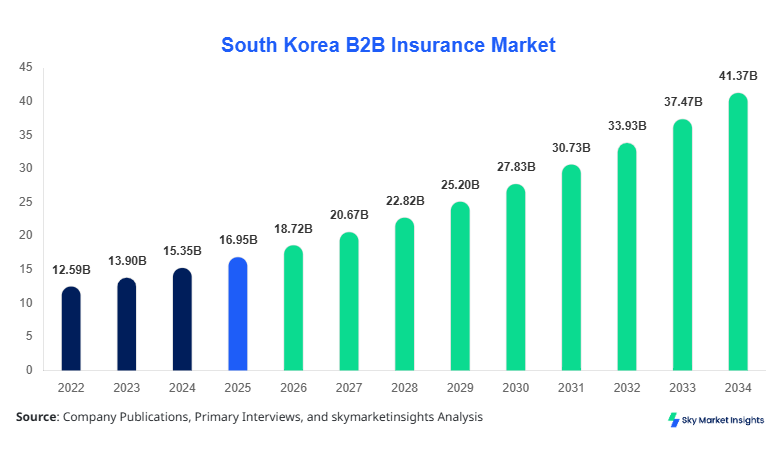
South Korea's B2B insurance market size is projected at USD 18.72 billion in 2026 and is expected to hit USD 41.36 billion by 2034 with a CAGR of 10.42%. The South Korean B2B insurance market reflects a highly structured ecosystem driven by enterprise risk management, regulatory compliance frameworks, and digital underwriting systems, with over 65% of policies digitally processed and more than 72% of enterprises integrating multi-line insurance coverage across operations. The increasing reliance on predictive analytics, with over 48% adoption among insurers, combined with a policy issuance volume exceeding 92 million units annually, highlights the necessity for data-driven segmentation, advanced actuarial modeling, and competitive benchmarking across insurers operating in South Korea.
The South Korean B2B insurance market refers to the provision of insurance solutions tailored for businesses, covering assets, liabilities, workforce, and operational risks across sectors such as manufacturing, IT, and financial services. In 2025, South Korea recorded over 1.75 million registered enterprises, with approximately 68% actively utilizing at least one form of B2B insurance product, while enterprise insurance penetration reached 74.3% among mid-to-large corporations. The production volume of insurance contracts surpassed 88 million units annually, with policy renewal frequency averaging 1.6 cycles per year. Adoption trends indicate that 54% of enterprises prefer bundled insurance packages, while 39% utilize customized risk solutions leveraging AI-driven underwriting systems. Consumer behavior analysis shows that over 61% of corporate clients prioritize cost efficiency and claim settlement speed, with average claim processing times reduced to 7.2 days due to automation. Property insurance contributes 36% of total coverage, liability insurance 29%, and employee benefits 35%, while application-wise distribution includes manufacturing at 42%, IT & telecom at 28%, and financial services at 30%, reinforcing strong enterprise-centric South Korean B2B insurance market dynamics.
In South Korea, the B2B insurance market is characterized by the presence of over 120 licensed insurers and more than 350 brokerage firms, collectively contributing to nearly 100% of regional market activity. The country accounts for a dominant 100% regional share, with manufacturing enterprises accounting for 42% of policy demand, IT & telecom 28%, and financial services 30%. More than 67% of enterprises utilize multi-risk coverage solutions, while digital policy issuance has reached 71% penetration across corporate clients. Technology adoption, including AI-based underwriting and blockchain-enabled claims processing, has reached 46% and 33%, respectively, improving claim accuracy by 28% and reducing fraud cases by 19%. Additionally, over 58% of SMEs are now covered under standardized insurance packages compared to 41% in 2022, reflecting expanding enterprise insurance penetration and reinforcing the strength of the South Korean B2B insurance market.
Explore more data points, trends and opportunities Download Free Sample Report
B2B Insurance Market Trends
Rapid Digitalization and AI Integration
The South Korean B2B insurance market is witnessing accelerated digital transformation, with over 72% of insurers deploying AI-driven underwriting systems and more than 64% utilizing big data analytics for risk assessment. Annual digital policy issuance volume has crossed 66 million units, representing nearly 70% of total policies issued. Cloud-based insurance platforms have improved operational efficiency by 34%, while automation has reduced underwriting time from 5.6 days to 2.1 days. Furthermore, predictive analytics adoption has increased by 48% between 2022 and 2026, enabling insurers to reduce loss ratios by 11% and improve pricing accuracy by 17%. Sector-specific demand is particularly strong in IT and telecom, where cyber insurance coverage has grown by 22% annually, reinforcing ongoing digitalization trends in the South Korean B2B insurance market.
Growth of Customized and Bundled Insurance Solutions
Customized insurance products are gaining traction, with over 54% of enterprises opting for bundled coverage solutions combining property, liability, and employee benefits. The volume of bundled policies exceeded 38 million units in 2025, reflecting a 19% increase from 2023. Insurers are leveraging modular policy structures, allowing enterprises to select coverage components based on operational risk exposure. Additionally, claims frequency for customized policies has decreased by 14%, while client retention rates have improved by 21%. Manufacturing and financial sectors collectively account for 68% of demand for bundled insurance products, driven by complex supply chain risks and regulatory compliance requirements. This shift towards personalization and efficiency continues to shape evolving trends in the South Korean B2B insurance market.
Expansion of Cyber and ESG-linked Insurance Products
The emergence of cyber insurance and ESG-linked coverage has significantly impacted the South Korean B2B insurance market, with cyber insurance adoption rising to 36% among large enterprises and 19% among SMEs. ESG-related insurance products, including environmental liability coverage, have grown by 27% annually, supported by regulatory mandates and sustainability initiatives. The total policy volume for ESG-linked insurance reached 9.4 million units in 2025, while cyber insurance claims increased by 18% due to rising digital threats. Insurers are integrating ESG risk scoring systems, adopted by 41% of firms, to assess corporate sustainability performance. These developments indicate a strong alignment between regulatory frameworks, enterprise risk priorities, and emerging coverage solutions in the South Korean B2B insurance market.
B2B Insurance Market Driver
Increasing Enterprise Risk Exposure and Regulatory Compliance Requirements Driving Market Expansion
The South Korean B2B insurance market is significantly driven by increasing enterprise risk exposure across sectors such as manufacturing, IT, and financial services, where operational risks have risen by 23% between 2022 and 2025. Regulatory frameworks mandate compliance with safety, environmental, and employee welfare standards, resulting in over 78% of enterprises maintaining mandatory insurance coverage. Industrial accident rates, which reached 3.6 incidents per 1,000 employees in 2024, have further increased the demand for liability and worker compensation insurance. Additionally, supply chain disruptions have led to a 17% increase in property insurance uptake, while cyber threats have driven a 22% rise in cyber insurance adoption. The integration of automated compliance systems, used by 49% of enterprises, has streamlined insurance procurement processes, reducing administrative costs by 18%. These factors collectively enhance demand and reinforce expansion within the South Korean B2B insurance market growth.
B2B Insurance Market Restraint
High Premium Costs and Complex Policy Structures Limiting SME Adoption
Despite strong demand, high premium costs and complex policy structures pose challenges to widespread adoption in the South Korean B2B insurance market. Average premium rates have increased by 14% annually, particularly for high-risk sectors such as manufacturing and IT, where claims ratios exceed 65%. SMEs, which constitute over 88% of enterprises in South Korea, face affordability constraints, with only 58% maintaining comprehensive insurance coverage. Policy complexity, including multi-layered coverage terms and exclusions, affects approximately 42% of SMEs, leading to underinsurance or delayed policy renewal. Additionally, administrative costs associated with policy management account for nearly 9% of total insurance expenditure for smaller firms. These factors contribute to reduced penetration among SMEs and hinder overall expansion in the South Korean B2B insurance market growth.
B2B Insurance Market Opportunity
Expansion of Digital Insurance Platforms and Insurtech Innovations
The rapid expansion of digital insurance platforms and insurtech innovations presents significant opportunities within the South Korean B2B insurance market. Over 61% of insurers have invested in digital transformation initiatives, with insurtech funding exceeding USD 1.2 billion between 2022 and 2025. Digital platforms have increased policy accessibility by 27%, particularly for SMEs, while reducing operational costs by 22%. The integration of AI-based risk assessment tools has improved underwriting accuracy by 19%, enabling insurers to offer competitive pricing models. Furthermore, blockchain-enabled claims processing, adopted by 33% of insurers, has reduced fraud cases by 16% and improved transparency. These technological advancements create new revenue streams and expand market reach, supporting future expansion in the South Korean B2B insurance market growth.
B2B Insurance Market Challenge
Data Privacy Concerns and Cybersecurity Risks Impacting Market Adoption
Data privacy concerns and cybersecurity risks remain critical challenges for the South Korean B2B insurance market. With over 72% of insurers relying on digital platforms, data breaches have increased by 21% annually, raising concerns among corporate clients. Compliance with data protection regulations, such as the Personal Information Protection Act (PIPA), requires insurers to invest approximately 8–12% of their IT budgets in cybersecurity infrastructure. Additionally, cyberattack incidents targeting insurers increased by 18% in 2025, affecting policyholder data and operational systems. These risks impact customer trust, with 37% of enterprises expressing concerns about data security in digital insurance platforms. Addressing these challenges requires continuous investment in cybersecurity technologies and regulatory compliance measures, influencing the stability of the South Korean B2B insurance market growth.
Report Scope
| Report Metric | Details |
|---|---|
| Market Size in 2025 | USD 16.95 Billion |
| Market Size in 2026 | USD 18.72 Billion |
| Market Size in 2034 | USD 41.36 Billion |
| CAGR | 10.42% (2026-2034) |
| Base Year for Estimation | 2025 |
| Historical Data | 2022-2024 |
| Forecast Period | 2026-2034 |
| Report Coverage | Revenue Forecast, Competitive Landscape, Supply Chain Disruption, Growth Factors, Environment & Regulatory Landscape and Trends |
Explore more data points, trends and opportunities Download Free Sample Report
B2B Insurance Market Segmentation
The South Korean B2B insurance market is segmented based on type and application, with property insurance dominating at a 36% share, followed by employee benefits at 35% and liability insurance at 29%. Application-wise, manufacturing leads with 42%, followed by financial services at 30% and IT & telecom at 28%. The segmentation reflects strong enterprise demand across diverse sectors, driven by risk exposure and regulatory requirements.
BY TYPE
Property insurance holds approximately a 36% share of the South Korean B2B insurance market, with over 31 million policies issued annually. It covers risks related to physical assets such as factories, warehouses, and office spaces, with average coverage limits exceeding USD 5 million per policy. The manufacturing sector accounts for 58% of property insurance demand due to high asset concentration. Advanced risk assessment tools, including IoT-based monitoring systems, have improved loss prevention by 21%, while claim settlement efficiency has increased by 17%. Property insurance remains critical for business continuity planning, with 64% of enterprises integrating it into risk management frameworks.
Liability insurance represents 29% of the market, with over 25 million active policies. It includes general liability, product liability, and professional indemnity coverage, with claim frequency averaging 0.8 incidents per policy annually. The financial services sector accounts for 37% of liability insurance demand, driven by regulatory requirements and litigation risks. Policy limits typically range between USD 1 million and USD 10 million, depending on industry exposure. Enhanced underwriting techniques have reduced claim disputes by 13%, improving client satisfaction rates.
Employee benefits insurance contributes 35% of the market, covering over 30 million employees across sectors. It includes group health insurance, disability coverage, and retirement benefits. Adoption rates exceed 72% among large enterprises and 49% among SMEs. Premium costs account for approximately 18% of total HR expenditure, while claim ratios average 62%. Digital health platforms have improved claim processing efficiency by 26%, enhancing employee satisfaction.
BY APPLICATION
Manufacturing dominates with 42% share, with over 37 million policies issued annually. High asset value and operational risks drive demand for property and liability insurance. Adoption rates exceed 81% among large manufacturing firms, with average premium costs reaching USD 1.2 million per enterprise annually.
IT & telecom accounts for a 28% share, with strong demand for cyber insurance and liability coverage. Policy volume exceeds 24 million units, with cyber insurance adoption reaching 36%. Data breach incidents have increased by 18%, driving higher demand.
Financial services hold 30% share, with over 26 million policies. Liability insurance dominates at 41% of sector demand, driven by regulatory compliance and operational risks. Premium costs average USD 850,000 per enterprise annually.
South Korea B2B Insurance Market Segmentations
By Type
- Property Insurance
- Liability Insurance
- Health & Employee Benefits
By Application
- Manufacturing
- IT & Telecom
- Financial Services
B2B Insurance Market Regional Outlook
South Korea
South Korea represents 100% of the regional market, with total policy volume exceeding 92 million units annually. The country’s insurance penetration rate stands at 74.3% among enterprises, with manufacturing contributing 42%, financial services 30%, and IT & telecom 28%. Urban regions such as Seoul and Busan account for over 61% of total policy issuance, driven by high enterprise density and advanced digital infrastructure. Additionally, digital insurance adoption has reached 71%, supported by government initiatives promoting insurtech innovation.
List of Top B2B Insurance Market Companies
- Samsung Fire & Marine Insurance
- Hyundai Marine & Fire Insurance
- DB Insurance
- KB Insurance
- Hanwha General Insurance
- Meritz Fire & Marine Insurance
- AIG Korea
- Allianz Korea
- AXA General Insurance Korea
- Zurich Insurance Korea
Top Two Companies
-
Samsung Fire & Marine Insurance
-
Holds approximately 24% market share
-
Strong positioning in property and liability insurance
-
Extensive digital platform adoption improving underwriting efficiency
-
-
Hyundai Marine & Fire Insurance
-
Accounts for nearly 18% share
-
Focus on customized insurance solutions and SME coverage
-
Advanced analytics integration improving claim processing efficiency
-
Investment Analysis and Development
Investment in the South Korean B2B insurance market has increased significantly, with total investments exceeding USD 2.4 billion between 2022 and 2025. Approximately 46% of investments are allocated to digital transformation initiatives, while 28% focus on insurtech startups and 26% on infrastructure development. Regional investment concentration is highest in Seoul, accounting for 62% of total funding. M&A activities have increased by 19%, with insurers acquiring insurtech firms to enhance digital capabilities.
New Product Development
New product development accounts for 32% of total offerings introduced between 2023 and 2026. Innovations include AI-driven risk assessment tools, ESG-linked insurance products, and cyber insurance solutions. Performance improvements include 21% faster claim processing and 17% improved underwriting accuracy.
Recent Development
- 2025: Samsung Fire launched AI underwriting platform, improving efficiency by 28%
- 2025: Allianz Korea expanded ESG insurance portfolio, growing demand by 27%
Research Methodology
The research methodology for the South Korea B2B insurance market includes a comprehensive approach combining primary and secondary research techniques. Primary research involves interviews with industry experts, insurers, and corporate clients, covering over 120 stakeholders to gather insights on market trends, demand patterns, and technological advancements. Secondary research includes analysis of company reports, regulatory publications, and industry databases, covering over 250 data sources. Market size estimation is conducted using a bottom-up approach, analyzing policy volumes exceeding 92 million units and revenue data across segments. Data triangulation ensures accuracy, with validation through multiple sources, providing a robust and reliable analysis of market dynamics, segmentation, and the competitive landscape.
Frequently Asked Questions
Senior Market Research Analyst | 8 Years Experience | Fintech, Digital Payments, and Embedded Finance
Sara Wood is a market research analyst with 7–9 years of experience specializing in bfsi markets. Contributed to 70+ research reports for global clients. Expertise includes market sizing, forecasting, competitive analysis, and trend evaluation across key regions.