North America Accident And Health Insurance Market Size
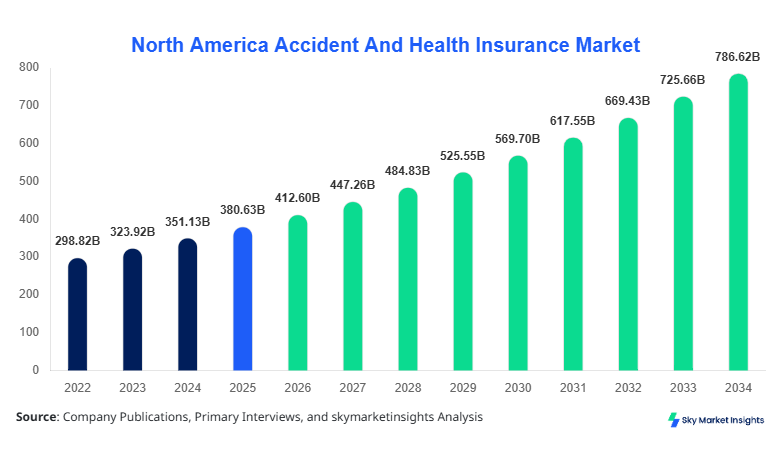
North America's accident and health insurance market size is projected at USD 412.6 billion in 2026 and is expected to hit USD 789.3 billion by 2034 with a CAGR of 8.4%. The market reflects a structured expansion driven by rising healthcare costs, increased insurance penetration rates exceeding 71% in urban regions, and policy digitization across over 2,500 insurers. The growing need for actuarial data modeling, segmentation analytics across 15+ product categories, and competitive benchmarking across 100+ providers is shaping industry dynamics.
The accident and health insurance market comprises policies designed to provide financial protection against medical emergencies, accidental injuries, and critical illnesses. In North America, total insured lives exceeded 245 million in 2025, with approximately 68% penetration in the working population aged 18–64. Annual premium collections crossed USD 380 billion in 2025, with claim ratios averaging 72–78% depending on policy type. Adoption rates in employer-sponsored plans reached 81%, while individual policy adoption stood at 43%. Consumer behavior indicates that 62% of policyholders prioritize hospitalization coverage, while 38% seek accident-specific riders. Digital policy issuance has grown by 29% year-over-year, with average claim processing times reduced to 5.2 days. Personal accident policies account for nearly 34% of total policies, while medical expense insurance contributes 49%, and critical illness coverage accounts for 17%. These metrics reinforce the structural expansion of the accident and health insurance market.
In the United States, the Accident and Health Insurance Market accounts for nearly 79% of the North American revenue share, supported by over 1,200 licensed insurers and 5,000+ distribution networks. The country recorded premium collections exceeding USD 310 billion in 2025, with employer-sponsored insurance covering approximately 156 million individuals. Application-wise, medical expense insurance dominates with a 52% share, followed by personal accident policies at 31% and critical illness coverage at 17%. Digital adoption rates in underwriting and claims reached 64%, with AI-based risk assessment implemented across 45% of insurers. Telehealth-integrated policies grew by 38% in 2025, and average policy renewal rates reached 84%. The United States continues to drive innovation and volume expansion in the accident and health insurance market.
Explore more data points, trends and opportunities Download Free Sample Report
Accident And Health Insurance Market Trends
The accident and health insurance market is witnessing a strong shift toward digital ecosystems, with over 58% of policies now issued through online or hybrid platforms in 2026 compared to 41% in 2022. Insurers are integrating AI-driven underwriting models that process over 3 million applications annually, reducing underwriting time by 42%. Wearable health data integration has expanded to 27% of policies, enabling dynamic premium pricing based on real-time health metrics. Additionally, claims automation systems now handle nearly 65% of total claims, reducing operational costs by 18%. The total number of digitally managed policies surpassed 180 million units in 2025, indicating a structural shift toward automation and efficiency in the accident and health insurance market.
Another prominent trend includes the expansion of customized micro-insurance products, particularly targeting gig workers and freelance populations, which represent 19% of the workforce in North America. Microinsurance policies grew by 36% year-over-year, with average premiums ranging between USD 120 and 350 annually. Critical illness coverage is being expanded to include over 25 disease categories compared to 15 categories in 2020, increasing policy attractiveness. Moreover, insurers are investing approximately 14% of their annual budgets into digital infrastructure upgrades, with over USD 22 billion allocated across North America in 2025 alone. These evolving patterns highlight ongoing innovation and adaptability within the accident and health insurance market.
North America Accident And Health Insurance Market Drivers
Rising Healthcare Costs and Increasing Insurance Penetration Fuel Market Expansion
Healthcare expenditure in North America exceeded USD 5.1 trillion in 2025, with per capita spending reaching USD 12,800 in the United States and USD 7,400 in Canada. This sharp rise in healthcare costs is compelling individuals and employers to adopt comprehensive insurance policies, resulting in a 6.8% annual increase in insured populations. Approximately 74% of households reported increased reliance on health insurance for financial security, while out-of-pocket expenses decreased by 11% due to policy coverage expansion. Additionally, employer-sponsored insurance programs cover nearly 62% of total insured individuals, creating a stable demand base. Insurers are also expanding product portfolios by 22% to cater to diverse consumer needs, driving policy volumes beyond 250 million annually. These factors collectively strengthen the accident and health insurance market growth.
North America Accident And Health Insurance Market Restraints
High Premium Costs and Regulatory Complexities Limit Market Expansion
Premium inflation rates in the accident and health insurance market have risen by 9–12% annually, making affordability a challenge for low-income groups representing 28% of the population. Regulatory compliance costs have increased by 17% over the past five years, particularly due to evolving healthcare mandates and data protection laws. Approximately 21% of insurers reported delays in product launches due to regulatory approvals exceeding 9–12 months. Additionally, administrative costs account for nearly 13% of total premiums, reducing profitability margins. Fraudulent claims, which constitute around 6% of total claims, further strain insurers' financial stability. These challenges collectively act as barriers to expansion in the accident and health insurance market.
North America Accident And Health Insurance Market Opportunities
Digital Transformation and Emerging Consumer Segments Create New Revenue Streams
Digital transformation initiatives are opening new opportunities, with insurers investing over USD 30 billion in AI, blockchain, and cloud-based systems between 2024 and 2026. The adoption of telemedicine services has increased by 44%, enabling insurers to bundle healthcare services with insurance products. Emerging consumer segments, including gig workers and freelancers, represent a potential market of over 60 million individuals in North America, with only 32% currently insured. Insurers are launching low-cost policies priced 25–40% lower than traditional plans to capture this segment. Furthermore, partnerships with fintech companies have increased by 18%, enhancing customer acquisition and retention rates. These developments significantly enhance the Accident And Health Insurance Market potential.
Challenges in North American Accident And Health Insurance Market
Data Security Risks and Operational Inefficiencies Impact Market Stability
Data breaches in the insurance sector increased by 23% in 2025, affecting over 12 million policyholders and leading to financial losses exceeding USD 3.5 billion. Operational inefficiencies, including manual claim processing in 35% of cases, contribute to delays averaging 7–10 days. Additionally, integration challenges between legacy systems and modern digital platforms affect 42% of insurers, limiting scalability. Workforce shortages in actuarial and data analytics roles have increased by 19%, impacting strategic decisionaccident and health insurance marketarket linked to claim denials and delays reached 14%, further affecting retention. These operational challenges create complexity within the accident and health insurance market.
Report Scope
| Report Metric | Details |
|---|---|
| Market Size in 2025 | USD 380.63 Billion |
| Market Size in 2026 | USD 412.6 Billion |
| Market Size in 2034 | USD 789.3 Billion |
| CAGR | 8.4% (2026-2034) |
| Base Year for Estimation | 2025 |
| Historical Data | 2022-2024 |
| Forecast Period | 2026-2034 |
| Report Coverage | Revenue Forecast, Competitive Landscape, Supply Chain Disruption, Growth Factors, Environment & Regulatory Landscape and Trends |
Explore more data points, trends and opportunities Download Free Sample Report
Accident And Health Insurance Market Segmentation
The accident and health insurance market is segmented by coverage type and distribution channel, with medical expense insurance dominating at 49%, followed by personal accident at 34% and critical illness at 17%. Distribution-wise, direct sales contribute 46%, bancassurance 32%, and digital platforms 22%.
By Type
Personal accident insurance accounts for approximately 34% of total policies, with over 85 million active policies in North America as of 2025. These policies provide coverage for accidental death and disability, with average insured sums in the accident and health insurance market. 00,000. Claim frequency averages 2.1 per 1,000 policyholders annually, and premiums typically range from USD 120 to USD 600 per year. Technological advancements, including real-time claim tracking adopted by 41% of insurers, have improved customer satisfaction rates to 82%.
Critical illness insurance represents 17% of the market, covering diseases such as cancer, stroke, and heart conditions. Approximately 42 million policies were active in 2025, with average coverage limits between USD 25,000 and USD 200,000. Policy adoption has increased by 11% annually, driven by rising chronic disease prevalence, which affects nearly 45% of adults. Advanced underwriting tools now assess over 50 health parameters, improving risk accuracy by 27%.
Medical expense insurance dominates with a 49% share, covering hospitalization and treatment costs. Over 120 million policies were issued in 2025, with average annual premiums ranging from USD 2,500 to USD 8,000. Claim ratios for these policies range between 75 and 82%, reflecting high utilization rates. Digital claim settlement systems now process 68% of claims, reducing processing times by 36%.
By Application
Direct sales claims account for 46% of total policy distribution and 75% and 82%, with over 110 million policies sold annually through agents and company representatives. Customer acquisition costs average USD 180 per policy, and retention rates exceed 83%. Advanced CRM systems are used by 58% of insurers to enhance customer engagement.
Bancassurance contributes 32% of policy sales, with partnerships between over 300 banks and insurance providers. Approximately 75 million policies are distributed through banking channels, with cross-selling success rates reaching 29%. Digital integration between banks and insurers has improved transaction efficiency by 33%.
Digital platforms represent 22% of distribution, with over 55 million policies sold online in 2025. Mobile applications account for 61% of digital transactions, while AI chatbots handle 47% of customer queries. Policy issuance time has reduced to less than 10 minutes in 72% of cases, significantly improving customer experience.
North America Accident And Health Insurance Market Segmentations
Coverage Type
- Personal Accident
- Critical Illness
- Medical Expense
Distribution Channel
- Direct Sales
- Bancassurance
- Digital Platforms
North America Accident And Health Insurance Market Regional Outlook
The United States dominates the regional landscape with a 79% share, driven by advanced healthcare infrastructure and high insurance penetration. Premium collections exceeded USD 310 billion in 2025, with over 156 million individuals covered under employer-sponsored plans. The medical expense segment accounts for 52% of the U.S. market, while digital policy adoption stands at 64%. The country’s insurance sector employs over 2.9 million professionals, contributing significantly to economic output.
Canada holds approximately 21% of the regional share, with premium collections reaching USD 82 billion in 2025. Insurance penetration rates exceed 68%, with public-private hybrid systems supporting widespread coverage. Medical expense insurance accounts for 47%, while personal accident policies contribute 36%. Digital adoption rates have reached 49%, with telehealth services integrated into 38% of policies. The Canadian market is characterized by stable growth and increasing policy customization.
Top players in North American accident and health insurance Market
- UnitedHealth Group
- Anthem Inc.
- Aetna Inc.
- Cigna Corporation
- Humana Inc.
- MetLife Inc.
- Prudential Financial
- Allianz SE
- Manulife Financial
- Sun Life Financial
- Aflac Incorporated
- Chubb Limited
-
UnitedHealth Group
-
Holds approximately 18% market share
-
Operates across 50 states with over 70 million members
-
Strong digital integration with 65% automated claims processing
-
-
Anthem Inc.
-
Accounts for nearly 12% market share
-
Covers over 45 million members
-
Focuses on value-based care models improving cost efficiency by 21%
-
Investment Analysis
Investment in the accident and health insurance market reached USD 48 billion in 2025, with 38% allocated to digital transformation, 27% to product innovation, and 35% to operational expansion. Venture capital funding in insurtech startups increased by 19%, reaching USD 8.5 billion. Regional investment distribution shows the United States accounting for 82%, while Canada contributes 18%.
M&A activity has intensified, with over 65 transactions recorded between 2023 and 2025. Strategic collaborations between insurers and healthcare providers have increased by 22%, enhancing service integration. Cross-border investments between the U.S. and Canada grew by 14%, focusing on digital healthcare solutions and telemedicine integration.
New Product Developments
New product launches increased by 26% in 2025, with insurers introducing over 120 innovative policies. Performance improvements in claim processing reached 35%, while AI-driven underwriting reduced risk assessment errors by 28%. Wearable-integrated policies now account for 19% of new offerings, enhancing customer engagement.
Additionally, insurers are focusing on personalized coverage plans, with 31% of new products tailored to specific demographics. Policy customization has improved customer retention rates by 17%, reflecting growing demand for flexible insurance solutions.
Recent Developments in North American Accident And Health Insurance
- 2025: UnitedHealth Group expanded digital claims processing by 22%, handling over 10 million claims annually and reducing processing time by 40%, significantly improving operational efficiency and customer satisfaction.
- 2025: Anthem Inc. partnered with fintech firms, increasing digital policy sales by 31% and expanding customer reach to over 8 million new users across North America.
Research Methodology
The research process involves a combination
Frequently Asked Questions
Senior Market Research Analyst | 8 Years Experience | Fintech, Digital Payments, and Embedded Finance
Sara Wood is a market research analyst with 7–9 years of experience specializing in bfsi markets. Contributed to 70+ research reports for global clients. Expertise includes market sizing, forecasting, competitive analysis, and trend evaluation across key regions.