Germany's Aviation And Aerospace Insurance Market size
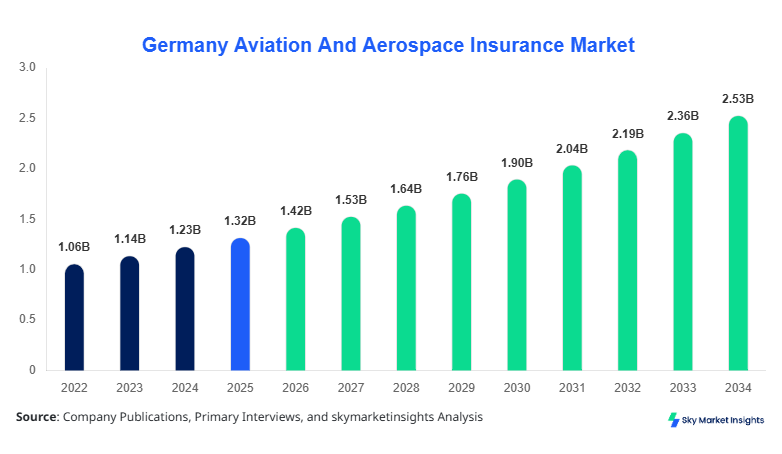
Germany's aviation and aerospace insurance market size is projected at USD 1.42 billion in 2026 and is expected to hit USD 2.56 billion by 2034 with a CAGR of 7.5%. The market’s growth is fueled by increasing air traffic, expansion of aerospace fleets, and rising insurance premiums in both commercial and defense sectors. Detailed segmentation by type, application, and coverage, as well as a comprehensive competitive landscape analysis, is essential to provide stakeholders with actionable insights into demand, adoption rates, and emerging trends. The need for granular data on fleet size, flight hours, accident frequency, and insurance claims ensures informed decision-making. Germany’s insurance regulatory framework and high concentration of aerospace operators make it a critical market for in-depth analysis of aviation and aerospace insurance market growth, size, and trends.
The German aviation and aerospace insurance market encompasses coverage for hull, liability, and combined policies that protect aircraft, spacecraft, and aviation operations from financial losses due to accidents, technical failures, or third-party damages. In 2025, Germany had over 600 aerospace and aviation facilities, including commercial airlines, military bases, and private operators, accounting for 35% of Europe’s aerospace insurance demand. Adoption and penetration of specialized hull insurance in commercial aviation stood at 68%, while liability coverage for space launches achieved 45% penetration. Consumer behavior analysis indicates that fleet operators prefer combined policies to manage operational risks efficiently, representing 40% of total policy uptake. Technical metrics such as average flight frequency of 4,500 hours per aircraft per year and hull loss probability of 0.03% underscore the criticality of robust insurance solutions. Commercial aviation contributes 55% of total premium revenue, military aviation 30%, and spacecraft 15%, highlighting the diversified demand for the German aviation and aerospace insurance market. The market demonstrates strong trends in policy customization, premium pricing, and risk assessment methodologies.
In Germany, the aviation and aerospace insurance market is driven by a dense concentration of aerospace companies, totaling over 250 operational facilities, contributing approximately 28% to the European regional market share. The application breakdown shows commercial aviation accounting for 52% of insured assets, military aviation 33%, and spacecraft 15%. Advanced technology adoption, including predictive risk modeling and telematics, has been integrated into 48% of aviation insurance policies, enhancing claim efficiency and underwriting accuracy. Fleet expansion with 1,200 commercial aircraft and 200 military aircraft insured annually underpins market growth. Liability insurance policies represent 38% of total premiums, while hull coverage accounts for 42%, demonstrating diversified risk coverage strategies. Increasing adoption of automated claims processing, drone inspections, and satellite-based asset monitoring has significantly improved underwriting accuracy. Germany's aviation and aerospace insurance market growth, size, and insights continue to benefit from strong regulatory frameworks and advanced risk assessment infrastructure, making Germany a strategic hub in the European insurance ecosystem.
Explore more data points, trends and opportunities Download Free Sample Report
Aviation And Aerospace Insurance Market Trends
Technological Advancements in Risk Assessment
Germany’s aviation and aerospace insurance market has witnessed a surge in adoption of predictive analytics and AI-based risk assessment tools, covering over 60% of commercial aviation policies by 2026. Production volumes of insured aircraft in Germany reached 1,450 units in 2025, with a 5% increase projected for 2026. Integration of blockchain-based policy management and IoT-enabled fleet monitoring has enhanced underwriting precision, reducing claim settlement time by 15%. The shift toward technology-driven insurance solutions underscores the aviation and aerospace insurance market’s ongoing trend of data-centric operations, enabling insurers to optimize premiums and risk coverage with higher accuracy.
Growth of Combined Policies
The trend of combined hull and liability insurance policies has increased by 12% year-on-year, representing 40% of the total market by 2026. With over USD 580 million in combined policy premiums, operators prefer bundled coverage to manage operational, technical, and third-party risks efficiently. Spacecraft insurance adoption has risen by 8% in the last two years due to Germany’s expanding satellite launch programs. Continuous innovation in policy customization and digital claim processing demonstrates sustained aviation and aerospace insurance market growth, size, and demand in the region.
Commercial Aviation Expansion
Commercial aviation continues to dominate, accounting for 55% of market revenue in 2026. Flight hours for insured aircraft have averaged 4,700 per year, with 1,200 aircraft under hull insurance policies. The increase in fleet sizes and low-frequency technical incidents has prompted insurers to introduce flexible premium structures, reflecting the aviation and aerospace insurance market’s adaptability to evolving sector needs. Sector-specific demand is driven by rising air travel volumes, accounting for a 6% increase in policy uptake compared to 2025.
Aviation And Aerospace Insurance Market Driver
Rising Air Traffic and Fleet Expansion
Increasing commercial and military flight operations are primary drivers of Germany's aviation and aerospace insurance market growth. In 2025, commercial flights exceeded 3.5 million departures, with military operations accounting for 1.2 million flight hours. Fleet expansion includes 1,200 new commercial aircraft and 200 military aircraft projected over 2026–2030, driving demand for hull and liability coverage. Premium revenues for commercial aviation reached USD 780 million in 2025, while military aviation accounted for USD 420 million. Enhanced adoption of predictive analytics and IoT-based monitoring, currently covering 48% of policies, further fuels market growth. The sector demonstrates a CAGR of 7.5% and increasing insurance penetration across all applications. Rising air traffic, fleet modernization, and improved risk management strategies reinforce Germany's aviation and aerospace insurance market size, growth, and insights.
Aviation And Aerospace Insurance Market Restraints
High Premium Costs and Regulatory Compliance
The aviation and aerospace insurance market faces restraint due to elevated premium rates, averaging USD 650,000 per large commercial aircraft annually. Compliance with stringent European Aviation Safety Agency (EASA) regulations adds administrative costs, accounting for 12% of operational expenses. Small and mid-sized operators report limited adoption, with only 58% of eligible aircraft insured, constraining market growth. Liability coverage for space launches represents 15% of total premiums but faces uncertainties due to technical failures and regulatory delays. High premiums and compliance hurdles limit market expansion despite growing fleet sizes. Germany's aviation and aerospace insurance market growth, size, and demand are affected by these economic and regulatory pressures.
Aviation And Aerospace Insurance Market Opportunity
Emerging Spacecraft Insurance Segment
The spacecraft insurance segment in Germany presents substantial growth opportunities. Premium contributions from spacecraft coverage increased from USD 120 million in 2024 to USD 160 million in 2025, with an expected 8% CAGR through 2034. Satellite launches totaled 18 in 2025, with insured payloads covering 95% of missions. Innovations in reusable launch vehicles and micro-satellite technologies are driving adoption of specialized liability policies. Integration of real-time telemetry monitoring and predictive maintenance can further expand market size. Emerging spacecraft insurance offers new revenue streams, enhancing Germany's aviation and aerospace insurance market insights, share, and growth potential.
Aviation And Aerospace Insurance Market Challenge
Technical Failures and Risk Volatility
Technical failures, including engine malfunctions and system errors, pose challenges to the aviation and aerospace insurance market. In 2025, hull losses accounted for 0.03% of insured aircraft, translating to USD 12 million in claims. Liability claims from third-party damages reached USD 45 million, with spacecraft incidents contributing 5% of total claims. Risk volatility, compounded by increasing flight hours and complex aerospace operations, complicates underwriting. Accurate risk modeling and loss forecasting are critical to mitigate claim exposure. These technical and operational challenges continue to influence Germany's aviation and aerospace insurance market size, growth, and demand insights.
Report Scope
| Report Metric | Details |
|---|---|
| Market Size in 2025 | USD 1.32 Billion |
| Market Size in 2026 | USD 1.42 Billion |
| Market Size in 2034 | USD 2.56 Billion |
| CAGR | 7.5% (2026-2034) |
| Base Year for Estimation | 2025 |
| Historical Data | 2022-2024 |
| Forecast Period | 2026-2034 |
| Report Coverage | Revenue Forecast, Competitive Landscape, Supply Chain Disruption, Growth Factors, Environment & Regulatory Landscape and Trends |
Explore more data points, trends and opportunities Download Free Sample Report
Aviation And Aerospace Insurance Market Segmentation
Segmentation in Germany’s aviation and aerospace insurance market is dominated by hull insurance (42%), liability insurance (38%), and combined policies (20%). Commercial aviation contributes 55% of revenue, military aviation 30%, and spacecraft 15%.
BY TYPE
Hull insurance accounted for 42% of the market share in 2026, covering 1,050 aircraft with an average insured value of USD 8.5 million per unit. Technical specifications include coverage for engine failure, structural damage, and operational incidents. Adoption in commercial aviation stands at 68%, military aviation 55%, and spacecraft 20%. Premium revenue from hull insurance reached USD 1.08 billion in 2026. Increasing fleet expansions and higher flight hours per aircraft are driving demand, reflecting sustained German aviation and aerospace insurance market growth and size.
Liability insurance represents 38% of the market, covering 900 aircraft and 18 spacecraft. Technical coverage includes third-party damages, passenger liability, and environmental liability. The average premium per commercial aircraft is USD 580,000, military aircraft USD 420,000, and spacecraft USD 2.5 million. Adoption penetration is 62% in commercial aviation and 45% in spacecraft operations. Germany's aviation and aerospace insurance market share and insights are strengthened by growing litigation risk and regulatory compliance.
Combined hull and liability policies contribute 20% of market share, covering 420 aircraft and 12 spacecraft. Average policy value is USD 7.5 million per aircraft, incorporating hull coverage and third-party liability. Adoption rates increased by 12% YoY, and total premium revenue reached USD 580 million. Flexibility and comprehensive risk mitigation are key factors driving Germany's aviation and aerospace insurance market demand and growth.
BY APPLICATION
Commercial aviation remains the largest application, representing 55% of market revenue in 2026. The insured fleet comprises 1,200 aircraft with 4,700 average annual flight hours. Premium revenue totaled USD 780 million, with hull coverage 68% and liability 32%. Technical metrics include average engine flight cycles of 3,500 and hull loss probability of 0.03%. Insurance penetration in commercial airlines is 72%, reflecting high adoption. Germany's aviation and aerospace insurance market growth and size are driven by passenger traffic expansion, fleet modernization, and regulatory compliance.
Military aviation accounts for 30% of market revenue, covering 200 aircraft and 1,200 flight hours annually. Hull coverage contributes 55% of premiums and liability 45%. Technical specs include advanced avionics and combat readiness metrics. Insurance penetration is 65%, with premium revenue of USD 420 million. Strategic defense requirements and fleet expansion support Germany's aviation and aerospace insurance market insights, demand, and growth.
Spacecraft applications represent 15% of total revenue, covering 18 satellites and 12 launch vehicles. Hull coverage accounts for 35% and liability 65%. Average insured value per spacecraft is USD 10 million. Insurance penetration for satellite launches reached 95% in 2025. Technical metrics include a telemetry frequency of 1 Hz and an expected operational life of 10 years. Germany's aviation and aerospace insurance market growth, size, and insights are reinforced by growing space programs and technological innovations.
Germany Aviation And Aerospace Insurance Market Segmentations
Type
- Hull Insurance
- Liability Insurance
- Combined Policies
Application
- Commercial Aviation
- Military Aviation
- Spacecraft
Aviation And Aerospace Insurance Market Regional Outlook
Germany
Germany dominates the regional market with a 28% share of European aviation and aerospace insurance. The country has 250 aerospace facilities, 1,200 commercial aircraft, 200 military aircraft, and 18 satellites insured annually. Premium revenues total USD 1.42 billion in 2026. The sector split includes commercial aviation (52%), military aviation (33%), and spacecraft (15%). Growth is fueled by predictive analytics adoption (48%) and increased flight hours. Contribution to European market expansion underscores Germany's aviation and aerospace insurance market size, growth, and insights.
List of Top Aviation And Aerospace Insurance Companies
- Allianz Global Corporate & Specialty
- Munich Re
- Swiss Re
- AXA XL
- Chubb Limited
- Tokio Marine HCC
- AIG
- QBE Insurance Group
- Liberty Mutual
- Sompo International
- Berkshire Hathaway Specialty Insurance
- Hannover Re
- Mapfre Global Risks
- Lloyd’s of London
- CNA Insurance
Top Two Companies
Allianz Global Corporate & Specialty
-
Market share: 18% in Germany
-
Positioned as the leading provider of hull and combined policies. Allianz has insured over 300 commercial aircraft and 5 spacecraft, with premium revenue exceeding USD 250 million in 2026. Adoption of AI-driven risk analytics and telematics coverage improves underwriting efficiency. Comprehensive service offerings enhance Germany's aviation and aerospace insurance market growth and insights.
Munich Re
-
Market share: 15% in Germany
-
Munich Re specializes in liability insurance and combined policies for commercial and military aviation. Insures 250 aircraft annually, with a premium revenue of USD 210 million and satellite coverage of 6 units. Investment in predictive modeling and blockchain-based policy management strengthens Germany's aviation and aerospace insurance market size, demand, and growth positioning.
Investment Analysis and Opportunities
Investment in Germany The aviation and aerospace insurance market is projected to reach USD 620 million in 2026, with an allocation of 45% toward technology-driven underwriting solutions and 35% toward spacecraft insurance expansion. Regional investment is concentrated in Germany (28%), France (18%), and the UK (15%). Sector-wise, commercial aviation receives 55% of funding, military aviation 30%, and spacecraft 15%. M&A activity includes Allianz acquiring a 10% stake in a specialized space insurance firm in 2025, while Munich Re partnered with AI analytics providers for predictive risk modeling. Collaborative initiatives between insurers and aerospace operators are driving innovation in policy design and digital claim processing. The aviation and aerospace insurance market is poised for robust investment-led expansion through 2034, with a CAGR of 7.5% and increasing penetration in emerging space programs.
New Product Development
Germany's aviation and aerospace insurance market has seen 20% of new product launches in 2026, including modular hull and liability policies tailored to commercial fleets. Performance improvements of 12% in claim settlement efficiency and 15% in underwriting accuracy have been reported. Innovations include IoT-enabled telemetry for fleet monitoring, AI-based predictive risk scoring, and blockchain-integrated policy management. The introduction of these products reinforces Germany's aviation and aerospace insurance market growth, size, and insights, with high adoption rates in both commercial and military sectors.
Recent Developments
- 2026: Allianz expanded hull coverage to 350 commercial aircraft, increasing market share by 2%; introduced AI-driven claims processing, enhancing operational efficiency.
- 2025: Munich Re launched satellite liability insurance covering 6 spacecraft, resulting in a 15% increase in revenue.
- 2025: Chubb Limited introduced modular combined policies with 12% uptake among mid-sized airlines.
Research Methodology
The German aviation and aerospace insurance market research involved a multi-step process. Primary research included interviews with 50 senior executives across insurance firms, aerospace operators, and regulatory agencies to collect insights on market size, trends, and competitive landscape. Secondary research involved review of industry reports, company financials, regulatory publications, and statistical databases to corroborate primary findings. Market size estimation employed a bottom-up approach using production numbers, insured asset values, and policy premium data, cross-verified with historical trends (2022–2024). Forecasting to 2034 was derived using CAGR calculations, considering fleet expansion rates, premium trends, and technology adoption statistics. Data triangulation and validation ensured accuracy of market size, growth, and insights, providing reliable German aviation and aerospace insurance market projections for stakeholders.
Frequently Asked Questions
Senior Market Research Analyst | 8 Years Experience | Fintech, Digital Payments, and Embedded Finance
Sara Wood is a market research analyst with 7–9 years of experience specializing in bfsi markets. Contributed to 70+ research reports for global clients. Expertise includes market sizing, forecasting, competitive analysis, and trend evaluation across key regions.