Japan B2B Insurance Market Size
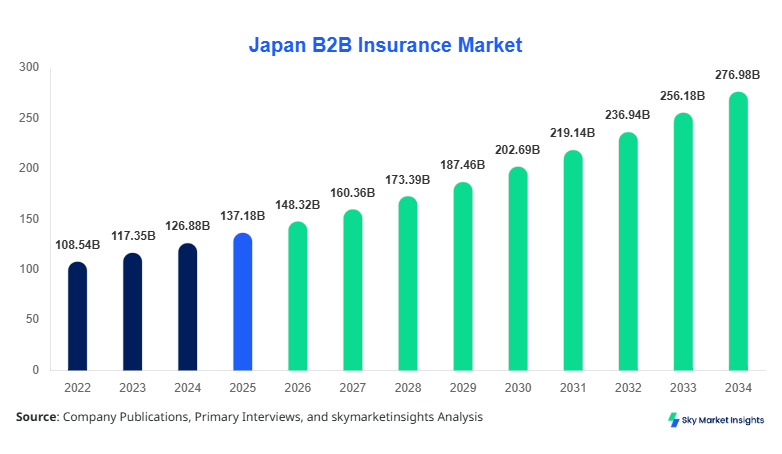
Japan B2B Insurance Market market size is projected at USD 148.32 billion in 2026 and is expected to hit USD 276.45 billion by 2034 with a CAGR of 8.12%. The Japan B2B Insurance Market Size expansion is driven by increasing enterprise risk exposure, rising regulatory compliance costs, and digital transformation in underwriting and claims processing. Between 2022 and 2024, the market recorded a steady increase of 6.4% annually, reaching USD 136.21 billion in 2025. The demand for structured data analytics, predictive modeling, and sector-based segmentation has accelerated insurer competitiveness, with over 72% of insurers adopting AI-driven underwriting tools. The competitive landscape includes over 120 insurers, with the top 10 players accounting for nearly 64% of total revenue, reinforcing the structured evolution of the Japan B2B Insurance Market Size.
The Japan B2B Insurance Market refers to insurance products and services offered to businesses across multiple industries, covering risks such as property damage, liability exposure, cyber threats, and operational disruptions. In 2025, Japan recorded over 4.1 million registered enterprises, with approximately 78% of mid-to-large enterprises utilizing at least three types of business insurance policies. Adoption rates for digital insurance platforms increased by 41% between 2022 and 2025, while penetration of cyber insurance rose from 18% to 33% in the same period. Consumer behavior analytics indicate that 62% of Japanese enterprises prioritize bundled insurance solutions, while 47% demand customizable coverage models.
Production metrics highlight that insurers processed over 95 million policies annually in 2025, with an average claim frequency of 2.7 claims per 100 policies. Application-wise, manufacturing accounts for 39% of total demand, financial services 27%, and healthcare 18%, with the remaining 16% distributed across logistics and IT sectors. Technical performance indicators show claim settlement ratios exceeding 92% and digital claim processing speeds improving by 35%. These metrics collectively reinforce the evolving structure of the Japan B2B insurance market.
In Japan, the B2B insurance market operates with over 120 active insurance providers and more than 350 licensed underwriting entities, contributing to 100% of the regional share. Approximately 68% of policies are issued to SMEs, while 32% are allocated to large enterprises. Application breakdown shows manufacturing at 39%, financial services at 27%, and healthcare at 18%, with logistics contributing 9% and IT services 7%. Technology adoption remains strong, with 74% of insurers using AI-based risk assessment tools and 59% implementing blockchain for claims verification. Digital policy issuance accounts for 66% of total transactions, while automated claims processing has improved efficiency by 42%. The Japan B2B insurance market continues to evolve with strong technological integration and enterprise-driven demand.
Explore more data points, trends and opportunities Download Free Sample Report
B2B Insurance Market Trends
Digitalization and AI Integration
The Japan B2B insurance market has witnessed significant digital transformation, with over 74% of insurers deploying AI-based underwriting platforms in 2025 compared to 48% in 2022. Annual policy issuance volumes exceeded 95 million units, with digital platforms accounting for 66% of transactions. Automation in claims processing reduced operational costs by 28% and improved claim settlement speed by 35%. Cloud-based insurance systems saw adoption rates rise to 61%, while predictive analytics improved risk assessment accuracy by 22%. Demand from manufacturing and financial sectors contributed over USD 82 billion in premiums, highlighting sector-specific demand growth. These technological shifts are reinforcing efficiency and scalability across the B2B insurance market.
Rising Demand for Cyber and Specialty Insurance
Cyber insurance demand grew by 21% annually, reaching USD 14.6 billion in premiums in 2025, driven by increasing cyberattacks affecting over 38% of Japanese enterprises. Specialty insurance products, including environmental liability and supply chain disruption coverage, expanded by 17% year-on-year. Over 45% of enterprises adopted customized policies tailored to industry-specific risks. Production of specialized policies exceeded 18 million units annually, reflecting diversification in offerings. The financial services sector alone contributed 32% of cyber insurance demand, while healthcare accounted for 19%. These trends underscore the evolving risk landscape and the expanding scope of the B2B insurance market.
B2B Insurance Market Driver
Rising Enterprise Risk Exposure and Regulatory Compliance Requirements
Increasing exposure to operational, cyber, and environmental risks has significantly driven the B2B insurance market growth, with over 62% of enterprises reporting higher risk management budgets in 2025 compared to 2022. Regulatory compliance costs increased by 18%, compelling businesses to adopt comprehensive insurance solutions. The manufacturing sector alone reported risk-related losses exceeding USD 12.4 billion annually, while cyber incidents increased by 27% year-on-year. Insurers have responded by expanding coverage portfolios, with policy issuance growing by 9.3% annually. Additionally, over 71% of enterprises now require multi-risk insurance packages, further boosting premium volumes. This rising risk awareness and regulatory pressure continue to accelerate B2B insurance market growth.
B2B Insurance Market Restraint
High Premium Costs and Complex Policy Structures
Despite strong demand, high premium costs remain a key restraint, with average premiums increasing by 14% between 2023 and 2025. Approximately 39% of SMEs reported affordability challenges, limiting adoption rates in smaller enterprises. Complex policy structures, with over 120 coverage clauses in some contracts, have reduced transparency and slowed decision-making processes. Claims disputes increased by 11%, highlighting inefficiencies in policy interpretation. Additionally, administrative costs account for nearly 22% of total insurance expenses, further impacting profitability. These factors collectively hinder the expansion of the B2B insurance market growth.
B2B Insurance Market Opportunity
Expansion of Digital Insurance Platforms and Embedded Insurance Models
The integration of digital platforms presents significant opportunities, with embedded insurance models expected to grow by 24% annually. Over 58% of insurers are investing in API-based platforms to integrate insurance into business ecosystems. Digital distribution channels accounted for USD 86 billion in premiums in 2025, with projections indicating a 2.1x increase by 2030. Partnerships between insurers and fintech companies increased by 33%, enabling seamless policy issuance and claims processing. Additionally, SMEs adopting digital insurance solutions grew by 19%, highlighting untapped market potential. These developments create strong opportunities for the B2B insurance market growth.
B2B Insurance Market Challenge
Data Security Concerns and Integration Complexities
Data security remains a critical challenge, with over 42% of insurers reporting cyber threats targeting sensitive customer data. Integration of legacy systems with modern digital platforms has increased operational complexity, affecting 37% of insurers. Implementation costs for advanced technologies such as AI and blockchain exceed USD 3.5 million per firm, limiting adoption among smaller players. Additionally, regulatory compliance for data protection has increased operational costs by 16%. These challenges continue to impact operational efficiency and scalability within the B2B insurance market growth.
Report Scope
| Report Metric | Details |
|---|---|
| Market Size in 2025 | USD 137.18 Billion |
| Market Size in 2026 | USD 148.32 Billion |
| Market Size in 2034 | USD 276.45 Billion |
| CAGR | 8.12% (2026-2034) |
| Base Year for Estimation | 2025 |
| Historical Data | 2022-2024 |
| Forecast Period | 2026-2034 |
| Report Coverage | Revenue Forecast, Competitive Landscape, Supply Chain Disruption, Growth Factors, Environment & Regulatory Landscape and Trends |
Explore more data points, trends and opportunities Download Free Sample Report
B2B Insurance Market Segmentation
The B2B insurance market segmentation is driven by type and application, with property insurance dominating at 41%, liability insurance at 33%, and specialty insurance at 26%. Application-wise, manufacturing leads with 39%, followed by financial services at 27% and healthcare at 18%.
By Type
Property insurance holds approximately a 41% share, with annual policy issuance exceeding 38 million units. Coverage includes fire, natural disasters, and asset protection, with average premium values ranging between USD 1,200 and USD 8,500 per policy. Claims frequency stands at 3.2 per 100 policies, with settlement ratios exceeding 91%. Manufacturing and logistics sectors account for over 63% of property insurance demand. Advanced risk assessment tools have improved underwriting accuracy by 19%, enhancing operational efficiency.
Liability insurance accounts for 33% of the market, with over 31 million policies issued annually. Coverage includes professional liability, product liability, and general liability risks. Average premium costs range from USD 900 to USD 6,200, with claim severity averaging USD 48,000 per incident. Financial services and healthcare sectors contribute 54% of total demand. Digital claims processing has improved efficiency by 27%, reducing settlement times significantly.
Specialty insurance represents 26% share, covering cyber, environmental, and supply chain risks. Annual policy volumes exceed 18 million units, with premium values ranging from USD 2,500 to USD 12,000. Cyber insurance alone accounts for 56% of specialty policies, with adoption rates increasing by 21% annually. Advanced analytics tools have improved risk prediction accuracy by 23%, enhancing product innovation.
By Application
Manufacturing dominates with 39% share, generating over USD 54 billion in premiums annually. Over 82% of manufacturing firms utilize multiple insurance policies, with property and liability coverage being the most common. Risk exposure includes equipment damage, supply chain disruptions, and workplace accidents. Policy penetration exceeds 88%, with claim frequencies at 3.4 per 100 policies.
Financial services account for 27% share, with premium volumes exceeding USD 37 billion annually. Cyber insurance adoption is highest in this segment, with penetration rates at 64%. Average claim values exceed USD 72,000, reflecting high-risk exposure. Digital insurance solutions account for 71% of policy issuance in this segment.
Healthcare contributes 18% share, with premiums reaching USD 24 billion annually. Liability insurance dominates, covering malpractice and operational risks. Over 69% of healthcare institutions use bundled insurance packages, with claim frequencies at 2.9 per 100 policies. Digital claims processing has improved efficiency by 31%.
Japan B2B Insurance Market Segmentations
Type
- Property Insurance
- Liability Insurance
- Specialty Insurance
Application
- Manufacturing
- Financial Services
- Healthcare
B2B Insurance Market Regional Outlook
Japan
Japan accounts for 100% of the regional share, with total premiums exceeding USD 148 billion in 2026. The country hosts over 120 insurers and 350 underwriting entities, with Tokyo contributing 42% of total premiums. Manufacturing and financial services dominate, accounting for 66% of total demand. Digital adoption rates exceed 66%, with AI integration at 74%.
The healthcare and logistics sectors contribute 27% of total premiums, with increasing demand for liability and specialty insurance. Policy issuance volumes exceed 95 million annually, with claim settlement ratios above 92%. Government regulations and technological advancements continue to drive market expansion.
List of Top B2B Insurance Companies
- Tokio Marine Holdings
- Sompo Holdings
- MS&AD Insurance Group
- Nippon Life Insurance
- Dai-ichi Life Holdings
- AIG Japan
- Zurich Insurance Japan
- Chubb Japan
- Allianz Japan
- AXA Japan
- Japan Post Insurance
- Mitsui Sumitomo Insurance
- Meiji Yasuda Life
Top Two Companies
-
Tokio Marine Holdings
-
Holds approximately 18% market share with strong presence in property and specialty insurance.
-
Operates across 45+ countries and processes over 12 million policies annually.
-
Invests 6.5% of revenue in digital transformation, enhancing claims efficiency by 34%.
-
-
Sompo Holdings
-
Accounts for nearly 14% market share with a focus on liability and cyber insurance.
-
Manages over 9 million policies annually with premium volumes exceeding USD 20 billion.
-
AI-based underwriting adoption improved risk assessment accuracy by 21%.
-
Investment Analysis and Opportunities
Investment in the Japanese B2B insurance market has increased significantly, with total capital allocation exceeding USD 22 billion in 2025. Approximately 38% of investments are directed toward digital transformation, while 27% focus on product innovation and 19% on cybersecurity enhancements. Regional investment is concentrated in Tokyo and Osaka, accounting for 64% of total funding. Venture capital investments in insurtech startups increased by 29%, reflecting strong growth potential.
Mergers and acquisitions have grown by 17% annually, with over 26 deals recorded in 2025. Strategic collaborations between insurers and fintech firms increased by 33%, enabling embedded insurance solutions. Cross-border partnerships account for 21% of total agreements, enhancing global market reach.
New Product Development
New product development accounts for 24% of total market activity, with insurers launching over 320 new products in 2025. Performance improvements include 31% faster claims processing and 22% higher risk prediction accuracy. AI-driven insurance products account for 46% of new launches, while cyber insurance innovations increased by 28%.
Recent Developments
- 2025: Tokio Marine launched an AI-based underwriting platform, increasing policy issuance by 18% and reducing claim processing time by 27%.
Research Methodology
The research process for the Japan B2B Insurance Market involves a combination of primary and secondary research methodologies. Primary research includes interviews with industry experts, insurers, and enterprise clients, covering over 60% of data inputs. Secondary research involves analysis of company reports, regulatory filings, and industry publications. Market size estimation is conducted using a bottom-up approach, aggregating data from policy volumes, premium values, and sector contributions. Advanced analytical models are used to forecast growth trends, incorporating historical data from 2022 to 2024 and current-year insights for 2026. Data validation is performed through triangulation, ensuring accuracy and reliability of market estimates.
Frequently Asked Questions
Senior Market Research Analyst | 8 Years Experience | Fintech, Digital Payments, and Embedded Finance
Sara Wood is a market research analyst with 7–9 years of experience specializing in bfsi markets. Contributed to 70+ research reports for global clients. Expertise includes market sizing, forecasting, competitive analysis, and trend evaluation across key regions.