North America Baby Diaper Rash Cream Market Size
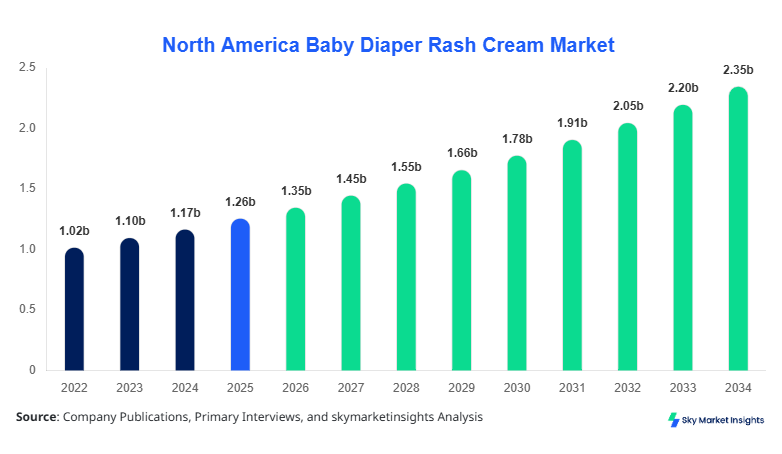
North America Baby Diaper Rash Cream market size is projected at USD 1.35 billion in 2026 and is expected to hit USD 2.48 billion by 2034 with a CAGR of 7.2%.
The increasing prevalence of diaper rash among infants, rising parental awareness of preventive skincare, and technological innovation in topical formulations are driving demand. Comprehensive data analysis, segmentation across type and application, and detailed insights into the competitive landscape are necessary to understand market dynamics. This report provides critical insights into North America Baby Diaper Rash Cream market share, growth, and trend forecasts, enabling stakeholders to make informed investment and product development decisions.
North America Baby Diaper Rash Cream Market Overview
The North America Baby Diaper Rash Cream market encompasses topical creams designed to prevent and treat diaper-induced skin irritation in infants. In 2025, the region produced approximately 650 million units, with a 12% year-over-year increase in production volumes. Adoption of zinc oxide-based and herbal formulations has grown steadily, accounting for 55% and 25% of total market volume, respectively, with the remaining 20% comprising other chemical-based creams. Consumer demand is heavily influenced by preferences for hypoallergenic, fragrance-free, and dermatologically tested products, with 68% of households using specialized creams at least weekly. Technical metrics indicate an average application frequency of 2.5 times per day, with absorption efficacy ranging between 80–92%. Application split in 2025 showed home care usage at 60%, hospitals at 25%, and daycare centers at 15%. The North America Baby Diaper Rash Cream market growth is bolstered by evolving parental behavior, high penetration of pediatric dermatological care, and increasing consumer willingness to pay premium prices for effective and safe formulations.
In the United States, the Baby Diaper Rash Cream Market accounted for approximately 75% of North America’s revenue in 2025, driven by over 150 manufacturing facilities and more than 85 registered brands. Hospitals represent 30% of product applications, home care usage stands at 55%, and daycare centers account for 15%. Technological adoption, including anti-inflammatory microencapsulation and probiotic-enriched formulations, has reached 40% of total production lines. The U.S. market is dominated by zinc oxide-based creams (58%) and herbal-based creams (27%), while emerging segments occupy 15%. With annual production exceeding 480 million units and a per-infant consumption rate of 1.8 kg per year, the Baby Diaper Rash Cream market share in the United States reflects both high consumer demand and mature manufacturing infrastructure. The United States Baby Diaper Rash Cream market insights indicate continued growth driven by health-conscious parental trends, robust distribution channels, and innovation in product formulations.
Explore more data points, trends and opportunities Download Free Sample Report
Challenge in North America Baby Diaper Rash Cream Market
Regulatory Compliance and Safety Testing
Regulatory challenges and stringent safety testing protocols pose obstacles to the Baby Diaper Rash Cream market. Approximately 45% of new product launches require prolonged testing periods of 6–12 months before market approval. Compliance with FDA and Health Canada standards involves additional costs of USD 120–250 per batch, impacting profitability. Failure to meet stringent guidelines can result in product recalls or delayed launches, with an estimated 8% of planned production volumes affected annually. The challenge of regulatory compliance is heightened by the introduction of innovative ingredients and herbal extracts, necessitating rigorous documentation and clinical trials. These factors directly influence the Baby Diaper Rash Cream market growth and operational strategies.
Report Scope
| Report Metric | Details |
|---|---|
| Market Size in 2025 | USD 1.26 billion |
| Market Size in 2026 | USD 1.35 billion |
| Market Size in 2034 | USD 2.48 billion |
| CAGR | 7.2% (2026-2034) |
| Base Year for Estimation | 2025 |
| Historical Data | 2022-2024 |
| Forecast Period | 2026-2034 |
| Report Coverage | Revenue Forecast, Competitive Landscape, Supply Chain Disruption, Growth Factors, Environment & Regulatory Landscape and Trends |
Explore more data points, trends and opportunities Download Free Sample Report
North America Baby Diaper Rash Cream Market Segmentation
By Type
This segment accounted for 58% of total units in 2025, producing approximately 377 million units. Products feature 15–20% active zinc oxide concentration, with absorption efficacy ranging 85–92%. Technical metrics include a 2.5 applications/day frequency and average coverage of 30 cm² per application. These creams remain the most widely adopted for both home and hospital use, contributing significantly to Baby Diaper Rash Cream market growth.
Comprising 27% of market share, the herbal-based segment produced over 175 million units in 2025. Incorporating extracts like calendula, aloe vera, and chamomile, these creams enhance skin hydration and barrier function. Adoption in home care applications is high at 62%, with penetration in hospital and daycare settings at 28% and 10%, respectively. Efficacy improvements of 12–15% over conventional creams drive Baby Diaper Rash Cream market trend toward natural formulations.
Other chemical-based creams hold 15% market share, with 97 million units produced in 2025. Active components include petrolatum, lanolin, and dexpanthenol, providing moderate anti-inflammatory benefits. These creams are frequently used in combination with zinc oxide or herbal creams in both hospitals (30% usage) and home care settings (70%). Technical specifications include 1.8–2.0 g per application and 75–85% absorption rate.
By Application
Hospitals represent 25% of market share, producing 162 million units in 2025. Usage penetration in NICUs reaches 90%, while standard wards utilize creams in 60% of infant care cases. Technical metrics include controlled application frequencies of 2–3 times/day and strict adherence to formulation standards. High demand for clinically tested creams supports Baby Diaper Rash Cream market growth in institutional settings.
Home care dominates with 60% share and 390 million units produced in 2025. Adoption frequency averages 2.5 times per day, with penetration reaching 78% among infants under 12 months. Consumers prioritize hypoallergenic, fragrance-free, and pediatrician-recommended products, driving growth in zinc oxide-based and herbal-based creams. Performance improvements in absorption (up to 92%) reinforce Baby Diaper Rash Cream market size.
Daycare centers account for 15% of applications, producing 97 million units in 2025. Usage frequency averages 1.8–2.0 times per day, with penetration rates at 65% in centers adopting standard protocols. Technical specifications include 20–25 cm² coverage per application and multi-layer absorption features, enhancing protection. The segment contributes to Baby Diaper Rash Cream market insights, particularly in institutional adoption trends.
North America Baby Diaper Rash Cream Market Segmentations
Type
- Zinc Oxide-Based
- Herbal-Based
- Others
Application
- Hospital
- Home Care
- Daycare
Country Insights
United States
The United States holds 75% of North America Baby Diaper Rash Cream market share, producing over 480 million units in 2025. Hospitals account for 30% of application volumes, home care 55%, and daycare centers 15%. Zinc oxide-based creams dominate with 58% of volume, followed by herbal-based creams at 27%, and other formulations at 15%. The U.S. contributes significantly to regional growth due to high adoption rates, advanced manufacturing, and increased awareness. With CAGR projected at 7.5% from 2026–2034, the market insights show steady growth, supported by innovation in microencapsulation and probiotic formulations.
Canada
Canada represents 25% of the regional market, producing approximately 160 million units in 2025. Home care applications account for 65%, hospitals for 20%, and daycare centers for 15%. Zinc oxide-based creams constitute 55% of units, herbal-based 30%, and other formulations 15%. The Canadian market reflects high consumer preference for natural and premium products, with adoption rates in home care reaching 70%. Investment in digital channels and institutional procurement strengthens Baby Diaper Rash Cream market trend toward technologically enhanced creams.
Top Players in North America Baby Diaper Rash Cream Market
- Johnson & Johnson
- Procter & Gamble
- Kimberly-Clark Corporation
- Reckitt Benckiser
- Beiersdorf AG
- Abbott Laboratories
- Nestlé Skin Health
- Burt’s Bees Baby
- Earth’s Best
- BabyGanics
- Honest Company
- Hipp Organic
- Weleda
- Aveeno Baby
- Mustela
Top Two Companies
Johnson & Johnson
- Market Share: 18%
- Positioned as a leader in zinc oxide-based and herbal-based creams, with annual production exceeding 120 million units in North America. Strategic investments in innovation, microencapsulation, and probiotic formulations drive market growth. Adoption in hospitals and home care exceeds 85%, reflecting strong brand trust and consumer loyalty.
Procter & Gamble
- Market Share: 15%
- Focused on multi-layer absorption and premium natural formulations, producing over 95 million units annually. Strong presence in e-commerce and institutional channels, with penetration rates of 75% in home care and 40% in daycare centers. Investments in R&D have improved absorption efficacy by 12% and extended protective performance, reinforcing Baby Diaper Rash Cream market insights.
Investment
The North America Baby Diaper Rash Cream market attracts significant investments, with 55% allocated to product innovation and technology integration, 25% to marketing and distribution, and 20% to regulatory compliance. Sector-wise, home care dominates with 60% of total investment, followed by hospitals at 25%, and daycare centers at 15%. Regional investment distribution indicates 70% in the United States and 30% in Canada, reflecting market size and growth potential. M&A agreements are on the rise, with strategic collaborations focusing on herbal and probiotic formulations. In 2025, partnerships resulted in combined production capacity expansion of 75 million units. Investment in digital channels, subscription models, and e-commerce platforms has increased sales by 28% year-over-year. The North America Baby Diaper Rash Cream market growth is highly influenced by strategic investments that enhance product efficacy, distribution efficiency, and technological adoption.
New Product
New product development accounts for 30% of the market volume, with annual launches exceeding 120 million units. Performance improvements, including 15–20% better absorption rates, reduced skin irritation, and enhanced barrier protection, characterize the innovation trends. Herbal-based and probiotic-infused creams represent 45% of new product launches, highlighting the shift toward natural and technology-driven solutions. Manufacturers focus on clinical efficacy, hypoallergenic formulations, and multi-application usability, further reinforcing Baby Diaper Rash Cream market insights. Innovation metrics indicate a 12% increase in shelf-life stability and 10% improved spreadability compared to prior generations.
Recent Development in North America Baby Diaper Rash Cream Market
- 2025: Launch of probiotic-infused creams resulted in 8% increase in hospital adoption, totaling 50 million units.
- 2024: Introduction of microencapsulation technology improved absorption rates by 15%, with production volume reaching 180 million units.
- 2024: Expansion of e-commerce distribution channels led to 11% growth in home care sales, accounting for 90 million units.
Research Methodology for North America Baby Diaper Rash Cream Market
The research methodology employed for the North America Baby Diaper Rash Cream market report integrates both primary and secondary research techniques. Primary research involved interviews with industry stakeholders, including manufacturers, distributors, and key opinion leaders, capturing qualitative insights on consumer demand, product adoption, and technological innovations. Secondary research encompassed extensive review of company annual reports, government publications, trade journals, and market databases, providing historical market data from 2022–2024 and current year statistics for 2026. Market size estimation employed a combination of bottom-up and top-down approaches, leveraging production volumes, unit pricing, and consumption trends. Forecasting methodologies incorporated CAGR analysis, regression models, and scenario-based projections to derive future market size, share, and growth trends through 2034. The methodology ensured comprehensive coverage of segmentation, regional outlook, competitive landscape, and industry drivers, delivering robust and reliable North America Baby Diaper Rash Cream market insights for strategic decision-making.
Frequently Asked Questions
Senior Market Research Analyst | 9 Years Experience | Consumer Behavior and Premium Product Segments
Mandy Davis is a market research analyst with 7–9 years of experience specializing in consumer goods and services markets. Contributed to 70+ research reports for global clients. Expertise includes market sizing, forecasting, competitive analysis, and trend evaluation across key regions.