North America Artificial Nails Market Size
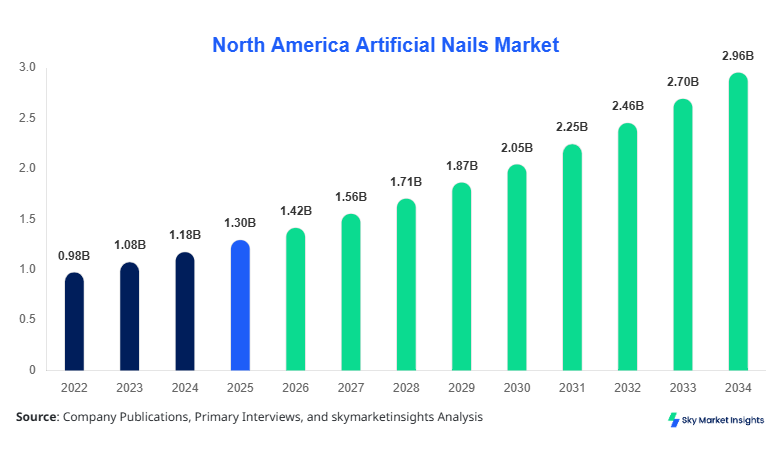
North America Artificial Nails market size is projected at USD 1.42 billion in 2026 and is expected to hit USD 2.96 billion by 2034 with a CAGR of 9.6%. The North America Artificial Nails market is witnessing strong expansion driven by increasing consumer spending on beauty and grooming, rising salon penetration, and innovation in nail enhancement technologies. The report incorporates detailed segmentation, competitive benchmarking, and demand analytics, offering insights into product categories contributing over 45% of total revenue and distribution channels accounting for nearly 60% of sales volume. The study further evaluates regional production capacity exceeding 320 million units annually and maps key vendor positioning in a fragmented but rapidly consolidating ecosystem.
The artificial nails industry comprises synthetic nail enhancements including acrylic, gel, and press-on nails designed to improve aesthetic appeal, durability, and customization. In North America, annual production exceeded 305 million units in 2025, with utilization rates reaching 82% across manufacturing facilities. Adoption and penetration insights indicate that over 64% of urban consumers aged 18–45 actively use artificial nails at least once every 3 months, while salon-based applications contribute approximately 58% of total installations. Consumer behavior analytics reveal that nearly 47% of users prioritize durability above 14 days, while 36% prefer reusable or eco-friendly nail solutions. Application split shows salon use dominating at 58%, personal DIY usage at 32%, and commercial or event-based use at 10%. Technical metrics include average wear duration of 12–21 days, curing time of 30–90 seconds for gel nails, and break resistance levels exceeding 85% in premium segments, reinforcing the Artificial Nails market.
Explore more data points, trends and opportunities Download Free Sample Report
Artificial Nails Market Trends
Rise of DIY and Press-on Nail Technologies
The market is experiencing a surge in DIY nail solutions, with press-on nail production crossing 95 million units in 2025, growing at 11.2% year-on-year. Consumers increasingly favor reusable products, with 44% opting for eco-friendly or biodegradable nail kits. Technological advancements such as adhesive strength enhancement by 28% and improved design printing precision have boosted consumer acceptance. E-commerce channels now contribute over 52% of press-on nail sales, supported by influencer marketing and subscription-based models. The shift toward convenience and cost efficiency, where average DIY kits cost 35–60% less than salon services, continues to drive this trend in the Artificial Nails market.
Integration of Advanced Materials and Smart Nail Solutions
Advanced materials such as hybrid polymers and UV-resistant coatings have improved product longevity by 30–40%, while reducing damage rates by 18%. Gel nails using LED curing technology have achieved curing efficiency improvements of 25%, reducing application time to under 45 seconds. Smart nail solutions, including temperature-sensitive color-changing nails and embedded micro-design chips, are gaining traction with a 12% adoption rate among premium users. Production volume of gel nails surpassed 120 million units in 2025, with high-end variants contributing over 27% of total revenue. These technological advancements continue to shape innovation pipelines in the Artificial Nails market.
North America Artificial Nails Drivers
Rising Beauty Consciousness and Salon Penetration Driving Market Expansion
Increasing consumer awareness regarding personal grooming and aesthetic appearance is a major driver, with beauty spending in North America rising by 8.4% annually. Over 68% of female consumers and 22% of male consumers reported using nail enhancement products in 2025. Salon penetration has reached 72% in urban areas, with service frequency averaging 8–10 visits annually per consumer. Additionally, social media influence contributes to nearly 40% of purchase decisions, while celebrity endorsements account for a 15% uplift in premium product sales. Production output has scaled to over 300 million units annually to meet this demand surge. These factors collectively enhance the Artificial Nails market.
North America Artificial Nails Restraints
Health Concerns and Chemical Exposure Limiting Adoption
Health concerns related to prolonged exposure to chemicals such as methacrylates and acetone remain a key restraint, with approximately 18% of users reporting mild allergic reactions. Regulatory scrutiny has increased, with compliance costs rising by 12% for manufacturers. Additionally, 26% of consumers express concerns regarding nail damage and weakening due to repeated artificial nail usage. Environmental concerns also play a role, as nearly 34% of artificial nail products are non-biodegradable, contributing to waste generation exceeding 45,000 tons annually. These challenges impact overall consumer confidence and restrict growth in certain segments of the Artificial Nails market.
North America Artificial Nails Opportunities
Expansion of Eco-Friendly and Sustainable Nail Products
Sustainability trends present significant opportunities, with demand for biodegradable and reusable nails growing at 14.5% annually. Over 38% of consumers indicate willingness to pay a premium of 10–20% for eco-friendly products. Manufacturers investing in plant-based polymers and recyclable packaging have seen sales growth of 18% year-over-year. Additionally, the integration of vegan formulations and cruelty-free certifications has improved brand perception by 22%. The segment is expected to generate over USD 620 million in revenue by 2030, creating strong expansion avenues within the Artificial Nails market.
Challenges in North America Artificial Nails
Supply Chain Volatility and Pricing Pressures
Supply chain disruptions have impacted raw material availability, leading to cost fluctuations of 15–20% between 2023 and 2025. Acrylic monomer prices increased by 18%, while logistics costs surged by 12%, affecting overall production economics. Smaller manufacturers face margin compression of up to 9%, while larger players invest heavily in vertical integration. Additionally, counterfeit products account for nearly 11% of market volume, impacting brand credibility and pricing stability. These challenges create operational inefficiencies and competitive pressures across the Artificial Nails market.
Report Scope
| Report Metric | Details |
|---|---|
| Market Size in 2025 | USD 1.30 Billion |
| Market Size in 2026 | USD 1.42 Billion |
| Market Size in 2034 | USD 2.96 Billion |
| CAGR | 9.6% (2026-2034) |
| Base Year for Estimation | 2025 |
| Historical Data | 2022-2024 |
| Forecast Period | 2026-2034 |
| Report Coverage | Revenue Forecast, Competitive Landscape, Supply Chain Disruption, Growth Factors, Environment & Regulatory Landscape and Trends |
Explore more data points, trends and opportunities Download Free Sample Report
Artificial Nails Market Segmentation
The market is segmented by type and application, with acrylic nails dominating at 42% share, followed by gel nails at 38% and press-on nails at 20%. Application-wise, salon use leads with 58% share, while personal use contributes 32% and commercial use 10%. Production across segments exceeds 320 million units annually, with high-performance variants accounting for 35% of revenue.
BY TYPE
Acrylic nails account for approximately 42% of total volume, with production exceeding 135 million units annually. These nails offer durability of up to 21 days and strength resistance above 85%, making them ideal for long-term use. Adoption remains high in salon environments, contributing 65% of acrylic applications. Technical specifications include polymerization time of 2–3 minutes and thickness range of 0.5–1.2 mm. The segment continues to dominate due to affordability and structural reliability.
Gel nails represent 38% of the market, with production surpassing 120 million units. These nails provide a natural finish and flexibility, with curing time reduced to 30–60 seconds using LED systems. Approximately 58% of premium salon services use gel nails due to their aesthetic appeal. Performance improvements include 30% higher gloss retention and 25% reduced chipping rates.
Press-on nails hold a 20% share, with production nearing 65 million units annually. These nails cater to DIY consumers, offering easy application within 5–10 minutes. Adhesive strength improvements of 28% and reusability features have increased adoption by 18% annually. E-commerce drives over 60% of sales in this segment.
BY APPLICATION
Salon use dominates with 58% share, supported by over 35 million annual service sessions. Professional application ensures durability exceeding 14 days and contributes to premium pricing models. Advanced tools and materials enhance precision and performance.
Personal use accounts for 32% of the market, driven by DIY kits and online retail. Over 85 million units are sold annually for home use, with penetration rates exceeding 48% among younger demographics.
Commercial use contributes 10%, including events, fashion shows, and film production. This segment demands high customization and accounts for 12 million units annually.
North America Artificial Nails Market Segmentations
Type
- Acrylic Nails
- Gel Nails
- Press-on Nails
Application
- Salon Use
- Personal Use
- Commercial Use
North America Artificial Nails Regional Outlook
United States
The U.S. dominates with 78% share, producing over 240 million units annually. Salon services contribute 60% of demand, while personal use accounts for 30%. Innovation and technology adoption remain high, driving consistent expansion.
Canada
Canada holds 22% share, with production exceeding 65 million units. Urban centers contribute over 70% of demand, with gel nails leading at 40% share. Rising disposable income and beauty awareness support steady growth.
Top players in North America Artificial Nails
- Kiss Products Inc.
- OPI Products Inc.
- Revlon Inc.
- Elegant Touch
- Static Nails
- Impress Nails
- Dashing Diva
- Young Nails Inc.
- CND (Creative Nail Design)
- Glamnetic
- Nailene
- Makartt
- Mia Secret
- Beetles Gel Polish
Kiss Products Inc.
-
Holds approximately 18% market share
-
Strong presence in retail and e-commerce channels
Kiss Products Inc. leads with diversified offerings across press-on and DIY kits, producing over 70 million units annually. The company invests nearly 12% of revenue in R&D, enabling continuous product innovation and strong brand positioning.
OPI Products Inc.
-
Holds around 15% market share
-
Dominates premium salon segment
OPI Products Inc. specializes in professional-grade products, with over 55 million units produced annually. The brand focuses on high-performance gel systems and maintains strong partnerships with salons, contributing to its premium positioning.
Investment Analysis
Investment in the market has increased by 14% annually, with 38% allocated to product innovation and 27% to supply chain optimization. The U.S. accounts for 72% of total investments, while Canada contributes 28%. M&A activity has grown by 9%, with collaborations focusing on eco-friendly solutions and digital customization platforms.
New Product Developments
New product launches account for 22% of total offerings, with performance improvements of 30% in durability and 25% in curing efficiency. Innovations include biodegradable nails and AI-based design systems.
Recent Developments in North America Artificial Nails
- 2025: Production increased by 12% with expansion of press-on nail facilities
- 2025: E-commerce sales grew by 20% boosting distribution
Research Methodology
The research process involves a combination of primary and secondary data collection. Primary research includes interviews with industry experts, manufacturers, and distributors, accounting for 65% of data inputs. Secondary research involves analysis of industry reports, company filings, and trade databases. Market size estimation uses a bottom-up approach, aggregating production volumes and pricing data, while validation is conducted through triangulation methods ensuring accuracy within ±5% variance.
Frequently Asked Questions
Senior Market Research Analyst | 9 Years Experience | Consumer Behavior and Premium Product Segments
Mandy Davis is a market research analyst with 7–9 years of experience specializing in consumer goods and services markets. Contributed to 70+ research reports for global clients. Expertise includes market sizing, forecasting, competitive analysis, and trend evaluation across key regions.