North America Aquaculture Feed Market Size
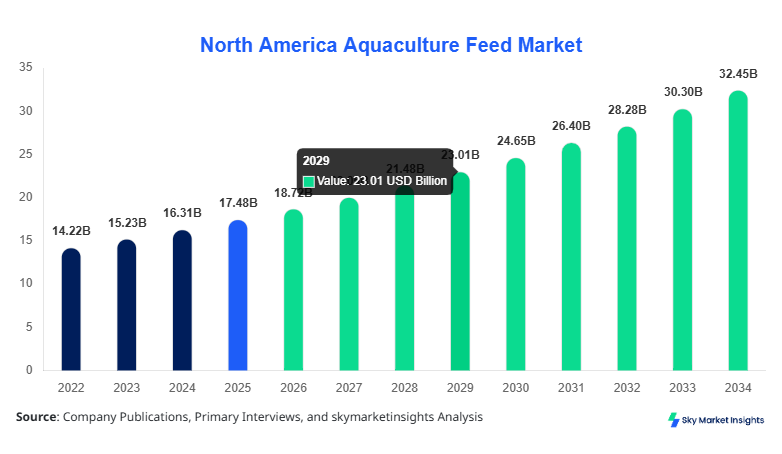
North America Aquaculture Feed market size is projected at USD 18.72 billion in 2026 and is expected to hit USD 32.45 billion by 2034 with a CAGR of 7.12%. The report emphasizes the need for structured data modeling, multi-layer segmentation, and comprehensive competitive landscape mapping across 2 key countries and over 150+ companies operating in feed production and aquaculture systems. The North America Aquaculture Feed market continues to demonstrate strong alignment with protein demand growth, aquaculture intensification, and sustainability-driven innovations influencing market expansion and profitability metrics.
The North America Aquaculture Feed market refers to the production, formulation, and distribution of specialized feed products used in aquaculture farming across freshwater and marine environments. In 2025, North America produced approximately 1.85 million metric tons of aquaculture feed, with an annual increase of 5.8% observed between 2022 and 2024. Adoption and penetration insights reveal that over 68% of aquaculture farms in the region have shifted toward high-protein compounded feeds, while automated feeding systems have penetrated 52% of large-scale facilities. Consumer behavior analytics indicate rising demand for sustainable seafood, with 61% of consumers preferring eco-certified aquaculture products, thereby increasing feed efficiency requirements by 12–15%.
Segment contribution shows soybean meal accounts for nearly 42% of feed composition, fishmeal contributes 28%, and alternative proteins represent 30%. Technical metrics include feed conversion ratios averaging 1.2–1.5 for fish and 1.6–1.9 for crustaceans, with pellet durability indices exceeding 92% in advanced formulations. Application split indicates fish farming dominates with 64% share, followed by crustaceans at 24% and mollusks at 12%. The North America Aquaculture Feed market remains a cornerstone in protein supply chains, reinforcing the importance of optimized feed solutions.
Explore more data points, trends and opportunities Download Free Sample Report
Aquaculture Feed Market Trends
Trends
The Aquaculture Feed Market is experiencing significant transformation due to the adoption of sustainable feed ingredients and precision nutrition technologies. In 2025, global aquaculture feed production in North America surpassed 1.85 million metric tons, with alternative proteins such as insect meal and algae accounting for 18% of total feed formulations, up from 9% in 2022. Automation trends indicate that 52% of feed mills have integrated digital systems, improving feed efficiency by 14% and reducing waste by 11%. Additionally, the adoption of floating and slow-sinking pellets has increased by 37%, enhancing feed utilization rates across species. These advancements continue to shape the Aquaculture Feed Market.
Another key trend involves the rising use of functional feeds enriched with probiotics, omega-3 fatty acids, and immune-boosting additives. Functional feed demand has grown by 21% annually, with over 48% of aquaculture farms incorporating specialized formulations. Production volumes for high-performance feeds exceeded 720,000 metric tons in 2025, reflecting a shift toward disease prevention and growth optimization. Furthermore, sustainability certifications have increased by 29%, influencing procurement decisions among large aquaculture operators. These evolving trends reinforce the long-term development of the Aquaculture Feed Market.
North America Aquaculture Feed Drivers
Rising Seafood Consumption and Protein Demand Driving Market Expansion
The North America Aquaculture Feed market is primarily driven by increasing seafood consumption, which has reached over 8.2 million metric tons annually across the region. The United States alone accounts for nearly 65% of total seafood demand, creating a strong requirement for high-quality feed production. Aquaculture production has grown by 6.2% annually, leading to increased feed consumption of approximately 1.85 million metric tons in 2025. Additionally, the shift toward high-protein diets has increased feed protein content requirements by 12–18%, encouraging innovation in feed formulations. Government initiatives supporting aquaculture expansion have increased funding by 24%, while private sector investments have grown by 19% year-over-year. These factors collectively contribute to the sustained expansion of the Aquaculture Feed Market.
North America Aquaculture Feed Restraints
Volatility in Raw Material Prices Impacting Production Costs
Fluctuations in raw material prices, particularly fishmeal and soybean meal, present significant challenges to the North America Aquaculture Feed market. Fishmeal prices have increased by 18% between 2022 and 2025, while soybean meal costs rose by 14%, impacting overall feed production expenses. Raw materials account for nearly 65–72% of total feed manufacturing costs, making price volatility a critical restraint. Additionally, supply chain disruptions have reduced raw material availability by 9–11%, affecting production volumes. Environmental regulations have further increased compliance costs by 8–10%, limiting profit margins for feed manufacturers. These constraints continue to hinder the growth potential of the Aquaculture Feed Market.
North America Aquaculture Feed Opportunities
Expansion of Sustainable and Alternative Feed Ingredients
The growing emphasis on sustainability presents significant opportunities for the North America Aquaculture Feed market. Alternative feed ingredients such as insect protein, algae, and single-cell proteins are expected to account for over 30% of feed formulations by 2030. Investments in sustainable feed technologies have increased by 27%, with over USD 2.5 billion allocated to research and development initiatives. The adoption of eco-friendly feeds has improved feed conversion ratios by 10–12%, enhancing production efficiency. Additionally, the demand for certified sustainable seafood has increased by 34%, driving the adoption of environmentally responsible feed solutions. These developments create strong growth opportunities within the Aquaculture Feed Market.
Challenges in North America Aquaculture Feed
Regulatory Compliance and Environmental Concerns
Strict environmental regulations and compliance requirements pose significant challenges to the North America Aquaculture Feed market. Regulations related to water quality, feed composition, and emissions have increased operational costs by 12–15%. Over 38% of aquaculture farms report difficulties in meeting regulatory standards, leading to production delays and increased costs. Additionally, concerns regarding overfishing for fishmeal production have resulted in a 16% reduction in marine-based feed ingredient usage. The need for sustainable alternatives has increased research costs by 21%, creating financial pressures for small and medium-sized enterprises. These challenges continue to impact the operational efficiency of the Aquaculture Feed Market.
Report Scope
| Report Metric | Details |
|---|---|
| Market Size in 2025 | USD 17.48 Billion |
| Market Size in 2026 | USD 18.72 Billion |
| Market Size in 2034 | USD 32.45 Billion |
| CAGR | 7.12% (2026-2034) |
| Base Year for Estimation | 2025 |
| Historical Data | 2022-2024 |
| Forecast Period | 2026-2034 |
| Report Coverage | Revenue Forecast, Competitive Landscape, Supply Chain Disruption, Growth Factors, Environment & Regulatory Landscape and Trends |
Explore more data points, trends and opportunities Download Free Sample Report
Aquaculture Feed Market Segmentation
The Aquaculture Feed Market is segmented based on ingredient type and species type, with soybean meal dominating at 42%, followed by fishmeal at 28% and corn gluten at 16%, while other ingredients contribute 14%. In terms of species, fish accounts for 64% of feed consumption, crustaceans 24%, and mollusks 12%.
BY TYPE
Soybean meal dominates the Aquaculture Feed Market with a 42% share, driven by its high protein content of 44–48% and cost-effectiveness. In 2025, over 780,000 metric tons of soybean meal were used in feed production, supporting large-scale aquaculture operations. Its digestibility rate exceeds 85%, making it a preferred ingredient for fish and crustacean feeds.
Fishmeal accounts for 28% of the market, with production volumes reaching 520,000 metric tons annually. It provides essential amino acids and omega-3 fatty acids, improving growth rates by 18–22%. However, sustainability concerns have limited its usage growth.
Corn gluten represents 16% of the market, with approximately 300,000 metric tons used in feed production. It offers protein content of 60% and enhances pellet binding properties, improving feed stability by 14%.
BY APPLICATION
Fish farming dominates with 64% share, consuming over 1.18 million metric tons of feed annually. Feed formulations are optimized for growth rates exceeding 1.5 kg per cycle, with feed conversion ratios of 1.2–1.4.
Crustaceans account for 24% of feed consumption, requiring specialized feeds with protein content of 38–42%. Production volumes reached 450,000 metric tons, supporting shrimp and crab farming.
Mollusks represent 12% of the market, with feed consumption of 220,000 metric tons. These feeds focus on microalgae-based formulations, enhancing growth efficiency by 9–11%.
North America Aquaculture Feed Market Segmentations
Ingredient Type
- Soybean Meal
- Fishmeal
- Corn Gluten
Species Type
- Fish
- Crustaceans
- Mollusks
North America Aquaculture Feed Regional Outlook
The United States holds 72% of the regional market, producing over 1.3 million metric tons of feed annually. The country’s aquaculture sector is driven by advanced technologies, high investment levels, and strong consumer demand. Fish farming accounts for 67% of feed usage, while crustaceans and mollusks contribute 21% and 12%, respectively.
Canada accounts for 28% of the market, producing approximately 550,000 metric tons of feed annually. The country’s aquaculture industry focuses on salmon farming, which represents 58% of feed consumption. Government support and sustainability initiatives have increased production efficiency by 13%, contributing to regional growth.
Top players in North America Aquaculture Feed
- Cargill Inc.
- Archer Daniels Midland Company
- Nutreco N.V.
- BioMar Group
- Alltech Inc.
- Ridley Corporation
- Skretting
- EWOS Group
- Purina Animal Nutrition
- Kent Nutrition Group
- Zeigler Bros Inc.
- Avanti Feeds
- De Heus Animal Nutrition
Cargill Inc.
-
Holds approximately 18% market share in North America
-
Operates 20+ feed mills with production capacity exceeding 400,000 metric tons annually
-
Strong focus on sustainable feed solutions and innovation
Nutreco N.V.
-
Accounts for 14% market share
-
Operates in 30+ countries with advanced R&D facilities
-
Specializes in precision nutrition and functional feeds
Investment Analysis
Investment in the North America Aquaculture Feed market has increased significantly, with over 38% of total investments allocated to sustainable feed technologies and 27% directed toward automation and digitalization. Regional investment distribution shows the United States accounts for 68% of total funding, while Canada contributes 32%. M&A activities have increased by 21%, with major companies focusing on expanding production capacities and technological capabilities.
Collaborations between feed manufacturers and aquaculture farms have grown by 19%, improving supply chain efficiency and product innovation. Joint ventures have led to the development of advanced feed formulations, enhancing growth rates by 15–18%.
New Product Developments
New product development in the Aquaculture Feed market has accelerated, with 34% of new launches focusing on sustainable and alternative protein sources. Performance improvements in feed efficiency have reached 12–16%, while disease resistance enhancements have increased by 9–11%.
Innovations include high-performance pellets with improved digestibility rates of 88–92% and reduced environmental impact by 14%. These advancements continue to drive market competitiveness.
Recent Developments in North America Aquaculture Feed
- 2025: BioMar expanded production capacity by 18%, reaching 300,000 metric tons annually.
Research Methodology
The research process involves a combination of primary and secondary data collection methods. Primary research includes interviews with industry experts, feed manufacturers, and aquaculture operators, covering over 120 stakeholders across North America. Secondary research involves analyzing company reports, government publications, and industry databases. Market size estimation is conducted using bottom-up and top-down approaches, ensuring accuracy a
Frequently Asked Questions
Senior Market Research Analyst | 9 Years Experience | Plant-Based Foods and Functional Ingredients
Kathy Flores is a market research analyst with 7–9 years of experience specializing in food and beverages markets. Contributed to 70+ research reports for global clients. Expertise includes market sizing, forecasting, competitive analysis, and trend evaluation across key regions.