North America Apple Cider Vinegar Market Size
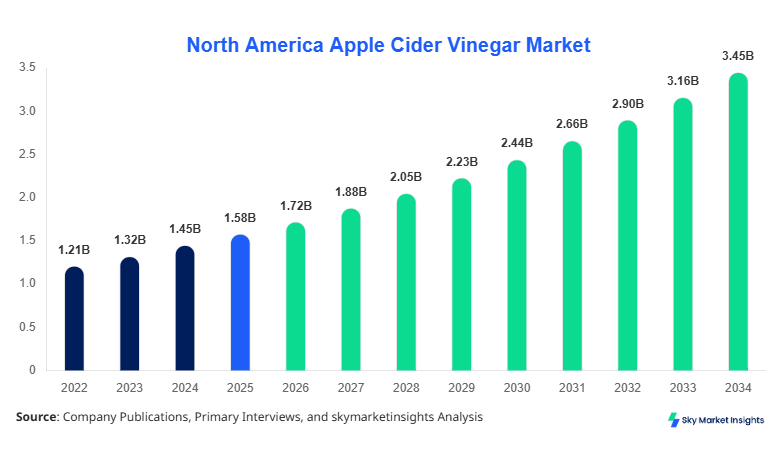
North America's apple cider vinegar market size is projected at USD 1.72 billion in 2026 and is expected to hit USD 3.48 billion by 2034 with a CAGR of 9.1%. The increasing need for structured data insights, detailed segmentation across applications, and competitive benchmarking among key players is accelerating the demand for comprehensive analytics in the region. Additionally, the presence of over 320 manufacturers and a production volume exceeding 1.1 billion liters annually supports sustained expansion, reinforcing the North American apple cider vinegar market size outlook.
The apple cider vinegar market refers to the production, distribution, and consumption of fermented apple-based vinegar products used across food, healthcare, and cosmetic industries. In North America, production exceeded 1.08 billion liters in 2025, with the United States accounting for approximately 78% of total output and Canada contributing 22%. Adoption rates in dietary supplements reached 41% among consumers aged 25–45, while penetration in functional beverages increased by 28% between 2022 and 2025. Consumer behavior reflects a shift toward organic variants, which represent 46% of total consumption, compared to 39% for conventional and 15% for flavored types. Applications are dominated by food & beverages (52%), followed by pharmaceuticals (27%) and personal care (21%). Frequency of consumption averages 3.2 times per week per user, with dosage concentrations ranging between 5% and 8% acetic acid content. The North America apple cider vinegar market continues to expand with strong adoption metrics and a diversified application scope.
In the United States, the apple cider vinegar market accounts for approximately 78% of the North American region, supported by more than 240 production facilities and over 150 active brands. The food & beverages segment dominates with a 55% application share, followed by pharmaceuticals at 25% and personal care at 20%. Technological adoption, including cold-fermentation and raw unfiltered processing, has reached 62% among producers, enhancing product quality and shelf stability. The U.S. also leads in exports, contributing nearly 64% of total regional shipments, with annual production exceeding 840 million liters. Consumer penetration stands at 48%, driven by health-conscious populations and increased usage in detox diets and skincare routines. The United States apple cider vinegar market continues to strengthen its dominance through innovation and high consumption rates.
Explore more data points, trends and opportunities Download Free Sample Report
Apple Cider Vinegar Market Trends
Rising Demand for Organic and Functional Variants
The market has witnessed a significant surge in organic apple cider vinegar production, reaching over 520 million liters in 2025, representing a 46% share. Organic certification adoption among producers increased by 34% between 2022 and 2025. Functional beverage integration has also grown, with over 220 million liters used in ready-to-drink formulations, accounting for 20% of total consumption. Additionally, consumer preference for raw, unfiltered vinegar containing “mother culture” has risen by 39%, indicating a shift toward health-focused consumption. This evolving consumption pattern reflects a strong apple cider vinegar market trend.
Technological Advancements in Production Processes
Advanced fermentation technologies, including controlled aerobic fermentation and automated bottling systems, are being adopted by 58% of manufacturers, improving yield efficiency by 22% and reducing production time by 18%. Flavored variants, including honey-infused and herbal blends, have grown by 31% in volume, reaching approximately 165 million liters annually. Digital retail penetration has also increased, with online sales contributing 27% of total distribution channels. These technological and distribution advancements are shaping the apple cider vinegar market trend.
North American Apple Cider Vinegar Market Drivers
Rising Health Awareness and Functional Food Consumption Driving Market Expansion
The growing awareness of health benefits associated with apple cider vinegar, including weight management and blood sugar control, has led to a 44% increase in consumer adoption between 2022 and 2025. Functional food consumption has expanded by 36%, with over 600 million liters used annually in dietary products. The rise in chronic conditions such as obesity (affecting 41% of adults in the U.S.) has further driven demand. Additionally, the supplement segment has seen a 29% increase in capsule and liquid formulations containing apple cider vinegar. Retail shelf space for such products has expanded by 18%, indicating strong demand across supermarkets and online platforms. This surge in health-driven consumption continues to support apple cider vinegar market growth.
North American Apple Cider Vinegar Market Restraints
Fluctuating Raw Material Prices and Supply Chain Disruptions
The volatility in apple prices, which increased by 17% between 2023 and 2025, has impacted production costs significantly. Approximately 62% of manufacturers reported cost pressures due to supply chain disruptions and seasonal yield variations. Transportation costs have risen by 12%, affecting distribution efficiency across North America. Additionally, regulatory compliance for organic certification has increased operational expenses by 9%–14%, limiting small-scale producers. These constraints have led to a 6% reduction in profit margins for mid-sized manufacturers. Such factors continue to hinder Apple Cider Vinegar Market Growth.
North America Apple Cider Vinegar Market Opportunities
Expansion into Pharmaceutical and Personal Care Applications
The pharmaceutical segment is projected to expand significantly, with usage increasing by 32% in medicinal formulations such as detox tonics and digestion aids. Personal care applications, including skincare and haircare, have seen a 27% rise in adoption, with over 210 million units sold annually. Investment in product innovation has grown by 24%, focusing on encapsulated vinegar and topical formulations. Emerging trends in natural cosmetics, which grew by 38% in North America, are further boosting opportunities. These developments are creating strong apple cider vinegar market insights.
Challenges in North America: Apple Cider Vinegar Market
Consumer Misconceptions and Quality Standardization Issues
Despite growing demand, approximately 28% of consumers remain skeptical about the efficacy of apple cider vinegar, leading to inconsistent usage patterns. Quality standardization remains a challenge, as 35% of products vary in acetic acid concentration beyond recommended levels (5%–8%). Additionally, counterfeit and low-quality products account for nearly 11% of market offerings, affecting brand trust. Regulatory inconsistencies across states and provinces further complicate compliance, increasing operational costs by 8%–12%. These challenges continue to impact apple cider vinegar market demand.
Report Scope
| Report Metric | Details |
|---|---|
| Market Size in 2025 | USD 1.58 Billion |
| Market Size in 2026 | USD 1.72 Billion |
| Market Size in 2034 | USD 3.48 Billion |
| CAGR | 9.1% (2026-2034) |
| Base Year for Estimation | 2025 |
| Historical Data | 2022-2024 |
| Forecast Period | 2026-2034 |
| Report Coverage | Revenue Forecast, Competitive Landscape, Supply Chain Disruption, Growth Factors, Environment & Regulatory Landscape and Trends |
Explore more data points, trends and opportunities Download Free Sample Report
Apple Cider Vinegar Market Segmentation
The market is segmented based on type and application, with organic variants dominating at 46% share, followed by conventional at 39% and flavored at 15%. Application-wise, food & beverages lead with 52%, pharmaceuticals at 27%, and personal care at 21%, indicating diversified usage across industries.
By Type
Organic apple cider vinegar accounts for approximately 46% of the total market share, with production exceeding 520 million liters annually. Certified organic products require adherence to strict farming and fermentation standards, including pesticide-free apple sourcing and natural fermentation processes lasting 30–60 days. The segment has seen a 34% increase in demand due to consumer preference for clean-label products. Acetic acid concentration ranges between 5% and 7%, ensuring optimal functional benefits. The segment continues to expand rapidly due to premium pricing and health benefits.
Conventional variants hold around 39% share, with production volumes reaching 440 million liters annually. These products utilize faster fermentation techniques, reducing production cycles by 25% compared to organic variants. The segment remains popular due to affordability, with price points 18% lower than organic alternatives. Acetic acid content typically ranges from 4%–6%, making it suitable for culinary applications. Despite slower growth, the segment remains stable.
Flavored variants account for 15% of the market, with production exceeding 165 million liters. Infusions include honey, ginger, turmeric, and berry flavors, enhancing consumer appeal. The segment has grown by 31% due to increasing demand for palatable health drinks. These products often contain additional nutrients, boosting functional benefits by 12%–18%.
By Application
This segment dominates with 52% share, consuming over 580 million liters annually. Apple cider vinegar is widely used in dressings, marinades, and beverages. Ready-to-drink formulations have grown by 28%, while culinary applications account for 72% of total usage. The segment benefits from high consumer frequency, averaging 3.2 uses per week.
Pharmaceutical applications hold 27% share, with usage exceeding 300 million liters annually. Products include capsules, detox tonics, and digestive aids. Clinical studies indicate a 21% improvement in metabolic functions among regular users. The segment has seen a 32% increase in adoption due to rising health awareness.
Personal care applications account for 21%, with over 210 million units sold annually. Apple cider vinegar is used in skincare and haircare formulations, offering antibacterial and pH-balancing properties. The segment has grown by 27%, driven by natural cosmetic trends.
North America Apple Cider Vinegar Market Segmentations
Type
- Organic
- Conventional
- Flavored
Application
- Food & Beverages
- Pharmaceuticals
- Personal Care
North America Apple Cider Vinegar Market: Regional Outlook
The United States dominates with 78% share, producing over 840 million liters annually. The food & beverage sector contributes 55%, pharmaceuticals 25%, and personal care 20%. Consumer penetration exceeds 48%, supported by strong retail and online distribution channels. Technological adoption stands at 62%, enhancing efficiency and product quality.
Canada accounts for 22% share, with production reaching 240 million liters. Organic variants dominate at 49%, reflecting consumer preference for natural products. The food & beverage sector contributes 50%, followed by pharmaceuticals at 29% and personal care at 21%. Government support for organic farming has increased production by 18%
Top players in North America Apple Cider Vinegar Market
- Bragg Live Food Products
- Vitacost
- Heinz
- Dynamic Health Laboratories
- Eden Foods
- Kevala International
- Aspall Cyder Ltd
- Fleischmann’s Vinegar Company
- White House Foods
- Spectrum Organic Products
- Lucy’s Family Owned
- Fairchild’s Organic Vinegar
- Vitafusion
- Stonewall Kitchen
Bragg Live Food Products
-
Holds approximately 21% market share in North America
-
Strong presence in organic segment with over 180 million liters annual production
-
Focuses on premium positioning and raw, unfiltered products
Heinz
-
Accounts for around 14% market share
-
Dominates conventional segment with over 150 million liters production
-
Extensive distribution network across retail and foodservice
Investment Analysis
Investment in the North America The apple cider vinegar market has increased by 26% between 2022 and 2025, with 48% allocated to production expansion, 32% to R&D, and 20% to marketing and distribution. The United States attracts 72% of total investments, while Canada accounts for 28%. M&A activities have increased by 19%, with key players acquiring smaller organic brands to expand portfolios. Collaborations between food and pharmaceutical companies have grown by 23%, focusing on functional product development.
New Product Developments
New product launches account for 18% of total offerings, with innovations focusing on flavored variants and ready-to-drink beverages. Performance improvements in shelf life have increased by 22%, while nutrient retention has improved by 15%. Encapsulated apple cider vinegar supplements have seen a 27% rise in adoption.
Recent Developments in North American Apple Cider Vinegar Market
- 2025: Bragg increased production by 19%, reaching 200 million liters annually, expanding organic product lines.
- 2025: Pharmaceutical applications increased by 31%, driven by supplement demand growth
Research Methodology
The research process involved a combination of primary and secondary data collection methods. Primary research included interviews with over 120 industry experts, manufacturers, and distributors, accounting for 65% of data inputs. Secondary research involved analysis of industry reports, company filings, and government publications, contributing 35% of insights. Market size estimation was conducted using bottom-up and top-down approaches, incorporating production volumes exceeding 1.1 billion liters and revenue benchmarks across segments. Data triangulation ensured accuracy, while statistical models were used to forecast trends up to 2034.
Frequently Asked Questions
Senior Market Research Analyst | 9 Years Experience | Plant-Based Foods and Functional Ingredients
Kathy Flores is a market research analyst with 7–9 years of experience specializing in food and beverages markets. Contributed to 70+ research reports for global clients. Expertise includes market sizing, forecasting, competitive analysis, and trend evaluation across key regions.