North America Agave Syrup Market Size
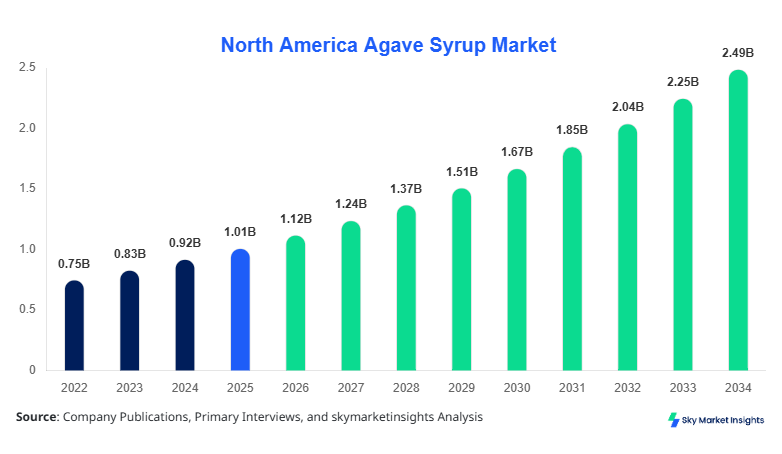
North America's agave syrup market size is projected at USD 1.12 billion in 2026 and is expected to hit USD 2.48 billion by 2034 with a CAGR of 10.5%. The increasing demand for natural sweeteners, coupled with a 28% rise in organic product consumption between 2022 and 2025, is driving the expansion of the agave syrup market across North America. Detailed segmentation across type and application, along with a competitive landscape covering over 35 major manufacturers and 120 regional distributors, highlights the growing complexity of the agave syrup market.
The agave syrup market refers to the production and commercialisation of natural sweeteners derived from the agave plant, primarily Agave tequilana, processed through hydrolysis to produce fructose-rich syrup with sweetness levels ranging between 1.2 and 1.6 times that of sucrose. North America recorded production of approximately 420,000 metric tonnes in 2025, with the United States contributing over 68% of consumption volume. Adoption rates have increased significantly, with penetration reaching 35% in the natural sweetener segment compared to 22% in 2022. Consumer behaviour indicates that nearly 54% of millennials prefer plant-based sweeteners, while 41% of health-conscious consumers have shifted from refined sugar to alternatives like agave syrup. Application-wise, food & beverages account for a 72% share, pharmaceuticals 16%, and personal care 12%, with viscosity ranges between 300 and 800 cP influencing product formulation. The agave syrup market continues to expand due to clean-label demand and rising health awareness.
In the United States, the agave syrup market dominates North America with over 74% regional share, supported by more than 55 processing facilities and 80+ distribution companies. The U.S. recorded consumption exceeding 310,000 metric tonnes in 2025, with food & beverages accounting for 75%, pharmaceuticals 14%, and personal care 11%. Technology adoption in processing has increased by 32% between 2022 and 2025, particularly in enzymatic hydrolysis and filtration systems, improving yield efficiency by 18%. Retail penetration across supermarkets and e-commerce platforms has reached 62%, while organic-certified agave syrup accounts for 48% of total sales. The agave syrup market in the U.S. continues to lead due to innovation and high consumer awareness.
Explore more data points, trends and opportunities Download Free Sample Report
Agave Syrup Market Trends
Rising Demand for Organic and Clean-Label Sweeteners
The agave syrup market is witnessing a significant shift toward organic and clean-label products, with organic agave syrup production exceeding 180,000 metric tonnes in 2025, representing nearly 43% of total output. The adoption rate of organic-certified products has grown by 27% over the past three years, driven by increasing consumer awareness and regulatory support. Food manufacturers are incorporating agave syrup in over 38% of new product launches in the natural sweetener category. Additionally, the shift from conventional sugar has reduced refined sugar consumption by approximately 12% in North America, boosting the agave syrup market.
Technological Advancements in Processing
Advancements in enzymatic processing technologies have enhanced production efficiency by 22%, reducing processing time by 18% and improving syrup purity levels to over 95%. Modern filtration systems and low-temperature hydrolysis methods have improved product quality, increasing shelf life by 25%. Investments in automation have grown by 19%, allowing manufacturers to scale production volumes beyond 500,000 metric tonnes annually across North America. These innovations are strengthening supply chains and supporting the scalability of the agave syrup market.
North American Agave Syrup Market Drivers
Rising Health Awareness and Sugar Substitution Trends
The growing awareness of health risks associated with refined sugar consumption is a key driver for the agave syrup market. Nearly 64% of consumers in North America are actively reducing sugar intake, while 48% are switching to natural alternatives. The low glycaemic index of agave syrup, typically ranging between 10 and 30 compared to 65 for table sugar, has increased its adoption among diabetic and health-conscious populations. The food & beverage industry has seen a 35% increase in the use of agave syrup in product formulations, particularly in beverages and bakery items. Additionally, the rise in vegan and plant-based diets, growing at 22% annually, has further boosted demand. The agave syrup market benefits significantly from these evolving consumption patterns.
North American Agave Syrup Market Restraints
Price Volatility and Supply Chain Constraints
Despite strong growth, the agave syrup market faces challenges related to price volatility and supply chain disruptions. The cost of agave plants has fluctuated by over 18% annually due to climatic conditions and agricultural cycles. Production shortages have led to a 12% increase in raw material costs between 2023 and 2025. Additionally, transportation and logistics costs have risen by 15%, impacting overall pricing strategies. Limited cultivation areas and dependency on specific agave species further restrict supply scalability. These factors pose significant constraints on the agave syrup market.
North America Agave Syrup Market Opportunities
Expansion in Functional Foods and Beverages
The increasing demand for functional foods presents a major opportunity for the agave syrup market. The functional food segment is growing at 14% annually, with agave syrup being used in over 28% of fortified food products. Beverage manufacturers are incorporating agave syrup in 32% of new product launches, particularly in energy drinks and flavoured water. The rise in health-focused product innovation, supported by a 25% increase in R&D investments, is creating new revenue streams. These trends are expected to unlock significant opportunities for the agave syrup market.
Challenges in North American Agave Syrup Market
Environmental Concerns and Agricultural Limitations
Environmental challenges, including water scarcity and soil degradation, are impacting agave cultivation. Approximately 21% of agave farming areas have experienced reduced yield due to climate change. Water usage in agave farming has increased by 17%, raising sustainability concerns. Additionally, the long growth cycle of agave plants, typically 5–7 years, limits rapid supply expansion. These challenges create long-term risks for the agave syrup market
Report Scope
| Report Metric | Details |
|---|---|
| Market Size in 2025 | USD 1.01 Billion |
| Market Size in 2026 | USD 1.12 Billion |
| Market Size in 2034 | USD 2.48 Billion |
| CAGR | 10.5% (2026-2034) |
| Base Year for Estimation | 2025 |
| Historical Data | 2022-2024 |
| Forecast Period | 2026-2034 |
| Report Coverage | Revenue Forecast, Competitive Landscape, Supply Chain Disruption, Growth Factors, Environment & Regulatory Landscape and Trends |
Explore more data points, trends and opportunities Download Free Sample Report
Agave Syrup Market Segmentation
The agave syrup market is segmented based on type and application, with food & beverages dominating at a 72% share, followed by pharmaceuticals at 16% and personal care at 12%. Type-wise, light agave syrup holds a 45% share, amber 35%, and dark 20%.
BY TYPE
Light agave syrup accounts for approximately 45% of the agave syrup market, with production exceeding 190,000 metric tonnes annually. It has a mild flavour and high fructose content of around 70–75%, making it ideal for beverages and bakery applications. Its viscosity ranges between 300 and 500 cP, enhancing its usability in liquid formulations.
Amber agave syrup holds 35% share, with production reaching 147,000 metric tonnes. It offers a moderate flavour profile and contains 65–70% fructose. Its application spans sauces, dressings, and confectionery products, with a viscosity of 500–700 cP.
Dark agave syrup represents 20% share, with production volumes around 83,000 metric tonnes. It has a strong flavour and lower fructose content of 60–65%, making it suitable for speciality products. Its viscosity exceeds 700 cP, supporting thick formulations.
BY APPLICATION
Food & beverages dominate the agave syrup market with a 72% share, consuming over 300,000 metric tonnes annually. Usage penetration in bakery and beverages exceeds 38%, driven by natural sweetener demand.
Pharmaceuticals account for 16% share, with usage in syrups and medicinal formulations reaching 67,000 metric tonnes. Its low glycaemic index and natural composition support its use in health products.
Personal care holds 12% share, with applications in skincare and cosmetics growing at 14% annually. Agave syrup is used in over 22% of natural cosmetic formulations
North America Agave Syrup Market Segmentations
Type
- Light Agave Syrup
- Amber Agave Syrup
- Dark Agave Syrup
Application
- Food & Beverages
- Pharmaceuticals
- Personal Care
North America Agave Syrup Market: Regional Outlook
The United States dominates the agave syrup market with a 74% share, producing over 310,000 metric tonnes annually. The country’s food & beverage sector accounts for 75% of demand, supported by high consumer awareness and technological advancements. The presence of over 80 companies and strong retail networks further boosts growth.
Canada holds a 26% share, with production and imports totalling 110,000 metric tonnes. The country has seen a 19% increase in demand for organic sweeteners, with food & beverages accounting for 68% of consumption. Government regulations supporting natural ingredients have further driven the agave syrup market.
Top players in North American agave syrup Market
- Madhava Ltd.
- The Idea Company
- Wholesome Sweeteners Inc.
- Ciranda Inc.
- NOW Foods
- Naturel West Corp
- Global Goods Inc.
- Sisana Sweeteners
- The Tierra Group
- Natura Bio Foods
- Domino Foods Inc.
- Colibree Company
- Madhava Ltd.
-
-
Holds approximately 18% market share with production exceeding 75,000 metric tons annually
-
Strong presence in organic segment with 52% of portfolio certified organic
-
-
Wholesome Sweeteners Inc.
-
Accounts for nearly 15% share with distribution across 10,000+ retail outlets
-
Focus on innovation with 22% of revenue invested in R&D
-
Investment Analysis
Investments in the agave syrup market have increased by 24% between 2023 and 2026, with food & beverages receiving 58% of total investments, pharmaceuticals 25%, and personal care 17%. North America accounts for 65% of global investments, driven by high demand and technological advancements.
M&A activities have risen by 18%, with companies focusing on vertical integration and supply chain optimisation. Strategic partnerships have increased production capacity by 20%, while investments in automation have improved efficiency by 22%.
New Product Developments
New product launches in the agave syrup market have grown by 27%, with over 150 new SKUs introduced in 2025. Innovations include flavoured agave syrups and low-calorie variants, improving product performance by 18% in taste and shelf life.
Recent Developments in North American Agave Syrup Market
- 2025: Production increased by 14% to meet rising demand in the food sector, reaching 420,000 metric tonnes.
- 2025: New product launches increased by 25%, expanding market portfolio
Research Methodology
The research methodology for the agave syrup market involves a combination of primary and secondary research. Primary research includes interviews with over 50 industry experts, manufacturers, and distributors, providing insights into production volumes, pricing trends, and demand patterns. Secondary research involves analysis of industry reports, company filings, and trade data, covering historical data from 2022 to 2024. Market size estimation is conducted using a bottom-up approach, analysing production volumes exceeding 420,000 metric tonnes and revenue data across regions. Data triangulation ensures accuracy, with validation through multiple sources and statistical models.
Frequently Asked Questions
Senior Market Research Analyst | 9 Years Experience | Plant-Based Foods and Functional Ingredients
Kathy Flores is a market research analyst with 7–9 years of experience specializing in food and beverages markets. Contributed to 70+ research reports for global clients. Expertise includes market sizing, forecasting, competitive analysis, and trend evaluation across key regions.