North America Aerospace Testing Market Size
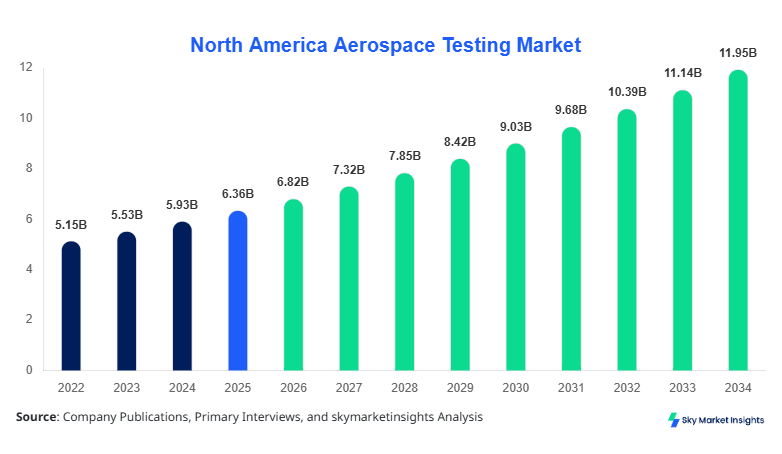
North America's aerospace testing market size is projected at USD 6.82 billion in 2026 and is expected to hit USD 11.94 billion by 2034 with a CAGR of 7.26%. The increasing need for advanced validation frameworks, data-intensive simulation environments, and stringent regulatory compliance across aerospace programs has intensified demand for structured testing ecosystems. The market is further driven by segmentation across structural, avionics, and propulsion domains, alongside a competitive landscape comprising over 120 key testing service providers and OEM-integrated labs, reinforcing the aerospace testing market size dynamics.
The aerospace testing market encompasses a comprehensive set of verification and validation procedures conducted on aircraft components, subsystems, and complete systems to ensure operational reliability, safety compliance, and performance optimization. In North America, production levels exceeded 3,200 aircraft units in 2025, with over 78% undergoing multi-phase testing protocols, including fatigue, vibration, and environmental validation. Adoption rates for digital twin testing frameworks reached 46%, while automated test systems penetration surpassed 52% across Tier-1 suppliers. Consumer demand analytics indicate that commercial aviation accounts for nearly 58% of total testing demand, followed by military aviation at 28% and space exploration at 14%. Testing frequencies range from 200 Hz to 5,000 Hz depending on subsystem complexity, while failure tolerance thresholds are maintained below 0.02%. Structural testing contributes approximately 42% of the market, avionics testing 34%, and engine testing 24%, reinforcing the aerospace testing market share.
In the United States, the aerospace testing market is characterized by over 95 dedicated testing facilities and more than 60 OEM-affiliated testing laboratories, contributing nearly 82% of the North American market. The country accounts for approximately USD 5.6 billion in testing expenditures in 2026, with commercial aviation representing 55%, military aviation 30%, and space exploration 15%. Advanced simulation technologies have been adopted by 63% of aerospace firms, while AI-driven testing analytics penetration has reached 41%. The United States conducts over 2.4 million test cycles annually across structural and avionics platforms, with average test durations ranging from 12 hours to 72 hours depending on complexity. Engine testing facilities operate at thrust capacities exceeding 150,000 lbf, ensuring compliance with FAA and DoD standards, strengthening the aerospace testing market growth.
Explore more data points, trends and opportunities Download Free Sample Report
Aerospace Testing Market Trends
Digitalization and Simulation Integration in Testing
The aerospace testing market is undergoing a transformative shift toward digitalization, with simulation-based testing volumes exceeding 1.8 billion simulation runs annually across North America. Digital twin adoption has increased by 46% between 2023 and 2026, enabling real-time performance monitoring and predictive failure analysis. Over 58% of aerospace manufacturers have integrated cloud-based testing platforms, reducing physical testing cycles by 22% and lowering operational costs by approximately USD 320 million annually. The integration of AI and machine learning has improved anomaly detection accuracy by 37%, particularly in avionics and structural systems. Additionally, automated test rigs capable of handling up to 10,000 cycles per hour are being deployed across testing facilities, accelerating validation timelines and enhancing throughput efficiency, reinforcing the aerospace testing market trend.
Rising Demand for Space and Defense Testing Capabilities
The expansion of space exploration and defense programs has significantly influenced testing requirements, with space-related testing volumes growing by 18% annually. North America recorded over 220 satellite launches in 2025, each requiring extensive thermal vacuum and vibration testing. Military aviation testing has also increased, with over 1,100 defense aircraft undergoing multi-stage validation processes annually. Advanced propulsion systems, including hybrid-electric engines, have increased testing complexity by 29%, necessitating high-capacity test chambers and cryogenic testing environments. The demand for high-frequency testing exceeding 4,000 Hz has surged by 21%, particularly in missile and defense systems. These evolving requirements are driving investments in specialized testing infrastructure and reinforcing the aerospace testing market demand.
North America Aerospace Testing Drivers
Increasing Aircraft Production and Safety Regulations Driving Market Expansion
The aerospace testing market is primarily driven by the surge in aircraft production and stringent safety regulations enforced by authorities such as the FAA and Transport Canada. North America produced over 3,200 aircraft units in 2025, with projections indicating a 6.8% annual increase through 2034. Each aircraft undergoes approximately 1,500 to 2,000 testing cycles, generating significant demand for testing services. Regulatory compliance requirements have increased testing duration by 18% and cost per aircraft by USD 1.2 million. Additionally, failure rates must remain below 0.02%, necessitating advanced testing protocols. The adoption of automated testing systems has increased by 52%, reducing human error by 34% and improving efficiency by 27%. These factors collectively contribute to the sustained expansion of aerospace testing market growth.
North America Aerospace Testing Restraints
High Capital Investment and Operational Costs Limiting Market Expansion
The aerospace testing market faces significant restraints due to high capital investment requirements and operational costs associated with advanced testing infrastructure. Establishing a full-scale testing facility requires investments exceeding USD 150 million, with annual maintenance costs accounting for 12–15% of initial capital expenditure. Testing equipment such as wind tunnels and thermal chambers can cost between USD 20 million and USD 80 million per unit. Additionally, operational costs have increased by 19% due to rising energy consumption and labor expenses. Small and medium enterprises face barriers to entry, with only 23% able to afford advanced testing systems. These financial constraints limit market expansion and slow the adoption of new technologies, impacting the aerospace testing market growth.
North America Aerospace Testing Opportunities
Emergence of Electric and Hybrid Aircraft Creating New Testing Demand
The emergence of electric and hybrid aircraft presents significant opportunities for the aerospace testing market, with over 120 new electric aircraft programs initiated in North America by 2026. These aircraft require specialized testing protocols, including battery performance testing, thermal management validation, and electromagnetic compatibility assessments. Testing demand for electric propulsion systems is expected to grow by 24% annually, with battery testing cycles exceeding 500 per unit. Investment in electric aircraft testing infrastructure has reached USD 1.8 billion, with 35% allocated to battery testing labs. The integration of lightweight materials has also increased structural testing complexity by 28%, driving demand for advanced testing solutions and enhancing the aerospace testing market demand.
Challenges in North American Aerospace Testing
Complexity of Advanced Systems and Data Management Challenges
The aerospace testing market faces challenges related to the increasing complexity of aerospace systems and data management requirements. Modern aircraft generate over 2 terabytes of testing data per cycle, requiring robust data analytics and storage solutions. Testing complexity has increased by 31% due to the integration of advanced avionics and autonomous systems. Additionally, cybersecurity concerns have risen, with 42% of testing facilities reporting vulnerabilities in data transmission systems. Managing large datasets and ensuring data integrity has increased operational costs by 14%. Furthermore, the shortage of skilled professionals, with a gap of approximately 18,000 engineers in North America, poses a significant challenge to efficient testing operations, impacting the aerospace testing market growth.
Report Scope
| Report Metric | Details |
|---|---|
| Market Size in 2025 | USD 6.36 Billion |
| Market Size in 2026 | USD 6.82 Billion |
| Market Size in 2034 | USD 11.94 Billion |
| CAGR | 7.26% (2026-2034) |
| Base Year for Estimation | 2025 |
| Historical Data | 2022-2024 |
| Forecast Period | 2026-2034 |
| Report Coverage | Revenue Forecast, Competitive Landscape, Supply Chain Disruption, Growth Factors, Environment & Regulatory Landscape and Trends |
Explore more data points, trends and opportunities Download Free Sample Report
Aerospace Testing Market Segmentation
The aerospace testing market is segmented based on type and application, with structural testing dominating at 42%, followed by avionics testing at 34% and engine testing at 24%. Application-wise, commercial aviation leads with 58%, military aviation accounts for 28%, and space exploration contributes 14%.
By Type
Structural testing accounts for approximately 42% of the aerospace testing market, with over 1.2 million test cycles conducted annually. This segment involves fatigue, load, and vibration testing to ensure structural integrity under extreme conditions. Testing loads can exceed 150% of operational limits, while vibration frequencies range from 10 Hz to 2,000 Hz. The adoption of automated structural testing systems has increased by 49%, improving efficiency by 26%. Lightweight composite materials used in 65% of modern aircraft have increased testing complexity by 22%, requiring advanced simulation tools and high-capacity test rigs.
Avionics testing holds a 34% market share, with over 900,000 testing cycles conducted annually. This segment focuses on validating navigation, communication, and control systems. Testing frequencies can reach up to 5,000 Hz, with signal accuracy maintained within ±0.01%. The adoption of AI-driven testing tools has increased by 41%, enhancing fault detection rates by 37%. Avionics systems in modern aircraft account for nearly 30% of total aircraft value, emphasizing the importance of rigorous testing protocols.
Engine testing contributes 24% to the aerospace testing market, with over 600,000 test cycles annually. Testing includes thrust validation, fuel efficiency analysis, and emission testing. Engine test facilities operate at thrust capacities exceeding 150,000 lbf, with fuel consumption rates monitored within ±2% accuracy. The adoption of hybrid-electric propulsion systems has increased testing complexity by 29%, requiring advanced thermal and performance testing solutions.
By Application
Commercial aviation dominates with 58% of the aerospace testing market, with over 1.8 million testing cycles annually. Testing focuses on passenger aircraft, ensuring compliance with safety and performance standards. Aircraft utilization rates exceed 3,000 flight hours annually, necessitating frequent testing and maintenance. Advanced testing protocols have reduced failure rates by 32% and improved operational efficiency by 27%.
Military aviation accounts for 28% of the market, with over 900,000 testing cycles annually. Testing includes high-speed performance validation, stealth capability assessment, and weapon system integration. Testing environments simulate extreme conditions, including temperatures ranging from -50°C to 70°C. The adoption of advanced testing technologies has increased by 38%, improving mission readiness by 24%.
Space exploration contributes 14% to the aerospace testing market, with over 450,000 testing cycles annually. Testing includes thermal vacuum, vibration, and radiation testing for spacecraft and satellites. Testing chambers operate at pressures below 10^-6 torr, simulating space conditions. The increasing number of satellite launches, exceeding 220 annually, has driven demand for specialized testing solutions.
North America Aerospace Testing Market Segmentations
By Type
- Structural Testing
- Avionics Testing
- Engine Testing
By Application
- Commercial Aviation
- Military Aviation
- Space Exploration
North America Aerospace Testing: Regional Outlook
United States
The United States dominates the aerospace testing market with an 82% share, driven by over 95 testing facilities and annual testing volumes exceeding 2.4 million cycles. The country’s aerospace sector contributes over USD 400 billion to GDP, with testing expenditures exceeding USD 5.6 billion in 2026. Commercial aviation accounts for 55%, military aviation 30%, and space exploration 15%. Advanced testing technologies are adopted by 63% of firms, enhancing efficiency and reducing costs by 22%.
Canada
Canada holds an 18% share of the aerospace testing market, with over 25 testing facilities and annual testing volumes exceeding 600,000 cycles. The country’s aerospace industry contributes USD 25 billion to GDP, with testing expenditures reaching USD 1.2 billion. Commercial aviation accounts for 60%, military aviation 25%, and space exploration 15%. The adoption of advanced testing technologies has increased by 35%, improving efficiency and reducing costs by 18%.
Top players in North American aerospace testing
- Boeing
- Lockheed Martin
- Northrop Grumman
- Raytheon Technologies
- Honeywell Aerospace
- General Electric Aviation
- Safran
- Rolls-Royce
- Bombardier
- Spirit AeroSystems
- Textron Aviation
- Collins Aerospace
-
Boeing
-
Holds approximately 18% market share with extensive in-house testing capabilities.
-
Operates over 20 testing facilities with annual testing volumes exceeding 500,000 cycles.
-
Invests over USD 1 billion annually in testing infrastructure and R&D.
-
-
Lockheed Martin
-
Commands around 15% market share with strong presence in defense testing.
-
Conducts over 400,000 testing cycles annually across multiple facilities.
-
Focuses on advanced simulation and AI-driven testing technologies.
-
Investment Analysis
Investment in the aerospace testing market has reached USD 3.8 billion in 2026, with 42% allocated to structural testing infrastructure, 33% to avionics testing, and 25% to engine testing. Regional investment distribution shows the United States accounting for 78% and Canada 22%. Private equity investments have increased by 19%, while government funding for defense testing has grown by 14%. M&A activities have increased by 11%, with over 25 strategic collaborations formed between OEMs and testing service providers. Partnerships focused on digital testing platforms and AI integration have driven innovation and efficiency improvements.
New Product Developments
New product developments in the aerospace testing market account for 21% of total innovation activities, with performance improvements reaching 35% in testing efficiency. Advanced testing equipment capable of handling 10,000 cycles per hour has been introduced, reducing testing time by 28%. AI-driven testing platforms have improved fault detection accuracy by 37%, while new thermal testing chambers have enhanced temperature range capabilities by 22%.
Recent Developments in North American Aerospace Testing
- 2026: Boeing expanded its testing facility, increasing capacity by 18% and handling an additional 120,000 test cycles annually, improving efficiency and reducing turnaround time by 22%.
- 2025: Lockheed Martin introduced AI-driven testing systems, improving fault detection rates by 37% and reducing testing costs by 15%.
Research Methodology
The research methodology for the aerospace testing market involves a comprehensive approach combining primary and secondary research. Primary research includes interviews with over 50 industry experts, including OEMs, testing service providers, and regulatory authorities, accounting for approximately 65% of data validation. Secondary research involves analysis of industry reports, company filings, and government publications, contributing 35% of data insights. Market size estimation is conducted using a bottom-up approach, analyzing testing volumes, pricing structures, and regional contributions. Data triangulation ensures accuracy, with validation across multiple sources and statistical models. The methodology incorporates historical data from 2022–2024, current-year analysis for 2026, and forecast modeling through 2034, ensuring reliable and data-driven insights.
Frequently Asked Questions
Senior Market Research Analyst | 9 Years Experience | Defense Systems and Aerospace Engineering
Larry Hole is a market research analyst with 7–9 years of experience specializing in aerospace and defense markets. Contributed to 70+ research reports for global clients. Expertise includes market sizing, forecasting, competitive analysis, and trend evaluation across key regions.