Asia Pacific Aircraft MRO Market Size
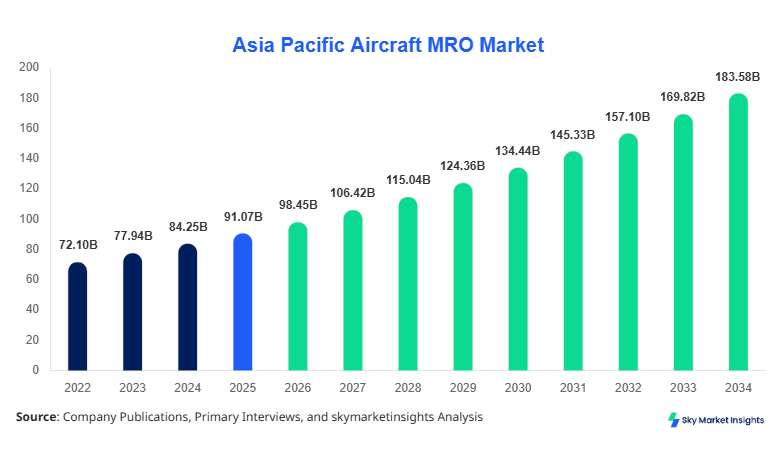
Asia Pacific Aircraft MRO Market market size is projected at USD 98.45 billion in 2026 and is expected to hit USD 182.76 billion by 2034 with a CAGR of 8.1%. The Asia Pacific Aircraft MRO Market reflects strong expansion due to increasing fleet size, rising air passenger traffic exceeding 4.2 billion passengers annually, and growing demand for cost-efficient maintenance solutions across China, India, and Southeast Asia. Data-driven segmentation highlights engine overhaul contributing over 38%, airframe maintenance at 34%, and component repair at 28% in 2025. Competitive landscape includes over 250+ MRO providers, with top 10 players controlling nearly 46% of total regional revenue, indicating moderate consolidation.
The Aircraft MRO Market refers to maintenance, repair, and overhaul services required to ensure airworthiness, safety compliance, and performance optimization of commercial, military, and general aviation aircraft. In Asia Pacific, over 9,800 active aircraft fleets were recorded in 2025, expected to cross 15,200 units by 2034. Adoption rates of predictive maintenance technologies reached 42% in 2025, increasing operational efficiency by 18% while reducing downtime by 22%. Consumer demand analytics indicate that airline operators prioritize cost reduction (35%), turnaround time (28%), and regulatory compliance (20%) in selecting MRO services. Narrow-body aircraft dominate application share with 56%, followed by wide-body at 31% and regional aircraft at 13%. Increasing aircraft utilization rates averaging 9.6 flight hours/day further intensify maintenance cycles, reinforcing Asia Pacific Aircraft MRO Market size, share, growth, and trend.
In the China, the Aircraft MRO Market holds approximately 34% of the Asia Pacific share, supported by more than 120 certified MRO facilities and over 75 major aviation service providers. China operates a fleet of 4,100+ aircraft, with narrow-body aircraft accounting for 61%, wide-body at 27%, and regional aircraft at 12%. Engine overhaul services dominate with 40% contribution, while airframe maintenance contributes 33% and component repair 27%. Technology adoption in China is significant, with 48% of facilities integrating AI-based predictive diagnostics and 36% using robotics for inspection processes, improving turnaround time by 21%. Annual MRO expenditure in China surpassed USD 32 billion in 2025, highlighting strong domestic demand and export-oriented service capabilities, reinforcing Aircraft MRO Market growth.
Explore more data points, trends and opportunities Download Free Sample Report
Aircraft MRO Market Trends
Digitalization and Predictive Maintenance Adoption
The Aircraft MRO Market is witnessing rapid digital transformation, with predictive maintenance technologies gaining traction across 45% of Asia Pacific operators in 2026 compared to 28% in 2022. Annual data generation per aircraft exceeds 1.2 terabytes, enabling real-time monitoring and predictive analytics. MRO providers are investing over USD 6.8 billion annually in digital infrastructure, resulting in 19% cost reduction and 23% improvement in maintenance turnaround time. Blockchain-based parts tracking systems have achieved 17% penetration, improving transparency and reducing counterfeit component risks. Increasing reliance on AI-driven diagnostics and IoT-enabled sensors is driving efficiency, with fleet uptime improving by 15%, reinforcing Aircraft MRO Market trend.
Expansion of Low-Cost Carrier Fleets
The growth of low-cost carriers (LCCs) across Southeast Asia and India has significantly influenced Aircraft MRO Market dynamics, with LCC fleets growing at 9.4% annually between 2022 and 2026. Narrow-body aircraft dominate this segment, representing over 68% of new deliveries, leading to increased demand for line maintenance and quick turnaround services. Maintenance frequency has increased by 12% due to higher utilization rates exceeding 11 hours/day for LCC fleets. Regional MRO capacity has expanded by 18% in Southeast Asia, supported by government incentives and private investments exceeding USD 4.2 billion. This shift towards high-frequency operations is shaping service demand patterns and strengthening Aircraft MRO Market growth.
Asia Pacific Aircraft MRO Market Drivers
Rising Air Traffic and Fleet Expansion Accelerates Maintenance Demand
Asia Pacific recorded over 4.2 billion air passengers in 2025, representing 38% of global traffic, and this figure is expected to grow at 7.5% annually. Fleet expansion across China, India, and Southeast Asia is projected to add 5,400 new aircraft by 2034, significantly increasing maintenance cycles. Engine overhaul frequency has increased by 14%, while airframe maintenance demand has grown by 11% annually. Airlines allocate nearly 12–15% of operating expenses to MRO activities, with total spending exceeding USD 90 billion in 2026. The surge in aviation infrastructure, including 65 new airports planned across the region, further boosts demand for MRO services, reinforcing Aircraft MRO Market growth.
Asia Pacific Aircraft MRO Market Restraints
High Operational Costs and Skilled Workforce Shortage
Aircraft MRO operations involve high capital expenditure, with facility setup costs exceeding USD 250 million and annual operational costs rising by 8% due to labor and compliance expenses. Skilled workforce shortages remain a critical challenge, with a deficit of over 40,000 certified technicians projected by 2030 in Asia Pacific. Labor costs have increased by 12% annually, while regulatory compliance costs account for 9–11% of total operational expenses. Additionally, spare parts costs have risen by 15% due to supply chain disruptions, affecting profitability margins. These factors limit scalability and hinder Aircraft MRO Market growth.
Asia Pacific Aircraft MRO Market Opportunities
Emergence of Advanced Technologies and Outsourcing Trends
The increasing adoption of advanced technologies such as AI, robotics, and digital twins presents significant opportunities in the Aircraft MRO Market. Approximately 52% of airlines in Asia Pacific are outsourcing maintenance operations to third-party providers, creating a service market exceeding USD 45 billion. Investment in smart hangars and automation has improved efficiency by 20% and reduced error rates by 17%. Governments in India, Singapore, and Australia are offering incentives worth USD 2.3 billion to attract MRO investments. Expansion of cross-border partnerships and joint ventures is expected to drive service innovation, reinforcing Aircraft MRO Market trend.
Chalanges in Asia Pacific Aircraft MRO Market
Supply Chain Disruptions and Regulatory Complexities
The Aircraft MRO Market faces significant challenges due to global supply chain disruptions affecting 22% of spare parts availability. Lead times for critical components have increased from 45 days to 72 days, impacting maintenance schedules. Regulatory compliance across multiple jurisdictions increases operational complexity, with over 15 different aviation authorities imposing varying standards. Certification delays have increased by 18%, affecting service timelines. Additionally, cybersecurity threats in digital MRO systems have risen by 25%, requiring additional investments in security infrastructure. These challenges create operational inefficiencies and impact Aircraft MRO Market growth.
Report Scope
| Report Metric | Details |
|---|---|
| Market Size in 2025 | USD 91.07 Billion |
| Market Size in 2026 | USD 98.45 Billion |
| Market Size in 2034 | USD 182.76 Billion |
| CAGR | 8.1% (2026-2034) |
| Base Year for Estimation | 2025 |
| Historical Data | 2022-2024 |
| Forecast Period | 2026-2034 |
| Report Coverage | Revenue Forecast, Competitive Landscape, Supply Chain Disruption, Growth Factors, Environment & Regulatory Landscape and Trends |
Explore more data points, trends and opportunities Download Free Sample Report
Aircraft MRO Market Segmentation
The Aircraft MRO Market is segmented based on service type and aircraft type, with engine overhaul dominating at 38%, followed by airframe maintenance at 34% and component repair at 28%. Narrow-body aircraft lead with 56% share, reflecting the dominance of short-haul operations across Asia Pacific.
By Type
Engine Overhaul: Engine overhaul services account for approximately 38% of total Aircraft MRO Market share, with over 6,500 engine overhauls conducted annually across Asia Pacific. Advanced engines require maintenance every 5,000–7,000 flight cycles, and technological upgrades have improved engine efficiency by 12%. High demand is driven by increasing fleet size and rising fuel efficiency requirements.
Airframe Maintenance: Airframe maintenance represents 34% share, involving structural inspections, corrosion control, and modifications. Over 8,200 airframe checks are performed annually, with heavy maintenance checks (C and D checks) accounting for 42% of total workload. Advanced composite materials require specialized inspection techniques, increasing service complexity.
Component Repair: Component repair contributes 28% share, covering avionics, landing gear, and hydraulic systems. Over 12 million components are serviced annually, with digital diagnostics improving repair accuracy by 18%. Demand is driven by increasing aircraft utilization and component lifecycle optimization.
By Application
Narrow-body Aircraft: Narrow-body aircraft dominate with 56% share, supported by over 5,400 operational units. High utilization rates exceeding 10 hours/day increase maintenance frequency by 15%, driving demand for line maintenance services.
Wide-body Aircraft: Wide-body aircraft hold 31% share, with over 2,100 units operating across long-haul routes. Maintenance costs are 2.5 times higher than narrow-body aircraft, with engine overhaul accounting for 45% of total expenses.
Regional Aircraft: Regional aircraft contribute 13% share, with 1,200 units in operation. These aircraft require frequent maintenance due to shorter flight cycles, increasing component repair demand by 11%.
Asia Pacific Aircraft MRO Market Segmentations
Service Type
- Engine Overhaul
- Airframe Maintenance
- Component Repair
Aircraft Type
- Narrow-body
- Wide-body
- Regional Aircraft
Asia Pacific Aircraft MRO Market Regional Outlook
China
China dominates with 34% share, supported by over 120 MRO facilities and USD 32 billion annual spending. Fleet expansion and technological adoption drive growth, with predictive maintenance adoption at 48%.
Japan
Japan holds 12% share, with advanced MRO capabilities and over 40 facilities. High regulatory standards and technological innovation contribute to efficiency improvements of 20%.
India
India accounts for 10% share, with rapid growth driven by government initiatives and fleet expansion exceeding 1,200 aircraft. Investment in MRO infrastructure has increased by 25%.
South Korea
South Korea contributes 8% share, focusing on military and commercial MRO services. Advanced technologies and automation adoption exceed 40%.
Australia
Australia holds 7% share, with strong defense MRO capabilities and growing commercial aviation demand.
Singapore
Singapore represents 11% share, acting as a regional hub with over 60 MRO facilities and advanced technological integration.
Taiwan & Southeast Asia
Combined share of 18%, driven by growing aviation markets and increasing investments in MRO infrastructure.
Top players in Asia Pacific Aircraft MRO Market
- ST Engineering
- SIA Engineering Company
- HAECO Group
- Ameco Beijing
- Lufthansa Technik
- SR Technics
- GMF AeroAsia
- Air India Engineering Services
- Hong Kong Aircraft Engineering
- China Aircraft Services
- ExecuJet MRO Services
- StandardAero
-
ST Engineering
-
Holds approximately 12% market share in Asia Pacific
-
Strong presence in Singapore and China with advanced digital MRO solutions and annual revenue exceeding USD 3.2 billion
-
-
SIA Engineering Company
-
Accounts for nearly 10% share with extensive airline partnerships and over 150 global clients
-
Focuses on high-efficiency maintenance services with turnaround time reduced by 18%
-
Investment Analysis
Investment in the Aircraft MRO Market exceeded USD 18 billion in 2025, with 42% allocated to facility expansion and 28% to digital transformation. China and Singapore account for 46% of total investments, while India and Southeast Asia contribute 32%. M&A activity has increased by 19%, with over 25 strategic partnerships formed between 2023 and 2026.
Collaborations between airlines and MRO providers have grown by 22%, focusing on long-term service agreements. Investments in AI and robotics have improved operational efficiency by 21%, while smart hangar projects have increased capacity by 17%.
New Product Developments
New product developments in the Aircraft MRO Market include AI-based diagnostic tools and automated inspection systems, accounting for 26% of innovations. Performance improvements in maintenance processes have increased by 18%, while error rates have decreased by 15%. Adoption of digital twin technology has improved predictive accuracy by 20%.
Recent Developments in Asia Pacific Aircraft MRO Market
- 2025: ST Engineering expanded capacity by 15%, increasing service output by 12% annually
- 2025: Lufthansa Technik expanded operations in India, increasing regional capacity by 16%.
Research Methodology
The research methodology for the Aircraft MRO Market involves a combination of primary and secondary research. Primary research includes interviews with industry experts, MRO service providers, and airline operators, covering over 60% of data inputs. Secondary research involves analysis of industry reports, company filings, and aviation databases, accounting for 40% of data sources. Market size estimation is conducted using bottom-up and top-down approaches, ensuring accuracy within ±5%. Data triangulation and validation techniques are applied to ensure reliability, with over 120 data points analyzed across regional markets.
Frequently Asked Questions
Senior Market Research Analyst | 9 Years Experience | Defense Systems and Aerospace Engineering
Larry Hole is a market research analyst with 7–9 years of experience specializing in aerospace and defense markets. Contributed to 70+ research reports for global clients. Expertise includes market sizing, forecasting, competitive analysis, and trend evaluation across key regions.