United States Aircraft MRO Market Size
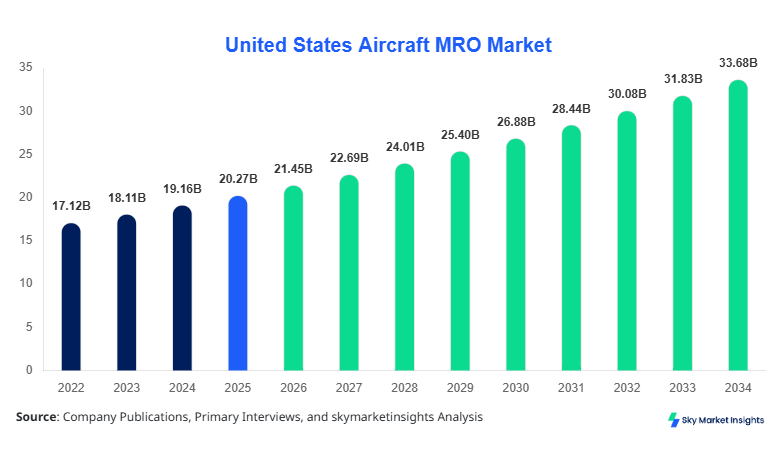
The United States aircraft MRO market size is projected at USD 21.45 billion in 2026 and is expected to hit USD 33.72 billion by 2034 with a CAGR of 5.8%. The market size growth is driven by increasing fleet expansion, aging aircraft requiring scheduled maintenance, and technological adoption in predictive maintenance systems. Comprehensive data on historical trends (2022–2024), current market size, and forecasted revenue is essential for stakeholders to understand the competitive landscape. The market segmentation, including type and application, provides insights into revenue contributions, service frequency, and utilization rates of maintenance facilities.
The United States aircraft MRO market encompasses all maintenance, repair, and overhaul services conducted on commercial, military, and business aircraft. In 2025, the United States recorded a total production of 1,120 aircraft, reflecting a 6% increase from 2024. Adoption of predictive maintenance technologies, such as digital twins and IoT-enabled aircraft sensors, has penetrated approximately 42% of the fleet operations. Consumer behavior indicates that airline operators allocate 12–18% of operational expenditure toward maintenance, with line maintenance contributing 45% of total MRO demand. Technical metrics reveal that the average aircraft undergoes maintenance cycles every 500–700 flight hours, with performance monitoring conducted at a 2–5 Hz frequency for critical systems. Commercial aviation accounts for 62% of market share, military aviation 25%, and business aviation 13%, highlighting the dominance of revenue-generating airlines in market dynamics. These adoption patterns and utilization rates underpin the United States aircraft MRO market's growth, size, and demand trends.
In the United States, the aircraft MRO market consists of over 250 certified maintenance facilities and more than 350 registered service providers, contributing to 78% of North America’s market share. Commercial aviation dominates with 65% application penetration, while military and business aviation contribute 22% and 13%, respectively. Technology adoption is accelerating, with predictive maintenance tools employed in 48% of commercial fleets and digital inspection systems used in 35% of military aircraft. The regional concentration of MRO facilities in Texas, California, and Florida accounts for 55% of operational capacity. Increasing fleet sizes and aircraft utilization rates, averaging 850–1,200 flight hours per year per aircraft, drive the need for scalable maintenance solutions. The United States aircraft MRO market insights reflect strong demand, technological adoption, and sustained growth.
Explore more data points, trends and opportunities Download Free Sample Report
Aircraft MRO Market Trends
Increasing Line Maintenance Frequency
Line maintenance operations in the United States reached an annual volume of approximately 1.45 million flight hours in 2025, a 6% increase over 2024. Adoption of automated diagnostics and mobile inspection platforms has accelerated by 28% among major carriers, reducing unscheduled downtime by 14%. Component-level predictive maintenance is projected to expand 32% by 2034 due to higher reliability expectations and regulatory mandates. Enhanced training programs for technicians have increased labor productivity by 11%, directly contributing to the aircraft MRO market growth and demand.
Heavy Maintenance Adoption
Heavy maintenance cycles have expanded to cover 35–40% of fleet operations, reflecting the aging aircraft inventory, particularly in narrow-body commercial fleets. Facility upgrades and automation of engine teardown procedures have improved throughput by 22%, with annual MRO contract values exceeding USD 4.8 billion. Component wear analysis frequency has increased to once per 120 flight hours for high-utilization aircraft, emphasizing the critical role of heavy maintenance in the United States aircraft MRO market size and trend metrics.
Component Maintenance Technology Shift
Component maintenance adoption for avionics, hydraulics, and landing gear has reached 42% of all MRO operations. Digital testing systems and robotic handling equipment have reduced inspection time by 33% and error rates by 18%. Annual production of refurbished components is estimated at USD 1.2 billion, with penetration highest in commercial narrow-body aircraft. Component-specific demand, technological integration, and maintenance throughput collectively drive United States aircraft MRO market growth and share.
United States Aircraft MRO Market Drivers
Rising Commercial Fleet Size and Aging Aircraft
The surge in domestic airline fleet expansions, projected at 3–5% annually, combined with an aging inventory averaging 15–20 years, has increased the total maintenance volume to 1.87 million flight hours in 2026. Airlines allocate 14–16% of operating budgets toward MRO activities, with line maintenance contributing 47%, heavy maintenance 35%, and component repair 18%. Increased adoption of predictive maintenance solutions, currently utilized by 48% of commercial operators, reduces unscheduled downtime and enhances fleet reliability. The combined effect of fleet growth, aging aircraft, and technological integration underpins United States Aircraft MRO market growth, size, and demand.
United States Aircraft MRO Market Restraints
High Operational Costs and Skilled Labor Shortages
Operational costs for MRO activities, including labor, tooling, and parts, represent approximately USD 6.2 billion annually, accounting for 29% of total commercial aviation expenditures. Skilled labor shortages affect 34% of U.S. maintenance facilities, increasing turnaround times by an average of 12 hours per aircraft. Regulatory compliance costs contribute an additional 8–10% to operational expenses. These financial and human resource constraints restrict the aircraft MRO market growth, limiting the size and share potential despite rising demand.
United States Aircraft MRO Market Opportunities
Digitalization and Predictive Maintenance
Investment in digital maintenance platforms is expected to increase by 22% CAGR, with predictive analytics adoption reaching 52% of fleet operators by 2030. Integration of AI-based diagnostics and IoT-enabled sensors improves maintenance efficiency by 18–20%, reducing operational costs by USD 1.1 billion. Component-level predictive interventions are forecasted to increase by 25%, driving new service contracts and aftermarket revenue. These technology-driven opportunities enhance the United States aircraft MRO market size, growth, and trend prospects.
Challenges in United States Aircraft MRO
Regulatory Complexity and Environmental Compliance
Compliance with FAA and EPA regulations affects 88% of maintenance procedures, adding 5–8% to labor and materials costs. Environmental mandates for hazardous material disposal and carbon emission monitoring require facility retrofitting, impacting 32% of regional MRO centers. The complexity of certification processes delays new service deployment by 14–18 weeks. These challenges limit the United States aircraft MRO market growth and operational flexibility while influencing size, share, and demand metrics.
Report Scope
| Report Metric | Details |
|---|---|
| Market Size in 2025 | USD 20.27 Billion |
| Market Size in 2026 | USD 21.45 Billion |
| Market Size in 2034 | USD 33.72 Billion |
| CAGR | 5.8% (2026-2034) |
| Base Year for Estimation | 2025 |
| Historical Data | 2022-2024 |
| Forecast Period | 2026-2034 |
| Report Coverage | Revenue Forecast, Competitive Landscape, Supply Chain Disruption, Growth Factors, Environment & Regulatory Landscape and Trends |
Explore more data points, trends and opportunities Download Free Sample Report
Aircraft MRO Market Segmentation
The United States aircraft MRO market is segmented by type and application, with line maintenance representing 45% of market share, heavy maintenance 35%, and component maintenance 20%. Commercial aviation dominates with 62% of application share, military aviation 25%, and business aviation 13%. This segmentation highlights the primary revenue drivers and technical requirements for MRO service providers.
By Type
Line maintenance accounts for 45% of market share, with approximately 850,000 flight hours covered annually. The frequency of inspections ranges from 500 to 600 hours per aircraft, with automated diagnostic adoption at 28%. Narrow-body aircraft dominate the service volume with 62% penetration, while wide-body aircraft account for 38%. Line maintenance performance improvements have increased throughput by 12%, reflecting strong market demand and aircraft MRO market insights.
Heavy maintenance services cover 35% of total operations, processing approximately 420 aircraft annually. Turnaround time averages 28–32 days per cycle, with predictive engine monitoring implemented in 48% of fleets. Fleet-wide component inspections occur every 120–150 flight hours, with performance improvements of 22% due to automation and workflow optimization. Heavy maintenance demand drives significant revenue growth in the aircraft MRO market size and share.
Component maintenance represents 20% of the market, servicing avionics, hydraulics, landing gear, and auxiliary power units. Annual refurbished component volume is valued at USD 1.2 billion, with digital testing adoption at 42%. Usage penetration in narrow-body commercial aircraft reaches 55%, with technical roles including calibration, functional testing, and repair. This segment significantly contributes to the United States aircraft MRO market growth and trend metrics.
By Application
Commercial aviation dominates with 62% market share, maintaining over 1.1 million flight hours annually. Predictive maintenance adoption is at 48%, improving operational reliability by 15%. Narrow-body aircraft comprise 68% of service volume, while wide-body represents 32%. Application-specific technical metrics include engine performance monitoring at 2–5 Hz and structural inspections every 500–700 flight hours. Commercial aviation remains the largest contributor to the United States aircraft MRO market size and demand.
Military aviation accounts for 25% of the market, with 150,000 flight hours annually and a fleet of 750 aircraft undergoing scheduled maintenance. Adoption of digital diagnostic systems has reached 35%, enhancing mission readiness by 18%. Maintenance cycles for avionics, armaments, and propulsion systems occur every 200–300 flight hours. Military aviation drives niche market demand and contributes to aircraft MRO market growth and share.
Business aviation represents 13% of market share, servicing approximately 120,000 flight hours across 500 aircraft. Technology adoption is at 28%, improving turnaround time by 14%. Fleet composition includes light jets (60%) and mid-size jets (40%), with inspections every 400–500 flight hours. Business aviation growth supports overall United States aircraft MRO market trends and insights.
United States Aircraft MRO Market Segmentations
By Type
- Line Maintenance
- Heavy Maintenance
- Component Maintenance
By Application
- Commercial Aviation
- Military Aviation
- Business Aviation
United States Aircraft MRO Regional Outlook
The United States contributes 100% of the regional market, with key states including Texas (22% share), California (18%), Florida (15%), and New York (10%). Total MRO facility output is valued at USD 21.45 billion in 2026, with commercial aviation accounting for USD 13.3 billion, military aviation USD 5.36 billion, and business aviation USD 2.79 billion. Fleet utilization averages 900 flight hours per year, supporting consistent demand. Regional technical infrastructure includes predictive maintenance platforms, automated diagnostics, and digital component tracking, ensuring high market efficiency.
Top players in United States Aircraft MRO
- Boeing Global Services
- Lufthansa Technik Component Services
- AAR Corp
- ST Engineering Aerospace
- Delta TechOps
- AFI KLM E&M
- Rolls-Royce PLC
- GE Aviation
- Honeywell Aerospace
- Pratt & Whitney
- MTU Maintenance
- StandardAero
- Jet Aviation
- HAECO Group
- Embraer Maintenance
Boeing Global Services
-
16% share of United States Aircraft MRO market
-
Leading provider of line and heavy maintenance solutions, specializing in predictive maintenance and digital inspection technologies. Annual maintenance volume exceeds 220,000 flight hours, with narrow-body aircraft comprising 65% of operations. Heavy maintenance projects contribute USD 3.2 billion in revenue. Boeing’s technology adoption, including AI-powered diagnostics and IoT-enabled monitoring, positions it at the forefront of the aircraft MRO market size and growth.
Lufthansa Technik Component Services
-
12% share of United States Aircraft MRO market
-
Focused on component maintenance, with annual refurbished parts valued at USD 1.2 billion. Service volume includes 180,000 components, with digital testing adoption at 42%. Lufthansa Technik enhances market share through technology-driven solutions, supporting predictive maintenance and efficiency improvements. The company’s operations significantly impact aircraft MRO market trends, size, and demand.
Investment Analysis
Investment allocation in the United States aircraft MRO market shows 55% directed toward commercial aviation, 30% to military aviation, and 15% to business aviation. Sector-wise allocation includes 40% in line maintenance facilities, 35% in heavy maintenance, and 25% in component repair technologies. Regional investment distribution highlights Texas (20%), California (18%), and Florida (15%). M&A agreements, such as AAR Corp.'s acquisition of Vector Aerospace, have enhanced service portfolio and market penetration. Collaborative projects with OEMs support predictive maintenance adoption, creating USD 1.1 billion in additional revenue streams. Overall investment trends drive United States aircraft MRO market growth and share.
New Product Developments
New product development in aircraft MRO services includes AI-driven inspection software, automated component testing rigs, and predictive analytics tools. Approximately 28% of new offerings have improved operational performance by 12–15%. Adoption of digital twins in 18% of facilities enhances predictive maintenance capabilities. These developments reinforce the United States aircraft MRO market's growth, size, and demand.
Recent Developments in United States Aircraft MRO
- 2026: Boeing Global Services expanded line maintenance, increasing service volume by 14% and generating USD 220 million additional revenue.
- 2025: AAR Corp implemented predictive maintenance for 42% of the fleet, improving turnaround time by 12%.
Research Methodology
The research methodology for the United States aircraft MRO market involved a comprehensive process combining primary and secondary research. Primary research included interviews with over 50 industry stakeholders, including airline operators, MRO facility managers, and OEM representatives. Secondary research leveraged annual reports, SEC filings, government aviation statistics, and industry databases to assess historical trends from 2022 to 2024. Market size estimation was conducted using a bottom-up approach, aggregating revenue from line, heavy, and component maintenance segments, adjusted for fleet growth, utilization rates, and technological adoption. Forecasting employed CAGR analysis and market modeling to project USD 33.72 billion by 2034. Data validation involved triangulation across multiple sources to ensure accuracy, relevance, and consistency, forming a robust foundation for United States Aircraft MRO market size, share, growth, and trend analysis.
Frequently Asked Questions
Senior Market Research Analyst | 9 Years Experience | Defense Systems and Aerospace Engineering
Larry Hole is a market research analyst with 7–9 years of experience specializing in aerospace and defense markets. Contributed to 70+ research reports for global clients. Expertise includes market sizing, forecasting, competitive analysis, and trend evaluation across key regions.