Europe's Aircraft MRO Market Size
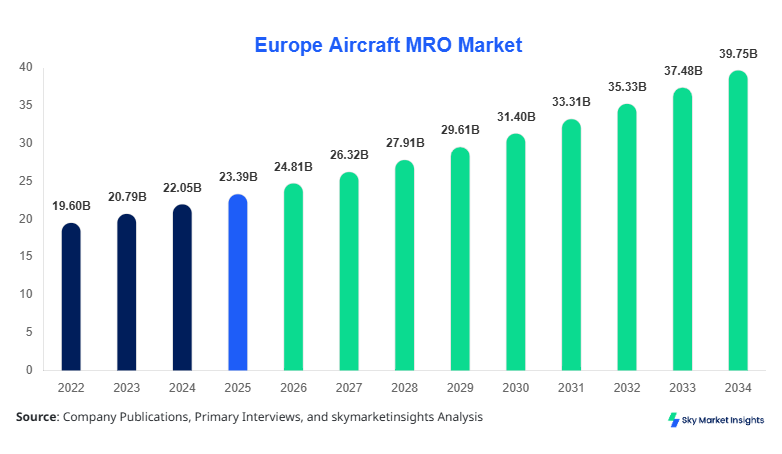
The European Aircraft MRO market size is projected at USD 24.81 billion in 2026 and is expected to hit USD 39.74 billion by 2034 with a CAGR of 6.07%.
The market expansion is supported by increasing commercial aircraft fleet utilization, rising aircraft aging rates, and stringent European Aviation Safety Agency (EASA) maintenance regulations across Europe. More than 6,900 active commercial aircraft operated across Europe in 2025, while average fleet age surpassed 11.4 years, increasing demand for line maintenance, engine overhaul, and heavy airframe inspections. The report evaluates service segmentation, aircraft categories, maintenance cycles, component replacement rates, and competitive benchmarking across the regional aviation ecosystem.
The aircraft MRO market comprises maintenance, repair, and overhaul services performed to ensure aircraft airworthiness, operational efficiency, and regulatory compliance. Europe accounted for nearly 22.8% of global aircraft maintenance expenditure in 2025, supported by over 420 certified MRO facilities and approximately 315 independent maintenance providers. Commercial aviation represented nearly 68% of total maintenance contracts, while military aviation contributed 21%, and business aviation accounted for the remaining 11%. Engine maintenance contributed approximately 41% of total service revenues because modern turbofan engines require overhaul intervals between 4,000 and 6,000 flight cycles. Adoption of predictive maintenance platforms increased by 37% between 2023 and 2025, while digital inspection technologies penetrated nearly 46% of European MRO workshops. Narrow-body aircraft represented nearly 59% of maintenance workloads due to rising short-haul traffic across Germany, France, Italy, and Spain. Consumer demand analytics indicate passenger air traffic in Europe exceeded 1.3 billion travelers in 2025, increasing aircraft utilization by 8.4% year-over-year. Airlines focused on minimizing aircraft downtime from 12 days to below 7 days for heavy checks, accelerating investment in automated diagnostics and AI-enabled maintenance scheduling. The aircraft MRO market continues to benefit from fleet modernization and growing aviation safety compliance requirements.
In France, the aircraft MRO market accounted for nearly 24.6% of total European maintenance revenues in 2025 due to the presence of major aerospace firms, advanced maintenance infrastructure, and military aviation investments. France operated more than 1,140 commercial aircraft and over 310 military aircraft requiring periodic inspections, engine servicing, avionics upgrades, and structural maintenance. More than 65 certified maintenance facilities operated across Toulouse, Paris, Bordeaux, and Marseille, while engine overhaul facilities processed over 2,800 engines annually. Commercial aircraft maintenance contributed approximately 61% of the national maintenance workload, military aviation represented 27%, and business aviation contributed 12%. Adoption of predictive maintenance systems reached nearly 49% among Tier-1 operators, while robotic fuselage inspection systems improved maintenance efficiency by 18%. France also witnessed increasing demand for LEAP engine servicing, with more than 920 engines entering maintenance programs during 2025. The aircraft MRO market in France continues to expand because of rising aircraft utilization rates and long-term fleet modernization programs.
Explore more data points, trends and opportunities Download Free Sample Report
Aircraft MRO Market Trends
Increasing Adoption of Predictive Maintenance Technologies
European airlines and maintenance operators increasingly adopted predictive maintenance software integrated with IoT sensors, machine learning, and digital twins. More than 38,000 aircraft components across Europe were connected to real-time monitoring systems in 2025, compared with 24,500 units in 2022. Airlines reduced unscheduled maintenance incidents by nearly 21% through predictive analytics platforms capable of identifying engine vibration abnormalities and hydraulic failures before operational disruptions occurred. Cloud-based maintenance planning systems achieved penetration of approximately 43% among large airline operators. Lufthansa Technik, Air France Industries KLM Engineering & Maintenance, and SR Technics accelerated digital transformation programs, increasing automated inspection adoption by 31%. European engine maintenance facilities processed more than 7.6 million maintenance labor hours annually while reducing inspection turnaround times by nearly 14%. Growing integration of AI-based diagnostics and digital maintenance planning continues strengthening the aircraft MRO market.
Expansion of Narrow-Body Fleet Maintenance Demand
The increasing dominance of Airbus A320neo and Boeing 737 MAX fleets significantly increased maintenance requirements for narrow-body aircraft across Europe. More than 3,400 narrow-body aircraft operated in the region during 2025, representing nearly 59% of the active fleet. Airlines focused on fuel efficiency improvements between 14% and 18%, accelerating replacement of older aircraft while simultaneously increasing maintenance demand for next-generation engines and composite structures. Engine overhaul demand for CFM LEAP and Pratt & Whitney GTF engines expanded by approximately 27% year-over-year. European low-cost carriers increased flight frequency by 11%, intensifying line maintenance demand at regional airports. Component repair cycles for avionics systems and landing gear assemblies increased by 16% due to rising aircraft utilization above 10 flight hours daily. Investments in rapid turnaround maintenance hangars exceeded USD 1.8 billion between 2023 and 2025. Such fleet utilization expansion continues to reinforce the aircraft MRO market.
Sustainability and Green Maintenance Practices
European aviation regulators and airlines increasingly emphasized sustainability-driven maintenance strategies. More than 34% of MRO facilities adopted energy-efficient maintenance equipment and eco-friendly chemical cleaning systems during 2025. Aircraft parts recycling programs processed approximately 18,000 tons of retired aircraft material annually, while component refurbishment reduced replacement costs by 23%. Sustainable aviation initiatives encouraged adoption of low-emission paint systems and water-based solvents across maintenance hangars. Airlines reduced aircraft idle fuel burn by implementing optimized maintenance scheduling systems that lowered ground testing durations by nearly 12%. Electrification of ground maintenance support vehicles reached 29% across major European airports. Increasing sustainability compliance and operational optimization continue shaping the aircraft MRO market.
Europe Aircraft MRO Market Drivers
Rising Commercial Aircraft Fleet Utilization Across Europe
Increasing passenger air traffic and airline route expansion are major contributors to regional maintenance demand. Europe recorded more than 1.3 billion passenger movements during 2025, increasing aircraft operating hours by approximately 8.4% compared with 2024. Airlines expanded narrow-body operations by nearly 13%, leading to higher maintenance cycles for engines, landing gear, and avionics systems. Heavy maintenance checks increased by 17% because aircraft older than 10 years represented 42% of the regional fleet. Engine overhaul demand crossed 8,500 maintenance events annually, while line maintenance procedures exceeded 2.4 million operations. MRO providers invested nearly USD 4.2 billion in advanced maintenance hangars, robotics, and predictive maintenance software between 2023 and 2025. The growth of low-cost airlines and increasing fleet utilization rates continue accelerating the aircraft MRO market.
Europe Aircraft MRO Market Restraints
Shortage of Skilled Aerospace Maintenance Workforce
The regional aviation industry faces a substantial shortage of licensed aircraft engineers and certified technicians. Europe experienced a workforce gap exceeding 38,000 qualified maintenance professionals during 2025, while retirement rates among senior technicians increased by 11%. Training costs for EASA-certified engineers rose by nearly 19% between 2022 and 2025, creating operational pressure for independent maintenance providers. Labor shortages increased average aircraft turnaround time by approximately 9%, particularly for engine overhaul and composite airframe repair services. Maintenance labor costs accounted for nearly 34% of total MRO operational expenditure, while technician wages increased by 14% across Germany, France, and the United Kingdom. Delays in component inspections and certification procedures negatively impacted airline operational efficiency. Workforce limitations remain a key challenge restricting the aircraft MRO market.
Europe Aircraft MRO Market Opportunities
Expansion of Digital and AI-Enabled Maintenance Solutions
The increasing adoption of AI-driven inspection systems and predictive maintenance platforms presents significant growth opportunities for maintenance providers. More than 46% of European airline operators initiated digital maintenance transformation programs in 2025. AI-enabled fault detection systems improved component inspection accuracy by nearly 28%, while drone-based fuselage inspection reduced manual inspection duration from 16 hours to below 5 hours. Investments in aviation digitalization exceeded USD 2.6 billion during 2024 and 2025. Blockchain-based maintenance record systems also improved traceability efficiency by 32%. Remote diagnostics and augmented reality maintenance training platforms expanded by 24%, supporting workforce productivity and operational optimization. These technological advancements continue creating strong opportunities within the aircraft MRO market.
Challenges in European Aircraft MRO
Supply Chain Disruptions and Spare Parts Availability Constraints
Supply chain instability remains one of the most significant operational challenges for European maintenance providers. Aircraft component lead times increased from an average of 38 days in 2022 to nearly 71 days during 2025 due to semiconductor shortages, raw material inflation, and geopolitical trade disruptions. More than 29% of MRO providers reported delays in sourcing engine parts, avionics modules, and landing gear systems. Inventory holding costs increased by approximately 18%, while spare engine leasing rates rose by 22%. Airlines faced extended aircraft-on-ground incidents averaging 6.3 additional days per event. Logistics costs for imported aerospace components increased by nearly 15% across Europe, particularly affecting independent maintenance operators with lower purchasing power. Addressing supply chain resilience and component localization remains essential for stabilizing the aircraft MRO market.
Report Scope
| Report Metric | Details |
|---|---|
| Market Size in 2025 | USD 23.39 Billion |
| Market Size in 2026 | USD 24.81 Billion |
| Market Size in 2034 | USD 39.74 Billion |
| CAGR | 6.07% (2026-2034) |
| Base Year for Estimation | 2025 |
| Historical Data | 2022-2024 |
| Forecast Period | 2026-2034 |
| Report Coverage | Revenue Forecast, Competitive Landscape, Supply Chain Disruption, Growth Factors, Environment & Regulatory Landscape and Trends |
Explore more data points, trends and opportunities Download Free Sample Report
Aircraft MRO Market Segmentation
The market is segmented based on service type and aircraft category. Engine maintenance dominated the market with approximately 41% revenue contribution in 2025, followed by airframe maintenance at 32% and component maintenance at 27%. Commercial aircraft accounted for nearly 68% of total maintenance expenditure because of high passenger traffic and fleet utilization rates.
- By Service Type
- Engine Maintenance
- Airframe Maintenance
- Component Maintenance
- By Aircraft Type
- Commercial Aircraft
- Military Aircraft
- Business Jets
BY TYPE
Engine maintenance represented the largest segment due to high overhaul costs and increasing next-generation turbofan adoption. More than 8,500 engine shop visits occurred across Europe during 2025, while LEAP and GTF engine servicing demand increased by approximately 27%. Engine maintenance facilities processed over 4.6 million labor hours annually and utilized advanced borescope inspection systems capable of reducing inspection time by 18%. Engine maintenance contracts typically ranged between USD 2 million and USD 12 million depending on engine complexity and overhaul scope. Digital engine monitoring systems achieved penetration of 44% across European airlines. Rising engine operating temperatures above 1,500°C and increasing pressure ratios intensified maintenance frequency and component replacement cycles.
Airframe maintenance accounted for approximately 32% of market expenditure because aging fleets required structural inspections, corrosion treatment, and composite repairs. More than 2,900 heavy airframe checks were conducted across Europe during 2025. Aircraft older than 12 years represented nearly 39% of heavy maintenance demand, while wide-body aircraft required maintenance intervals every 18 to 24 months. Composite repair operations increased by 21% because modern aircraft such as the Airbus A350 and Boeing 787 incorporated over 50% composite materials. Robotic fuselage inspection systems reduced maintenance downtime by approximately 15%.
Component maintenance represented nearly 27% of total regional revenues. Landing gear, avionics, hydraulic systems, and electrical systems collectively generated over 14 million component repair events annually. Avionics modernization projects increased by approximately 19%, driven by digital cockpit integration and navigation upgrades. Component maintenance turnaround times improved from 14 days to 9 days through automation and AI-enabled diagnostics. High-frequency component replacement cycles continued driving operational expenditure among airlines and military operators.
BY APPLICATION
Commercial aircraft represented the dominant application segment with approximately 68% market share. Europe operated more than 6,900 commercial aircraft during 2025, while average daily aircraft utilization exceeded 9.6 flight hours. Narrow-body aircraft maintenance represented nearly 59% of commercial maintenance workloads because of increasing short-haul passenger traffic. Airlines performed over 1.7 million line maintenance procedures annually to support operational continuity. Engine maintenance costs for commercial fleets increased by 13% year-over-year due to fuel-efficient turbofan complexity and supply chain inflation. Advanced predictive maintenance systems reduced unscheduled maintenance events by nearly 21%, improving aircraft availability rates.
Military aircraft maintenance accounted for approximately 21% of total maintenance expenditure. European defense modernization programs expanded military aircraft servicing contracts by 16% between 2023 and 2025. More than 1,850 military aircraft operated across NATO-aligned European countries, requiring regular engine overhauls, avionics upgrades, and structural inspections. Fighter aircraft maintenance represented nearly 44% of military maintenance activities, while transport aircraft contributed 29%. Defense agencies invested over USD 3.4 billion in military MRO modernization initiatives, including digital maintenance systems and predictive diagnostics.
Business jets accounted for nearly 11% of total market demand. Europe operated approximately 3,200 active business jets during 2025, while charter aviation demand increased by 12%. Maintenance expenditure for midsize and long-range jets increased by 15% due to rising private aviation utilization. Cabin refurbishment projects represented nearly 23% of business jet maintenance revenues, while avionics modernization contributed 18%. Enhanced connectivity systems and luxury cabin upgrades accelerated component replacement demand.
Europe Aircraft MRO Market Segmentations
Service Type
- Engine Maintenance
- Airframe Maintenance
- Component Maintenance
Aircraft Type
- Commercial Aircraft
- Military Aircraft
- Business Jets
Europe Aircraft MRO Market Regional Outlook
United Kingdom
The United Kingdom accounted for approximately 19% of regional maintenance expenditure during 2025. The country operated more than 1,020 commercial aircraft and over 220 military aircraft, requiring extensive maintenance support. London Heathrow, Manchester, and Birmingham airports collectively handled over 340,000 maintenance-related aircraft movements annually. Engine overhaul facilities processed approximately 1,400 engines each year, while digital predictive maintenance adoption exceeded 47%. Commercial aviation represented nearly 66% of maintenance revenues, while military maintenance contributed 24%. Investments in sustainable maintenance infrastructure exceeded USD 620 million between 2023 and 2025.
Germany
Germany contributed nearly 21% of total European maintenance revenues. Lufthansa Technik remained one of the largest maintenance operators globally, supporting over 800 airline customers. Germany processed more than 2.1 million maintenance labor hours annually and operated over 70 certified maintenance facilities. Engine maintenance accounted for approximately 43% of national maintenance revenues. Predictive analytics implementation reached nearly 52% among major operators. Germany also witnessed increasing demand for composite repair services due to growing Airbus A350 operations.
France
France represented approximately 24.6% of total regional maintenance demand. The country processed nearly 2,800 engine overhaul operations annually and maintained more than 1,140 commercial aircraft. Air France Industries KLM Engineering & Maintenance remained a leading regional maintenance provider with strong engine and airframe capabilities. Digital maintenance adoption surpassed 49%, while automated inspection systems improved maintenance productivity by 17%. Military aircraft servicing represented approximately 27% of national maintenance contracts due to defense aviation modernization.
Spain
Spain accounted for approximately 11% of European maintenance revenues in 2025. The country handled more than 640 commercial aircraft and experienced passenger traffic growth above 9%. Maintenance activities at Madrid and Barcelona airports increased by 13% year-over-year. Low-cost airline expansion increased narrow-body maintenance workloads by nearly 18%. Spain also invested over USD 410 million in maintenance infrastructure modernization and digital diagnostic systems.
Italy
Italy represented approximately 10% of regional maintenance expenditure. The country operated more than 520 commercial aircraft and approximately 140 military aircraft requiring scheduled maintenance. Component repair services represented nearly 31% of national maintenance revenues, while engine servicing contributed 38%. Maintenance outsourcing by regional airlines increased by 14%, creating opportunities for independent providers. Italy also expanded business jet maintenance facilities due to rising executive aviation demand.
Russia
Russia accounted for approximately 14% of total regional maintenance activities despite supply chain challenges and operational restrictions. The country operated more than 760 commercial aircraft during 2025. Domestic maintenance capabilities expanded by 19% as operators localized spare parts sourcing and engine servicing programs. Heavy airframe maintenance represented nearly 36% of maintenance workloads because of aging fleets. Russia also increased investment in domestic component manufacturing and military aircraft overhaul programs.
Top players in the European aircraft MRO Market
- Lufthansa Technik
- Air France Industries KLM Engineering & Maintenance
- SR Technics
- MTU Aero Engines
- Rolls-Royce plc
- Sabena Technics
- Turkish Technic
- AAR Corp
- Magnetic Group
- FL Technics
- SIA Engineering Company
- GMF AeroAsia
- Haite Group
- StandardAero
- Delta TechOps
Lufthansa Technik
-
Estimated regional share: 14.8%
-
Strong presence across engine, airframe, and component maintenance
-
Operates more than 35 international maintenance facilities
-
Processes approximately 800,000 component repairs annually
-
Advanced predictive maintenance platform adoption exceeded 52%
Lufthansa Technik maintained leadership due to diversified maintenance capabilities, digital diagnostics integration, and strong airline partnerships. The company supported more than 800 airline clients globally while managing over 4,000 aircraft maintenance events annually across Europe. Investments in AI-enabled maintenance systems improved turnaround efficiency by approximately 18%.
Air France Industries KLM Engineering & Maintenance
-
Estimated regional share: 12.6%
-
Leading engine overhaul and airframe maintenance provider
-
Operates more than 20 major maintenance facilities
-
Handles approximately 1,900 engine shop visits annually
-
Composite repair capabilities expanded by 23%
Air France Industries KLM Engineering & Maintenance strengthened its market positioning through advanced engine servicing, predictive analytics, and sustainable maintenance solutions. The company invested more than USD 420 million in modernization initiatives between 2023 and 2025. Automated inspection systems improved labor productivity by 16%, while digital maintenance scheduling reduced aircraft downtime by nearly 11%.
Investment Analysis
Investments across the regional aviation maintenance sector increased substantially between 2023 and 2025. More than USD 7.8 billion was allocated toward maintenance infrastructure modernization, digital transformation, and engine overhaul expansion. Engine maintenance attracted approximately 41% of total investments because of increasing demand for LEAP and GTF engine servicing. Airframe maintenance projects accounted for nearly 29%, while component maintenance represented 21%. France, Germany, and the United Kingdom collectively captured approximately 64% of total regional investment flows.
Private equity participation in aviation maintenance increased by nearly 18% during 2025. Strategic partnerships between airlines and independent maintenance providers expanded rapidly to improve maintenance efficiency and reduce operational disruptions. More than 27 joint ventures and collaboration agreements were announced across Europe between 2023 and 2025. M&A activity focused on engine servicing capabilities, digital maintenance software, and component repair specialization. Companies increasingly invested in robotics, AI diagnostics, and sustainable maintenance infrastructure.
Defense aviation maintenance investments also expanded significantly. European governments allocated over USD 3.4 billion for military aircraft modernization and maintenance optimization programs. Investments in predictive maintenance systems improved military aircraft operational readiness by approximately 22%, while component digitization initiatives reduced maintenance delays by 17%.
New Product Developments
Maintenance providers increasingly launched AI-enabled maintenance software, automated inspection drones, and advanced repair technologies. More than 31% of new aviation maintenance technologies introduced during 2025 focused on predictive analytics and digital diagnostics. Drone-assisted aircraft inspection systems reduced fuselage inspection durations by nearly 68%, while AI-based engine fault detection improved maintenance accuracy by approximately 28%.
Advanced composite repair technologies also gained traction across Europe. Maintenance facilities introduced laser-assisted composite repair systems capable of improving structural repair efficiency by 24%. Sustainable maintenance innovations, including eco-friendly chemical cleaning solutions and low-emission paint technologies, reduced maintenance-related emissions by nearly 19%. Digital maintenance platforms integrating blockchain-based maintenance records improved traceability efficiency by 32%.
Recent Developments in European Aircraft MRO
- 2025: Lufthansa Technik expanded engine maintenance capacity in Germany by approximately 18%, increasing annual engine overhaul capability to more than 1,600 units. The expansion included digital inspection systems and AI-enabled predictive maintenance platforms that reduced inspection turnaround times by 14%. The company also invested heavily in sustainable maintenance practices, including electrified ground support systems and low-emission hangar operations.
- 2025: Air France Industries KLM Engineering & Maintenance launched a next-generation predictive maintenance platform capable of monitoring more than 40,000 aircraft components in real time. The platform improved maintenance forecasting accuracy by nearly 26% while reducing unscheduled aircraft downtime by 19%. The initiative strengthened maintenance efficiency across commercial and military fleets operating within Europe.
Research Methodology
The research process involved extensive collection and analysis of aviation maintenance data from commercial airlines, MRO operators, aerospace manufacturers, regulatory authorities, and defense organizations operating across Europe. Primary research included interviews with maintenance executives, aircraft engineers, airline procurement managers, aviation consultants, and industry specialists to validate market trends, operational statistics, and technology adoption patterns. Secondary research included analysis of aviation regulatory databases, airline annual reports, aircraft fleet databases, aerospace journals, maintenance expenditure records, and government aviation publications. Market size estimation was conducted using a combination of bottom-up and top-down analytical frameworks incorporating aircraft fleet volume, maintenance cycle frequency, engine overhaul statistics, labor utilization rates, and maintenance spending per aircraft category. Data triangulation methodologies ensured accurate validation of revenue distribution, country-level maintenance expenditure, service penetration rates, and operational benchmarks across the regional aviation maintenance ecosystem.
Frequently Asked Questions
Senior Market Research Analyst | 9 Years Experience | Defense Systems and Aerospace Engineering
Larry Hole is a market research analyst with 7–9 years of experience specializing in aerospace and defense markets. Contributed to 70+ research reports for global clients. Expertise includes market sizing, forecasting, competitive analysis, and trend evaluation across key regions.