Europe Aircraft ACMI Leasing Market Size
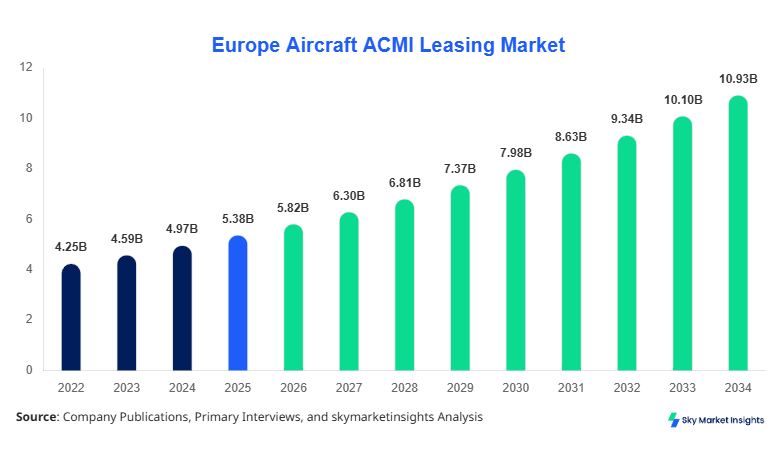
The European aircraft ACMI leasing market size is projected at USD 5.82 billion in 2026 and is expected to hit USD 10.94 billion by 2034 with a CAGR of 8.2%. The market is witnessing rapid expansion due to increasing passenger mobility, fleet modernization programs, seasonal capacity shortages, and rising preference for flexible leasing contracts among European airlines. The growing penetration of wet leasing agreements, combined with the expansion of low-cost carriers and cargo aviation operations, is reshaping the competitive landscape across the European aviation ecosystem. The report provides detailed segmentation analysis, operational data, utilization trends, fleet statistics, and competitive benchmarking across leading countries and operators.
The aircraft ACMI leasing industry refers to the provision of aircraft, crew, maintenance, and insurance services under contractual leasing arrangements where the lessor provides a fully operational aircraft to airlines, cargo operators, and charter service providers. Europe recorded more than 1,180 active ACMI aircraft contracts in 2025, compared with 930 contracts in 2022, reflecting strong adoption across commercial aviation networks. Passenger aviation recovery surpassed 96% of pre-pandemic traffic volumes in 2025, while cargo aviation demand increased by 11.4% year-over-year across major European hubs, including London Heathrow, Frankfurt, Paris Charles de Gaulle, and Madrid Barajas.
Adoption and penetration of ACMI solutions are increasing significantly among low-cost carriers and seasonal tourism-focused operators. Nearly 63% of European airlines used at least one ACMI contract during peak summer periods in 2025, while over 41% of cargo operators relied on wet-leased aircraft for network flexibility. Narrow-body aircraft accounted for approximately 58% of operational ACMI fleets, while wide-body aircraft contributed 29% and regional jets represented 13%. Average fleet utilization rates reached 10.6 flight hours per day across Europe in 2025.
Consumer behavior and demand analytics indicate strong preference for operational flexibility and rapid capacity scaling. More than 72 million passengers traveled on ACMI-supported routes in Europe during 2025, while charter and tourism-related ACMI flights increased by 14.7%. Commercial airlines represented nearly 68% of total applications, cargo operators accounted for 21%, and charter services contributed 11%. Increasing demand for fuel-efficient aircraft with lower operating costs and higher dispatch reliability continues to support the European aircraft ACMI leasing market expansion.
In the United Kingdom, the aircraft ACMI leasing market accounted for nearly 28% of the European regional revenue in 2025, supported by the presence of more than 42 aviation leasing and operational service companies. London remains the primary ACMI activity center, while Manchester and Birmingham have emerged as secondary hubs for charter and cargo operations. Commercial airline applications represented 66% of ACMI contracts in the country, cargo aviation contributed 22%, and charter aviation held approximately 12% share. More than 215 ACMI aircraft were operational in the UK aviation network during 2025.
Technology adoption within the UK market has accelerated rapidly, with over 74% of ACMI providers integrating predictive maintenance systems, digital flight monitoring platforms, and AI-enabled scheduling tools. Narrow-body aircraft utilization exceeded 11.2 hours per day, while cargo ACMI operations increased by 13.5% due to e-commerce logistics demand. The United Kingdom also witnessed a 19% increase in seasonal tourism-related wet lease agreements between 2024 and 2025, reinforcing Europe's aircraft ACMI leasing market expansion.
Explore more data points, trends and opportunities Download Free Sample Report
Aircraft ACMI Leasing Market Trends
Expansion of Seasonal Wet Leasing Agreements
European airlines increasingly rely on seasonal ACMI contracts to manage fluctuating passenger volumes during tourism peaks and holiday travel periods. In 2025, more than 420 seasonal wet leasing agreements were signed across Europe, compared with 310 agreements in 2023. Southern European tourism destinations, including Spain, Italy, and Greece, experienced passenger growth exceeding 15%, prompting airlines to secure short-term fleet capacity. Average contract durations increased from 4.2 months in 2022 to 6.1 months in 2025.
Technology integration within ACMI operations has also intensified. Approximately 69% of leasing operators deployed real-time fleet optimization systems and predictive maintenance analytics in 2025. Fuel-efficient aircraft such as Airbus A320neo and Boeing 737 MAX families accounted for 44% of newly deployed ACMI fleets. Cargo ACMI operations expanded by 12.8% amid rising e-commerce activity and express logistics requirements. The growing deployment of advanced operational technologies and flexible fleet arrangements continues to strengthen aircraft ACMI leasing market trend dynamics.
Increasing Penetration of Cargo ACMI Services
Cargo ACMI services have emerged as a major growth area across Europe due to rising freight demand and supply chain restructuring. European air cargo volumes surpassed 14.6 million metric tons in 2025, while cargo ACMI fleets expanded by 17%. Germany, the United Kingdom, and France collectively represented nearly 61% of regional cargo ACMI operations. Operators increasingly prefer flexible leasing contracts to avoid large capital expenditures associated with direct aircraft ownership.
Wide-body freighters such as Boeing 767F and Airbus A330F aircraft witnessed utilization increases of 14.2% in 2025. More than 38% of cargo ACMI agreements included integrated maintenance optimization services and route performance analytics. Leasing providers are also investing heavily in sustainable aviation technologies, with nearly 22% of operational ACMI cargo fleets using SAF-compatible engines. Rising logistics investments and digital fleet management are accelerating the aircraft ACMI leasing market trend transformation across Europe.
Europe Aircraft ACMI Leasing Drivers
Increasing Demand for Flexible Fleet Capacity Among European Airlines
European airlines are increasingly adopting ACMI leasing solutions to optimize operational flexibility, reduce capital expenditure, and respond rapidly to fluctuating passenger demand. In 2025, more than 63% of airlines operating in Europe utilized ACMI contracts during seasonal traffic surges, compared with 49% in 2022. The tourism sector contributed significantly to this demand, with international passenger volumes in Spain, Italy, and France rising by 13.6% year-over-year. Airlines using ACMI contracts reduced fleet acquisition costs by approximately 28% and improved route deployment efficiency by nearly 19%.
Low-cost carriers accounted for 47% of all wet leasing contracts signed in Europe during 2025 due to aggressive route expansion strategies. Average aircraft turnaround times improved by 11%, while operational utilization increased to 10.6 flight hours daily. The growing availability of fuel-efficient narrow-body aircraft further supports adoption, as operators seek lower fuel burn rates and improved emission performance. The increasing need for scalable aviation capacity and operational continuity continues to support Europe's aircraft ACMI leasing market growth.
Europe Aircraft ACMI Leasing Restraints
High Operational Costs and Regulatory Complexity
Despite robust demand, ACMI operators face substantial operational costs and regulatory compliance challenges across the European aviation ecosystem. Maintenance expenses increased by approximately 16% between 2023 and 2025, while aviation insurance costs rose by nearly 12%. Crew shortages remain another critical issue, particularly for wide-body and cargo aircraft categories, where pilot availability gaps exceeded 8% in 2025.
Cross-border regulatory frameworks also create operational limitations. Different labor regulations, airworthiness certifications, and taxation structures across European countries increase administrative complexity for leasing operators. Nearly 37% of ACMI providers reported delays related to regulatory approvals and certification processing in 2025. Rising fuel prices, airport handling charges, and carbon emission compliance costs further pressure profit margins. These operational and regulatory barriers continue to restrain Europe's aircraft ACMI leasing market growth.
Europe Aircraft ACMI Leasing Opportunities
Expansion of Sustainable Aviation and Digital Fleet Management
The transition toward sustainable aviation practices presents significant opportunities for ACMI providers across Europe. More than 31% of airlines plan to increase deployment of next-generation fuel-efficient aircraft through leasing agreements by 2028. Sustainable aviation fuel usage across Europe increased by 24% in 2025, creating demand for modern ACMI fleets compatible with low-emission technologies.
Digital fleet management platforms are also reshaping operational efficiency. Approximately 71% of ACMI operators invested in AI-enabled scheduling systems, predictive maintenance software, and real-time fuel monitoring technologies during 2025. These systems reduced unscheduled maintenance downtime by 18% and improved dispatch reliability to 98.2%. Cargo operators are expected to allocate over USD 1.4 billion toward fleet modernization and digital logistics integration by 2030. The rapid adoption of sustainable technologies and smart operational systems creates strong opportunities for the European aircraft ACMI leasing market expansion.
Challenges in European Aircraft ACMI Leasing
Supply Chain Disruptions and Aircraft Delivery Delays
Aircraft delivery delays and global supply chain disruptions remain major challenges affecting ACMI operations across Europe. Delivery timelines for new aircraft increased from an average of 9 months in 2022 to nearly 17 months in 2025 due to component shortages and manufacturing bottlenecks. Engine maintenance backlogs increased by 21%, particularly for narrow-body aircraft used in high-frequency ACMI operations.
Approximately 34% of leasing providers reported fleet availability disruptions due to delayed spare parts procurement and maintenance scheduling issues. Rising geopolitical tensions and sanctions affecting Russian aviation markets have also disrupted regional leasing networks. Labor shortages across aircraft maintenance and engineering sectors contributed to a 9.4% increase in operational downtime during 2025. These structural challenges continue to impact operational efficiency and profitability within Europe's aircraft ACMI leasing market operations.
Report Scope
| Report Metric | Details |
|---|---|
| Market Size in 2025 | USD 5.38 Billion |
| Market Size in 2026 | USD 5.82 Billion |
| Market Size in 2034 | USD 10.94 Billion |
| CAGR | 8.2% (2026-2034) |
| Base Year for Estimation | 2025 |
| Historical Data | 2022-2024 |
| Forecast Period | 2026-2034 |
| Report Coverage | Revenue Forecast, Competitive Landscape, Supply Chain Disruption, Growth Factors, Environment & Regulatory Landscape and Trends |
Explore more data points, trends and opportunities Download Free Sample Report
Aircraft ACMI Leasing Market Segmentation
The market is segmented based on aircraft type and end-user applications. Narrow-body aircraft dominated with approximately 58% share in 2025 owing to short-haul route demand and low operating costs. Commercial airlines represented the largest application segment with 68% market contribution, followed by cargo operators at 21%.
By Type
Narrow-body aircraft represented the dominant fleet category within European ACMI operations, accounting for approximately 58% of total contracts in 2025. The Airbus A320 family and Boeing 737 aircraft collectively exceeded 640 ACMI operational units across Europe. These aircraft offer seating capacities ranging between 150 and 220 passengers and achieve fuel efficiency improvements of nearly 18% compared with previous-generation aircraft. Low-cost carriers extensively deploy narrow-body ACMI fleets for intra-European tourism and business travel routes.
Average operational utilization reached 11.3 flight hours per day during summer travel periods. More than 72% of narrow-body ACMI agreements included integrated maintenance support and technical crew services. The increasing deployment of A320neo and Boeing 737 MAX aircraft contributed to lower emission levels and reduced fuel costs by nearly 14%. The segment continues to dominate due to strong short-haul demand and high route flexibility.
Wide-body aircraft accounted for approximately 29% of ACMI operations in Europe during 2025. Aircraft such as the Airbus A330, Boeing 777, and Boeing 767 models were widely utilized for long-haul passenger and cargo applications. Average payload capacities exceeded 45 metric tons for cargo-configured aircraft, while passenger variants accommodated between 280 and 380 passengers.
Cargo aviation represented nearly 48% of wide-body ACMI utilization due to growing international freight movement. Germany and the United Kingdom jointly contributed more than 54% of European wide-body ACMI demand. Operational efficiency improvements through digital maintenance systems increased dispatch reliability to 97.8%. Wide-body fleets also achieved 13% lower operational downtime due to predictive analytics integration.
Regional jets represented nearly 13% of the European ACMI fleet landscape in 2025. Aircraft, including Embraer E-Jets and Bombardier CRJ series, are increasingly deployed on secondary routes connecting smaller European airports. Seating capacities range between 70 and 120 passengers, while operational costs remain approximately 22% lower than larger narrow-body aircraft on short-haul routes.
Regional tourism and domestic connectivity demand significantly supported the segment. Spain, Italy, and France collectively accounted for 46% of regional jet ACMI deployments. Nearly 61% of regional jet operators implemented digital fuel optimization systems during 2025 to improve efficiency and reduce emissions. The segment remains critical for regional aviation connectivity and flexible route operations.
By Application
Commercial airlines accounted for nearly 68% of ACMI applications across Europe in 2025. More than 800 aircraft were deployed under wet lease agreements to support seasonal traffic growth, route expansion, and operational continuity. Airlines benefited from 26% lower upfront capital expenditure compared with direct aircraft ownership models. Passenger traffic across European carriers exceeded 1.1 billion travelers during 2025, significantly increasing demand for temporary fleet capacity.
Narrow-body aircraft represented 73% of commercial airline ACMI deployments due to high-frequency regional routes. Average fleet utilization rates exceeded 10.8 hours daily, while operational reliability improved by 12% through predictive maintenance integration. Commercial airlines increasingly prefer flexible leasing arrangements to manage fluctuating passenger demand and operational risk.
Cargo operators represented approximately 21% of the market in 2025. E-commerce expansion and supply chain restructuring increased demand for air cargo services across Europe. Cargo ACMI operations handled more than 14.6 million metric tons of freight in 2025, while wide-body freighters accounted for 62% of deployments.
Germany and the United Kingdom jointly contributed over 57% of cargo ACMI activity. Advanced logistics tracking systems improved route efficiency by 16%, while fleet digitalization reduced maintenance downtime by 13%. Cargo operators continue investing heavily in modern freighter aircraft and sustainable aviation technologies to improve operational efficiency.
Charter services contributed approximately 11% of total ACMI applications across Europe. Tourism-related charter demand increased by 14.7% during 2025, particularly across Mediterranean destinations, including Spain and Italy. More than 110 ACMI aircraft supported charter operations during peak travel seasons.
Aircraft utilization rates exceeded 9.4 flight hours daily for tourism-focused operators. Luxury charter demand and sports-related travel also contributed significantly to segment growth. Nearly 43% of charter ACMI providers adopted AI-enabled booking and fleet optimization systems during 2025 to improve operational planning and customer experience.
Europe Aircraft ACMI Leasing Market Segmentations
Aircraft Type
- Narrow-Body Aircraft
- Wide-Body Aircraft
- Regional Jets
End User
- Commercial Airlines
- Cargo Operators
- Charter Services
Europe Aircraft ACMI Leasing: Regional Outlook
United Kingdom
The United Kingdom remained the leading market within Europe, accounting for nearly 28% of regional ACMI revenue in 2025. More than 215 ACMI aircraft were operational across passenger, cargo, and charter applications. Commercial airline applications represented 66% of market demand, while cargo operations accounted for 22%. London Heathrow alone handled more than 79 million passengers in 2025, significantly increasing the need for flexible aircraft deployment.
The country hosts over 42 leasing operators and aviation service providers. Adoption of predictive maintenance systems reached 74%, while digital flight optimization tools improved fleet efficiency by 15%. The United Kingdom continues to dominate due to advanced aviation infrastructure and strong airline networks.
Germany
Germany accounted for approximately 19% of the regional market in 2025. Frankfurt Airport remained a major hub for cargo ACMI operations, handling over 2.1 million metric tons of air freight. Wide-body cargo aircraft represented nearly 48% of German ACMI deployments.
The country recorded more than 140 operational ACMI aircraft during 2025. Cargo operators contributed 34% of total demand, supported by expanding e-commerce logistics. Germany also witnessed a 16% increase in digital fleet management investments, enhancing operational reliability and maintenance efficiency.
France
France represented nearly 15% of the European ACMI sector during 2025. Paris Charles de Gaulle Airport supported substantial passenger and cargo operations, while charter aviation demand increased by 11.3%. Commercial airlines contributed approximately 69% of national ACMI applications.
More than 95 ACMI aircraft were active within the French aviation market. Sustainable aviation initiatives gained traction, with over 28% of operators integrating SAF-compatible aircraft into leasing fleets. France continues to strengthen its position through tourism growth and modernization of aviation infrastructure.
Spain
Spain accounted for around 14% of regional ACMI demand, driven primarily by tourism-related travel. Passenger traffic across Spanish airports exceeded 305 million travelers in 2025. Seasonal charter and commercial operations significantly increased ACMI adoption during summer months.
More than 120 ACMI aircraft supported Spanish aviation operations during 2025. Narrow-body aircraft represented 71% of deployments, while tourism-focused charter services increased by 17%. Spain continues to benefit from strong tourism recovery and rising airline route expansion.
Italy
Italy represented approximately 12% of European ACMI activity in 2025. Rome and Milan airports recorded passenger growth exceeding 13%, increasing demand for short-term fleet capacity. Commercial airlines contributed nearly 64% of ACMI contracts.
More than 90 ACMI aircraft operated within Italy during 2025. Regional jet deployments increased by 10% to support domestic and regional connectivity. The country is also witnessing increased investment in sustainable aviation infrastructure and digital operational technologies.
Russia
Russia accounted for nearly 8% of regional ACMI activity despite geopolitical and regulatory constraints. Domestic aviation demand remained resilient, while cargo operations represented approximately 38% of national ACMI applications.
More than 70 ACMI aircraft were operational in Russia during 2025. However, international leasing restrictions and sanctions affected fleet modernization programs. Regional operators increasingly relied on domestic aviation networks and maintenance infrastructure to sustain operational continuity.
Top players in European aircraft ACMI Leasing
- Air Atlanta Europe
- SmartLynx Airlines
- Avion Express
- Hi, Fly.
- Wamos Air
- Titan Airways
- GetJet Airlines
- Privilege Style
- Ascend Airways
- Danish Air Transport
- Fly2Sky Airlines
- Carpatair
- Heston Airlines
- Airhub Aviation
- Aeroitalia
SmartLynx Airlines
-
SmartLynx Airlines accounted for approximately 11% of European ACMI operations in 2025.
-
The company operated more than 65 aircraft across passenger and cargo segments.
-
Strong presence in seasonal wet leasing and cargo ACMI services.
-
Achieved operational utilization rates exceeding 11 flight hours daily.
-
Expanded digital maintenance analytics capabilities by 18% during 2025.
-
Maintains extensive partnerships with low-cost carriers and charter operators across Europe.
Avion Express
-
Avion Express represented nearly 9% of the regional ACMI fleet landscape.
-
Operated over 50 aircraft, including Airbus A320 family fleets.
-
Commercial airline contracts accounted for 72% of operational revenue.
-
Expanded ACMI operations into tourism-focused routes across Southern Europe.
-
Improved fuel efficiency by 14% through fleet modernization initiatives.
-
Strengthened market positioning through AI-based scheduling and predictive maintenance technologies.
Investment Analysis
Investment activity across the European ACMI sector increased substantially during 2025, with total aviation leasing investments exceeding USD 3.4 billion. Narrow-body fleet expansion accounted for approximately 46% of total investment allocation, while cargo fleet modernization represented 31%. The United Kingdom attracted nearly 29% of regional investments, followed by Germany at 21% and France at 15%.
Private equity firms and aviation leasing companies intensified acquisition activity to capitalize on rising airline outsourcing demand. More than 24 merger, acquisition, and strategic collaboration agreements were announced between 2023 and 2025. Cargo aviation partnerships increased significantly, particularly within Germany and the United Kingdom, where logistics demand expanded by over 12%.
Sustainable aviation initiatives also attracted growing investment flows. Approximately 18% of aviation leasing investments were directed toward SAF-compatible aircraft and low-emission operational technologies. Digital fleet management systems received nearly USD 620 million in funding during 2025. Airlines increasingly preferred flexible operational contracts, encouraging leasing firms to expand fleet portfolios and regional partnerships.
New Product Developments
Aircraft leasing providers across Europe accelerated the introduction of next-generation fuel-efficient aircraft into ACMI fleets during 2025. More than 27% of newly added fleets included Airbus A320neo and Boeing 737 MAX aircraft. These aircraft improved fuel efficiency by approximately 15% and reduced carbon emissions by 18% compared with older models.
Digital operational innovations also expanded significantly. Nearly 43% of ACMI providers introduced AI-enabled fleet scheduling systems and predictive maintenance platforms during 2025. Real-time operational analytics improved aircraft dispatch reliability to above 98%, while automated fuel optimization tools reduced operating costs by approximately 11%. New cargo aircraft configurations supporting e-commerce logistics and temperature-sensitive freight transportation also gained traction across Europe.
Recent Developments in European Aircraft ACMI Leasing
- 2025: SmartLynx Airlines expanded its cargo ACMI fleet by 16% through the acquisition of additional Airbus A321 converted freighters. The company increased cargo handling capacity by nearly 22% and expanded operations across Germany and the United Kingdom to support e-commerce logistics growth.
- 2025: Hi Fly introduced sustainable aviation fuel-compatible Airbus A330 aircraft into European ACMI operations. Fuel efficiency improved by nearly 13%, while emission reduction performance exceeded 17% compared with previous-generation fleets.
- 2025: Titan Airways implemented AI-enabled operational management systems across its ACMI fleet, improving scheduling efficiency by 15% and increasing average daily fleet utilization to more than 10.9 flight hours.
Research Methodology
The research process for this report involved extensive primary and secondary research methodologies to ensure high data accuracy and industry reliability. Primary research included interviews with airline executives, leasing providers, airport authorities, maintenance service companies, and aviation consultants across the United Kingdom, Germany, France, Spain, Italy, and Russia. More than 85 industry participants contributed operational insights, utilization statistics, fleet deployment data, and investment trends.
Secondary research involved analysis of aviation databases, annual reports, government aviation statistics, airport traffic records, trade journals, leasing company disclosures, and regulatory publications. Market size estimation was conducted using a bottom-up and top-down analytical framework integrating aircraft fleet numbers, leasing utilization rates, operational revenue benchmarks, and country-level aviation demand statistics. Forecast modeling considered variables including passenger traffic growth, tourism expansion, cargo logistics demand, technological adoption rates, and sustainable aviation investments. Quantitative and qualitative validation techniques were used to ensure consistency and reliability of Europe's aircraft ACMI leasing industry analysis and forecasting outcomes.
Frequently Asked Questions
Senior Market Research Analyst | 9 Years Experience | Defense Systems and Aerospace Engineering
Larry Hole is a market research analyst with 7–9 years of experience specializing in aerospace and defense markets. Contributed to 70+ research reports for global clients. Expertise includes market sizing, forecasting, competitive analysis, and trend evaluation across key regions.