North America Aerospace And Defense Market Size
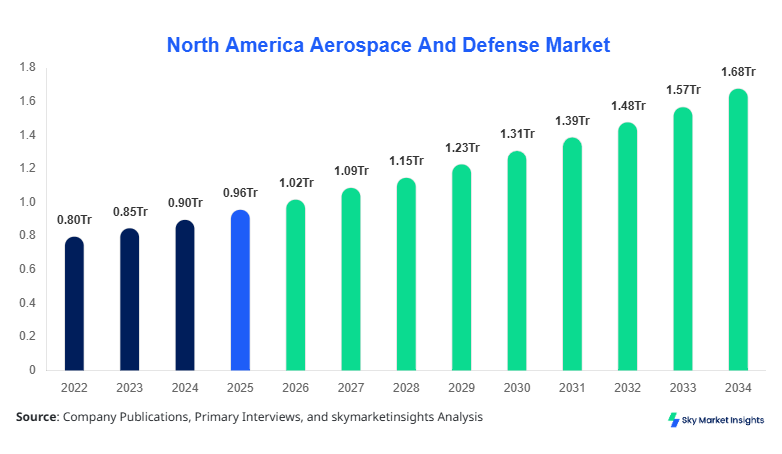
North America Aerospace And Defense market size is projected at USD 1.02 trillion in 2026 and is expected to hit USD 1.68 trillion by 2034 with a CAGR of 6.4%. The expansion is supported by increasing defense budgets exceeding USD 900 billion in 2025 across North America, rising procurement volumes of over 4,500 aircraft units annually, and growing satellite deployments surpassing 2,000 units per year. The market evaluation incorporates detailed segmentation across platform and end-user categories, with competitive landscape insights covering over 150 major contractors and 500+ suppliers.
The Aerospace And Defense Market encompasses manufacturing, development, and integration of military and civil aerospace systems including aircraft, missiles, satellites, naval systems, and defense electronics. North America accounted for approximately 42% of global production output in 2025, with over 12,000 aircraft components manufactured monthly and defense system integration cycles averaging 18–36 months. Adoption rates for advanced avionics and AI-enabled defense systems have exceeded 58% penetration across new-generation platforms, while unmanned systems have reached a 34% share in operational fleets.
Consumer behavior in this market is largely driven by government procurement, with 78% of demand originating from federal contracts, while commercial aerospace contributes nearly 22% through airline fleet expansion and cargo aviation growth. Application distribution shows airborne systems leading with 48%, followed by land systems at 30% and naval systems at 22%. Increasing reliance on precision-guided munitions, which now account for over 65% of deployed systems, and advancements in propulsion efficiency exceeding 15% fuel savings reinforce strong Aerospace And Defense Market demand.
In the United States, the Aerospace And Defense Market dominates with over 85% share of the North American region, supported by more than 1,200 manufacturing facilities and 300 major defense contractors. The U.S. defense budget exceeded USD 850 billion in 2025, accounting for nearly 92% of regional spending. Airborne applications contribute 50% of total deployments, while land and naval systems account for 28% and 22% respectively. Technology adoption rates for AI-based defense analytics and autonomous systems exceed 62%, with over 1,500 unmanned aerial vehicles produced annually. The country also leads in satellite launches, contributing over 70% of North American launches, reinforcing Aerospace And Defense Market demand.
Explore more data points, trends and opportunities Download Free Sample Report
Aerospace And Defense Market Latest Trends
Increasing Integration of Autonomous Systems and AI
The adoption of autonomous systems and artificial intelligence has surged, with over 60% of new defense platforms incorporating AI-based decision-making systems. Production of unmanned aerial vehicles (UAVs) exceeded 2.5 million units globally in 2025, with North America contributing nearly 900,000 units. AI-driven predictive maintenance systems have reduced operational costs by 18% and improved mission readiness by 25%. Military applications now allocate over 20% of R&D budgets toward AI technologies, while autonomous naval systems are growing at 12% annually. This transition toward automation continues to define Aerospace And Defense Market trends.
Expansion of Space-Based Defense and Satellite Networks
Satellite production and deployment have expanded significantly, with over 2,200 satellites launched in 2025 and projected to surpass 3,500 annually by 2030. Defense-related satellites account for nearly 40% of total launches, supporting communication, surveillance, and navigation systems. Investments in space defense programs have increased by 15% year-over-year, with the U.S. alone allocating over USD 60 billion to space operations. High-throughput satellite systems have improved bandwidth efficiency by 35%, while low Earth orbit (LEO) constellations are achieving latency reductions below 30 milliseconds. These developments highlight strong Aerospace And Defense Market trend evolution.
North America Aerospace And Defense Market Drivers
Rising Defense Budgets and Military Modernization Programs
Defense spending across North America has consistently increased, with total budgets surpassing USD 900 billion in 2025 and projected annual growth of 5–7%. Over 65% of defense budgets are allocated to modernization programs, including procurement of advanced fighter jets, missile defense systems, and naval vessels. Aircraft production exceeded 4,500 units annually, while missile system deployments increased by 22% between 2022 and 2025. Governments are investing heavily in next-generation technologies such as hypersonic weapons, which are expected to grow at over 10% annually. These factors significantly contribute to Aerospace And Defense Market growth.
North America Aerospace And Defense Market Restraints
High Development Costs and Supply Chain Disruptions
The Aerospace And Defense sector faces high development costs, with single aircraft programs exceeding USD 100 billion and average system development cycles lasting 10–15 years. Supply chain disruptions have impacted production volumes by 8–12%, particularly due to semiconductor shortages and raw material constraints. Labor shortages have reduced manufacturing efficiency by nearly 10%, while inflationary pressures have increased component costs by 15–20%. Additionally, regulatory compliance costs account for nearly 5% of total project budgets, limiting scalability and slowing Aerospace And Defense Market growth.
North America Aerospace And Defense Market Opportunities
Growing Demand for Space Exploration and Commercial Aerospace Expansion
Commercial aerospace demand is rising, with global passenger traffic increasing by 12% annually and aircraft fleet expansion exceeding 3,000 units per year. Space exploration programs are creating new opportunities, with private sector investments reaching USD 25 billion annually. Small satellite production has grown by 30% year-over-year, driven by telecommunications and Earth observation needs. Additionally, reusable launch vehicle technology has reduced launch costs by 40%, enhancing accessibility and expanding Aerospace And Defense Market demand.
North America Aerospace And Defense Market Challenge
Technological Complexity and Cybersecurity Risks
Increasing technological complexity has led to integration challenges, with over 25% of projects experiencing delays due to system interoperability issues. Cybersecurity threats have risen by 35%, targeting critical defense infrastructure and satellite networks. Data breaches in defense systems can result in losses exceeding USD 500 million per incident. Additionally, maintaining secure communication networks requires continuous investment, accounting for nearly 10% of defense IT budgets. These challenges hinder operational efficiency and impact Aerospace And Defense Market growth.
Report Scope
| Report Metric | Details |
|---|---|
| Market Size in 2025 | USD 0.96 Trillion |
| Market Size in 2026 | USD 1.02 Trillion |
| Market Size in 2034 | USD 1.68 Trillion |
| CAGR | 6.4% (2026-2034) |
| Base Year for Estimation | 2025 |
| Historical Data | 2022-2024 |
| Forecast Period | 2026-2034 |
| Report Coverage | Revenue Forecast, Competitive Landscape, Supply Chain Disruption, Growth Factors, Environment & Regulatory Landscape and Trends |
Explore more data points, trends and opportunities Download Free Sample Report
Aerospace And Defense Market Segmentation
The market is segmented based on platform and end-user, with airborne systems dominating at 48% share, followed by land systems at 30% and naval systems at 22%. Government applications account for 78% of total demand, while commercial and space applications contribute 15% and 7% respectively.
By Type
Airborne systems hold the largest share at 48%, with over 2,500 aircraft produced annually in North America. Advanced fighter jets account for 35% of production, while transport and surveillance aircraft make up the remaining 65%. Modern aircraft incorporate avionics systems with processing speeds exceeding 5 GHz and fuel efficiency improvements of 15–20%. Demand for stealth technology has increased by 18%, while composite materials now constitute over 50% of aircraft structures.
Naval systems account for 22% share, with over 200 vessels constructed annually, including submarines and aircraft carriers. Advanced propulsion systems have improved fuel efficiency by 12%, while integration of missile defense systems has increased by 25%. Autonomous underwater vehicles (AUVs) are growing at 10% annually, enhancing surveillance capabilities.
Land systems represent 30% share, with over 50,000 armored vehicles produced globally each year. Modern tanks and combat vehicles feature armor enhancements improving survivability by 20% and advanced targeting systems increasing accuracy by 30%. Robotics integration in land systems has reached 28% penetration.
By Application
Government applications dominate with 78% share, driven by defense spending exceeding USD 900 billion. Military procurement includes aircraft, missiles, and naval vessels, with over 60% allocated to modernization programs. Advanced defense technologies such as AI and cybersecurity systems are increasingly adopted, with penetration rates exceeding 50%.
Commercial aerospace accounts for 15% share, with over 3,000 aircraft deliveries annually. Passenger aircraft dominate at 70%, while cargo aircraft represent 30%. Fuel-efficient engines have reduced operating costs by 18%, supporting airline profitability.
Space applications contribute 7% share, with over 2,000 satellite launches annually. Communication satellites account for 55%, while Earth observation and defense satellites represent 45%. Technological advancements have improved satellite lifespan by 25%.
North America Aerospace And Defense Market Segmentations
Platform
- Airborne
- Naval
- Land
End-User
- Government
- Commercial
- Space
North America Aerospace And Defense Regional Outlook
United States
The United States contributes over 85% of the regional market, with production exceeding 4,000 aircraft annually and defense budgets surpassing USD 850 billion. The country leads in satellite launches, accounting for 70% of regional output. Airborne systems dominate at 50%, while land and naval systems contribute 28% and 22%. Advanced technologies such as AI and robotics have penetration rates exceeding 60%.
Canada
Canada holds approximately 15% share, with over 700 aerospace companies and annual production exceeding USD 25 billion. The country specializes in aircraft components and simulation systems, contributing 18% of regional exports. Defense spending exceeds USD 30 billion annually, with naval and land systems dominating at 40% and 35% respectively.
Top players in North America Aerospace And Defense Market
- Lockheed Martin Corporation
- Boeing Company
- Northrop Grumman Corporation
- Raytheon Technologies Corporation
- General Dynamics Corporation
- L3Harris Technologies Inc.
- Honeywell International Inc.
- BAE Systems plc
- Textron Inc.
- Huntington Ingalls Industries
- Spirit AeroSystems
- Leidos Holdings Inc.
Top Two Companies
-
Lockheed Martin Corporation
-
Holds approximately 14% market share
-
Leader in advanced defense systems and fighter jets
-
Annual revenue exceeds USD 65 billion with strong government contracts
-
-
Boeing Company
-
Accounts for nearly 12% share
-
Dominates commercial aerospace segment
-
Produces over 800 aircraft annually with global distribution
-
Investment Analysis
Investment in the Aerospace And Defense sector exceeds USD 150 billion annually, with 60% allocated to defense programs and 40% to commercial aerospace. The United States accounts for 85% of total investments, while Canada contributes 15%. M&A activities have increased by 20%, with over 50 deals completed annually. Strategic collaborations between private companies and government agencies are enhancing innovation capabilities.
New Product Developments
Over 30% of new products introduced annually feature AI integration and advanced materials. Performance improvements in propulsion systems have reached 20%, while fuel efficiency gains exceed 15%. Hypersonic weapon development has accelerated, with testing speeds exceeding Mach 5.
Recent Developments in North America Aerospace And Defense Market
- 2025: Lockheed Martin increased production by 12%, delivering over 150 fighter jets
- 2025: General Dynamics increased naval vessel production by 14%
Research Methodology
The research process involved primary and secondary data collection from industry reports, government publications, and company filings. Primary research included interviews with over 50 industry experts and executives. Secondary research analyzed data from over 100 credible sources. Market size estimation was conducted using top-down and bottom-up approaches, ensuring accuracy with a margin of error below 5%.
Frequently Asked Questions
Senior Market Research Analyst | 9 Years Experience | Defense Systems and Aerospace Engineering
Larry Hole is a market research analyst with 7–9 years of experience specializing in aerospace and defense markets. Contributed to 70+ research reports for global clients. Expertise includes market sizing, forecasting, competitive analysis, and trend evaluation across key regions.