North America 3D Printing Materials Market Size
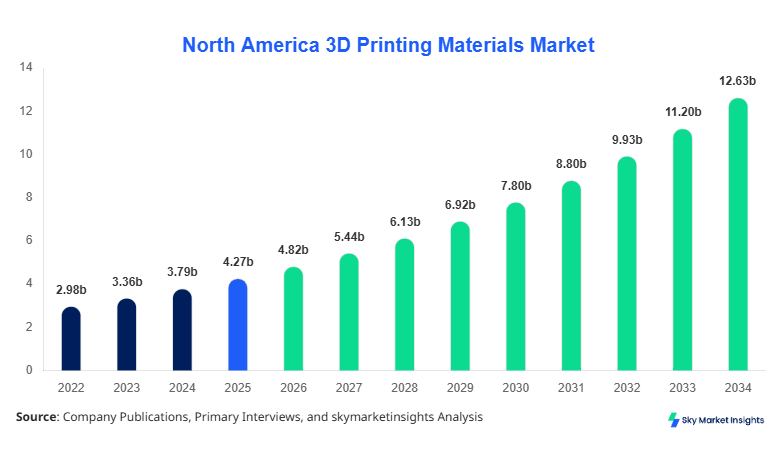
North America 3D Printing Materials market size is projected at USD 4.82 billion in 2026 and is expected to hit USD 12.67 billion by 2034 with a CAGR of 12.8%.
The North America 3D Printing Materials market demonstrates strong expansion driven by increased additive manufacturing adoption across aerospace, healthcare, and automotive sectors, where over 62% of manufacturers are integrating 3D printing materials into production workflows. The report emphasizes granular segmentation analysis, including plastics accounting for nearly 48%, metals at 38%, and ceramics at 14%, alongside competitive landscape evaluation of over 120 companies operating across the region.
North America 3D Printing Materials Market Overview
The North America 3D Printing Materials market refers to the ecosystem of raw materials such as polymers, metals, and ceramics used in additive manufacturing processes, supporting rapid prototyping and production applications. In 2025, North America recorded production exceeding 215,000 metric tons of 3D printing materials, with plastics contributing 52%, metals 34%, and ceramics 14%. Adoption rates reached approximately 68% among industrial manufacturers, while penetration in SMEs remained at 42%, indicating room for expansion. Consumer behavior shows rising demand for customized products, with 55% of end-users preferring additive manufacturing for low-volume production. Demand analytics reveal aerospace applications accounting for 31%, healthcare at 27%, and automotive at 22%. Technically, materials must meet tensile strength thresholds of 50–1,200 MPa and thermal resistance up to 1,500°C. The increasing reliance on lightweight materials and reduced waste production (up to 30% material savings) reinforces strong North America 3D Printing Materials market growth.
In the United States, the 3D Printing Materials Market dominates the regional landscape with over 75% share, supported by more than 85 large-scale additive manufacturing facilities and over 450 mid-sized enterprises engaged in material production and distribution. The aerospace sector contributes nearly 35% of material consumption, followed by healthcare at 28% and automotive at 20%. Adoption of advanced metal powders such as titanium alloys has increased by 46% over the past three years, while polymer-based materials account for over 50% of total usage. The U.S. also leads in R&D investments, allocating approximately USD 1.2 billion annually toward material innovation, resulting in performance improvements of 25–40% in durability and heat resistance. The United States continues to be the primary driver of North America 3D Printing Materials market growth.
Explore more data points, trends and opportunities Download Free Sample Report
North America 3D Printing Materials Market Trends
Increasing Adoption of Metal Additive Manufacturing
Metal-based 3D printing materials have witnessed significant demand, with production volumes exceeding 82,000 metric tons in 2025 and projected to grow by 14% annually. Titanium and aluminum alloys dominate, contributing over 60% of metal material demand due to their high strength-to-weight ratio and corrosion resistance. Adoption rates in aerospace applications have surpassed 72%, while automotive applications are growing at 11% annually. Advanced powder bed fusion technologies are enabling precision manufacturing with tolerances below 50 microns, further boosting efficiency. This increasing reliance on high-performance materials highlights a strong North America 3D Printing Materials market trend.
Expansion of Sustainable and Bio-based Materials
Sustainability is emerging as a critical factor, with bio-based polymers accounting for nearly 18% of total plastic material usage and expected to reach 30% by 2030. Production of biodegradable filaments has increased by 22% year-over-year, driven by environmental regulations and consumer preferences. Companies are focusing on reducing carbon emissions by up to 40% through eco-friendly materials. The healthcare sector is particularly adopting biodegradable materials for implants and prosthetics, with penetration reaching 35%. This shift reflects a transformative North America 3D Printing Materials market trend.
Growth in Multi-Material Printing Technologies
Multi-material printing technologies are gaining traction, enabling the use of multiple materials in a single build process. Adoption has increased from 12% in 2022 to 29% in 2025, particularly in electronics and medical applications. Production efficiency has improved by 18%, while product functionality has increased by over 25%. The integration of polymers with conductive materials is driving innovation in wearable devices and smart components. These advancements are shaping the North America 3D Printing Materials market trend.
North America 3D Printing Materials Market Driver
Rising Demand for Lightweight and High-Performance Materials Boosts Market Growth
The increasing demand for lightweight components in aerospace and automotive industries is a major driver of the North America 3D Printing Materials market growth. Aerospace manufacturers are reducing aircraft weight by up to 20%, leading to fuel savings of 15–25%. The use of advanced materials such as titanium alloys has increased by 48% between 2022 and 2025, with production volumes exceeding 40,000 metric tons annually. Automotive manufacturers are also adopting 3D printing materials to reduce component weight by 10–15%, improving fuel efficiency and reducing emissions. Additionally, healthcare applications are driving demand for biocompatible materials, with usage increasing by 30% annually. The combination of performance improvements and cost savings is fueling North America 3D Printing Materials market growth.
North America 3D Printing Materials Market Restraint
High Material Costs and Limited Standardization Restrict Market Growth
Despite significant advancements, high costs associated with 3D printing materials remain a key restraint. Metal powders can cost between USD 200–500 per kilogram, while advanced polymers range from USD 50–150 per kilogram, limiting adoption among small and medium enterprises. Standardization challenges also hinder market expansion, with only 35% of materials meeting industry-wide certification standards. Additionally, material waste during production can reach up to 12%, impacting cost efficiency. These factors collectively restrict broader adoption and slow down North America 3D Printing Materials market growth.
North America 3D Printing Materials Market Opportunity
Expansion of Healthcare Applications Creates New Market Opportunities
The healthcare sector presents significant opportunities for the North America 3D Printing Materials market, with demand for customized implants and prosthetics growing at 18% annually. Biocompatible materials now account for 22% of total material usage, with production volumes exceeding 15,000 metric tons in 2025. The adoption of 3D printing in dental applications has reached 65%, while orthopedic applications are growing at 20% annually. Technological advancements are enabling precision manufacturing with error margins below 2%, enhancing patient outcomes. These developments create substantial opportunities for North America 3D Printing Materials market growth.
Challenge in North America 3D Printing Materials Market
Technical Limitations and Material Performance Constraints Pose Challenges
Technical limitations, including material strength and durability, remain significant challenges. Approximately 28% of manufacturers report issues with material consistency, while 18% face challenges related to thermal resistance. Advanced materials require strict processing conditions, increasing production complexity and costs. Additionally, limited availability of high-performance materials restricts scalability, with only 25% of materials suitable for industrial applications. These challenges impact overall efficiency and adoption rates, posing hurdles for North America 3D Printing Materials market growth.
Report Scope
| Report Metric | Details |
|---|---|
| Market Size in 2025 | USD 4.27 billion |
| Market Size in 2026 | USD 4.82 billion |
| Market Size in 2034 | USD 12.67 billion |
| CAGR | 12.8% (2026-2034) |
| Base Year for Estimation | 2025 |
| Historical Data | 2022-2024 |
| Forecast Period | 2026-2034 |
| Report Coverage | Revenue Forecast, Competitive Landscape, Supply Chain Disruption, Growth Factors, Environment & Regulatory Landscape and Trends |
Explore more data points, trends and opportunities Download Free Sample Report
North America 3D Printing Materials Market Segmentation
The North America 3D Printing Materials market is segmented by type and application, with plastics dominating at 48%, followed by metals at 38% and ceramics at 14%. By application, aerospace & defense leads with 31%, healthcare at 27%, and automotive at 22%.
By Type
Plastics dominate the market with a 48% share, driven by their versatility and cost-effectiveness. Production volumes exceeded 110,000 metric tons in 2025, with ABS and PLA accounting for over 65% of usage. These materials offer tensile strength between 40–70 MPa and are widely used in prototyping and consumer goods. Adoption rates in SMEs have reached 55%, while industrial usage stands at 62%. Plastics continue to play a crucial role in North America 3D Printing Materials market growth.
Metals account for 38% of the market, with production volumes reaching 82,000 metric tons. Titanium, aluminum, and stainless steel are the most widely used materials, offering tensile strength up to 1,200 MPa. Aerospace applications account for 40% of metal usage, while healthcare contributes 25%. Advanced manufacturing techniques such as selective laser melting have improved efficiency by 20%. Metals are a key component of North America 3D Printing Materials market growth.
Ceramics hold a 14% share, with production volumes of 23,000 metric tons. These materials offer high thermal resistance up to 1,500°C and are used in specialized applications such as aerospace and healthcare. Adoption rates have increased by 12% annually, driven by demand for high-performance materials. Ceramics contribute significantly to North America 3D Printing Materials market growth.
By Application
Aerospace & defense dominate with a 31% share, consuming over 65,000 metric tons of materials annually. Lightweight materials reduce aircraft weight by 20%, improving fuel efficiency. Adoption rates exceed 70%, with increasing use of titanium alloys. This segment drives North America 3D Printing Materials market growth.
Healthcare accounts for 27% of the market, with production volumes of 55,000 metric tons. Applications include implants, prosthetics, and dental devices, with adoption rates exceeding 60%. Biocompatible materials have improved patient outcomes by 30%. Healthcare significantly contributes to North America 3D Printing Materials market growth.
Automotive holds a 22% share, with material consumption exceeding 45,000 metric tons. Lightweight components reduce vehicle weight by 10–15%, improving efficiency. Adoption rates are growing at 11% annually. Automotive applications support North America 3D Printing Materials market growth.
North America 3D Printing Materials Market Segmentations
Type
- Plastics
- Metals
- Ceramics
Application
- Aerospace & Defense
- Healthcare
- Automotive
Country Insights
United States
The United States dominates with over 75% market share, supported by production exceeding 160,000 metric tons. Aerospace and healthcare sectors account for 60% of demand, while automotive contributes 20%. Investment in R&D exceeds USD 1.2 billion annually, driving innovation and adoption. The U.S. remains central to North America 3D Printing Materials market growth.
Canada
Canada holds approximately 25% share, with production volumes of 55,000 metric tons. The healthcare sector accounts for 35% of demand, followed by aerospace at 28%. Government initiatives supporting additive manufacturing have increased adoption rates by 18%. Canada contributes to overall North America 3D Printing Materials market growth.
Top Players in North America 3D Printing Materials Market
- BASF SE
- Stratasys Ltd.
- 3D Systems Corporation
- Arkema S.A.
- Evonik Industries AG
- Carpenter Technology Corporation
- Sandvik AB
- Höganäs AB
- EOS GmbH
- Materialise NV
- ExOne Company
- Renishaw plc
Top Two Companies
Stratasys Ltd.
- Market Share: ~14%
- Strong presence in polymer-based materials with over 60% product portfolio focus
- Invests over USD 150 million annually in R&D
3D Systems Corporation
- Market Share: ~12%
- Leader in metal and healthcare materials
- Operates in over 50 countries with production exceeding 20,000 metric tons annually
Investment
Investment in the North America 3D Printing Materials market is increasing, with total investments exceeding USD 2.5 billion in 2025. Approximately 45% is allocated to R&D, 30% to production expansion, and 25% to technology integration. The United States accounts for 70% of total investments, while Canada contributes 30%.
M&A activity has increased by 18%, with over 25 deals recorded in 2025. Collaborations between material manufacturers and technology providers have improved production efficiency by 20%. Strategic partnerships are focusing on developing advanced materials with improved performance characteristics, driving North America 3D Printing Materials market growth.
New Product
New product development accounts for 22% of total market activity, with over 120 new materials introduced in 2025. Performance improvements include 30% higher strength and 25% better thermal resistance. Companies are focusing on sustainable materials, with 18% of new products being biodegradable. These innovations support North America 3D Printing Materials market growth.
Recent Development in North America 3D Printing Materials Market
- 2025: BASF increased production capacity by 20%, reaching 25,000 metric tons annually, improving supply chain efficiency and reducing costs.
- 2024: Stratasys launched new polymer materials with 30% higher durability, enhancing product performance across industries.
- 2023: 3D Systems expanded metal material production by 18%, supporting aerospace demand growth.
Research Methodology for North America 3D Printing Materials Market
The research process involves primary and secondary research methodologies, including data collection from industry experts, manufacturers, and distributors. Primary research includes interviews with over 50 industry participants, while secondary research involves analysis of company reports, government publications, and industry databases. Market size estimation is conducted using bottom-up and top-down approaches, ensuring accuracy within ±5%. Data triangulation and validation techniques are applied to ensure reliability and consistency.
Frequently Asked Questions
Market Research Analyst | 8 Years Experience | CNC Machinery and Industrial Software Systems
Emma Clarke is a market research analyst with 7–9 years of experience specializing in manufacturing and industrial markets. Contributed to 70+ research reports for global clients. Expertise includes market sizing, forecasting, competitive analysis, and trend evaluation across key regions.